United States
Richmond Kelly Turner
Director of the Navy's War Plans Division (1940–1941), commander of the South Pacific Amphibious Force (1942–1943) and of the Pacific Fleet and Fifth Fleet amphibious forces (1943–1945)
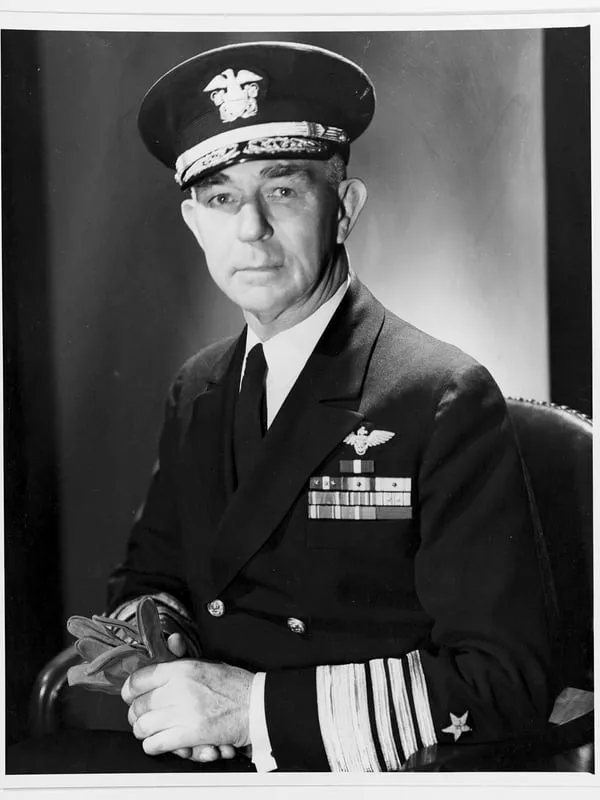
- Born:
- 27 May 1885, Portland, Oregon (United States)
- Died:
- 12 February 1961, Monterey, California (United States)
- Author:
- Łukasz
- Photo:
- U.S. Navy, domena publiczna, Wikimedia Commons

Richmond Kelly Turner was the man who, for three years of the Pacific war, put American troops ashore. From the first landing on Guadalcanal in August 1942 to Okinawa in the spring of 1945 he commanded a fleet of transports, landing ships and support ships that grew from a few dozen vessels to more than a thousand. He planned every detail himself, shouted at his subordinates, quarrelled with Marine generals and drank more than was seemly, yet his superiors considered him irreplaceable. Admiral Chester Nimitz is said to have described him as brilliant, caustic, arrogant and tactless – just the man for the job.
The gunner who became an airman
He was born on 27 May 1885 in Portland, Oregon, but spent most of his childhood in Stockton (PL), California, where his father, Enoch Turner, alternated between farming and running a small printing shop. In 1904 he passed the competitive examination for the Naval Academy at Annapolis, from which he graduated in June 1908. His classmates included the future admirals Thomas Kinkaid and Willis Lee. In 1910 he married Harriet Sterling; the marriage lasted half a century, but they had no children.
For the first twenty years of his service Turner was above all an ordnance specialist. He briefly commanded the destroyer Stewart, served in battleships during the First World War, then worked at the Naval Gun Factory in Washington and was gunnery officer of the battleship California. In 1927, by then a commander, he took flight training at Pensacola and qualified as a naval aviator. He went on to command the aircraft squadrons of the Asiatic Fleet and was executive officer of the carrier Saratoga. From 1935 to 1938 he taught strategy at the Naval War College in Newport. In 1939, as captain of the heavy cruiser Astoria, he carried to Japan the ashes of the Japanese ambassador Hiroshi Saitō, who had died in the United States.
War plans and Pearl Harbor
In the autumn of 1940 Turner became Director of the War Plans Division on the staff of the Chief of Naval Operations, Admiral Harold Stark, and in 1941 he was promoted to rear admiral. He took part in the work from which the “Germany first” strategy grew: an offensive in the Atlantic and a defensive in the Pacific. He was ambitious and possessive. His division in effect took over the assessment of enemy intentions, which should have been the business of naval intelligence, and this caused bitter conflicts with intelligence officers.
Turner helped to draft the dispatch of 27 November 1941 that warned commanders in the Pacific to expect Japanese aggression within the next few days and that opened with the words “This dispatch is to be considered a war warning”. It did not, however, mention Hawaii, and the Commander-in-Chief of the Pacific Fleet, Admiral Husband Kimmel, was not receiving the decrypted Japanese diplomatic messages from Washington. After the attack on Pearl Harbor Turner testified before every one of the successive boards of inquiry and consistently denied that he was to blame. Some historians, Gordon Prange among them, concluded nevertheless that since he had taken over the assessment of the threat, he had to bear part of the responsibility for the warnings not being clear enough. Turner himself wrote years later that he had failed to put all the pieces together, both before Pearl Harbor and before Savo.
Guadalcanal and the defeat at Savo
After the outbreak of war Turner became assistant chief of staff to the new Commander-in-Chief of the US Fleet, Admiral Ernest King, and in July 1942 he took command of the South Pacific Amphibious Force. He had three weeks to prepare the first American offensive of the war. On 7 August his transports landed the 1st Marine Division of General Alexander Vandegrift on Guadalcanal and Tulagi. Even before the landing Vice Admiral Frank Jack Fletcher had announced that he would not keep his carriers near the islands for more than two or three days, and on the evening of 8 August he did indeed withdraw them.
That same night Japanese cruisers routed the screening force in the Battle of Savo Island, sinking four heavy cruisers, among them Turner’s old ship Astoria. Turner was taken by surprise: the reports of the Japanese force had reached him many hours late and with a wrong description, and he was convinced that the strait was being patrolled by aircraft. Without cover from the air or the sea, on 9 August he took the transports away, although less than half of the supplies had been unloaded. For a long time the Marines regarded this as desertion. Turner’s biographer called Savo his “galling defeat”.
In the months that followed his convoys brought reinforcements to the island: the 7th Marine Regiment in September, army units in October and November. In the naval battle of November he sent the transports away and left every warship of the screen still fit to fight in the strait to stop the Japanese battleships. At the same time he was quarrelling with Vandegrift, because he wanted to scatter the Marines’ strength against secondary objectives on the island.
In 1943 Turner carried out the occupation of the Russell Islands and the landing on New Georgia. On 30 June, the day of the landing on Rendova, a Japanese aerial torpedo hit his flagship, the transport McCawley, which sank. In mid-July he handed over his command to Rear Admiral Theodore Wilkinson and moved to the Central Pacific.
From Tarawa to Okinawa
In Admiral Raymond Spruance’s Fifth Fleet Turner commanded the amphibious forces in one operation after another, while the landing troops were led by General Holland Smith. Both men were explosive and often clashed, but together they formed the team that carried out all the great landings in the Central Pacific. In November 1943 Turner personally led the force that put troops ashore on Makin Atoll, while the assault on Tarawa was conducted by Rear Admiral Harry Hill. The bloody experience of Tarawa brought changes: a longer and more accurate bombardment, more amphibian tractors, and also the Underwater Demolition Teams, which reconnoitred reefs and destroyed obstacles before a landing and whose creation is credited to Turner himself.
In the Marshall Islands operation at the turn of January and February 1944 his joint expeditionary force took Kwajalein Atoll quickly and at little cost. On 7 March 1944 Turner was promoted to vice admiral. In June he led the largest operation so far, in the Marianas: he landed troops on Saipan, then on Guam and Tinian. It was he who declared the fighting on Saipan over on 9 July. At Saipan he also agreed to the relief of the commander of the 27th Infantry Division, General Ralph Smith, which set off a long conflict between the Marines and the army.
In February 1945 Turner commanded the amphibious forces at Iwo Jima, where Holland Smith and his officers demanded a longer bombardment than the navy agreed to; some historians hold Turner partly responsible for this as well. On 1 April 1945 his fleet landed General Simon Buckner’s Tenth Army on Okinawa. According to Turner’s biography, 1,213 ships and craft were under his command at Okinawa, compared with only 51 at Guadalcanal. The radar picket ships that he stationed to give early warning of kamikaze attacks suffered some of the heaviest losses in the navy’s history. Turner received his fourth star, with effect from 24 May 1945. He was to have commanded the amphibious forces in the planned invasion of Kyushu, which never took place. On 2 September 1945 he was aboard the Missouri for the surrender of Japan.
Character and drinking
Turner was known as “Terrible Turner”. He worked a dozen or more hours a day and wrote out the orders for the positions of individual landing ships himself. His subordinates valued his mind and his courage but complained of his pedantry and his fits of temper. Many stories about his drinking circulated during the war. Asked about it years later, Nimitz replied that he would gladly have learned the brand of whisky Turner drank so that he could serve it to his other admirals, while Spruance said that he had taken the matter upon himself and that it had never got out of hand.
After the war
After the war Turner sat on the navy’s General Board, and from the end of 1945 he was the navy’s representative on the United Nations Military Staff Committee in New York and London. On 1 July 1947 he retired and settled in Monterey, California. His wife died on 3 January 1961. He himself died suddenly on 12 February 1961, during lunch at a friend’s home near Monterey. The coroner found that he had choked, while his own physician attributed his death to a heart attack; some sources also give the date as 13 February. He was buried in the Golden Gate National Cemetery in San Bruno, beside his wife, in a spot agreed on in their lifetimes by Nimitz, Spruance, Turner and Admiral Charles Lockwood.
Turner did not write a memoir, saying that he could not have avoided controversy or the temptation to give himself credit. His two-volume biography, based on the navy’s archives and on interviews with hundreds of witnesses, was published by the navy in the early 1970s; it was written by Vice Admiral George Dyer. Historians differ in their assessment of his part in the failures at Pearl Harbor and Savo, but as the creator of American amphibious warfare in the Pacific he is rated highly. His name was borne by the guided missile cruiser Richmond K. Turner, in service from 1964 to 1995.
Sources
Commanded in battles
(08)- 7 August 1942 – 9 February 1943Guadalcanal campaignPacific
- 21 June – 25 August 1943New Georgia campaignPacific
- 20–23 November 1943Battle of TarawaPacific
- 31 January – 23 February 1944Fighting for the Marshall IslandsPacific
- 15 June – 9 July 1944Battle of SaipanPacific
- 21 July – 10 August 1944Battle of Guam (1944)Pacific
- 19 February – 26 March 1945Battle of Iwo JimaPacific
- 1 April – 22 June 1945The Battle of OkinawaPacific
Mentioned in battles
(01)Often appears with
People who appear in the same events.