United States
Holland Smith
Commander of V Amphibious Corps (1943–1944), of the Expeditionary Troops in the Marianas (1944), of Fleet Marine Force, Pacific (1944–1945)
- Born:
- 20 April 1882, Hatchechubbee, Alabama (United States)
- Died:
- 12 January 1967, San Diego, California (United States)
- Author:
- Natalia
- Photo:
- autor nieznany, domena publiczna, Wikimedia Commons

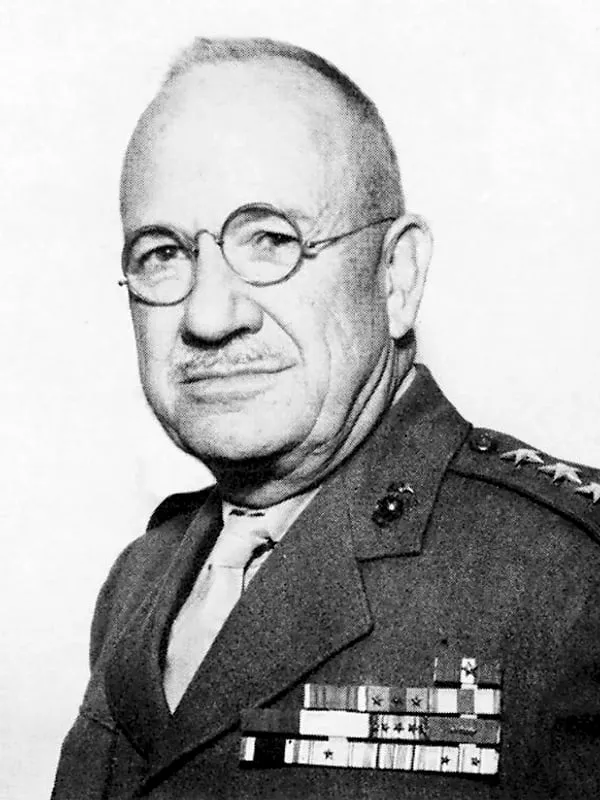
Holland Smith, called “Howlin’ Mad” by his men, was a Marine general who before the war taught the American armed forces how to come ashore from the sea, and during the war led their best divisions onto the beaches. He commanded the landing troops in the assaults on the Gilbert and Marshall Islands, on Saipan, Tinian and Guam, and on Iwo Jima. He is sometimes called the father of modern American amphibious warfare. He was also one of the most quarrelsome commanders of the war. His relief of an army general on Saipan set off the “Smith versus Smith” controversy, which divided the Marine Corps and the army for many years.
A lawyer from Alabama
Holland McTyeire Smith was born on 20 April 1882 in Hatchechubbee, Russell County, Alabama (the Marine Corps biography gives nearby Seale), into a family of strict Methodists. In 1901 he graduated from the Alabama Polytechnic Institute, today’s Auburn University, and in 1903 in law from the University of Alabama, and for a year he practised as a lawyer in Montgomery. He wanted to become an army officer, but as there were no vacancies, he joined the Marine Corps. On 20 March 1905 he was commissioned a second lieutenant.
In the years that followed he served wherever the Marines were sent: in the Philippines, in Panama, aboard the cruiser Galveston in Asian waters and in the Dominican Republic, where in 1916 he fought against insurgents. According to the most often repeated version, it was there that his men gave him his nickname, after his explosive temper. In June 1917 he sailed for France in command of a machine gun company of the 5th Marine Regiment. As one of the first Marines, he completed the army staff course at Langres, was adjutant of the 4th Marine Brigade during the fighting at Belleau Wood (PL), and then a liaison officer on the staff of I Corps in the offensives on the Marne, at Saint-Mihiel and in the Argonne. The French awarded him the Croix de Guerre with palm.
Between the wars
After the war Smith attended the Naval War College and became the first Marine officer to serve on the Joint Army-Navy Planning Committee. He served in Haiti, at Quantico, aboard battleships of the fleet and at Marine Corps Headquarters, where from 1937 to 1939 he headed the Division of Operations and Training. In 1939 he was for a few months Assistant Commandant of the Marine Corps and was promoted to brigadier general.
Teacher of amphibious warfare
In October 1940 Smith took the 1st Marine Brigade to Guantánamo Bay in Cuba for extended amphibious training. In February 1941 the brigade became the 1st Marine Division, with him as its first commander. From June 1941 he commanded in the Atlantic the force that grew into the Amphibious Force, Atlantic Fleet, and trained the 1st Marine Division and the army’s 1st and 9th Infantry Divisions in landings. In October 1941 he was promoted to major general.
In August 1942 he moved to San Diego, where, as commander of the Amphibious Corps, Pacific Fleet, he prepared the 2nd and 3rd Marine Divisions and the army’s 7th Infantry Division for the landing on Attu in the Aleutians. When in 1943 the Commandant, Thomas Holcomb, chose his successor, he named the junior Alexander Vandegrift, the victor of Guadalcanal, rather than Smith.
The Gilberts and the Marshall Islands
In September 1943 Smith arrived at Pearl Harbor as commander of V Amphibious Corps to prepare the attack on the Gilbert Islands. The amphibious forces were commanded by Rear Admiral Richmond Kelly Turner, and the whole operation by Admiral Raymond Spruance. During the Battle of Tarawa in November 1943 he held the 6th Marine Regiment, also earmarked for Makin, as corps reserve, and released it to the 2nd Division only when its commander, General Julian Smith, reported that the assault on Betio was faltering. On Makin he sharply criticised the pace of the army’s 27th Infantry Division and of its commander, General Ralph Smith. This was the beginning of the conflict that broke out in full half a year later.
The bloody lesson of Tarawa brought a longer bombardment to the Marshall Islands, more amphibian tractors and artillery emplaced on neighbouring islets. Smith, Turner and Spruance were wary of the leap deep into the archipelago to Kwajalein, but Nimitz held to his plan. The atoll was taken at the beginning of February 1944, quickly and at little cost, and the unused reserves were sent at once to Eniwetok. Early in 1944 Smith was promoted to lieutenant general.
Saipan and “Smith versus Smith”
In the Marianas Smith commanded all the Expeditionary Troops: two Marine divisions and an army division on Saipan, and indirectly also the forces that landed on Guam. The Marines landed on Saipan on 15 June 1944 and at once met fierce resistance. On 16 June Smith sent the reserve 27th Infantry Division ashore. When in the following days its advance in the centre of the island, in a valley the soldiers called Death Valley, stalled and fell behind the neighbouring Marine divisions, Smith on 24 June, with the approval of Turner and Spruance, relieved General Ralph Smith.
The commander of army forces in the Pacific, General Robert Richardson, considered this unjust and set up a board under General Simon Buckner, made up entirely of army officers. It found that Holland Smith had had the authority to relieve his subordinate, but that he had not been fully informed of the situation of the 27th Division, which at the entrance to Death Valley had run into the main Japanese defensive line, and that the relief was not justified by the facts. After the fighting was over Richardson flew to Saipan, decorated army soldiers without Smith’s knowledge and, according to accounts, angrily told him that he would not be allowed to push the army around any longer. Spruance and Turner complained about this to Nimitz. After the last Japanese attack on 7 July Smith and some Marine officers claimed that the battalions of the 27th Division had given way too easily. The dispute over the division went on long after the war, in Smith’s memoirs of 1949, in the history of the 27th Division and in the official histories of both services.
Smith later called the capture of Tinian at the end of July, with its landing on two tiny beaches in the north of the island where the Japanese did not expect it, the most perfect amphibious operation of the Pacific war.
Iwo Jima
In August 1944 Smith became the first commander of Fleet Marine Force, Pacific, and no longer commanded army divisions in battle. As commander of the Expeditionary Troops (Task Force 56), however, he led three Marine divisions to Iwo Jima. His officers asked for ten days of naval bombardment and got three; Smith considered this a costly mistake and after the war accused the navy of having saved shells at the cost of Marines’ lives. Historians still argue over whether a longer bombardment would have destroyed fortifications hidden deep underground. On the island the operation was directed by the commander of V Amphibious Corps, General Harry Schmidt, while Smith read the reports of mounting casualties aboard the command ship.
On 23 February 1945 he was on the beach with the Secretary of the Navy, James Forrestal, when the flag was raised on the summit of Suribachi. Forrestal told him then that the flag meant a Marine Corps for the next five hundred years. On 17 March Smith left the island. In his memoirs he wrote that of all the enemies in the Pacific, General Tadamichi Kuribayashi was the most formidable.
Smith did not command on Okinawa. The landing troops there were led by the army’s General Simon Buckner. According to some writers Spruance and Turner wanted to give the role to Smith, but Nimitz decided that after Saipan a Marine general could not command an army.
After the war
In July 1945 Smith returned to the United States and took command of the Marine Training and Replacement Command at Camp Pendleton. On 15 May 1946 he retired and, having been specially commended in combat, was advanced to general on the retired list. He settled in La Jolla, California, where he tended his garden and worked with young people. In 1949 he published his memoirs, Coral and Brass, in which he judged the navy and the army harshly, which only fuelled the old disputes. He died after a long illness on 12 January 1967 in the naval hospital in San Diego. He was buried in Fort Rosecrans National Cemetery overlooking San Diego Bay.
Smith is regarded as one of the creators of American amphibious doctrine and as a commander who stubbornly defended his men and his Corps. His critics charge that he was unfair to the army and that his dislike of the 27th Division blinded him to the real difficulties it faced. Despite their violent tempers, he and Turner formed the team that carried out all the great landings in the Central Pacific. In Hawaii his name is borne by Camp H. M. Smith, the headquarters of the American command in the Pacific.
Sources
Commanded in battles
(04)Mentioned in battles
(01)Often appears with
People who appear in the same events.