United States
Marc Mitscher
Captain of the carrier Hornet (1941–1942), Commander Air, Solomon Islands (1943), commander of the Fast Carrier Task Force (Task Force 58/38, 1944–1945)
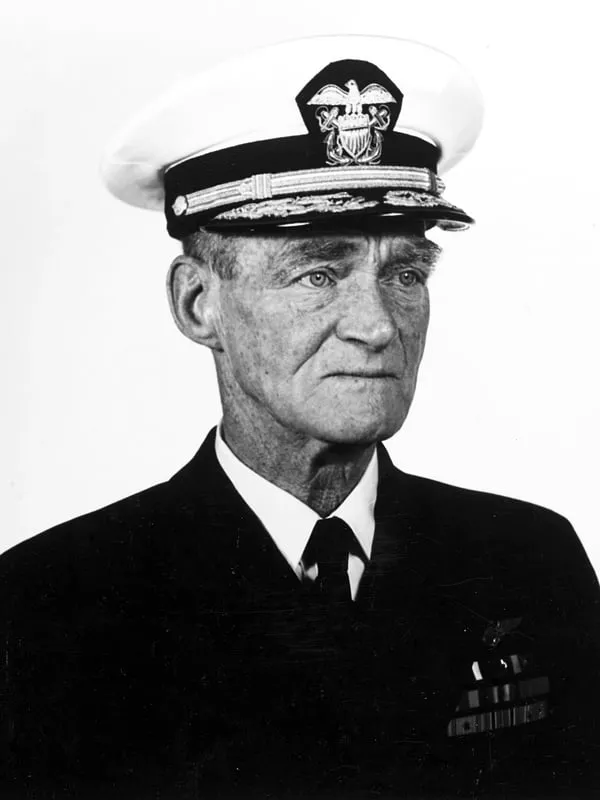
- Born:
- 26 January 1887, Hillsboro, Wisconsin (United States)
- Died:
- 3 February 1947, Norfolk, Virginia (United States)
- Author:
- Natalia
- Photo:
- U.S. Navy, domena publiczna, Wikimedia Commons

Marc Mitscher was a slight, taciturn airman who, in the last year and a half of the Pacific war, commanded the most powerful striking force the seas had yet seen: the fast carrier task force of the US Navy. His aircraft wrecked the Japanese bases on Truk and in the Marianas, destroyed Japan’s carrier air power in the Battle of the Philippine Sea, and sank its last carriers off Cape Engaño and the battleship Yamato. Before all that, Mitscher lived through the Battle of Midway, after which his career hung by a thread.
Poor midshipman, aviator number 33
Marc Andrew Mitscher was born on 26 January 1887 in Hillsboro (PL), Wisconsin. At the age of two he moved with his family to Oklahoma Territory, newly opened to settlers. His father, Oscar Mitscher, was mayor of Oklahoma City and later agent for the Osage Indians at Pawhuska. He sent his son to school in Washington. At the Naval Academy in Annapolis the boy from Oklahoma was given the nickname “Oklahoma Pete” by the upperclassmen, later shortened to “Pete”, which stayed with him for the rest of his life. He studied badly and collected so many demerits that he had to leave after his second year. His father secured his reappointment; Mitscher started again from the beginning and graduated in 1910, 113th of 131.
He was drawn to aviation from the start. In 1915 he finally got onto a training course, and on 2 June 1916 he was designated naval aviator number 33. In May 1919 he was one of the pilots of the flying boat NC-1 in the first attempt to fly across the Atlantic. In thick fog short of the Azores the crew landed on the water to find their position, and the heavy sea made it impossible to take off again; a ship picked them up. Only their sister aircraft NC-4 completed the flight, and Mitscher was awarded the Navy Cross for his part in the venture.
Between the wars
In the 1920s and 1930s Mitscher belonged to the small group of officers who built American carrier aviation. He worked in the Bureau of Aeronautics under Admiral William Moffett and served in the first carrier, Langley, and in Saratoga, on which in January 1928 he made the first landing. He commanded the seaplane tender Wright and a patrol wing of flying boats. In 1938 he was promoted to captain, and from 1939 to 1941 he was assistant chief of the Bureau of Aeronautics. In the autumn of 1941 he took command of the new carrier Hornet.
Hornet, Doolittle and Midway
In April 1942 Hornet took on board sixteen B-25 bombers under Lieutenant Colonel James Doolittle. When on the morning of 18 April the force was spotted by a Japanese picket boat, far from the planned launch point, Mitscher, Vice Admiral William Halsey and Doolittle decided that the bombers would take off at once. The Doolittle Raid was the first American strike on Japan.
At the Battle of Midway on 4 June 1942 Hornet’s air group flew a course on which there was no enemy. The dive bombers and fighters turned back without finding a target, all the escorting fighters and some of the bombers ditched for lack of fuel, and Torpedo Squadron 8, which broke away from the group and found the Japanese carriers on its own, was wiped out almost entirely; a single airman survived. To this day there is no agreement on who set the wrong course or on whether Mitscher’s report of the battle, which did not match the airmen’s accounts, was an attempt to cover up the mistake. Mitscher received his long-planned promotion to rear admiral, but he lost his ship and was sent to Hawaii to command a wing of patrol flying boats.
The Solomon Islands
At the end of 1942 Halsey brought him to the South Pacific, first to Nouméa and then, in April 1943, to Guadalcanal as commander of all air forces in the Solomon Islands: army, navy, Marine and New Zealand. “I knew we’d catch hell in the air. That’s why I sent Pete Mitscher up there,” Halsey said. Mitscher switched the island’s weary air forces to the offensive. It was army P-38 fighters under his command that on 18 April 1943 intercepted the aircraft of Admiral Isoroku Yamamoto over Bougainville and shot it down. Mitscher later remembered those months as the hardest of the whole war. In July he handed over his command and returned to the United States, where he commanded naval aviation on the West Coast.
Task Force 58
In January 1944 Mitscher took over Carrier Division 3 and command of the fast carrier force of Admiral Raymond Spruance’s Fifth Fleet, designated Task Force 58. It comprised a dozen or more fleet and light carriers in four groups, screened by new fast battleships. From 29 January it covered the landings in the Marshall Islands; on 17 and 18 February it destroyed dozens of ships and aircraft at the Japanese base on Truk in Operation Hailstone, and a few days later it struck the Marianas for the first time. In March 1944 Mitscher was promoted to vice admiral; at that time Captain Arleigh Burke became his chief of staff. Over the following months the force’s aircraft attacked Palau, supported the landing at Hollandia in New Guinea, and struck Truk again.
In June 1944 Vice Admiral Jisaburō Ozawa’s Japanese Mobile Fleet set out to relieve the Marianas. Mitscher and Burke wanted to steam west during the night so as to strike the Japanese carriers at dawn, but Spruance, whose first duty was to cover the landing on Saipan, refused. On 19 June the Japanese strikes were broken up by the force’s fighters and anti-aircraft guns; the American airmen called the battle the “Great Marianas Turkey Shoot”. Late the following afternoon, scouts found Ozawa at the limit of range. Mitscher knew that the aircraft would return in darkness with their tanks nearly empty, but he launched the strike, which sank the carrier Hiyō. As the aircraft came back at night, he ordered the lights turned on aboard the carriers and their escorts, although this could draw Japanese submarines. Even so, some eighty aircraft crashed or ditched, but most of the airmen were rescued. Many naval aviators believed for the rest of their lives that had Spruance let Mitscher go west earlier, Ozawa’s carriers would have been destroyed.
Leyte
In August 1944, when Halsey took over the fleet, the force was renamed Task Force 38. Mitscher commanded it during the raids on the Philippines and Formosa, and then in the Battle of Leyte Gulf. There, however, Halsey in practice directed the force himself, and Mitscher carried out his orders. On 24 October the force’s aircraft sank the battleship Musashi in the Sibuyan Sea, and that night Halsey took all the carriers and battleships north against Ozawa’s decoy. On 25 October Mitscher’s airmen sank four Japanese carriers off Cape Engaño, but the San Bernardino Strait was left unguarded and Kurita’s force fell upon the escort carriers off Samar. On 30 October Mitscher handed over command to Vice Admiral John McCain and went on leave.
Iwo Jima, Okinawa and the kamikaze
At the end of January 1945 he was again at the head of Task Force 58. On 16 and 17 February his aircraft struck the Tokyo area for the first time, and then supported the landing on Iwo Jima. In March the force attacked the airfields of Kyushu and the port of Kure; on 19 March two bombs all but destroyed the carrier Franklin. On 7 April, without waiting to see whether battleships would stop the Japanese force, Mitscher sent his aircraft against Yamato, which was heading for Okinawa. The world’s largest battleship went down together with a cruiser and four destroyers.
For nearly three months of fighting for Okinawa, Mitscher’s carriers stayed off the island, fighting off mass kamikaze attacks. On 11 May two suicide aircraft hit his flagship Bunker Hill; several hundred men were killed, among them three officers and eleven enlisted men of his staff. Mitscher shifted his flag to Enterprise, which was also hit on 14 May. On 28 May he was again relieved by McCain. Nimitz then described him as the most experienced and most able officer the navy had for handling fast carrier task forces.
After the war
In July 1945 an exhausted Mitscher became Deputy Chief of Naval Operations for Air. In the disputes over the shape of the post-war armed forces he defended an independent naval aviation against plans to merge it into a new air force. He was given the rank of admiral with effect from 1 March 1946, briefly commanded the Eighth Fleet and in September 1946 became Commander-in-Chief of the Atlantic Fleet. He died in that post on 3 February 1947 of a heart attack in the naval hospital at Norfolk and was buried in Arlington National Cemetery.
Mitscher was calm and sparing with words, but very demanding; he relieved incompetent officers without hesitation, while forgiving pilots their honest mistakes. He was attached to his airmen as few others were and treated the rescue of downed crews as a personal matter. How he is judged depends on whether one looks at Midway or at 1944–1945. At Midway either he or his air group failed, and his report of the battle raises doubts. As commander of Task Force 58, however, he created the model for operating a large carrier force that the US Navy followed for decades. Two navy ships have borne his name, among them the guided missile destroyer Mitscher.
Sources
Commanded in battles
(05)Mentioned in battles
(02)Often appears with
People who appear in the same events.