United States
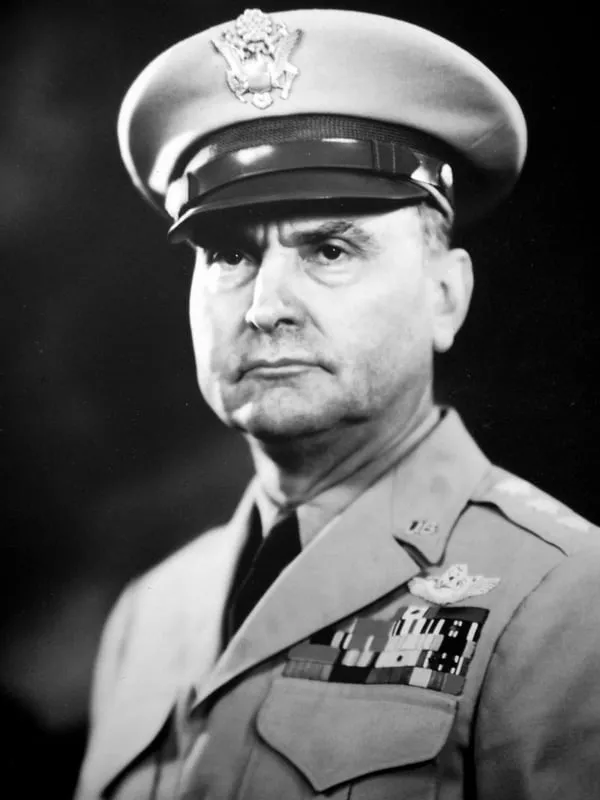
Ira Eaker
Commander of VIII Bomber Command (1942) and the US Eighth Air Force (1942–1943), Commander-in-Chief of the Mediterranean Allied Air Forces (1944–1945), Deputy Commander of the US Army Air Forces (1945–1947)
- Born:
- 13 April 1896, Field Creek (Texas, United States)
- Died:
- 6 August 1987, Andrews Air Force Base (Maryland, United States)
- Author:
- Natalia
- Photo:
- U.S. Army Air Forces, domena publiczna, Wikimedia Commons

Ira Eaker built the American bomber force in England from scratch. In February 1942 he flew into Britain with six officers, and when at the end of 1943 he handed over command of the Eighth Air Force, it had dozens of heavy bomber groups and its own fighter arm. He was the chief champion of the American doctrine of daylight “precision” raids on German industry, and it was he who in January 1943 at Casablanca persuaded Winston Churchill to let the Americans bomb by day while the RAF bombed by night. The same doctrine cost his crews enormous losses over Schweinfurt and in October 1943, which weighed heavily in his removal. In 1944 he commanded all the Allied air forces in the Mediterranean, and so also the bombers that destroyed the abbey on Monte Cassino.
A tenant farmer’s son from Texas
He was born on 13 April 1896 at Field Creek in Llano County, Texas, into the family of a tenant farmer. The family moved around Texas and south-eastern Oklahoma, and Ira studied at the teachers’ college in Durant. In 1917, after the United States entered the war, he joined the army and as an infantry second lieutenant was posted to the 64th Infantry Regiment at El Paso. In the spring of 1918 he transferred to aviation and after training in Texas qualified as a pilot. At Rockwell Field in California he met the two officers with whom he was to share his whole career: Henry Arnold and Carl Spaatz. He did not get overseas in time for the First World War.
Record-breaking flyer and journalist
In 1919–1921 he served in the Philippines, then in New York and Washington, where he studied law. Over the turn of 1926 and 1927 he was one of the pilots of the seaplanes that circled South America on the Pan American Goodwill Flight; the participants received the Mackay Trophy for it. In January 1929 he was the chief pilot of the aircraft “Question Mark”, which, refuelled in the air, circled over Los Angeles for more than 150 hours; the mission commander was Spaatz. In 1936 he flew across the whole United States, from New York to Los Angeles, on instruments alone, without seeing the ground.
Eaker was also an able writer. In the early 1930s he took a degree in journalism at the University of Southern California, and with Arnold he wrote three books popularising aviation. He also graduated from the Air Corps Tactical School and the staff school at Fort Leavenworth. By training and experience he was a fighter pilot: in 1940 he took over the 20th Pursuit Group in California.
England: the Eighth Air Force
In January 1942, by then a brigadier general, he was given the task by Arnold of organising an American bomber command in England and learning British methods. When he protested that he was a fighter pilot, Arnold replied that this was exactly why: the bombers needed a fighter pilot’s spirit. On 20 February 1942 Eaker flew into England with six officers, mostly reservists from civilian life, who were known as “Eaker’s Amateurs”. In April his staff moved into a hastily vacated girls’ school at High Wycombe, right next to the headquarters of RAF Bomber Command. Its commander, Air Marshal Arthur Harris, quickly became the American’s friend and adviser, although he considered daylight raids over Germany a costly mistake. Eaker won the British over with a short speech: the Americans would not do much talking until they had done more fighting, and when they left, the British would be glad they had come.
On 17 August 1942 Eaker flew in person in one of the twelve B-17s that bombed the railway yards near Rouen; all of them came back. On 1 December he took command of the whole Eighth Air Force when Spaatz left for Africa. In the autumn the British pressed ever harder for the Americans to join the night raids, and Churchill doubted the value of daylight missions. Eaker and Arnold defended their doctrine. The issue was settled at the Casablanca Conference: on 20 January 1943 Eaker handed the Prime Minister a one-page memorandum in which he wrote that if the RAF bombed by night and the Americans by day, the Germans would be bombed round the clock and the devil would get no rest. Churchill was persuaded. A week later, on 27 January, Eaker’s bombers struck Germany for the first time, at Wilhelmshaven. In the spring Eaker prepared a detailed plan for the Combined Bomber Offensive, which the chiefs of staff approved at the Trident Conference.
Schweinfurt and removal
The doctrine assumed that bombers flying in close formation would defend themselves with their own guns. The year 1943 showed that this was untrue. The escort fighters, first Spitfires, then P-47 Thunderbolts, reached only as far as the borders of the Reich, and beyond them the Luftwaffe attacked unhindered. Over Kiel on 13 June 22 of 76 bombers were lost. On 17 August, in the raid on Schweinfurt and Regensburg, 60 aircraft failed to return. In October Eaker, making the most of the weather, sent his forces deep into Germany; on 9 October his bombers attacked, among other targets, the Focke-Wulf factory at Marienburg (Malbork) and the port of occupied Gdynia. The week ended with “Black Thursday” on 14 October, when another 60 bombers and nearly 600 airmen were lost over Schweinfurt. According to some studies, between July and November 1943 the Eighth Air Force lost nearly two-thirds of its crews.
Eaker looked for answers: he pushed for drop tanks for the fighters and tried the heavily armed YB-40 escort B-17s, which proved a failure. But he held to the rule that the fighters should stay with the bombers rather than hunt the enemy. Arnold, himself under pressure, blamed the losses and the slow pace of the raids on a lack of aggressiveness among commanders. When Dwight Eisenhower became supreme commander of the invasion in December 1943, he wanted his own people from Africa in England. The Eighth Air Force was taken over by James Doolittle, who let the fighters chase the Germans and in February 1944, in Big Week, reaped the fruits of Eaker’s work. Eaker himself regarded the transfer as a “kick upstairs”.
In the Mediterranean
In January 1944, by then a lieutenant general, Eaker succeeded Arthur Tedder at the head of the Mediterranean Allied Air Forces: the American Twelfth and Fifteenth Air Forces and the British Desert and Balkan Air Forces. From the airfields around Foggia his heavy bombers reached Austria, Hungary and Romania; in April they struck Budapest and Bucharest, and later the refineries of Ploiești.
His hardest test was Monte Cassino. In February 1944 the commanders at the front demanded the bombing of the Benedictine abbey, where they suspected German observers. According to his American biographers, Eaker had doubts about the military sense of this target. After flying over the hill with General Jacob Devers, however, he claimed to have seen a radio mast and men in uniform there, and his command turned a modest request into a large heavy bomber operation. On 15 February the bombers destroyed the abbey; the Germans had not occupied it before, and the ruins became a fortress for them. Historians today generally believe that the monastery could have been spared without harm to the Allied advance. On 15 March Eaker’s aircraft flattened the town of Cassino to clear the way for the New Zealanders, which also failed to bring a breakthrough.
On 2 June 1944 Eaker flew in person in the B-17 “Yankee Doodle II” on the first mission of Operation Frantic: the bombers attacked Debrecen and landed in Ukraine, at Poltava, where he was greeted by Ambassador W. Averell Harriman. In August his air forces, by various counts more than 3,400 aircraft, covered the landings in Provence. In February 1945 he warned Spaatz in a letter that the planned Operation Clarion, with raids on transport targets in small towns, would cause many civilian casualties; in his view the history of this war must never be able to accuse the Americans of throwing the strategic bomber at the man in the street.
After the war
On 30 April 1945 Eaker became Deputy Commander of the US Army Air Forces and Chief of the Air Staff in Washington, where he helped the ailing Arnold prepare for the creation of an independent air force. He retired on 31 August 1947, and in 1948 he was given the rank of lieutenant general on the retired list. For ten years he was a vice-president of Hughes Tool and Hughes Aircraft, then of Douglas Aircraft, and from 1962 he wrote a weekly column on military affairs, syndicated in many newspapers. In 1978 Congress awarded him the Congressional Gold Medal, and on 26 April 1985, by special decision, he received his fourth star as a general. He died on 6 August 1987 in the hospital of Andrews Air Force Base in Maryland and was buried in Arlington National Cemetery.
Assessment
Eaker did not command in the victorious phase of the air war over Germany, but he prepared it. He built the organisation, trained the staff, won from Churchill the right to bomb by day and planned the Combined Bomber Offensive, whose fruits Spaatz and Doolittle reaped in 1944. His weakness was his attachment to the doctrine of the self-defending bomber, which in 1943 cost thousands of airmen. At the same time he was one of the few American air commanders who openly warned against bombing the civilian population, although at Monte Cassino, despite his own doubts, he gave way to the pressure of the ground commanders. The character of General Pritchard in the 1949 Hollywood film “Twelve O’Clock High” was modelled on him.
Sources
Mentioned in battles
(02)Often appears with
People who appear in the same events.