United States
Carl Spaatz
Commander of the Eighth Air Force (1942), of the Allied air forces in North-West Africa (1943), of the US Strategic Air Forces in Europe (1944–1945) and in the Pacific (1945), first Chief of Staff of the US Air Force (1947–1948)
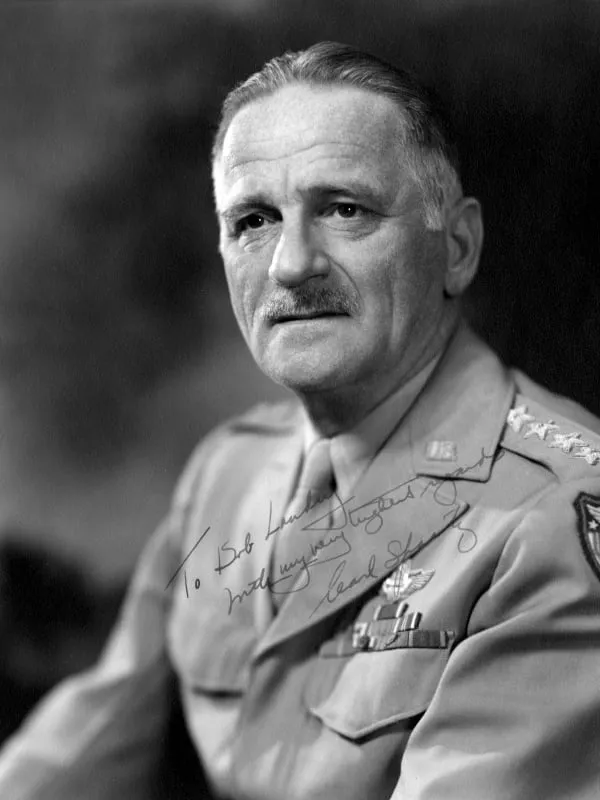
- Born:
- 28 June 1891, Boyertown (Pennsylvania, United States)
- Died:
- 14 July 1974, Washington (United States)
- Author:
- Łukasz
- Photo:
- AFHRA, domena publiczna, Wikimedia Commons

Carl Spaatz was the most important American air commander in the war against Germany. From 1942 he built up the American bomber force in England, then commanded the Allied air forces in North Africa and the Mediterranean, and from January 1944 he headed the US Strategic Air Forces in Europe, which controlled the air forces in England and in Italy. It was he who decided to launch “Big Week”, which broke the German fighter arm, and he who stubbornly pressed for the attacks on German oil that in the second half of 1944 immobilised a large part of the Wehrmacht and the Luftwaffe. In the summer of 1945, by then in the Pacific, he received the order to drop the first atomic bomb. He was the only general present at all three great surrenders: at Reims, in Berlin and in Tokyo Bay.
Cadet “Tooey” and First World War airman
He was born on 28 June 1891 in Boyertown, Pennsylvania, as Carl Andrew Spatz, into a family of German descent. His father, a printer and publisher of a local newspaper, sat in the state senate; as a schoolboy the son worked a linotype machine. Thanks to his father he got into the military academy at West Point, where he earned the nickname “Tooey” because he resembled another red-haired cadet called Toohey. In June 1914 he graduated as an infantry second lieutenant, 57th of 107. He added the second “a” to his surname only in 1937, at the request of his wife and daughters, to help people pronounce it correctly.
After a short spell with the infantry in Hawaii he went through flying training at San Diego in 1915–1916 and joined the 1st Aero Squadron, which in 1916 accompanied General John Pershing’s punitive expedition against Pancho Villa in Mexico. When the United States entered the war he sailed for France, where he ran the flying school at Issoudun. In September 1918, when he was ordered home, he begged for a posting to a fighter squadron at the front and flew in it as a major serving as an ordinary pilot, under officers junior to him in rank. In three weeks he shot down three German aircraft (two, according to some sources), and once, chasing an enemy, he lost his flight and landed with dry tanks just behind the American lines. For this he received the Distinguished Service Cross.
Between the wars
In the 1920s he commanded, among other things, Kelly Field in Texas and the 1st Pursuit Group. In 1925 he testified as a defence witness at the court martial of Billy Mitchell, the outspoken advocate of an independent air force, and that loyalty slowed his promotions for years. At the beginning of 1929, together with Captain Ira Eaker and Lieutenant Elwood Quesada, he kept the aircraft “Question Mark” aloft over the Los Angeles area for more than 150 hours, refuelling it in the air from another machine. It was a world record and a demonstration of possibilities that were fully exploited only after the war.
He then commanded bomber units in California, graduated from the staff school at Fort Leavenworth and served on the staff of the Army’s striking air arm (GHQ Air Force) under General Frank Andrews. He was regarded as one of the best air power experts in the American army. In the summer of 1940 he spent several weeks in England as an observer of the Battle of Britain. His German surname and his constant travels round British airfields gave rise to rumours, to which he responded by once signing the visitors’ book of a base as “Col. Carl A. Spaatz, German spy”. On his return he became the closest aide of the air chief Henry Arnold, whom he had known since 1918, and in the summer of 1941 chief of staff of the newly created US Army Air Forces.
From England to Africa
In January 1942, as a major general, he took over the Air Force Combat Command, and in May the Eighth Air Force, whose headquarters moved to England in July. He also became commander of all American air forces in Europe. The first months were modest: a dozen or so B-17 bombers and the raid on the railway yards near Rouen on 17 August 1942. Spaatz left the building of the bomber command to Eaker, because as early as the autumn part of his forces was diverted to the landings in North Africa, and in November he himself moved to North Africa, where on the orders of Dwight Eisenhower he sorted out the Allied air forces.
In Africa began the partnership that shaped the rest of his war. In February 1943 he took over the North-West African Air Forces, subordinate to the British Air Chief Marshal Arthur Tedder, and in March he was promoted to lieutenant general. His aircraft covered the final stage of the fighting in Tunisia, smashed the Axis air bridge over Cape Bon and bombed the garrison of Pantelleria into surrender. In the summer of 1943 his bombers supported the invasion of Sicily and on 19 July bombed Rome for the first time.
The Strategic Air Forces in Europe
When Eisenhower became supreme commander of the invasion of France, he took Spaatz with him to London. From 1 January 1944 Spaatz commanded the US Strategic Air Forces in Europe (USSTAF): the Eighth Air Force in England, taken over from Eaker by James Doolittle, and General Nathan Twining’s Fifteenth Air Force in Italy. The first task was to defeat the German fighters, because without command of the air the invasion had no chance. On 19 February the meteorologists forecast a few clear days over Germany, but not over England, where the bombers had to take off and form up in cloud. Spaatz decided to take the risk. In Big Week, from 20 to 25 February, American and British bombers struck aircraft factories, while the Mustangs and Thunderbolts escorting them wore down the Luftwaffe, whose losses in experienced pilots proved impossible to make good.
In the spring of 1944 Spaatz fought the most important dispute of his war. Tedder and the invasion’s tactical air commander Trafford Leigh-Mallory wanted to throw the heavy bombers against the railways of France and Belgium to cut off Normandy. Spaatz, like the head of RAF Bomber Command Arthur Harris, preferred to hit German industry, and specifically oil: synthetic fuel plants and refineries. From April until the autumn the heavy bombers were under Eisenhower, who adopted the railway plan, and Spaatz carried it out, if reluctantly. The bombing before the invasion nevertheless gave him an opening: Eisenhower agreed to a trial, and on 12 May 1944 several hundred bombers of the Eighth Air Force attacked the plants at Leuna, Böhlen and Zwickau. The armaments minister Albert Speer judged after the war that the technological war was decided on that day. At the same time the Fifteenth Air Force from Italy was striking at Ploiești, officially at the railway junction, in practice at the refineries as well.
On 8 June, two days after the landings in Normandy, Spaatz made cutting Germany off from fuel the main objective of both his air forces, and in September the oil offensive officially became the first priority of all Allied strategic air power. In the autumn the Reich’s output of aviation fuel fell to a fraction of what it had been, and German tanks and aircraft were more and more often stranded without fuel. Spaatz also directed the shuttle raids through bases in the USSR: it was he who chose the first target, the railway junction at Debrecen, to which Moscow had no objection.
Spaatz defended the American doctrine of daylight “precision” bombing, but in practice, especially in bad weather and when bombing by radar, his bombers also destroyed residential districts, and from the autumn of 1944 they increasingly struck railway junctions in the middle of cities. On 3 February 1945 nearly a thousand B-17s bombed the centre of Berlin; Spaatz named the stations, marshalling yards and government quarter as targets. Shortly afterwards, on 22–23 February, in Operation Clarion Allied aircraft struck hundreds of transport targets in small towns that had so far been spared. Eaker warned him in a letter that such raids would kill many civilians and convince the Germans that the Americans were barbarians. Spaatz did not give way. Several mistaken raids on Switzerland, including the March bombing of Basel and Zurich, forced him to apologise to the Swiss in person.
Three surrenders and the atomic bomb
On 7 May 1945 Spaatz was at Reims when Alfred Jodl signed the German surrender, and the following night in Berlin-Karlshorst he signed as a witness to the final act of surrender, alongside the French general Jean de Lattre de Tassigny. On 10 May at Augsburg he interrogated Hermann Göring, who had given himself up to the Americans.
In the summer he was transferred to the Pacific. In July 1945 on Guam he took over the US Strategic Air Forces in the Pacific, with Curtis LeMay as his chief of staff. The B-29s had already burned most of Japan’s large cities in incendiary raids, which Spaatz inherited and continued. On 25 July he received an order signed on behalf of the Army Chief of Staff George Marshall: after about 3 August, as soon as the weather allowed visual aiming, the 509th Composite Group was to drop the first “special bomb” on Hiroshima, Kokura, Niigata or Nagasaki. On 6 August the bomb fell on Hiroshima, and Spaatz decorated the pilot of the “Enola Gay”, Paul Tibbets, with the Distinguished Service Cross right after he landed. On 9 August a second bomb destroyed Nagasaki. On 2 September Spaatz was aboard the battleship “Missouri” in Tokyo Bay when Japan signed its surrender.
Founder of the US Air Force
In February 1946 he succeeded Arnold at the head of the US Army Air Forces and saw them through to independence. In September 1947, after the National Security Act was passed, he became the first Chief of Staff of the new armed service, the United States Air Force. He retired on 30 June 1948 as a general. In the following years he wrote on military affairs for the weekly “Newsweek”, chaired the board of the Civil Air Patrol, a volunteer organisation that trains young people, and was the first president of the Air Force Historical Foundation. He died on 14 July 1974 at the Walter Reed hospital in Washington and was buried in the cemetery of the Air Force Academy at Colorado Springs.
Assessment
After the war Eisenhower considered Spaatz and Omar Bradley the two American generals who had contributed most to victory in Europe. His greatest achievement was the oil offensive, whose effects were confirmed by post-war analyses: from the autumn of 1944 the shortage of fuel increasingly hobbled the German air force and armoured troops. Historians point out, however, that Spaatz, while professing loyalty to precision bombing, accepted raids in which many civilians died, in Berlin, in Operation Clarion and in Japan. The debate over how much strategic bombing contributed to victory, and how much it cost the civilian population, therefore concerns him as well.
Sources
Often appears with
People who appear in the same events.
On the timeline
(38)1942
1943
1944
1945
February
May
- 07
- Key eventThe surrender at ReimsAt 2.41 a.m. on 7 May 1945, at Eisenhower's headquarters in Reims, General Alfred Jodl signed the unconditional surrender of all German armed forces.
- Göring taken prisonerOn 7 May 1945 Hermann Göring, freed from SS arrest, surrendered to the Americans in Austria. He hoped to meet Eisenhower but ended up in prison and in the dock.