United Kingdom
Arthur Tedder
Air Officer Commanding-in-Chief RAF Middle East (1941–1943), Allied air commander in the Mediterranean (1943), Deputy Supreme Commander at SHAEF (1944–1945), Chief of the Air Staff (1946–1950)
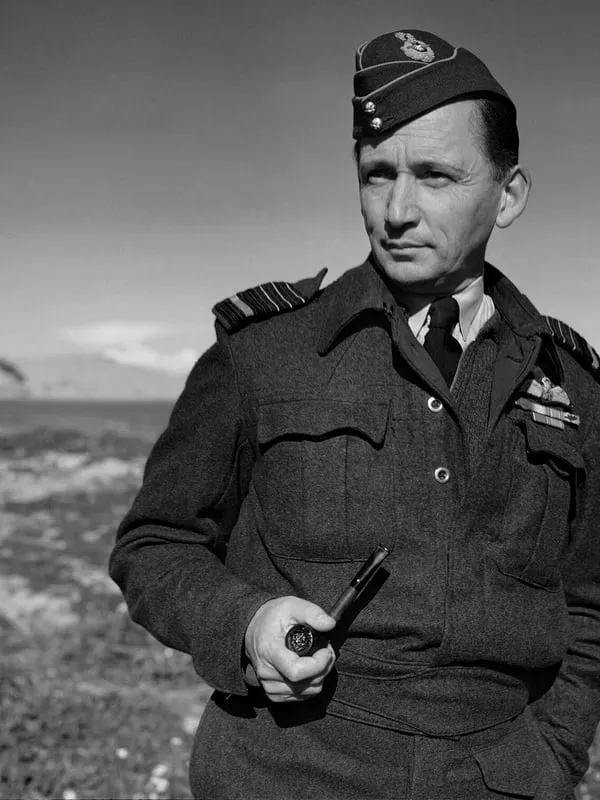
- Born:
- 11 July 1890, Glenguin near Glasgow (United Kingdom)
- Died:
- 3 June 1967, Banstead (United Kingdom)
- Author:
- Łukasz
- Photo:
- British official photographer, domena publiczna, Wikimedia Commons

Arthur Tedder was the most important British airman of the coalition war. He did not lead great raids like Arthur Harris or win an air battle like Keith Park, but it was he who taught the air force and the land forces to fight together. In 1941–1942 he built up over the desert the air forces that helped to stop Rommel, in 1943 he took charge of the combined British and American air forces in the Mediterranean, and in 1944 he became deputy to General Dwight Eisenhower for the invasion of France. On 8 May 1945 in Berlin, on behalf of the Western Allies, he received Germany’s surrender.
A historian in uniform
Arthur William Tedder was born on 11 July 1890 at Glenguin, in the buildings of a whisky distillery at the foot of the Campsie Fells north of Glasgow. His father, Sir Arthur John Tedder, was an official of the customs service; he rose to be a Commissioner of Customs and devised the state old-age pension scheme, and the family followed him around the country, from Shetland to Croydon near London. Tedder read history at Magdalene College, Cambridge; his study of the navy after the Stuart Restoration was published in 1916. He wanted to become a diplomat, and at the beginning of 1914 he went out to the colonial service in Fiji. When war broke out he returned to England and joined the Dorsetshire Regiment as a reserve officer.
A knee injury ruled him out of infantry service, so in 1916 he transferred to the Royal Flying Corps. He flew as a pilot with No. 25 Squadron over the Western Front, in January 1917 took command of No. 70 Squadron, and later commanded training units in Egypt, where by 1918 he was a lieutenant-colonel.
The interwar years
In 1919 Tedder stayed on in the new Royal Air Force. He commanded a heavy bomber squadron that was stationed in Turkey during the Chanak crisis of 1922–1923, attended the naval staff college and the Imperial Defence College, was assistant commandant of the RAF Staff College and from 1934 Director of Training at the Air Ministry. He was regarded as an intellectual in uniform. In November 1936 he took command of the air forces in the Far East, from Burma to Hong Kong, with headquarters in Singapore, and in July 1938 he became Director-General of Research and Development at the Air Ministry. He pushed forward work on the new fighters and bombers that the RAF was to bring into service during the war.
The Middle East
In 1940 his department passed to the new Ministry of Aircraft Production, headed by Lord Beaverbrook. Tedder could find no common language either with him or, through him, with Winston Churchill, and at first he was refused the post of deputy commander of the RAF in the Middle East. When the officer chosen for it, Air Vice-Marshal Owen Boyd, was taken prisoner, the Prime Minister gave way. On 29 November 1940 Tedder became deputy to Air Marshal Arthur Longmore in Cairo, and on 1 June 1941, after Longmore’s recall, commander of the RAF throughout the Middle East.
He took over forces stretched from Malta to Iraq, exhausted by the fighting in Greece and on Crete, from which the troops had just been evacuated. He began with the rear services: putting repair, maintenance and supply in order, without which aircraft stayed on the ground, and expanding the ferry route for aircraft across Africa from Takoradi to Egypt. For Operation Battleaxe he assembled, according to the British official history, 98 serviceable fighters and 105 bombers. In the summer he brought Arthur Coningham out from England and gave him the air forces over the Western Desert. From then on the two formed a well-matched team: Tedder obtained the aircraft and shielded the airmen from the politicians, Coningham led them into battle alongside the Eighth Army. In November 1941, during Operation Crusader, it was after talks with Tedder that General Claude Auchinleck removed the commander of the Eighth Army, General Alan Cunningham, who wanted to break off the offensive.
In 1942 Tedder’s air forces covered the retreat from Gazala, and in the summer, over El Alamein, their ceaseless attacks on columns and airfields helped to stop Rommel. In August Tedder accompanied Churchill on his journey to Moscow and, together with General Alan Brooke, held talks with Marshals Voroshilov and Shaposhnikov. By the autumn, in the Second Battle of El Alamein, the Allied air forces already had clear superiority. Tight formations of bombers dropping their loads on a small area just ahead of their own troops became known at the time as the “Tedder carpet”. In January 1943 his wife Rosalinde was killed in an air crash in Egypt; in the autumn of that year Tedder married again, to Marie Black.
The Mediterranean
At the Casablanca Conference in January 1943 the Allies decided to unite their air forces in the Mediterranean. In February Tedder took over Mediterranean Air Command, to which British and American forces from Morocco to the Middle East were subordinated, under Eisenhower’s supreme command. Thus was formed the team of Eisenhower, Alexander, Tedder and Cunningham that carried through the victory in Tunisia, the invasion of Sicily and the landings in Italy. Tedder got on well with his subordinate, the commander of the Northwest African Air Forces, the American General Carl Spaatz. In April, when Coningham publicly accused Patton’s corps of being unfit for battle, it was Tedder who went with Spaatz to Patton to smooth over the quarrel and ordered Coningham to apologise.
In June 1943, after a month of bombing, the garrison of the Italian island of Pantelleria surrendered before any fighting on land took place. Tedder feared, however, that from then on the army would demand that heavy bombers “soften up” the defences before every attack, turning the air force into artillery. In September, in the crisis at Salerno, he threw every aircraft over the beachhead, including the strategic bombers, which helped to hold the landing. In December 1943 his command was transformed into the Mediterranean Allied Air Forces.
Eisenhower’s deputy
When Eisenhower was given command of the invasion of France, he wanted at his side the airman he had worked with in the Mediterranean. In January 1944 Tedder became Deputy Supreme Commander at SHAEF, the invasion headquarters, with the principal task of coordinating the air forces. There he championed the Transportation Plan, drawn up by his adviser, the scientist Solly Zuckerman: before the invasion the bombers were to destroy railway junctions, engine sheds and workshops in France and Belgium systematically, to paralyse the movement of German reserves to the Channel. It was opposed by Harris and Spaatz, who preferred to bomb Germany, and by Churchill, who feared heavy losses among French civilians. Eisenhower and Tedder did not give way. From April the heavy bombers operated on Eisenhower’s directions, passed on through Tedder, and by the day of the invasion they had destroyed much of the French railway network, killing, by frequently cited estimates, some 10,000 French and Belgians.
After the landings Tedder became one of the sharpest critics of Bernard Montgomery. He believed that Montgomery was too slow in gaining ground around Caen, needed among other things for airfields, and after the failure of Operation Goodwood in July 1944 he even demanded his removal. Of Operation Market Garden, which Montgomery called 90 per cent successful, he is said to have remarked that a jump off a cliff is also successful almost to the very end. Tedder also backed Coningham in his quarrels with Montgomery and warned Eisenhower that removing the tactical air commander would be a disaster. In January 1945, after the Ardennes offensive, he flew to Moscow and discussed with Stalin the coordination of operations on both fronts.
On 7 May 1945 Tedder waited with Eisenhower in his office while in Reims the Germans signed the surrender. The next day he flew to Berlin and on the evening of 8 May at Karlshorst, together with Marshal Georgy Zhukov, received the repeated act of unconditional surrender, signed by Field Marshal Wilhelm Keitel. In September 1945 he was promoted to Marshal of the Royal Air Force.
After the war
On 1 January 1946 Tedder succeeded Charles Portal as Chief of the Air Staff and was made a baron. He led the RAF through the difficult years of demobilisation, expanded Fighter Command and prepared the British part in the Berlin Airlift of 1948. In 1950 he became head of the British Joint Services Mission in Washington, and in 1951 he retired. He was Chancellor of the University of Cambridge, chairman of the Standard Motor Company and vice-chairman of the BBC’s Board of Governors. In 1966 he published his war memoirs under the telling title “With Prejudice”. Towards the end of his life he suffered from Parkinson’s disease (PL). He died on 3 June 1967 at his home in Banstead, Surrey; his ashes were laid in St Clement Danes, the RAF church in London.
Assessment
Tedder was above all an organiser and a diplomat of the coalition. He understood earlier than many others that victory in the air depends not only on pilots but also on workshops, airfields and supply, and that the air force, the army and the navy must plan together. Eisenhower valued him as a loyal deputy who could calm the disputes between the British and the Americans. His critics, especially Montgomery’s supporters, saw him as an intriguer, and the dispute over the Transportation Plan and its cost in the lives of French civilians still divides historians. Even his opponents, however, admitted that it was thanks to him that the air forces of the Western Allies became, in 1943–1945, part of a single, coordinated war machine.
Sources
Mentioned in battles
(07)Often appears with
People who appear in the same events.