United States
W. Averell Harriman
Special envoy of the US President for Lend-Lease in London (1941–1943), Ambassador of the United States to the USSR (1943–1946), Ambassador to the United Kingdom (1946)
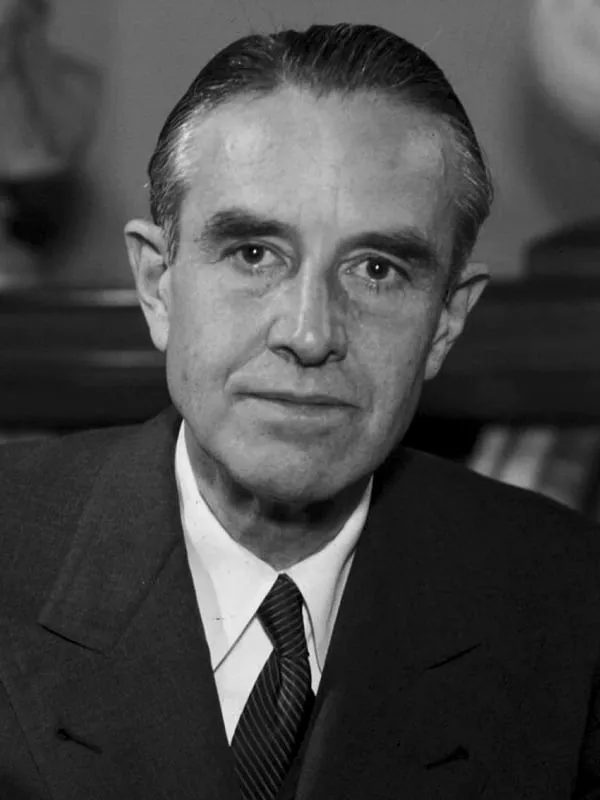
- Born:
- 15 November 1891, New York (United States)
- Died:
- 26 July 1986, Yorktown Heights (New York State, United States)
- Author:
- Natalia
- Photo:
- autor nieznany, domena publiczna, Wikimedia Commons

William Averell Harriman was the son of one of the richest men in America and spent twenty years in railways, shipping and banking himself before, at nearly fifty, he became one of the most important diplomats of the Second World War. First as the personal envoy of President Franklin Delano Roosevelt in London, then as ambassador in Moscow, he was present at the talks of the Big Three throughout the war: he negotiated arms deliveries for the Red Army, accompanied Winston Churchill to the Kremlin, and took part in the conferences at Tehran, Yalta and Potsdam. He watched at close quarters as the post-war fate of Poland was decided, and he was among the first Americans to warn Washington that Joseph Stalin did not intend to keep his promises. After the war, for more than twenty years, he advised successive presidents on the Cold War.
The tycoon’s son
He was born on 15 November 1891 in New York, the son of Edward Henry Harriman, owner of the Union Pacific railroad and one of the greatest railway magnates in the United States, and Mary Williamson Averell. In 1899, aged seven, he sailed with his father on a scientific expedition to Alaska which also reached the Russian coast of Asia. His father died in 1909, leaving the family an enormous fortune. Harriman went to school at Groton and graduated from Yale University in 1913, where he belonged to the Skull and Bones society.
For the next two decades he was a businessman and financier. He worked on the board of Union Pacific and later chaired it for many years. After the First World War he founded a shipyard and a shipping line, and in 1922 a bank of his own, which in 1931 merged with Brown Brothers to form Brown Brothers Harriman. He also invested in Central Europe, among other things in coal mines in Poland, for which he received compensation after the war. He was a well-known polo player and a breeder of racehorses. In the late 1920s he joined the Democratic Party; during the Great Depression he worked in the New Deal administration and chaired the business advisory council of the Department of Commerce, where he won the trust of Roosevelt and of his adviser Harry Hopkins.
Envoy in London and the Moscow mission
In March 1941 Roosevelt sent him to London as his special representative for Lend-Lease. Harriman was to establish what Britain needed most and to make sure American supplies arrived quickly. He soon grew close to Churchill, and during air raids watched London burning with him from a roof in Downing Street. In August 1941 he attended the meeting of Roosevelt and Churchill at which the Atlantic Charter was proclaimed.
After the German attack on the USSR, Roosevelt and Churchill decided to find out whether and how to help Moscow. At the end of September 1941 Harriman flew there with the British Minister of Supply, Lord Beaverbrook. He carried a personal letter from the President to Stalin. In the talks at the Kremlin the two envoys went point by point through the Soviet list of needs, and on 1 October they signed with Vyacheslav Molotov a protocol on deliveries of arms and raw materials for nine months. Harriman agreed to them without setting any conditions. Critics later accused him of thereby setting the whole policy of aid to the USSR on the basis of giving without anything in return; his defenders, such as the historian Gerhard Weinberg, point out that in 1941 the most important thing was to keep Russia in the war against Germany.
In August 1942 Harriman, as Roosevelt’s representative, accompanied Churchill to Moscow, where the Prime Minister had to explain to Stalin that there would be no second front in Europe that year, and listened to his sharp reproaches.
Ambassador in Moscow
In October 1943 Harriman became ambassador to the Soviet Union; he presented his credentials on 23 October. Straight after his arrival he took part in the Moscow Conference of Foreign Ministers, and in November in the Tehran Conference. In January 1944 his daughter Kathleen, who was with him in Moscow, went with a group of Western correspondents to Katyn for a show staged by the Burdenko Commission. She came back convinced by the Soviet version, which attributed the Katyn massacre to the Germans, and the embassy sent a report to Washington in the same vein. Questioned years later in the Senate, Harriman testified that he did not recall the matter of Katyn being discussed at the time.
The ambassador also dealt with military cooperation. At the beginning of 1944 he obtained Stalin’s consent to Operation Frantic, shuttle raids by American bombers landing at airfields in Ukraine. In the summer of 1944 the Polish question became for him the touchstone of Soviet intentions. When the Warsaw Uprising broke out in August, Moscow refused American aircraft supplying the insurgents the right to land at its airfields. Harriman and the British ambassador, Archibald Clark Kerr, protested to Molotov and his deputies, and Harriman wrote to Washington that the refusal stemmed from “ruthless political calculations” and advised a harder line towards the Kremlin. Roosevelt, however, did not choose to confront Stalin.
In October 1944 Harriman was Roosevelt’s observer at the talks between Churchill and Stalin in Moscow, during which the leaders agreed on spheres of influence in the Balkans and pressed Prime Minister Stanisław Mikołajczyk to accept a border on the Curzon Line. He also conducted talks on Soviet participation in the war against Japan. In December 1944 Stalin set out his conditions to him: leases in Manchuria, recognition of the independence of Outer Mongolia, and the return of southern Sakhalin and the Kurils. At the Yalta Conference in February 1945 they were accepted without consulting China. At the same time Harriman urged the President to stand firm on Poland.
Warnings and Potsdam
Yalta entrusted Harriman, Clark Kerr and Molotov with preparing a new Polish government. The commission stalled almost at once: Molotov wanted the Communists from Warsaw to form the core of the government, while the ambassadors demanded the participation of politicians from outside that circle, above all Mikołajczyk. In March 1945 the NKVD arrested the leaders of the Polish Underground State, who had been invited to talks. For Harriman this was proof that Stalin treated the Yalta promises as a screen. After Roosevelt’s death on 12 April 1945 he flew to Washington and argued to the new President, Harry Truman, that the Soviet Union wanted to impose its system on its neighbours and that yielding to it was a mistake. Truman was receptive to these arguments, though later the Secretary of State, James Byrnes, pushed Harriman away from the main decisions.
In May and June 1945 Harriman took part in Hopkins’s talks with Stalin in Moscow, which led to a compromise on the Polish government, and in July he was at Potsdam. In August, when the USSR declared war on Japan, it was to him and Clark Kerr that Molotov announced the decision. Harriman also encouraged the Chinese not to concede more in their treaty with Moscow than Yalta had provided for, and when Molotov demanded a Soviet say in the choice of the Allied commander in Japan, he flatly refused.
After the war
Harriman left Moscow in January 1946. For half a year he was ambassador in London, and in 1946–1948 Secretary of Commerce in Truman’s cabinet. He then directed the implementation of the Marshall Plan in Europe, and in 1951–1953 the Mutual Security Agency. From 1955 to 1958 he was Governor of New York State. Twice he sought the Democratic presidential nomination without success. Under President John F. Kennedy he negotiated the neutralisation of Laos and, in 1963, the nuclear test ban treaty, and in 1968 he led the American delegation at the peace talks with North Vietnam in Paris. In 1971 he married Pamela, the former wife of Randolph Churchill, with whom he had had an affair during the war. In 1975 he published his memoirs of the years 1941–1946. He died on 26 July 1986 at Yorktown Heights near New York.
Harriman did not take the great decisions of this war, but he was one of their best-informed witnesses. He knew Stalin better than most Western politicians and described him as the most inscrutable and contradictory man he had ever known. Historians judge that in 1944–1945 he read Soviet intentions towards Poland and Eastern Europe correctly, but his warnings came at a time when the Red Army already stood on the Vistula and the Oder, and the West no longer had the means to change that.
Sources
Often appears with
People who appear in the same events.