France
Paul Reynaud
Minister of Finance (1930, 1938–1940), Minister for the Colonies (1931–1932), Prime Minister of France (1940), Deputy Prime Minister (1953–1954)
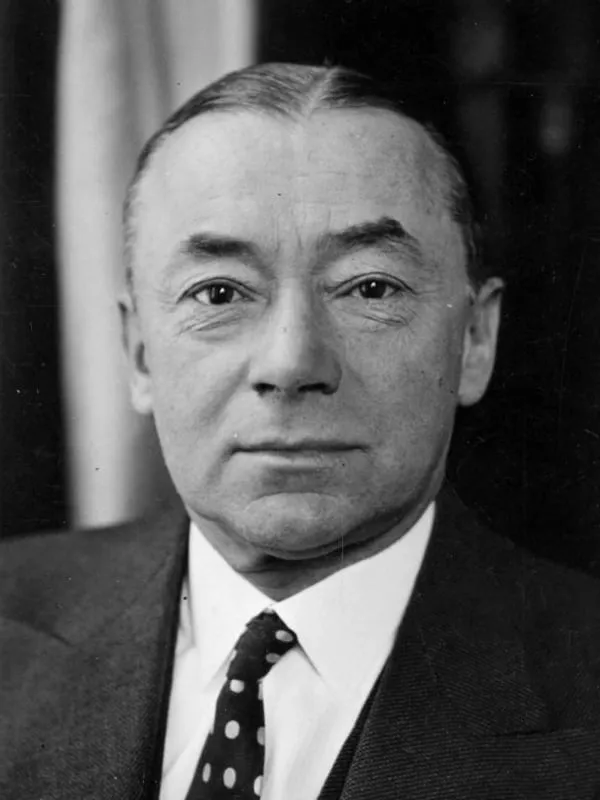
- Born:
- 15 October 1878, Barcelonnette (France)
- Died:
- 21 September 1966, Neuilly-sur-Seine
- Author:
- Łukasz
- Photo:
- autor nieznany, domena publiczna, Wikimedia Commons

Paul Reynaud was the last Prime Minister of the Third Republic who wanted to fight Hitler to the finish. A politician of the moderate right, an economic liberal and a nonconformist in foreign policy, he was throughout the 1930s one of the few voices on the French right calling for rearmament, an alliance with Britain and resistance to Germany. He backed the young officer Charles de Gaulle’s ideas for an armoured army, opposed Munich and, as Minister of Finance in 1938–1940, found the money for rearmament. In March 1940 he formed a government with a majority of a single vote; three months later, in the hour of defeat, he failed to prevent an armistice and handed power to Marshal Pétain. He spent the rest of the war in Vichy prisons and in German captivity. After the war he was one of the fathers of European integration, and for twenty years he kept asking himself whether he could have acted differently in June 1940.
From the Alps to the Bar
He was born on 15 October 1878 in Barcelonnette in the Provençal Alps, in the Ubaye valley, from which many inhabitants emigrated in the 19th century to seek their fortune in Mexico. His father, Alexandre Reynaud, made money there in the textile trade, which gave his son a comfortable life and a careful education. Paul graduated from the Paris business school HEC and studied law; he became a barrister in Paris and in 1910 was named first secretary of the Conférence du stage, the traditional distinction for the best young advocate at the Paris Bar. In 1912 he married Jeanne Henri-Robert, daughter of the head of the Paris Bar, and in 1914 their daughter Colette was born. He was short, slim and upright, and spoke in a sharp, metallic voice. One British observer wrote that he had the face of a samurai educated at Cambridge.
In 1914 he stood for the Chamber of Deputies for the first time, without success. During the First World War he was mobilised and served at the front, but was evacuated during the Battle of the Somme, seriously ill with pleurisy. Towards the end of the war he was posted to the French military mission in Siberia, attached to the Czechoslovak Legion. He ended the war with the Croix de Guerre. His elder brother Albert was killed in 1914.
Deputy and minister
In 1919 Reynaud was elected deputy for the Basses-Alpes department on the list of the right-wing Bloc National. He soon joined the moderate-right, liberal Democratic Alliance (Alliance démocratique), of which he later became vice-president. He lost his seat in 1924, and in a 1926 by-election in Paris he was beaten by the communist Jacques Duclos, but in 1928 he won the capital’s 2nd arrondissement and held it until 1940. In the 1920s he stood out for his moderation on German reparations, which was rare on the right at the time.
In the cabinets of André Tardieu and Pierre Laval he served as Minister of Finance (March–December 1930), Minister for the Colonies (January 1931 – February 1932) and finally as Minister of Justice and Deputy Prime Minister (February–June 1932). As Minister for the Colonies he made a long tour of French Indochina in the autumn of 1931, when the colony was still shaken by the Yên Bái mutiny and the peasant uprising in Annam. In public he declared that no revolt against France would succeed and rejected demands for autonomy, though he also announced limited reforms; in private he admitted that the brutality of the repression had shocked him.
A loner on the right
After 1932 Reynaud was out of government for several years, as he increasingly swam against the current of his own camp. From 1934 he was one of the first French politicians to demand a devaluation of the franc, which the country, loyal to the “Poincaré franc”, regarded as sacrosanct. He argued that the overvalued currency was keeping France mired in the slump, and he was right, but the devaluation was carried out only in 1936, by the Popular Front government. In foreign policy he diverged from the right even more sharply. He saw Hitler as the heir of pan-Germanism who sooner or later would turn against France. He advocated a close alliance with Britain and, unlike most of the right, an understanding with the Soviet Union as a counterweight to the Reich.
In December 1934 he met Lieutenant Colonel Charles de Gaulle, author of the book “Towards a Professional Army”, who argued that the next war would be decided by professional armoured divisions rather than a mass army of reservists standing behind fortifications. Reynaud became the only politician of any weight to embrace these ideas. In 1935 he put before the Chamber a bill to create a motorised corps of professional soldiers. The bill failed, and the generals regarded it as an attack on the army’s doctrine. After the remilitarisation of the Rhineland in March 1936 Reynaud warned that a France whose army was fit only for defence could not help its allies in the east, neither Poland nor Czechoslovakia. He set out his views in the book “The French Military Problem” (1937).
In 1938 he came out against the policy of concessions when the president of his party, Pierre-Étienne Flandin, called for an accommodation with Germany. “A policy of peace at any price is a policy of war,” he said. He considered the Munich Agreement a defeat. He and Georges Mandel considered resigning from the government at the time, but in the end he stayed and voted confidence in it. He broke with Flandin’s party.
Minister of Finance
From April 1938 Reynaud was Minister of Justice in the third government of Édouard Daladier. On 1 November 1938 he swapped portfolios with Paul Marchandeau and took over the Ministry of Finance, which he had always coveted. With the decrees of 12 November he launched a programme of liberal recovery: he raised taxes, cut civilian spending while sparing rearmament, and in practice abolished the 40-hour week, the symbol of the Popular Front. “Do you think France can at the same time maintain her standard of living, spend 25 billion on armaments and rest two days a week?” he asked. The government broke the general strike called by the trade unions for 30 November, and strikers were dismissed en masse. Capital that had fled abroad in the Popular Front years returned, the public finances improved and the arms factories got their money. For the left, however, Reynaud remained the minister who had crushed the workers.
When France declared war on Germany in September 1939, Reynaud as Minister of Finance was responsible for paying for it. His slogan “We shall win because we are the stronger”, set against a world map showing the Allied empires beside a small Germany, hung on posters throughout the country during the Phoney War. He later explained that he had been thinking of a world war in which the resources of the empires and of America were bound to prevail in the end, but after the defeat the slogan was mocked as a symbol of illusion. In the government he was increasingly Daladier’s rival, criticising the inaction and doubting the abilities of the Commander-in-Chief, Maurice Gamelin. His companion since the 1930s was Countess Hélène de Portes, ambitious and influential, who unlike him doubted that the war made sense. In 1938 Reynaud separated from his wife.
Prime Minister
Finland’s defeat in the Winter War and the Moscow Peace Treaty of 12 March 1940 brought Daladier down. After a secret debate in the Chamber, ending on 19 March with a vote in which some 300 deputies abstained, the Prime Minister resigned, and on 21 March Reynaud formed a government. He also took the Foreign Ministry, but had to leave Daladier as Minister of National Defence and War. On 22 March the Chamber gave him its confidence by 268 votes to 156 with 111 abstentions, that is, a majority of one vote over opponents and abstainers combined. In his declaration, which according to de Gaulle’s memoirs de Gaulle had drafted for him, he proclaimed: “To win is to save everything; to succumb is to lose everything.”
On 28 March in London, at his first meeting of the Supreme War Council, he agreed with Neville Chamberlain a declaration that neither country would conclude a separate armistice or peace with Germany. He pressed for action in Scandinavia and supported the mining of Norwegian waters (Operation Wilfred). When the Allies landed troops in Norway after the German attack, he announced from the tribune that “the iron route has been cut”, but the Norwegian campaign soon began to go badly. On 9 May, at a cabinet meeting, Reynaud accused Gamelin of mismanaging the war and, unable to dismiss him against Daladier’s wishes, declared that the government was resigning. The following morning the Germans attacked the Netherlands, Belgium and Luxembourg, and President Albert Lebrun persuaded him to stay on.
On the morning of 15 May, two days after the German crossing of the Meuse at Sedan, Reynaud telephoned Winston Churchill, British Prime Minister for the past five days, and said: “We are beaten; we have lost the battle.” The next day Gamelin admitted in front of him and Churchill that he had no strategic reserve. On 18 May Reynaud took over the Ministry of National Defence and War himself, moved Daladier to foreign affairs, made Mandel Minister of the Interior and appointed the 84-year-old Marshal Philippe Pétain, the hero of Verdun, Deputy Prime Minister. On 19 May he dismissed Gamelin and gave the command to General Maxime Weygand. Both appointments were meant to raise the nation’s spirits, and both turned against him: Pétain and Weygand very quickly concluded that the war was lost. On 28 May, in a radio broadcast, Reynaud sharply condemned the capitulation of the Belgian army and King Leopold III. On 5 June he dropped Daladier from the government and appointed the newly promoted Brigadier General de Gaulle Under-Secretary of State at the War Ministry.
June 1940
On 10 June, as Italy declared war on France, the government left Paris. At the conferences with Churchill at Briare on 11 and 12 June and at Tours on 13 June, Weygand demanded that the whole of the RAF’s fighter force be sent to France, and Churchill refused. At Tours Reynaud asked whether Britain would release France from the undertaking of 28 March. Churchill refused. Reynaud sent desperate appeals to President Franklin Delano Roosevelt, but the United States could promise nothing beyond supplies. He himself wanted the army to capitulate in the field, as the Dutch had done, while the government, the fleet and the air force moved to North Africa and fought on. Weygand rejected this as a dishonour to the army, and Pétain declared that he would not leave France. Although Reynaud still had supporters of continued resistance in his cabinet, he could not bring himself to dismiss Weygand.
At Bordeaux on 15 June most ministers backed the proposal of Camille Chautemps to ask the Germans for their armistice terms. On 16 June de Gaulle telephoned from London with the British offer of a Franco-British union, with common citizenship and a joint government, drawn up in the circle of Jean Monnet. Reynaud put it to the cabinet, but the majority would not hear of it. On the evening of 16 June he resigned and, according to most accounts, himself named Pétain to the President as his successor, hoping the marshal would discover that no honourable armistice could be concluded with Hitler. That same night Pétain asked the Germans for a ceasefire. Reynaud still managed to pass de Gaulle money from the secret fund, with which the general flew to London. For the next twenty years Reynaud blamed himself for handing power to Pétain.
On 28 June, on the road south, the car Reynaud was driving hit a tree at La Peyrade near Frontignan. Hélène de Portes was killed outright; he himself was slightly injured.
Prisoner of Vichy and the Reich
The new authorities made Reynaud one of the men to blame for the defeat. In September 1940 the Vichy government had him arrested together with Léon Blum, Daladier, Gamelin and Mandel. He was held at the Château de Chazeron, then at Vals-les-Bains, and in the autumn of 1941, on Pétain’s decision and without any court verdict, he was confined in the Fort du Portalet in the Pyrenees. He was not among the defendants at the Riom trial. After the Germans occupied southern France at the end of 1942 he was handed over to them, and they held him in Sachsenhausen concentration camp and, from May 1943, at Schloss Itter in the Tyrol, together with Daladier, Gamelin, Weygand and other prominent Frenchmen. His assistant Christiane Mabire joined him there. On 5 May 1945 the prisoners were freed after the Battle for Castle Itter, in which American soldiers and Wehrmacht soldiers who had gone over to the Allies beat off an attack by the Waffen-SS. In July 1945 Reynaud was the first witness at Pétain’s trial.
After the war
He returned to politics despite the hostility of some of his former allies on the right. From 1946 to 1962 he was a deputy for the Nord department, associated with the National Centre of Independents and Peasants. In the summer of 1948 he was briefly Minister of Finance, and in 1953–1954 Deputy Prime Minister in Joseph Laniel’s government. Twice he tried in vain to form a government. He was an ardent supporter of European unity and sat in the Consultative Assembly of the Council of Europe and in the Common Assembly of the European Coal and Steel Community. In 1949 he married Christiane Mabire, with whom he had three children.
In 1958 he supported de Gaulle’s return to power and chaired the consultative committee that gave its opinion on the constitution of the Fifth Republic. Four years later he broke with his former protégé: in October 1962 he was the first signatory of the motion of censure against Georges Pompidou’s government, in protest against the election of the President by universal suffrage, and he led the “no” camp in the referendum. He lost his seat in the elections of November 1962. He died on 21 September 1966 in hospital in Neuilly-sur-Seine after an appendix operation. He left extensive memoirs and the book “France Saved Europe” (1947), in which he defended his decisions of 1940.
Assessment
Raymond Aron called Reynaud the most intelligent French politician of the interwar period. In the 1930s he was right on three questions on which most of his camp was wrong: devaluation, armour and Hitler. Yet when his hour came, he proved a Prime Minister without a base. He took office with a majority of one vote, with a rival at the War Ministry and a Commander-in-Chief he did not trust, and in the hour of defeat he himself brought to power the men who concluded the armistice. Historians reproach him for hesitating in the decisive days, for failing to dismiss Weygand and for yielding to the influence of those around him, Countess de Portes among them. They credit him with refusing an armistice to the end and with bringing into the government de Gaulle, who carried on the war in France’s name. De Gaulle called him a man of great worth, unjustly crushed by events beyond all measure.
Sources
Mentioned in battles
(07)Often appears with
People who appear in the same events.
On the timeline
(27)1940
February
March
April
May
- 28
- Belgium capitulatesAt 4 a.m. on 28 May 1940 the Belgian Army laid down its arms. Leopold III, defying his government, stayed as a prisoner; his ministers fought on from France.
- The War Cabinet crisisOn 25–28 May 1940 Halifax wanted to sound out peace terms via Mussolini. Churchill, backed by Chamberlain and Labour, won the government over to fighting on.
June
- 14
- Key eventThe Germans enter ParisOn 14 June 1940 German troops entered Paris, declared an open city, without a fight. A swastika flag was hoisted over the Eiffel Tower.
- The French Navy against ItalyOn 14 June 1940 French cruisers from Toulon shelled Vado, Savona and the outskirts of Genoa. Until 21 June the French fleet fought the Italians at sea.