Greece
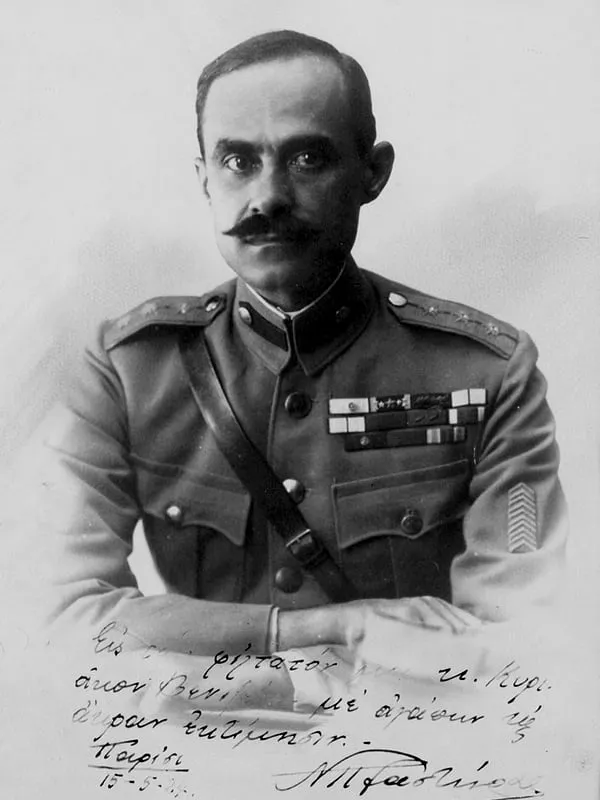
Nikolaos Plastiras
Commander of the 5/42 Evzone Regiment in the Greco-Turkish War, leader of the 1922 revolution, nominal leader of EDES (1941), Prime Minister of Greece (January–April 1945, 1950, 1951–1952)
- Born:
- 4 November 1883, Vounesi, now Morfovouni near Karditsa (Greece)
- Died:
- 26 July 1953, Athens (Greece)
- Author:
- Łukasz
- Photo:
- autor nieznany, domena publiczna, Wikimedia Commons

Nikolaos Plastiras, known as the “Black Rider”, was the most famous Greek soldier of his generation and one of the most stubborn republicans in Greece’s turbulent interwar history. In 1922, after the defeat in Asia Minor, he led the coup that forced the king to abdicate and sent the politicians blamed for the catastrophe to their deaths. He then gave up power of his own accord, only to try to take it back in 1933 and fail. He sat out the Second World War in exile in France, although his name stood at the head of one of the resistance organisations. In January 1945, after bloody fighting in Athens, the British and the regent made him prime minister in the hope that his authority would reconcile a divided country. He governed for three months, and the reconciliation he sought came only after the civil war.
The Black Rider
He was born on 4 November 1883 in Thessaly. Some sources give his birthplace as the village of Vounesi (now Morfovouni) in the Agrafa mountains, others as nearby Karditsa, where the family had moved. After school, in 1903 or 1904, he enlisted in the army as a volunteer and took part in the struggle for Macedonia at the beginning of the twentieth century. He was involved in the military coup at Goudi in 1909, which paved the way to power for Eleftherios Venizelos. Between 1910 and 1912 he completed the school for non-commissioned officers and went to the Balkan Wars as an infantry second lieutenant. His daring in the battles of Elassona and Lachanas earned him promotion, and his comrades gave him the nickname of the Black Rider.
During the First World War he sided with Venizelos and the National Defence movement, which, against the neutrality to which the king clung, brought Greece into the war on the side of the Entente. In 1918 he fought on the Macedonian front at Skra-di-Legen and was promoted to lieutenant colonel for that battle. In 1919 he commanded the 5/42 Evzone Regiment in the Allied intervention in Ukraine, where the Greeks supported the Whites against the Bolsheviks, and he was then transferred to Smyrna.
The war with Turkey and the 1922 revolution
In the Greco-Turkish War Plastiras’s regiment was one of the best in the army. The Turks called its commander Kara Biber, the Black Pepper, and his soldiers the devil’s army. When after the elections of November 1920 the monarchists returned to power, and King Constantine I to the throne, Venizelist officers were removed from the army; Plastiras was the only one from the former National Defence movement to keep his command, because his men declared that they would fight under no one else. When in August 1922 the Turkish offensive broke through the front, his regiment withdrew in good order to the coast near Çeşme and crossed to the island of Chios, covering thousands of refugees. Yet he was also blamed for a failed counter-attack that contributed to the destruction of one of the divisions.
The shattered units gathered on Chios and Lesbos. On 11 September 1922 by the Julian calendar, that is 24 September by the Gregorian, Plastiras, together with Colonel Stylianos Gonatas and Commander Dimitrios Fokas, proclaimed a revolution. The revolutionary committee demanded the resignation of the king and the government, and while ships carrying the troops were heading for Athens, on 27 September Constantine abdicated in favour of his son, George II. Real power lay with the committee, and Plastiras was its leader. Under pressure from the army and the street, an extraordinary court sentenced to death five politicians, including the former prime minister Dimitrios Gounaris, and the last commander-in-chief, General Georgios Hatzianestis. They were shot on 28 November 1922. Plastiras took responsibility for the verdict; to the monarchists he was from then on a murderer, to many refugees from Asia Minor a hero.
The revolutionary government had to take in more than a million refugees in a country ruined by war. Plastiras brought Venizelos back from exile to negotiate the peace, and the rebuilt army on the Evros gave him leverage in the talks that led to the Treaty of Lausanne. In 1923 the revolution survived the Corfu crisis, when Mussolini seized the island, and a failed coup by monarchist generals in October. After the elections of December 1923 Plastiras handed power to the elected parliament and at the beginning of January 1924 left the army. The National Assembly declared him worthy of the fatherland and gave him the rank of lieutenant general in retirement. A few months later Greece became a republic.
Coup and exile
The republic proved unstable. In 1925 power was seized by his former subordinate, General Theodoros Pangalos, whose dictatorship persecuted Plastiras and expelled him from the country. In March 1933 the elections were won by Venizelos’s opponents. During the night of 5 to 6 March, before the results were announced, Plastiras attempted a coup, convinced that their rule would mean the end of the republic. The coup collapsed within a day; not even Venizelos supported it. Plastiras fled via the Dodecanese to Beirut and from there to France, settling in Nice. After another failed Venizelist coup in March 1935 he was sentenced to death in absentia, although he had not been in the country. Soon afterwards the monarchy returned, and with it George II.
The sentence was covered by an amnesty, but Plastiras remained in exile. From 1937 he chaired an émigré committee against the dictatorship of Ioannis Metaxas. Republicans, officers dismissed from the army and refugees from Asia Minor still saw him as their leader.
The Second World War
When the Germans took Paris, Plastiras moved to the unoccupied zone and in the autumn of 1940 settled in Nice again. The Metaxas dictatorship did everything it could to keep him out of the country. When Italy attacked Greece, Plastiras called on the Greeks of America to support the struggle. As he himself later wrote in a letter that was to cost him office, at the end of November 1940 he heard that Germany might mediate an end to the Italo-Greek war and tried to pursue the idea, but the Greek legation to the Vichy government received his emissary with hostility. In the summer of 1941, after the German invasion of Greece, an envoy of the German security services visited him in Nice with an invitation to Paris; according to an account given to the Vichy authorities, he was offered power in Greece. He went to Paris, but what was said there remains unknown.
In the autumn of 1941 his trusted associate Komninos Pyromaglou returned to Greece. In September that year Colonel Napoleon Zervas and his companions founded EDES, the National Republican Greek League, and proclaimed Plastiras its leader. It was a purely nominal role, taken on, as historians write, regardless of his wishes; Plastiras stayed in France throughout the occupation, and from the autumn of 1941 to 1943 his traces in the records almost vanish. EDES in time became the second-strongest organisation of the resistance, a rival of the communist ELAS. The government in exile in Cairo and London regarded Plastiras with suspicion, because his return would have reopened the dispute over the monarchy. The British special services, on the other hand, saw him as a Greek counterpart of de Gaulle, a symbol of the republic.
Prime minister after the Dekemvriana
After the liberation of Athens Prime Minister Georgios Papandreou invited Plastiras home. By December 1944 the general was in Athens, where fighting was going on between British and government troops and ELAS, later called the Dekemvriana. On 26 December he sat at the conference table convened in Athens by Winston Churchill, at which the leaders of all the parties met together with representatives of the communists. In talks during those days, according to Greek accounts, he clashed sharply with the communist secretary Georgios Siantos, accusing the ELAS guerrillas of murdering opponents and burning villages.
On 3 January 1945 the regent, Archbishop Damaskinos, appointed Plastiras prime minister. A republican of spotless reputation, an opponent of the communists and at the same time a man respected by part of the left, he seemed a candidate acceptable to all. His government included people from the whole political spectrum except the communists. On 11 January an armistice was signed, and on 12 February 1945 the government and EAM concluded the Varkiza Agreement, which provided for the disarmament of ELAS, an amnesty for political offences and a plebiscite on the monarchy. Plastiras demanded the release of the hostages taken by ELAS from Athens and tried to steer a middle course between the British and the left. The British did not trust him. The French ambassador in Athens wrote at the beginning of April that they regarded him as a mediocrity and were doing everything to get rid of him.
The pretext came from the right-wing press. In March 1945 the newspaper “Ellinikon Ema” published his wartime letter describing his efforts to obtain German mediation in the war with Italy. In a country that was settling accounts with collaboration, the letter was compromising for the prime minister. The regent demanded his resignation, and at the beginning of April 1945, between 7 and 10 April according to different sources, Plastiras stepped down.
Last years
During the civil war of 1946–1949 Plastiras kept away from politics and criticised both sides. After it ended he founded the centrist party EPEK and preached national reconciliation. He was prime minister from April to August 1950 and again from November 1951 to October 1952. His governments eased repression against the left, carried out land distribution, gave women the vote and took Greece into NATO. At the same time, under his premiership and despite international protests, the communist Nikos Beloyannis was executed in March 1952. After an electoral defeat in November 1952 his career came to an end. He died in poverty in Athens on 26 July 1953. Queen Frederica, visiting him before his death, is said to have been surprised at how modest his home was.
In Greece today Plastiras is an almost undisputed figure: the patron of a municipality, of streets and of the reservoir on the Tavropos river, named Lake Plastira, whose construction he himself initiated. Historians take a more critical view. He was a battlefield hero and a selfless politician, but also a putschist who twice tried to settle disputes by force of arms, and the execution of “the Six” poisoned Greek politics for a long time. His wartime contacts with the Germans remain unexplained. As prime minister in 1945 he had too little time and too weak a position vis-à-vis the British to prevent the civil war, whose coming he saw more clearly than many others.
Sources
Mentioned in battles
(01)Often appears with
People who appear in the same events.