United Kingdom
Ronald Scobie
Commander of the 70th Infantry Division and of Tobruk fortress (1941), commander of the troops on Malta (1942–1943), commander of III Corps and of British forces in Greece (1943–1946)
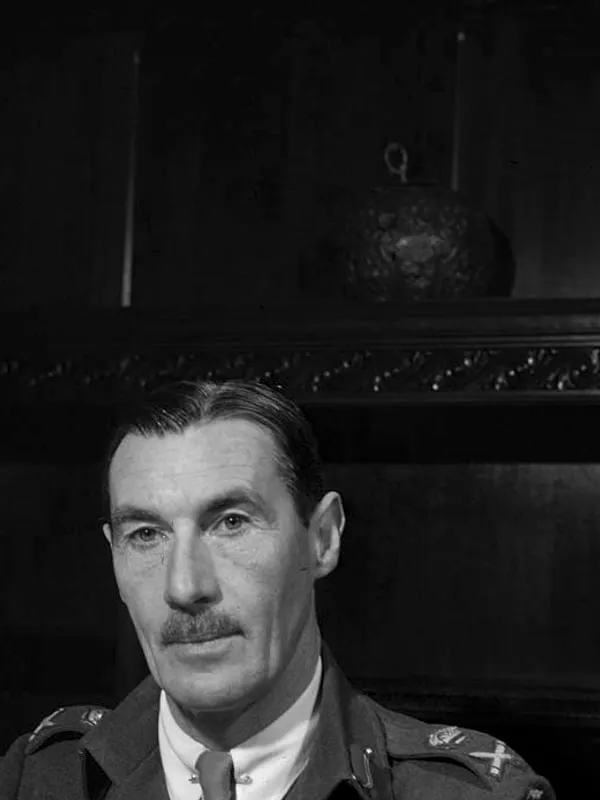
- Born:
- 8 June 1893, Mandalay (Myanmar), then British India
- Died:
- 23 February 1969, Odiham, Hampshire (United Kingdom)
- Author:
- Łukasz
- Photo:
- Tanner (kpt.), War Office official photographer, domena publiczna, Wikimedia Commons

Ronald Scobie was a sapper by training and a staff officer by experience, and he made his mark on the history of the Second World War twice, each time in a completely different role. In 1941, as commander of the British 70th Infantry Division, he took over the defence of besieged Tobruk, where Poles of the Independent Carpathian Rifle Brigade fought alongside his soldiers, and led the breakout from the fortress to meet the Eighth Army. Three years later, as a lieutenant general, he commanded the British forces in liberated Greece and in December 1944 found himself at the centre of the fighting with the communist partisans for Athens. To the British right he was then the defender of Greece against a communist coup; to the Greek left, the symbol of foreign intervention.
Sapper and rugby player
Ronald MacKenzie Scobie was born on 8 June 1893 in Mandalay in Burma, then part of British India, the son of Mackay John Scobie, an engineer in the Indian Public Works Department. He was educated at Cheltenham College and at the Royal Military Academy, Woolwich, the nursery of artillery and engineer officers. He was an outstanding sportsman: he played cricket, and at rugby he appeared as a centre for the Army team. At the beginning of 1914 he won three caps for Scotland, in matches against Wales, Ireland and England.
In February 1914 he was commissioned as a second lieutenant in the Corps of Royal Engineers. From the autumn of 1914 until the end of the war he served in France and Belgium, was wounded, and in 1916 was awarded the Military Cross. Towards the end of the war he moved to staff work as a staff officer and brigade major, and remained in France until 1920. He was mentioned in despatches four times, twice of them for the First World War.
Between the wars
Scobie spent the interwar years on the typical path of an officer marked for higher posts. He trained cadets at Woolwich, attended the Staff College at Camberley in 1925–1926, and then served on the staff of Aldershot Command. In 1927 he married Joan Duncan Sidebotham, with whom he had a daughter. In 1932–1935 he taught the art of war at the Royal Military College of Australia at Duntroon. He also attended the Imperial Defence College in London, and in 1938, as a colonel, he joined the War Office, in the Adjutant-General’s department, responsible for the army’s personnel matters.
Sudan and Tobruk
The outbreak of war found him as deputy director of mobilisation at the War Office. In the spring of 1940 he left for the Middle East, and in August he became chief of staff of the British troops in Sudan. From that post he took part in preparing and conducting the East African campaign, in which the forces of General William Platt advanced from Sudan into Eritrea, broke the Italian defences in the Battle of Keren and took Asmara and Massawa.
In October 1941 Scobie, promoted to major general, took command of the 70th Infantry Division, formerly the 6th Division, which since September had been shipped by night in warships into besieged Tobruk to replace the exhausted Australians. On 22 October he took over command of the fortress from General Leslie Morshead. Under his orders was a multinational garrison: the British 70th Division, the tanks of the 32nd Army Tank Brigade, the Polish Independent Carpathian Rifle Brigade of Brigadier General Stanisław Kopański and the Czechoslovak 11th Infantry Battalion.
The garrison had an important part to play in the British November offensive, Operation Crusader. On 21 November 1941, while the Eighth Army’s tanks were fighting at Sidi Rezegh, Scobie’s soldiers broke out of the fortress towards the Ed Duda ridge, while the Poles made a diversionary attack on the western sector. British infantry and tanks punched a gap in the ring of the siege, though not without losses. On 26 November, while Rommel was leading his divisions on a dash to the Egyptian frontier, Scobie’s units took Ed Duda and during the night met the New Zealand 19th Battalion coming from the east. For the first time since April, Tobruk had a land link with the rest of the British forces. Rommel’s returning divisions cut the corridor once more, but at the beginning of December the exhausted Germans and Italians began to retreat westwards and the siege was lifted. Scobie remained commander of the fortress until 13 December. For the fighting in Egypt and Libya he was appointed a Companion of the Order of the Bath. The Czechoslovak government in exile awarded him its War Cross.
Malta and Cairo
After a few months as deputy adjutant-general at Middle East Command, in August 1942 Scobie took command of the land forces on Malta. He arrived on the island at the hardest moment of the siege, when its survival depended on whether the convoy of Operation Pedestal got through. His task was to keep the garrison ready in case of an Axis landing, to help unload the ships and repair the airfields, and to work with the governor, Lord Gort, and the air commander Keith Park. In March 1943 he was promoted to lieutenant general and became chief of staff of Middle East Command in Cairo, under General Henry Maitland Wilson.
Greece: from liberation to the Dekemvriana
In December 1943 Scobie took command of III Corps, which was to form the core of the force sent to Greece once the Germans began to withdraw. The plan was named Operation Manna, and Scobie’s forces, designated Force 140, were small: a parachute brigade, an armoured brigade, Greek units and aircraft. The political foundations were laid by the Caserta Agreement of 26 September 1944. The government of national unity of Georgios Papandreou and the leaders of the partisan armies, the communist ELAS and the republican EDES, agreed that all Greek forces were subordinate to the government and, through it, to Scobie. In Athens itself no armed action could be taken without his order.
In mid-October 1944, after the liberation of Athens, Scobie arrived in the capital and took command of all forces in Attica. For a few weeks crowds greeted the British as liberators. Tension grew, however, over the question of who would control the armed forces of the state. When the negotiations on demobilising the partisans broke down, on 1 December 1944 Scobie issued a proclamation calling on the partisan units to lay down their arms by 10 December. The ministers linked to EAM left the government, and on 3 December police opened fire on a demonstration in Syntagma Square. So began the Dekemvriana, more than a month of fighting between ELAS and British and government troops.
During the night of 4–5 December Winston Churchill sent Scobie a telegram ordering him to hold Athens and to act as if he were in a conquered city where a local rebellion was in progress, not shrinking from bloodshed if necessary. The text quickly leaked to the American press and caused a storm. In the first half of December ELAS had the upper hand: the British and government forces were squeezed into the city centre, in a district the partisans mockingly called “Scobia”, and some of the garrisons around Athens were cut off. London rushed reinforcements from Italy, including the 4th Indian Infantry Division, and General John Hawkesworth was brought in to direct the fighting in Attica. From the second half of December the British, with superior firepower, drove ELAS out of one district after another.
On 25 December Churchill flew to Athens to seek a political solution. It ended with the establishment of a regency under Archbishop Damaskinos. Once ELAS had lost the capital, it asked Scobie for a ceasefire. The truce was signed on 11 January 1945 and came into force on 15 January. In February the Varkiza Agreement provided for the disarmament of ELAS. Scobie remained in Greece as commander of British land forces until March 1946, when the country was already preparing for elections and entering a period that soon turned into civil war. In April 1945 he was knighted.
After the war and assessment
In June 1947 Scobie retired with the honorary rank of lieutenant general. From 1951 to 1958 he was Colonel Commandant of the Corps of Royal Engineers, and from 1951 to 1954 Lieutenant of the Tower of London, that is, deputy to the Constable of the fortress. He died on 23 February 1969 in hospital at Odiham in Hampshire, according to some sources in nearby Aldershot. In 1975 a biography by Henry Maule appeared under the telling title “Scobie, Hero of Greece”.
How Scobie is judged depends on which of his campaigns one looks at. At Tobruk he was an able commander who welded together a garrison of soldiers of several nations and carried out a difficult breakout according to plan, although his division paid a high price for it. In Greece he was above all the executor of the policy of Churchill, who was determined not to let the communists take power in a country that the percentages agreement with Stalin had assigned to the British sphere of influence. The proclamation of 1 December, issued without EAM’s consent, became the spark that set Athens ablaze, and the general’s name entered the Greek political vocabulary as a byword for foreign intervention. British authors stress, on the other hand, that in December 1944 his small forces saved the centre of Athens from a seizure of power by force.
Sources
Commanded in battles
(01)Mentioned in battles
(01)Often appears with
People who appear in the same events.