Greece
George II of Greece
King of Greece (1922–1924 and 1935–1947), head of state in exile (1941–1944)
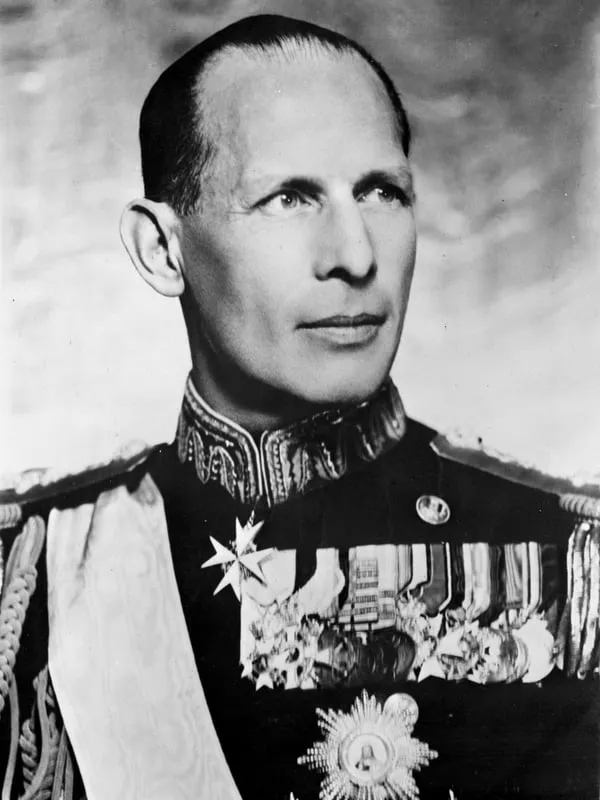
- Born:
- 19 July 1890, Tatoi near Athens (Kingdom of Greece)
- Died:
- 1 April 1947, Athens (Greece)
- Author:
- Natalia
- Photo:
- United States Office of War Information, domena publiczna, Wikimedia Commons

George II was King of Greece during the most turbulent decades of its history. He lost the throne twice and twice regained it, and his fortunes were bound up with every crisis the country went through, from the defeat in Asia Minor to the civil war. He matters to this war for three reasons. In 1936 he signed the decrees that gave dictatorial power to General Ioannis Metaxas. In the spring of 1941, when the Germans overran Greece, he did not surrender but left for Crete and then for exile, so that Greece remained in the Allied camp until the end of the war. And his return, stubbornly supported by Winston Churchill, became one of the main fault lines of the dispute that at the end of 1944 turned into fighting in the streets of Athens.
A prince trained in Prussia
George was born on 19 July 1890 in the palace of Tatoi near Athens, the eldest son of the then crown prince Constantine and of Sophia, sister of Emperor Wilhelm II. The family came from the Danish Glücksburg dynasty, and all his life George seemed something of a stranger to the Greeks: cold and taciturn, he felt more at home in London than in Athens. He earned his commission in the Greek army and then served for several years in a Prussian Guards regiment in Berlin. He came home for the Balkan Wars and in November 1912 was present at the capture of Salonika. When his grandfather, King George I, was assassinated in March 1913, he became heir to the throne.
During the First World War Greece was torn apart by the quarrel between his father and Prime Minister Eleftherios Venizelos. In 1917 the Entente forced Constantine out and would not allow the German-educated George to take the throne; his younger brother Alexander became king, and George went into exile in Switzerland with his father. He returned at the end of 1920, after Alexander’s death and Constantine’s restoration, and took part in the war with Turkey. In February 1921 he married the Romanian princess Elisabeth (PL) in Bucharest. The marriage proved unhappy and childless, and ended in divorce in 1935.
First reign and exile
After the catastrophe in Asia Minor, rebel officers under Colonel Nikolaos Plastiras forced Constantine to abdicate, and on 27 September 1922 George II became king. He reigned in the shadow of a revolutionary military committee, with no real power. He could not even pardon the six politicians and generals, among them Georgios Hatzianestis, who were shot in November 1922 as those to blame for the defeat. In October 1923 royalist officers attempted a coup and failed. The republicans blamed the king, although most historians think he had nothing to do with it. The government demanded that he leave the country while the question of the regime was settled. On 19 December 1923 George sailed for Romania, but he did not abdicate. On 25 March 1924 the assembly proclaimed a republic, and a plebiscite in April confirmed it; members of the dynasty were stripped of their citizenship and property.
Over the following years George lived in Bucharest and in Italy, and from 1932 in London, in a modest hotel suite. In Greece, meanwhile, the republic was not working: governments fell every few months, and generals seized power time and again, as Theodoros Pangalos did in 1925 and 1926. More and more Greeks longed for the monarchy as a guarantee of stability.
Restoration and the 4th of August dictatorship
On 10 October 1935 General Georgios Kondylis, once a Venizelist, seized power and organised a plebiscite on the king’s return. The vote on 3 November was not secret, and according to the official figures almost 98 per cent of voters backed the monarchy – a blatantly rigged result. On 25 November George II returned to Athens. He immediately fell out with Kondylis because he wanted to declare a broad amnesty for the Venizelists convicted after the failed coup of March 1935; Kondylis resigned. The elections of January 1936 gave the royalists and the Venizelists an almost equal number of seats, leaving the communists holding the balance. Within a few months several leading politicians died, among them Prime Minister Konstantinos Demertzis, and in April the king entrusted the government to Metaxas, whose party had only a handful of seats in parliament.
On 4 August 1936, on the pretext of a threatened general strike, George II signed decrees dissolving parliament and suspending the key articles of the constitution. Thus was born the 4th of August Regime, a dictatorship modelled partly on Fascist Italy, with censorship, prisons for the opposition and exile to the islands. Metaxas ran domestic policy, but the king kept his influence over the army and foreign policy and kept Greece close to Britain. That decision weighed on the whole of the rest of his reign: for a large part of the Greek people the monarchy now became a byword for dictatorship.
War with Italy and Germany
In 1940 Fascist Italy provoked Greece ever more openly; in August an Italian submarine sank the cruiser Elli off the island of Tinos. When on 28 October Metaxas rejected Mussolini’s ultimatum and the Italians attacked, the king called the nation to arms and presided over the war council. The Greeks not only stopped the invader but, in the Greco-Italian War, drove him far back into Albania.
After Metaxas’s death on 29 January 1941, George II chose the successor himself: that same day the banker Alexandros Koryzis became prime minister. The king rejected calls for a government of national unity including the old parties and kept the machinery of the dictatorship. In practice it was he and the commander-in-chief, Alexandros Papagos, who now took the key decisions, including the one to accept a British expeditionary force. When the German invasion began on 6 April, the front collapsed within two weeks. On 18 April, after a conversation with the king, Koryzis took his own life. For several days George II acted as head of government himself, while rejecting the British minister’s advice to seize the moment to break with the dictatorship. In the end the premiership went to Emmanouil Tsouderos, a former governor of the central bank and a Cretan with a Venizelist past. When General Georgios Tsolakoglou surrendered the Army of Epirus to the Germans without the government’s consent, the king and government refused to recognise the capitulation. On 23 April they flew to Crete.
On the island the king lived near Chania. On the morning of 20 May, the first day of the Battle of Crete, German paratroopers landed close to his quarters. Escorted by a New Zealand platoon, the royal party walked for two days through the mountains and the Samaria Gorge to the south coast, from where on the night of 22–23 May the destroyer Decoy took him to Alexandria. For his conduct on Crete the British awarded him the Distinguished Service Order.
King in exile
George II settled in London, while his government worked alternately in London and Cairo. He was the head of state recognised by the Allies and had Churchill on his side, who saw the monarchy as a guarantee of British influence in Greece. Foreign Office officials, however, found him exceptionally difficult: he stubbornly defended his royal prerogatives, kept Metaxas’s men in the government in exile for a long time and suspected the British of plotting with the republicans. Only under their pressure, and with evident reluctance, did he formally distance himself from the dictatorship and promise free elections after liberation.
In occupied Greece, meanwhile, a resistance movement was growing, in which the communist-led National Liberation Front (EAM) gained the upper hand. For EAM, but also for many pre-war politicians, the king’s return before a vote on the regime was unacceptable. In March 1944 the Political Committee of National Liberation, in effect a rival government, was set up in the mountains, and in April some Greek units in Egypt mutinied, demanding a government of national unity. The British put down the mutiny, Tsouderos resigned, and the liberal Georgios Papandreou became prime minister. At the Lebanon conference in May 1944 it was agreed that a plebiscite after liberation would decide the fate of the monarchy. When the Germans left Athens in October 1944, Papandreou returned without the king: he and the British decided, against George II’s expectations, that his arrival before the plebiscite would cause an explosion.
The regency
The explosion came anyway. At the beginning of December 1944 the dispute over disarming the partisans turned into fighting in Athens between ELAS and government and British troops. Churchill, who flew to Athens at Christmas, became convinced that the only way out was a regency under Archbishop Damaskinos. George II, who regarded the archbishop as a republican and would not even hear of a regency, was still rejecting the idea on Christmas Eve. On the night of 29–30 December Churchill and Anthony Eden told him in London that the British government would recognise the regent’s authority even without his consent. Towards morning the king gave way: he entrusted the regency to Damaskinos and undertook not to return to the country until the nation had decided on its form of government. In January 1945 a truce was concluded, and in February the Varkiza agreement ended the fighting.
Return and assessment
In March 1946 elections, boycotted by the communists, were won by the royalists, who set the plebiscite for 1 September. According to the official results, some 68–69 per cent of voters backed the king’s return. The vote, however, took place amid terror against the left, and even Allied observers found that the government side had exerted undue pressure on voters. At the end of September 1946 George II returned to a ruined country in which civil war was beginning. He reigned for less than six months. On 1 April 1947 he was found unconscious in his study in the palace in Athens; he died the same day of arteriosclerosis, aged 56. He was buried at Tatoi, and the throne passed to his brother Paul I.
Historians judge George II harshly. By consenting to Metaxas’s dictatorship he himself undermined the legitimacy of the monarchy and deepened the division of Greeks into royalists and republicans, and in exile he refused for too long to break with the regime’s men. That obstinacy made it easier for the communists to present themselves as the only force fighting for democracy. In fairness, though, in April 1941 he did not take the road of capitulation, he remained a loyal ally of Britain to the end, and thanks to his departure the legitimate authorities of Greece never submitted to the occupier. In the civil war he became a symbol for those Greeks who fought the communists, and for the others the embodiment of everything they had taken up arms against.
Sources
Mentioned in battles
(03)Often appears with
People who appear in the same events.