Battle of Rostov (1941)
- Dates:
- 17 November – 2 December 1941
- Front:
- Eastern Front
- Location:
- Rostov-on-Don and its approaches in Rostov Oblast (USSR): the steppe between the Mius, Tuzlov and Don rivers, the Shakhty–Novocherkassk area, Bolshekrepinskaya, Sultan-Saly and Chaltyr, and Bataysk on the left bank of the DonOn the battle map →
- Sides:
- Nazi GermanyGerd von Rundstedt, Ewald von KleistSoviet UnionSemyon Timoshenko, Yakov Cherevichenko
- Result:
- Soviet victory. Kleist's 1st Panzer Army took Rostov-on-Don on 21 November, but a counter-offensive by the Soviet Southern Front and the 56th Army threatened to cut it off. On 27–29 November Soviet troops retook the city, and by 2 December the Germans had fallen back 60–80 kilometres westwards to the Mius river. It was the Wehrmacht's first serious retreat of the Second World War. On 1 December Hitler dismissed Field Marshal Rundstedt, but his successor, Reichenau, had to sanction the retreat. According to Russian tallies the Red Army lost more than 15,000 killed and missing and almost 18,000 wounded in the offensive operation; there are no precise figures for German losses.
- Author:
- Łukasz
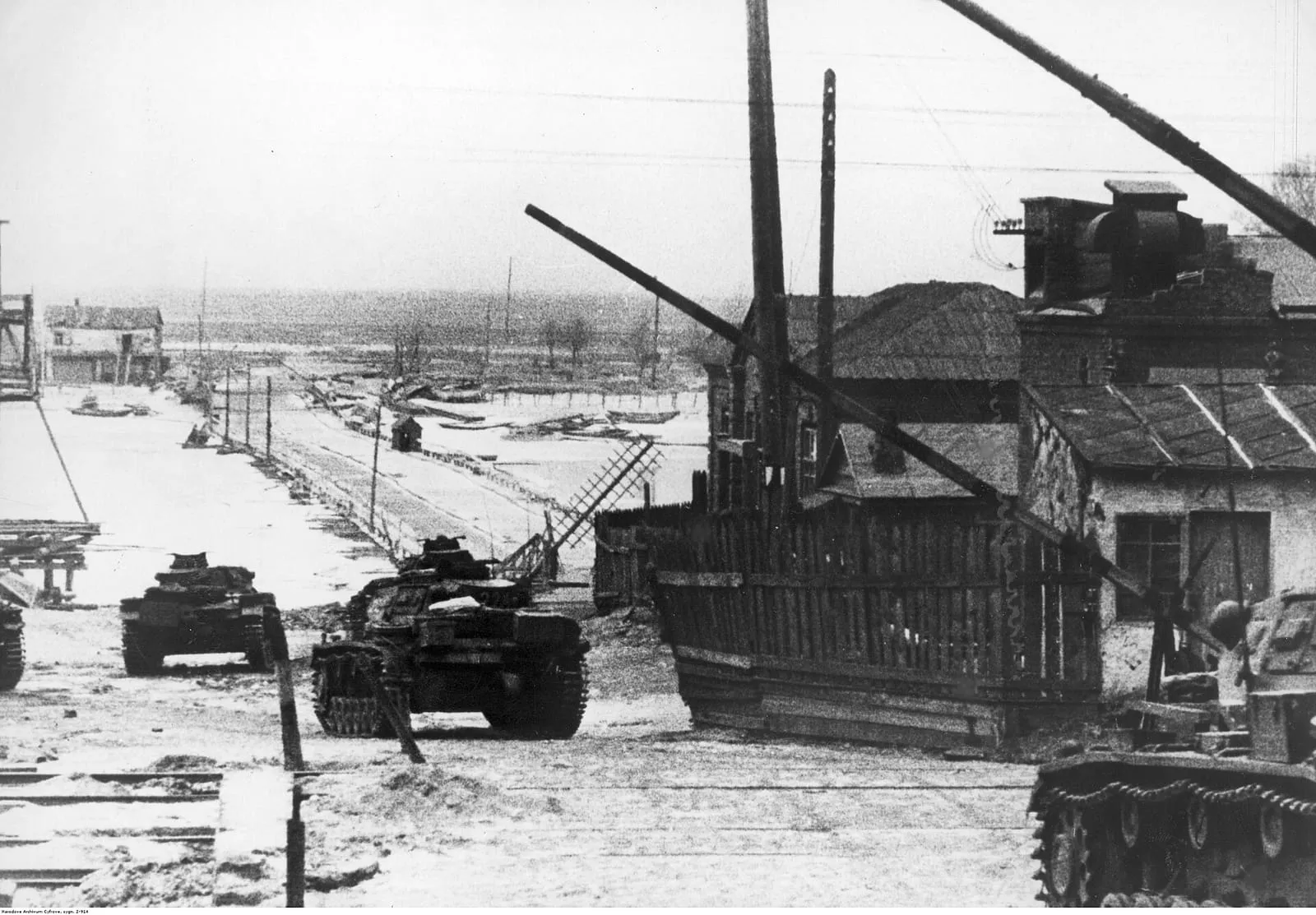
The Battle of Rostov was the first battle in which the Wehrmacht captured a major Soviet city and then had to give it up. In the autumn of 1941, after its victories at Kiev and on the Sea of Azov, Field Marshal Gerd von Rundstedt’s Army Group South was pushing eastwards towards Rostov-on-Don – a city of half a million people, a railway junction and a port near the mouth of the Don, which the Germans called the gateway to the Caucasus. Beyond Rostov lay the Caucasian oilfields of Maykop and Grozny, and further still Baku. On 17 November Colonel General Ewald von Kleist’s 1st Panzer Army moved against the city, and on 21 November it took it.
On that same 17 November, at almost the same hour, the newly formed Soviet 37th Army went over to the attack on Kleist’s northern flank. Marshal Semyon Timoshenko, Commander-in-Chief of the South-Western Direction, and Colonel General Yakov Cherevichenko, commander of the Southern Front, struck at the overextended flank of the German panzer army while it was busy storming the city. Within a week Kleist was in danger of being cut off. On 27–29 November Soviet troops retook Rostov, and by 2 December the Germans had withdrawn to the Mius river. Rundstedt ordered the retreat against the wishes of Adolf Hitler and lost his command on 1 December. He was the first of many German field marshals and generals to be dismissed in the winter of 1941/1942.
Name and dates
German and Western studies speak of the Battle of Rostov, whereas in Russia the fighting is divided into two operations. The Southern Front’s Rostov defensive operation, which closed the Donbas–Rostov strategic defensive operation, lasted from 5 to 16 November 1941. The Rostov offensive operation, conducted by the Southern Front and the 56th Separate Army, lasted from 17 November to 2 December; Russian historians distinguish within it the advance on Bolshekrepinskaya (17–23 November) and the liberation of Rostov proper (27 November – 2 December). The battle itself ran from 17 November, when both offensives began – the German one against Rostov and the Soviet one against Kleist’s rear – until 2 December, when the 1st Panzer Army took up positions on the Mius; the fighting of the first half of November formed its background.
Sources differ over the dates on which the city was retaken. The first Soviet units entered Rostov on 27 November, and the Germans abandoned most of it on 28 November; that date appears in many Western studies and in some Russian biographies. Soviet communiqués and Russian historiography treat 29 November as the day of liberation, when after three days of street fighting the whole city had been cleared.
Background
The road to the Mius
After the Battle of the Sea of Azov, which ended at the beginning of October with the destruction of the Soviet 18th and 9th Armies, Hitler and Rundstedt divided up the tasks in the south. General Erich von Manstein’s 11th Army turned towards the Crimea, the 6th and 17th Armies advanced on Kharkiv and deep into the Donets Basin, and the advance on Rostov was taken over by the 1st Panzer Army, reinforced by XLIX Mountain Corps and by the SS brigade – soon a division – Leibstandarte SS Adolf Hitler under Josef “Sepp” Dietrich. On its left flank advanced General Giovanni Messe’s Italian Expeditionary Corps and units of the 17th Army, while the coast of the Sea of Azov was guarded by a Slovak motorised division, the so-called Fast Division.
On 17 October the Germans took Taganrog, and on 20 October Stalino. Then, however, the autumn rains – the rasputitsa – turned the steppe roads into a quagmire. Supply columns were stuck for tens of kilometres, tanks stood idle without fuel, and the infantry was left far behind the panzer divisions. The panzer divisions, which had been fighting almost without a break since June, had only a fraction of their tanks still in the line. The railway behind the front, which was being converted from the Soviet broad gauge to the European standard gauge, could not keep up with deliveries. Kleist halted on the Mius, a few dozen kilometres from Rostov, and had to wait for the frost to harden the ground.
The Southern Front made use of this pause. After the defeat on the Sea of Azov its armies – Major General Konstantin Koroteyev’s 12th, Major General Vladimir Kolpakchi’s 18th and Major General Fyodor Kharitonov’s 9th – had been badly depleted, and all the country’s reserves were going to Moscow at the time. The direct defence of Rostov was entrusted to Lieutenant General Fyodor Remezov’s 56th Separate Army, subordinated directly to the Stavka, which since October had been building a ring of fortifications around the city and Novocherkassk. The inhabitants dug anti-tank ditches, and some of the city’s industrial plants were evacuated.
The advance on Shakhty
The Germans knew about the fortifications along the coast and the railway from Taganrog, so in November they decided to bypass Rostov in a wide arc from the north, through Shakhty and Novocherkassk. If it succeeded, the 9th and 56th Armies would be encircled, and then, in concert with the 17th Army, the whole Southern Front in the eastern Donbas. The main blow was to be delivered by General Gustav von Wietersheim’s XIV Motorised Corps, with the 14th and 16th Panzer Divisions and the SS division Wiking, supported from the south by General of Cavalry Eberhard von Mackensen’s III Motorised Corps.
The attack began on 5 November in the sector of the Soviet 9th Army and met stiff resistance from the very first day. According to Russian studies, Kharitonov had prepared in the Dyakovo area one of the first systems of anti-tank strongpoints of the war, each covering the others with its fire. By 8 November the Germans had advanced 30–35 kilometres, and by 16 November only a dozen or so more. They did not take Shakhty. By driving a wedge to the north-east, however, they lengthened their left flank – and that is precisely what Timoshenko noticed.
Timoshenko’s plan
On 8 November Timoshenko presented Joseph Stalin with a plan to strike the left flank and rear of the 1st Panzer Army, and on 9 November the Stavka approved it. It was a bold move: in those same days the Germans were preparing their November offensive against Moscow, and the Stavka was sending every fresh division to the western direction. Timoshenko therefore had to assemble his forces from what he had. From divisions drawn from other armies of the South-Western Front and his few reserves he formed the 37th Army in the area of Kamensk-Shakhtinsky and Krasnodon. From the end of October it was commanded by Major General Anton Lopatin, a former corps commander from the fighting around Kiev. In mid-November the army entered the line between the 18th and 9th Armies. It was to strike southwards towards Bolshekrepinskaya and on to Taganrog, reach the Sea of Azov and cut Kleist off from the rest of Army Group South. The attack was to be supported by the adjoining flanks of the 18th and 9th Armies and by two cavalry divisions.
According to Russian studies, on 15 November the Southern Front had 16 rifle divisions, 5 cavalry divisions and several tank brigades, some 262,000 men in all, and the 56th Army a further 86,000. In manpower and in the air the two sides were roughly equal, and the Russians had a slight advantage in artillery, but in tanks the Germans had a superiority of about two to one – according to the same sources, some 250 against 120.
On 16 November the German command, discouraged by the slow progress towards Shakhty, changed its plan. Instead of a wide outflanking movement, the 1st Panzer Army was to strike straight at Rostov from the north. The task was given to Mackensen’s III Motorised Corps, with the 13th and 14th Panzer Divisions, the 60th Motorised Division and the Leibstandarte. XIV Corps and XLIX Mountain Corps were to cover its northern flank. Kleist warned his superiors that his left flank was exposed and that his tanks and lorries were breaking down more and more often in the frost, but the Army High Command and Hitler pressed for Rostov to be taken before winter.
Course of the battle
17 November: two offensives
On the night before 17 November the frost came. The ground froze, and for the first time in weeks tanks could move freely across the steppe. At eight in the morning the main body of III Corps set off southwards towards Rostov. According to Russian sources, roughly an hour later – by coincidence – the 37th Army went over to the attack together with the flanks of the 18th and 9th Armies. Each side struck where the enemy was weakest, and neither broke off its own operation.
On the first day Lopatin’s divisions advanced 15–18 kilometres, overrunning German outposts. In the days that followed they ran into counter-attacks by the 14th Panzer Division, the Wiking division and the mountain divisions, and by 21 November they had covered a further 15–20 kilometres. The attack was badly organised: infantry, tanks, artillery and aircraft cooperated poorly, commanders relied on stereotyped solutions, and until 20 November low cloud and fog all but grounded the Soviet air force. Even so, the 37th Army could not be stopped, and with each day it pushed deeper into the rear of the panzer army.
Meanwhile III Corps was advancing on Rostov. Its tanks broke through the 56th Army’s positions on the northern approaches to the city and on 19 November reached the north-eastern suburbs, in the rear of its defences. On 20 November fighting raged on the outskirts and in the city itself, fiercest around the bridges and Green Island on the Don, where the Germans tried to seize the crossings. Remezov’s troops lost many guns and tanks and three armoured trains. During the night of 20/21 November they were ordered to withdraw to the left bank of the Don.
The capture of Rostov
On 21 November the Germans occupied Rostov, and the 56th Army fell back across the Don, southwards towards Bataysk and eastwards towards Novocherkassk. According to German accounts, men of the Leibstandarte seized the railway bridge over the Don before the defenders could blow it up, but the Germans failed to break through to the south bank of the river: Soviet troops dug in opposite the city and shelled it from the other bank. German propaganda announced the capture of some 10,000 prisoners and of the gateway to the Caucasus. The news coincided with the furthest German advance towards Moscow, and in Berlin it was taken as proof that the Red Army was on its last legs.
The success was short-lived and hollow. III Corps had thrown all its strength into the fighting, had suffered heavy losses and had nothing left with which to go further. On the very day the Germans entered Rostov, Kleist had to send the first units back north to defend the line of the Tuzlov river against the advancing 37th Army. The troops in the city, frozen and supplied along a single road, now stood at the end of a long, narrow salient, with the Don in front of them and the enemy on their flank.
Eight days of occupation
The first German occupation of Rostov lasted only eight days, but the inhabitants remembered it as the “bloody week”. According to the findings of Rostov historians, based on witness testimony and on the records of Soviet commissions investigating the occupiers’ crimes, the Germans shot random civilians, among them old people, women and children, in reprisal for shelling and attacks. The best known are the executions in the Armenian district of Nakhichevan, on 36th Line, and at the Armenian cemetery, where according to these accounts some 200 people died, as well as the shooting of about 90 people rounded up near the Gorky Theatre and of several dozen people from a bread queue. In all, according to these findings, several hundred people were killed. On 28 November, the last day of the fighting, the Germans shot 16-year-old Viktor Cherevichkin, a vocational school pupil. According to the Soviet version, he was killed for refusing to hand over his pigeons, which the occupiers had forbidden people to keep for fear that they would be used to carry messages. His photograph, with a pigeon in his hand, was later presented by the Soviet prosecutors at Nuremberg. The detailed figures for this period come mainly from Soviet sources and are hard to verify today.
The counter-offensive
Timoshenko gave the Germans no respite. On 22 and 23 November the 37th Army fought its way forward up to a further 25 kilometres and reached the Tuzlov, and on 23 November the 56th Army was placed under the Southern Front. The threat that Kleist’s troops in Rostov would be cut off from the rest of Army Group South was becoming ever more real. On 24 November the Stavka ordered the Southern Front to destroy Kleist’s panzer group and seize the Rostov and Taganrog area, advancing to the Mius.
Timoshenko, however, decided to direct his main blow straight at Rostov rather than, as the Stavka wished, at Taganrog and the coast. Russian historians judge this decision critically: the Southern Front lost three days regrouping, and instead of encircling the whole 1st Panzer Army it threatened only the units standing in the city itself. Kleist meanwhile, without waiting for permission from Rundstedt and Hitler, shifted both panzer divisions to the Tuzlov opposite the 37th Army, also summoned the Slovak division from the coast, and quietly began moving his supply trains and rear units out of Rostov. Soviet intelligence failed to notice.
The recapture of Rostov
On 27 November Soviet troops attacked from all sides. The 37th Army struck from the Tuzlov line towards Sultan-Saly and the western suburbs of Rostov, the 9th Army towards Bolshiye Saly and from the direction of Novocherkassk, and the 56th Army in three groups: from the east, from Bataysk against the southern edge of the city and – the strongest – from the direction of Azov against the western suburbs and Chaltyr. The first units of the 56th Army crossed the frozen Don and broke into the city. Bitter street fighting began.
By now the city was covered mainly by the Leibstandarte and the 60th Motorised Division. On 28 November Rundstedt agreed that Kleist could withdraw them from Rostov and pull the whole army back to the Mius, some 70–80 kilometres to the west, where a shorter front could be formed along the river. That day the Germans abandoned most of the city. On 29 November units of the 56th and 9th Armies, after three days of street fighting, secured the whole of Rostov, and the 37th Army broke through the German defences north of Sultan-Saly. According to a text cited in Soviet literature, Stalin that day congratulated Timoshenko and Cherevichenko on the victory and the liberation of Rostov and sent his greetings to the troops of the 9th and 56th Armies and to their commanders, Generals Kharitonov and Remezov. Moscow radio and the press announced the first recapture of a large city in the war, and the news quickly went round the world.
The retreat to the Mius and Rundstedt’s dismissal
When Hitler learned of the retreat, he forbade it and ordered the troops to be halted on an intermediate line east of the Mius. Rundstedt replied that the order could not be carried out, and added: “If there is no longer confidence in my leadership, I ask to be replaced by someone who has the necessary confidence of the high command.” Hitler took him at his word. During the night of 30 November/1 December the field marshal was relieved, and on 1 December command of Army Group South passed to Field Marshal Walter von Reichenau, hitherto commander of the 6th Army and reputed to be the most devoted to the regime of all the senior commanders. Rundstedt was the first field marshal Hitler dismissed in the war.
Reichenau at first tried to carry out the order and halt the troops on the intermediate line, but that same day he realised that the front could not be held there. On the evening of 1 December, through the Chief of the Army General Staff, General Franz Halder, he obtained Hitler’s consent to a retreat to the Mius – in other words, exactly what Rundstedt had wanted. Between 30 November and 2 December the 1st Panzer Army, covering itself with rearguards on successive lines, withdrew from Rostov to prepared positions on the Mius. The weak forces of the 37th Army that tried to push on towards Taganrog were halted, and Army Group South brought four divisions down from the Kharkiv area to strengthen the new front. Taganrog remained in German hands.
On 3 December Hitler flew to Poltava, to the headquarters of Army Group South. There both Reichenau and Sepp Dietrich, whom Hitler held in particular esteem, defended Rundstedt’s decision, and the army group’s chief of staff, General Georg von Sodenstern, set out the circumstances of the retreat. Hitler accepted these explanations reluctantly, met Rundstedt, called the whole affair a misunderstanding and offered him sick leave. On 5 December Rundstedt left Poltava and never returned to the Eastern Front.
Losses
According to the tallies of the Russian General Staff, compiled by a team under Colonel General Grigoriy Krivosheev, Soviet forces lost 15,264 killed, missing and captured and 17,847 wounded and sick in the Rostov offensive operation between 17 November and 2 December, a total of 33,111 men – of whom the Southern Front accounted for almost 24,000 and the 56th Army for more than 9,000. They also lost 42 tanks, more than a thousand guns and mortars and 42 aircraft. To these must be added the losses of the preceding defensive operation and of the 56th Army’s fighting for the city itself before 21 November; the Germans reported taking about 10,000 prisoners at that time.
There are no reliable figures for German losses in this battle. Soviet studies gave some 30,000 killed and the capture of 154 tanks, 245 guns, 93 mortars and more than 1,400 motor vehicles; these figures, based on battlefield reports, are probably inflated. German medical reports covered whole armies and longer periods, and in November the 1st Panzer Army was also fighting around Shakhty and on the Tuzlov. What is certain is that its divisions, already weakened after five months of war, came out of the battle exhausted, with much of their equipment abandoned or destroyed during the retreat, and for a long time lost the ability to attack.
Significance
The Battle of Rostov was the Red Army’s first successful large-scale counter-offensive and the Wehrmacht’s first serious retreat of the Second World War. The Germans fell back only 60–80 kilometres and kept Taganrog, but they lost the only great city on the Don they had captured in 1941, and with it the hope of reaching the Caucasus before winter. The news of Rostov’s recapture came just as the advance on Moscow was dying away a few dozen kilometres from the Kremlin, and it undermined the German command’s conviction that the Red Army no longer had the strength to counter-attack. A few days later, on 5 and 6 December, the Soviet forces before Moscow went over to the counter-offensive, and on 9 December Tikhvin, near Leningrad, was retaken.
Russian historians stress that the Southern Front, smashed only a month and a half earlier on the Sea of Azov, managed within a few weeks to rebuild its defences, pick out the enemy’s weak point and strike without an operational pause, without numerical superiority and against a two-to-one German advantage in tanks. At the same time they point to weaknesses that would recur in the following months: haste in preparing the offensive, poor cooperation between the arms of service and a slow pace, usually 4–5 kilometres a day. Timoshenko’s decision to strike straight at Rostov instead of at Taganrog allowed the 1st Panzer Army to escape the trap. The battle also tied down the forces of Army Group South: in December none of its divisions could be transferred to Moscow.
For the German command, Rostov was a harbinger of the crisis of the winter of 1941/1942. Rundstedt’s dismissal opened a series of removals: in December Walther von Brauchitsch went – Hitler himself took over his post as Commander-in-Chief of the Army – and so did Fedor von Bock and Heinz Guderian, followed in January 1942 by Wilhelm von Leeb. Hitler increasingly decided the movements of divisions himself and forbade retreats, and the Rostov affair confirmed him in his mistrust of the field marshals. Reichenau commanded Army Group South for only a few weeks: in January 1942 he suffered a stroke and died in the aircraft that was flying him home. Rundstedt returned to service in the spring of 1942 as Commander-in-Chief West.
On the Mius a fortified front came into being that for more than half a year formed the southern end of the Eastern Front. In the summer of 1942, in Case Blue, the Germans set out eastwards from these positions once again and at the end of July reoccupied Rostov. The second occupation of the city lasted until February 1943 and was incomparably bloodier than the first: in August 1942, at Zmievskaya Balka on the edge of Rostov, the Germans murdered some 27,000 people, according to a Soviet commission, most of them Jews. Despite the later defeats, the November battle for Rostov remained in memory as the first sign that the Blitzkrieg in the East had failed and that Operation Barbarossa would not bring Germany victory before winter.