- Category:
- Military operations
- Front:
- Eastern Front
- Date:
- 23 August 1942
- Author:
- Łukasz
- Battle:
- Battle of Stalingrad
- Tags:
- Luftwaffe, Wehrmacht, Red Army, Friedrich Paulus
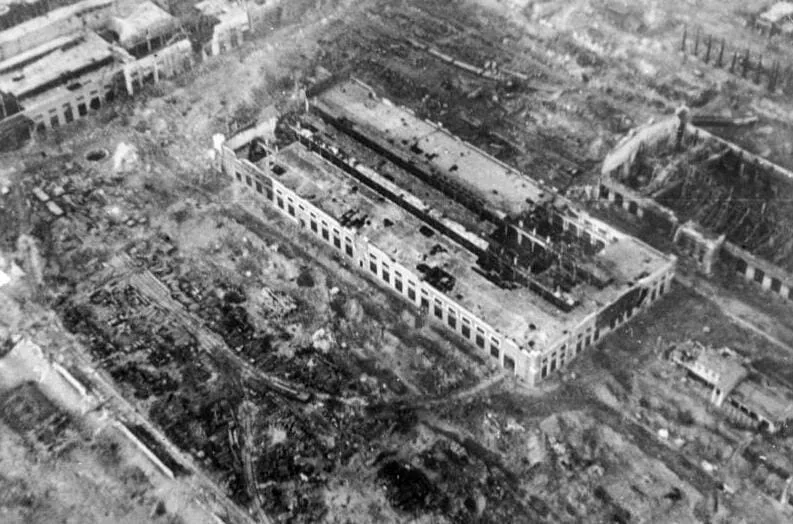
On Sunday 23 August 1942 two things happened at Stalingrad which together opened one of the bloodiest battles in history. In the morning the German XIV Panzer Corps set out from its bridgehead on the eastern bank of the Don and, after crossing some 60 kilometres of steppe, reached the Volga on the city’s northern outskirts that same afternoon. In the afternoon and evening aircraft of the Luftwaffe’s Luftflotte 4 carried out the heaviest air raid the Eastern Front had yet seen. War chronologies record under this date only a “great German air raid on Stalingrad”. In reality the blow from the air was part of a single operation whose aim was for the 6th Army to take the city on the march.
The city on the Volga
Stalingrad – formerly Tsaritsyn, today Volgograd – stretched in a narrow strip for several tens of kilometres along the high right bank of the Volga. It was one of the great industrial centres of the USSR. In the north of the city stood three huge plants: the Stalingrad Tractor Factory, which had been producing T-34 tanks since 1941, the Barrikady armaments works and the Red October steelworks. Oil from the Caucasus and Baku passed through the city and its port on its way up the Volga. The city also bore the name of Joseph Stalin, who had directed its defence during the Civil War, which gave the fighting for it an additional symbolic significance for both sides.
The city was not ready for the arrival of the war. Four rings of fortifications had been under construction around it since the autumn of 1941, but in August 1942 they were unfinished, and the troops of the Stalingrad Front were still fighting in the great bend of the Don. Before the war Stalingrad had some 450,000 inhabitants. From 1941 hundreds of thousands of refugees from eastern Ukraine and the western provinces passed through it, and in the summer of 1942 more arrived from the Donbas and the Don. Exactly how many people were in the city on 23 August is not known. Russian studies state that of some 400,000 inhabitants no more than 100,000, mainly women and children, had been ferried across to the left bank of the Volga by that day, while the historian Tatyana Pavlova estimates that there may have been more than 700,000 people in the city.
There was no organised evacuation of the population. The city defence committee, chaired by the first secretary of the regional Party committee, Aleksei Chuyanov, shipped out grain, machinery, hospitals and children’s homes, and on 15 August decided to evacuate 15,000 non-working women with children. The authorities would not agree to a wider evacuation: the factories were to keep working to the end, and it was feared that the flight of the population might weaken the will to defend the city. Historians attribute this decision to Stalin himself, although no unambiguous order has survived. The inhabitants, women and children included, dug anti-tank ditches and trenches on the approaches.
The dash to the Volga
On the night of 20–21 August infantry of the 6th Army’s LI Army Corps crossed the Don near Vertyachy and Peskovatka, and on 22 August the XIV Panzer Corps of General of Infantry Gustav von Wietersheim moved into the bridgehead over pontoon bridges built by the engineers. The plan, approved on 19 August by the army’s commander, General of Panzer Troops Friedrich Paulus, envisaged the corps breaking straight through eastwards across the narrowest point between the Don and the Volga, reaching the river north of the city and sealing it off from the north, while the rest of the army and Colonel General Hermann Hoth’s 4th Panzer Army attacked from the west and south.
Early on the morning of 23 August Lieutenant General Hans-Valentin Hube’s 16th Panzer Division, followed by the 3rd and 60th Motorised Divisions, moved out of the bridgehead. The spearhead had some 120 tanks and over 200 armoured personnel carriers. In their path stood the exhausted regiments of the Soviet 98th Rifle Division and the regiments of Colonel Aleksei Kazartsev’s 87th Rifle Division, which were marching towards the bridgehead and had already been bombed from the air. The fight took place in open country, without trenches. The Germans cut Kazartsev’s division in two and pressed on. Around noon they crossed the railway line to Stalingrad, and at about 4 p.m. Colonel Hyacinth von Strachwitz’s armoured units and the panzergrenadiers reached the Volga near the settlements of Rynok, Latoshinka and Spartanovka, on the northern edge of the city. By evening German tanks stood about a kilometre and a half from the halls of the Tractor Factory.
Wietersheim’s corps had punched a narrow corridor, some eight kilometres wide, between the Don and the Volga, cutting off the 62nd Army from the Stalingrad Front’s troops to the north. Yet the corps itself was almost encircled in that corridor. As soon as it reached the river it came under fire and counter-attack from the north and from the city, and for several days supplies reached it only by air and in convoys escorted by tanks. The other corps of the 6th Army had failed to keep pace with the armoured wedge, and Hoth’s 4th Panzer Army still stood several tens of kilometres south of the city. That day the Chief of the Army General Staff, General Franz Halder, noted that Paulus had “unexpectedly” broken through across the Don and reached the Volga.
Anti-aircraft guns against tanks
The first to stand in the way of the 16th Panzer Division on the northern outskirts were the soldiers of the 1077th Anti-Aircraft Artillery Regiment, which was covering the Tractor Factory and the Volga crossing. The batteries learnt of the approaching tanks after 2.30 p.m. They lowered their barrels for direct fire and fought the tanks until evening, although they had mostly fragmentation shells. Like many air-defence units, the regiment had many women in its ranks, often young volunteers just out of school. They mostly manned the rangefinders, fire-control instruments, signals and headquarters, but some also served the guns. The regiment’s report praised the women’s “exceptional steadfastness and heroism”. On 23 and 24 August the regiment lost 35 guns, with 18 killed, 46 wounded and 74 missing. A German 6th Army report on the evening of 23 August noted that the 16th Panzer Division had been unable by nightfall to eliminate the “anti-aircraft artillery nests” north of the city, and the division’s post-war history mentioned with surprise that women had fought at the guns.
The episode soon acquired the trappings of legend. In later tellings the regiment consisted solely of teenage girls, fought alone without support from other units and destroyed 83 tanks. The surviving documents do not allow these figures to be confirmed, and the German records of the 16th Panzer Division were lost at Stalingrad. What is certain is that the batteries’ resistance held up the German tanks for several hours at a moment when there were almost no troops between them and the factories.
Workers joined the gunners in the fight. Workers’ militia battalions from the Tractor Factory, the Barrikady works and other enterprises, armed with rifles and a few guns, took up positions along the small Mokraya Mechetka river. Tanks fresh off the assembly lines drove out of the factory gates straight into action, often crewed by the factory’s mechanics and testers. They were supported by Colonel Aleksandr Sarayev’s 10th NKVD Rifle Division, the city’s garrison, and by cadets of military schools. On the night of 27–28 August Colonel Sergei Gorokhov’s 124th Rifle Brigade was ferried across the Volga, and around it a group was formed that defended the northern suburbs and the factory until November.
The air raid
At the same time as Wietersheim’s corps struck, aircraft of Colonel General Wolfram von Richthofen’s Luftflotte 4 appeared over Stalingrad. In the morning Junkers Ju 87 dive-bombers and ground-attack aircraft of General Martin Fiebig’s VIII Air Corps cleared the way for the tanks, and in the afternoon – according to German data from about 3.20 p.m. (Soviet sources speak of the evening) – bombs from successive waves of Heinkel He 111s and Junkers Ju 88s from several bomber wings fell on the city itself. The raid continued, with breaks, into the night. According to Christer Bergström and Joel Hayward, Luftflotte 4 flew some 1,600 sorties that day and dropped about a thousand tonnes of high-explosive and incendiary bombs, losing only three aircraft. Soviet studies speak of more than 2,000 sorties.
The effects were horrific. The city centre and the southern districts, built largely of wooden houses, burnt down within a few hours. Bombs hit the oil tanks by the river. Burning oil ran down the slopes into the Volga and blazed on its surface, and a column of black smoke rose over the city, visible from several tens of kilometres away. The water mains, the power station and communications were destroyed. One of the first targets hit was the headquarters of the city’s air defence. There were very few shelters, and people hid in cellars, ditches and the ravines along the Volga. By the morning of 24 August a large part of the centre had been razed to the ground, and fires were still raging in many blocks. Further raids, block by block, followed over the next days. Soviet fighters and anti-aircraft defences tried to fight back, but between 23 and 31 August the Soviet air force lost more than 200 aircraft in the area, and by day the sky over the city belonged to the Luftwaffe.
Richthofen, who in 1937, as chief of staff of the Condor Legion, had been responsible for the bombing of Guernica, and in September 1939 had directed the raids on besieged Warsaw, saw the destruction of the city as a means of breaking the will to resist. On 30 August, convinced that Stalingrad was about to fall, he ordered massed raids to be resumed for precisely that purpose. The ruins, however, proved an obstacle to the attackers. In the weeks that followed, the rubble, the blocked streets and the cellars became ready-made defensive positions, and among them German tanks could not exploit their superiority.
How many died
The death toll of the raid of 23 August and the following days is one of the most disputed questions of the battle. The literature, Western studies included, most often repeats that some 40,000 people were killed, mainly civilians, and some estimates go as high as 70,000. These figures come from Soviet studies and do not rest on documented counts. The surviving documents from those days give far fewer: a report by the city defence committee of 26 August speaks of 955 killed and 1,181 wounded on 23–26 August, but it was compiled amid chaos, when many bodies had not yet been recovered from the rubble. The British historian Richard Overy, who considers the figure of 40,000 exaggerated, cites a post-war report of the Soviet air defence according to which 7,846 civilians were killed in air raids there between July 1942 and January 1943. Other researchers, in turn, regard these data as incomplete. All that can honestly be said is that between several thousand and several tens of thousands of people died on 23 August and in the days that followed.
The toll of the whole battle for the city’s population is even more disputed. Incomplete figures from the Party archive in Volgograd speak of some 43,000 inhabitants dead, while Tatyana Pavlova has estimated that more than 200,000 civilians died in the city and its surroundings. The difference stems mainly from the fact that no one knows how many refugees were in Stalingrad.
Moscow’s response
That same day, 23 August, Colonel General Andrei Yeremenko, who commanded both fronts, formed a strike group under Major General Kirill Kovalenko north of the corridor, which attacked the flank of the German wedge that evening without waiting for the tank corps. At four o’clock in the morning of 24 August Stalin sent Yeremenko a telegram ordering him to “firmly close the gap” through which the Germans had broken through to the Volga, to encircle and destroy the enemy, but not to take troops from other sectors of the front. The gap was not closed, but the counter-attacks from the north kept Wietersheim’s corps isolated for several days and forced Paulus to send infantry there – infantry he then lacked for the assault on the city itself. On 24 August the city defence committee finally decided to evacuate women, children and the wounded across the Volga. The crossing went on for weeks, under bombs and shellfire.
Stalin, who in May had seen a badly planned offensive end in defeat at Kharkov and who in July had issued the order “Not a step back!”, resolved to defend the city at any cost. On 26 August he appointed General of the Army Georgy Zhukov as his deputy and sent him to the Volga. Adolf Hitler, meanwhile, believed that Stalingrad would fall within a few days.
Place in the war
The Battle of Stalingrad proper began on 23 August. Russian historiography does date its start to 17 July, when the first clashes with the 6th Army took place on the distant approaches, on the Chir, but it was the Germans’ arrival on the Volga and the destruction of the city that carried the fighting into Stalingrad itself. At the beginning of September the wings of the 6th Army and the 4th Panzer Army linked up west of the city, and the Soviet 62nd Army, commanded from 12 September by Lieutenant General Vasily Chuikov, was pinned against the Volga. From 13 September there was fighting in the streets, for the railway station, the Mamayev Kurgan and the grain elevator, and then for the halls of the Tractor Factory, the Barrikady and Red October. Rynok and Spartanovka, before which the Germans had halted on 23 August, remained largely in Soviet hands until November and became the northern anchor of the defence; German soldiers called this sector “little Verdun”.
By November the Germans controlled most of the ruins but had failed to push the defenders into the river. On 19 November the Red Army launched Operation Uranus and encircled the 6th Army, whose remnants capitulated at the beginning of February 1943. The raid of 23 August is remembered as one of the heaviest blows struck from the air against a Soviet city during the war, and also as an example of how destroying a city does not in itself break its defence. In 1942 this was not a new lesson: the same had happened in Warsaw and in London during the Blitz. Stalingrad, razed to the ground in a single day, became the place where the Wehrmacht suffered the greatest defeat in its history up to that time.
Sources
Meanwhile
(04)Elsewhere, within a week.
- 22 August 1942 · DiplomacyBrazil declares war on Germany and ItalyAfter U-507 sank five ships with over 600 dead, Brazil recognised on 22 August 1942 that it was at war with Germany and Italy.
- 21 August 1942 · PacificThe Battle of the TenaruOn the night of 20–21 August 1942 Colonel Ichiki’s detachment attacked the Marines guarding the Guadalcanal airfield. Nearly 800 Japanese were killed.
- 26 August 1942 · PacificThe Battle of Milne BayOn the night of 25–26 August 1942 Japanese naval infantry landed at Milne Bay. The Australians held the airfields, and after 12 days the Japanese withdrew.
- 19 August 1942 · Western FrontThe Dieppe RaidOn 19 August 1942 over 6,000 troops, mostly Canadians, landed at Dieppe. After the defeat 3,367 Canadians had been killed, wounded or captured.
Related events
(04)The same battle, people or subject.
- 3 September 1942 · Eastern FrontThe fighting for Stalingrad beginsOn 3 September 1942 the wings of the 6th Army and 4th Panzer Army met outside Stalingrad as Soviet armies fell back to the suburbs. The battle reached the city.
- 13 September 1942 · Eastern FrontChuikov takes command of the 62nd ArmyOn 13 September 1942 the Germans stormed central Stalingrad, held by General Vasily Chuikov, who a day earlier took over the 62nd Army, pinned to the Volga.
- 1 August 1942 · Eastern FrontThe fighting in the great bend of the DonIn August 1942 Paulus's 6th Army smashed Soviet forces at Kalach and crossed the Don, while Hoth's 4th Panzer Army advanced on Stalingrad from the south.
- 19 November 1942 · Eastern FrontOperation Uranus beginsOn 19 November 1942 the Red Army hit the Romanians on the 6th Army's flanks. In three days the front broke and the pincers were closing west of Stalingrad.