1945: From the Vistula to the Oder
East Pomeranian offensive
- Dates:
- 10 February – 4 April 1945
- Front:
- Eastern Front
- Location:
- Western Pomerania and Gdańsk Pomerania between the lower Vistula and the Oder: Grudziądz, Chojnice, the Pomeranian Wall, Stargard (Stargard in Pommern), Choszczno, Szczecinek, Koszalin (Köslin), Kołobrzeg (Kolberg), Słupsk, Gdynia (Gotenhafen), Gdańsk (Danzig) and the Oksywie HeightsOn the battle map →
- Sides:
- Soviet Union and Poland (Polish 1st Army)Konstantin Rokossovsky, Georgy Zhukov, Stanisław PopławskiNazi GermanyHeinrich Himmler, Gotthard Heinrici
- Result:
- A Soviet and Polish victory. The 2nd and 1st Belorussian Fronts split the German Army Group Vistula in Pomerania, reached the Baltic on 4–5 March and by the end of March had taken Kołobrzeg, Gdynia and Gdańsk; the remnants of the Second Army held out on the Hel peninsula and the Vistula Spit until 9 May. The right flank of the advance on Berlin was secured. According to the figures compiled by Grigori Krivosheev, Soviet and Polish losses amounted to some 55,000 killed and missing and some 179,000 wounded and sick; German losses and civilian deaths are known only from estimates.
- Author:
- Natalia
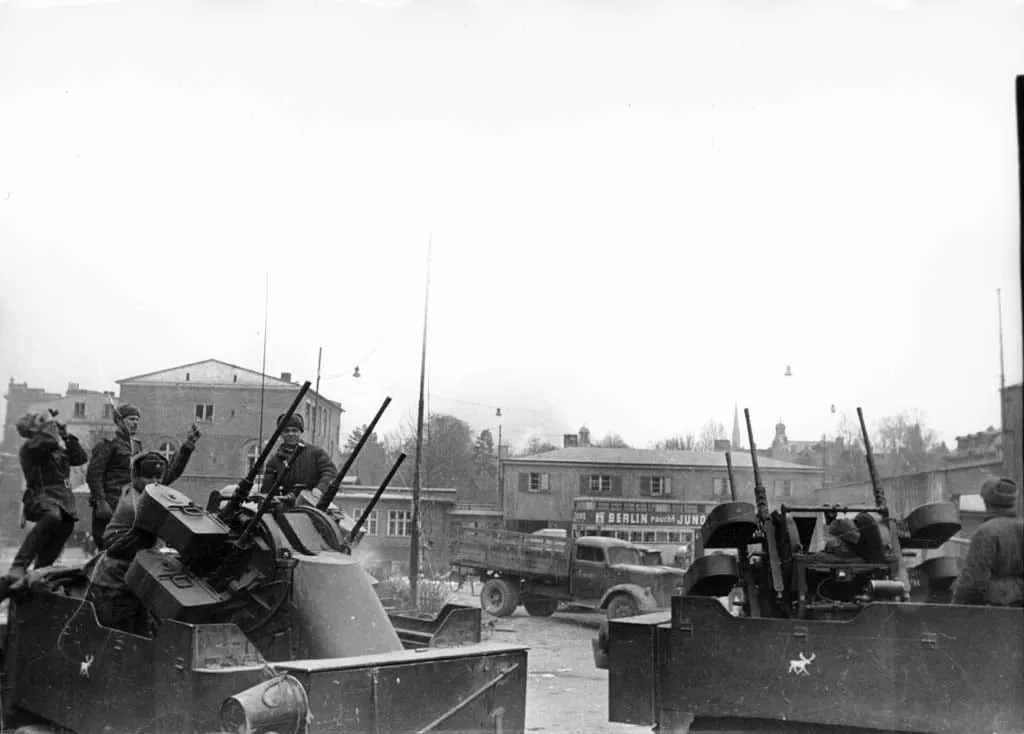
The East Pomeranian offensive, also known as the Pomeranian operation (Russian Восточно-Померанская операция), was an offensive by two fronts of the Red Army which, between 10 February and 4 April 1945, cleared Pomerania of German forces from the lower Vistula to the Oder. It was conducted by Marshal Konstantin Rokossovsky’s 2nd Belorussian Front and the right wing of Marshal Georgy Zhukov’s 1st Belorussian Front, within which fought the Polish 1st Army under Major General Stanisław Popławski.
The opponent was Army Group Vistula, formed at the end of January, which Adolf Hitler had entrusted to Reichsführer-SS Heinrich Himmler – a man with no experience of commanding large formations. In March, after the defeat in Pomerania, he was replaced by General Gotthard Heinrici.
The operation was a consequence of the winter offensive from the Vistula. At the turn of January and February Zhukov’s troops had reached the Oder about 70 km from Berlin, but their right flank, stretched over hundreds of kilometres, was overhung by the German grouping in Pomerania. Before the Red Army could strike at the capital of the Reich, it had to remove this threat. The fighting lasted nearly two months and included the German counter-attack near Stargard, the cutting of Pomerania in two on the Baltic coast, the siege of Kołobrzeg and the capture of Gdynia and Gdańsk. For the Polish 1st Army it was one of the bloodiest campaigns of the war, and for hundreds of thousands of German inhabitants of Pomerania and refugees from East Prussia a time of flight, evacuation by sea and violence.
Name and dates
The name “Pomeranian” (or East Pomeranian) operation comes from Soviet historiography, which dates it 10 February – 4 April 1945: from the attack of the 2nd Belorussian Front from the Vistula and the Narew to the end of the fighting for Gdańsk, Gdynia and the Oksywie Heights (PL) (Kępa Oksywska). In Russian tabulations it is a strategic operation made up of several front operations – among them the 2nd Belorussian Front’s Chojnice–Koszalin and Danzig operations and the 1st Belorussian Front’s Choszczno–Kołobrzeg (Arnswalde–Kolberg) and Dąbie (Altdamm) operations – and three phases are usually distinguished: Rokossovsky’s unsuccessful first offensive (10–19 February), the drive of both fronts to the coast (from 24 February and 1 March), and the destruction of the two cut-off German groupings (from 6 March).
The dates are given in various ways. German authors tend to describe the fighting for Pomerania (Kampf um Pommern) as a series of separate battles, and date its start to the January fighting for the Pomeranian Wall and Piła (Schneidemühl). Polish military tradition singles out above all the stages involving the Polish 1st Army: the breaching of the Pomeranian Wall (1–10 February, still within the Vistula–Oder offensive), the fighting for the switch line and the pursuit at the beginning of March, the battle of Kołobrzeg (4–18 March) and the part played by the 1st Armoured Brigade in the fighting for Gdynia and Gdańsk. The end, too, is sometimes reckoned differently: Gdańsk fell on 30 March and the defence of the Oksywie Heights collapsed on 4–5 April, but the German groupings on the Hel peninsula and in the Vistula delta – outside the limits of the operation – surrendered only on 9 May.
Background
In the Vistula–Oder offensive the 1st Belorussian Front advanced in three weeks from the Vistula to the Oder and at the turn of January and February seized bridgeheads near Küstrin (Kostrzyn). At the same time the 2nd and 3rd Belorussian Fronts, in the East Prussian offensive, cut East Prussia off from the rest of the Reich: on 26 January Rokossovsky’s troops reached the Vistula Lagoon, and then turned west, to the lower Vistula. Between the two fronts lay a vast area of Gdańsk Pomerania and Western Pomerania held by the Germans. At the beginning of February the front line ran from the Vistula Lagoon along the Nogat and the Vistula to the Chełmno area, and from there turned west through Sępólno, Okonek, Kalisz Pomorski and Pyrzyce to the Oder. Behind it the encircled garrisons of Piła, Wałcz, Choszczno, Grudziądz and Malbork were holding out.
This area was held by Army Group Vistula, formed on 24 January from the remnants of shattered units, divisions brought in from the west and from Courland, Waffen-SS formations, the Volkssturm and improvised battle groups. It consisted of the Second Army in the east, the new Eleventh Army (the 11th SS Panzer Army) in the centre, and the Ninth Army and the 3rd Panzer Army on the Oder. According to some accounts based on Soviet studies, at the time of the main fighting the German forces in Pomerania (excluding the 3rd Panzer Army) numbered some 430,000 soldiers, 1,000–1,500 tanks and assault guns and about 500 aircraft. The backbone of the defence was the Pomeranian Wall (Pommernstellung) – a belt of fortifications built from the mid-1930s along the then border with Poland, from Szczecinek through Nadarzyce and Wałcz to the Noteć – and, further west, field positions and towns declared fortresses, in line with Hitler’s orders to defend them “to the last man”.
The Chief of the Army General Staff, General Heinz Guderian, saw in this grouping a chance for a counter-blow: an attack southwards from Pomerania was to cut through Zhukov’s extended flank and push the threat away from Berlin. For the same reason Pomerania became a problem of the first order for the Soviet command. At the beginning of February it abandoned an immediate march on Berlin, which some commanders, among them General Vasily Chuikov, later considered to have been possible. The question remains a matter of dispute among historians, but the divisions weakened by the January offensive, the overstretched supply lines and the spring thaw argued for caution.
Both sides’ forces were exhausted. According to some accounts, at the beginning of February the average division of the 2nd Belorussian Front was at about half its establishment strength, and the whole front had fewer than 300 tanks. The Polish 1st Army, covering the right flank of Zhukov’s front, was advancing west from Bydgoszcz and from 30 January was engaged in heavy fighting in the forefield of the Pomeranian Wall.
Course of the battle
The Pomeranian Wall and Rokossovsky’s first attack (1–19 February)
Before the operation formally began, the Polish 1st Army fought its first great battle on this axis. According to some accounts based on military studies, from 30 January the Polish divisions fought units of the 15th (Latvian) SS Grenadier Division on the screening position along the Gwda – for Podgaje, Jastrowie and Złotów. At Podgaje SS men burned alive soldiers of the 1st Infantry Division whom they had taken prisoner, an event preserved in Polish memory as the Podgaje massacre. On 5–6 February the 4th and 6th Infantry Divisions broke into the main position of the Wall between the lakes near Nadarzyce, and on 10 February a strike group with the 1st Warsaw Armoured Brigade took Mirosławiec, cutting the line of retreat of the Wałcz garrison. According to the same figures, the breaching of the Pomeranian Wall (PL) cost 1,780 killed, 2,767 wounded and 1,055 missing. The date is sometimes confused: the Polish 1st Army’s fighting on the Wall itself took place in the first ten days of February (the inscription on the Tomb of the Unknown Soldier reads “Wał Pomorski 1–10 II 1945”), not in March, when the Poles were already breaking through a further switch line near Borujsko and Wierzchowo.
On 10 February the 2nd Belorussian Front went into the attack. The 65th Army struck from the Grudziądz area towards Bytów, the 49th Army towards Biały Bór and the 70th Army from near Bydgoszcz towards Czaplinek; a cavalry corps joined in a day later. The front, however, was too weak, and the terrain – the forests of the Tuchola Forest, rivers, the thaw – favoured the defenders. By 15 February Rokossovsky’s troops had advanced only 15–40 km, taking Chojnice and Tuchola among other places, and by 20 February Czersk. On 19 February Rokossovsky halted the attack. Meanwhile the troops of the 1st Belorussian Front were mopping up the encircled garrisons in their rear: Wałcz fell on 12 February, and most of the garrison of Piła (Schneidemühl) fought its way back to German lines during the night of 13–14 February. Separately, the siege of Grudziądz, which had been turned into a fortress, went on; its garrison (some 10,000 soldiers, according to some accounts) surrendered only on 6 March.
At sea, meanwhile, the evacuation went on. During the night of 9–10 February the Soviet submarine S-13 under Captain 3rd Rank Alexander Marinesko – the same man who eleven days earlier had sunk the Wilhelm Gustloff – torpedoed the transport Steuben off Ustka; the ship had sailed from Pillau with wounded soldiers and refugees, and several thousand people died (estimates usually range between 3,000 and 4,500).
The counter-attack near Stargard (15–18 February)
On the southern edge of Pomerania the Germans prepared the only major counter-offensive of this campaign – Operation Sonnenwende (“Solstice”; not to be confused with the January attack of the same name in Alsace). Guderian wanted to strike simultaneously from Pomerania and from near Głogów, but shortages of troops and Hitler’s refusal to evacuate the forces in Courland meant that only the attack from the north remained. According to some accounts, Guderian objected to Himmler being given command, and the operation was in fact directed by his deputy, General Walther Wenck. The striking force included the III SS Panzer Corps with its divisions of foreign volunteers (“Nordland”, “Nederland”, “Langemarck”) and the 10th SS Panzer Division “Frundsberg”.
On 15 February German units moved out from near Suchań towards encircled Choszczno and opened a narrow corridor to it; on 16 February came the main attack southwards from near Stargard and Lake Miedwie. The advance was slow, and during the night of 17 February Wenck was seriously injured in a car accident; he was replaced by General Hans Krebs. That evening the 3rd Shock Army counter-attacked, and on 18 February the Germans called off the operation. Choszczno fell on 22 February. Militarily Sonnenwende was a failure, but it thoroughly alarmed the Stavka: Zhukov had to send two tank armies north, and the attack on Berlin was postponed until Pomerania had been cleared.
Pomerania cut in two (24 February – 6 March)
After the failure of the first attack, the Stavka adopted a new plan on 17 and 22 February: the adjoining wings of the two Belorussian fronts were to strike on converging axes towards Kołobrzeg and Koszalin, cut the German grouping in two at the sea, and then destroy its parts separately – the 2nd Belorussian Front in the east, towards Gdynia and Gdańsk, the 1st Belorussian Front in the west, towards the lower Oder. Rokossovsky received the 19th Army and the 2nd Shock Army from the reserve.
On 24 February the 19th Army, supported by the 3rd Guards Tank Corps, broke through the front between Czarne and Człuchów and in two days drove 25–30 km deep. After a short halt and regrouping the attack resumed on 28 February, when Szczecinek (Neustettin) was also taken. On 3 March Miastko and Polanów fell, and the tanks of the 3rd Corps reached the Baltic between the lakes of Jamno and Bukowo; on 5 March, after two days of fighting, the garrison of Koszalin (Köslin) surrendered.
On 1 March the right wing of the 1st Belorussian Front went over to the attack. The 3rd Shock Army, with the 1st Guards Tank Army, broke through the defences near Recz and penetrated about 20 km on the first day; it took Świdwin on 3 March, and on 4 March its spearheads stood outside Kołobrzeg; on 5 March the tanks reached the sea near Mrzeżyno. In the south the 2nd Guards Tank Army and the 61st Army took Stargard (Stargard in Pommern) on 4 March, and the 47th Army took Pyrzyce, pushing the Germans back towards the bridgehead at Dąbie (Altdamm).
From 1 March the Polish 1st Army attacked the German switch line on the Borujsko–Wierzchowo axis from the Żabin area, at first without much success. When the success of the neighbouring 3rd Shock Army threatened the defenders with encirclement, the Germans began to withdraw, and on 2 March the Polish divisions went over to the pursuit, taking Drawsko Pomorskie, Złocieniec and Czaplinek by 5 March. Together with Soviet troops they then destroyed, in the area of Świdwin and Połczyn-Zdrój, the remnants of the X SS Corps and of General Hans von Tettau’s corps group, which were trying to break out to the north-west; only part of them managed to reach the area of Trzebiatów and from there – covered by the guns of warships, including the cruiser Admiral Scheer – to escape by sea.
By 5–6 March the German forces in Pomerania had been cut in two. In the west the shattered Eleventh Army and the 3rd Panzer Army were falling back across the Oder; in the east the Second Army, cut off from the Reich, was holding out in Gdańsk Pomerania. Between them lay isolated Kołobrzeg.
Kołobrzeg (4–18 March)
Kołobrzeg (Kolberg) was a symbolic city in German propaganda: in 1807 it had held out against Napoleon’s army, and on 30 January 1945 the colour film Kolberg had premiered – the most expensive production of Third Reich cinema, made on the orders of Joseph Goebbels as a call to resist at any cost. Now the city, declared a fortress, was packed with refugees from all over Pomerania waiting for ships. According to some accounts it was defended by about 10,000 soldiers under Colonel Fritz Fullriede, supported by naval gunfire, coastal batteries and an armoured train.
A first attempt by the Soviet 45th Guards Tank Brigade to take the city on the march on 4 March failed. On 7 March the Polish 1st Army entered the battle: the 6th Infantry Division attacked from the south-west, and on 8 March the 3rd Division closed the ring from the east. By 12 March the Poles had broken through the outer ring of the defences, taking the White and Red Barracks among other positions; then they fought for the town centre, the port, the railway station and Salt Island (Wyspa Solna), house by house, in assault groups supported by tanks and guns firing over open sights. On 13 March the 4th Infantry Division and the 4th Heavy Tank Regiment were committed to the battle. On 14 March Fullriede rejected a call to surrender. The garrison had no chance of holding out, but its task was to gain time: throughout the siege ships and vessels of the Kriegsmarine took refugees and wounded off from the port and the beach – tens of thousands of people, according to Western studies.
During the night of 17–18 March the final assault began; the remnants of the garrison were evacuated by sea, and the remaining soldiers were taken prisoner. On 18 March, on the beach at Kołobrzeg, soldiers of the Polish 1st Army performed Poland’s Wedding to the Sea, echoing the gesture made by General Józef Haller at Puck in 1920; similar ceremonies had been held a few days earlier at Dziwnówek (15 March) and Mrzeżyno (17 March). According to some accounts, the battle of Kołobrzeg cost the Poles 1,206 killed and missing and about 2,500 wounded. Most of the city was destroyed – as were many other towns in Pomerania, among them Choszczno and Pyrzyce.
Gdynia, Gdańsk and the Oksywie Heights (6 March – 4 April)
On 6 March the 2nd Belorussian Front, reinforced by the 1st Guards Tank Army handed over by Zhukov and by the Polish 1st Armoured Brigade “Heroes of Westerplatte”, moved east with all its forces. By 9 March Słupsk, Bytów, Ustka, Kościerzyna and Starogard Gdański had been taken; on 10 March Soviet troops stood outside Lębork and Kartuzy; on 12 March Tczew fell, and on 17 March Malbork surrendered. The German Second Army, taken over on 12 March by General Dietrich von Saucken, fell back to Gdynia and Gdańsk. According to some accounts, around 200,000 soldiers, supported by heavy units of the Kriegsmarine, found themselves in the area of the two cities, together with – counting the inhabitants – as many as a million refugees from East Prussia and Gdańsk Pomerania. The defence was meant above all to cover their evacuation through the port of Gdynia, Nowy Port and Hel.
Rokossovsky decided to drive a wedge through near Sopot and separate Gdynia from Gdańsk. The fighting for the fortified hills above Wielki Kack, Reda and Rumia was very bloody; on 22 March Soviet troops reached the sea between Sopot and Orłowo, and by 25 March they had taken Sopot and Oliwa. On 19 and 20 March Soviet aircraft bombed the centre of Gdańsk with incendiaries; on 24 March Rokossovsky called on the Germans to surrender, and after their refusal four armies began a concentric assault. On 28 March tanks, Polish ones among them, broke into the burning centre, and by 30 March the city and port were in Soviet hands – except for Westerplatte, where in 1939 the war had begun, which was taken only at the beginning of April. In the battle of Gdańsk the historic Main Town and Old Town were almost completely destroyed – in the fighting, in air raids and, as Polish and German historians stress, in arson and looting after the city had already been taken.
Gdynia was attacked by the 19th Army, within which the Polish armoured brigade fought. After the defences on the western approaches had been broken, the assault began on 26 March, and by 28 March the Germans had been driven out of the city and port onto the Oksywie Heights – an upland above the Bay of Gdańsk where in September 1939 Colonel Stanisław Dąbek’s Land Coastal Defence had held out until 19 September. The grouping, numbering some 30,000 soldiers according to some accounts, held out until 4–5 April; the Kriegsmarine managed to ship a large part of it to Hel. With that the Pomeranian operation came to an end.
In the west, in a separate phase, the 1st Belorussian Front eliminated between 14 and 20 March the German bridgehead at Dąbie and Gryfino on the eastern bank of the Oder opposite Szczecin (Stettin); on the islands of Wolin and Usedom (Uznam) the Germans held on until the Berlin offensive. In the east the remnants of the Second Army – some 125,000 soldiers in the Vistula delta and on the Vistula Spit and some 200,000 on the Hel peninsula, according to some accounts – were no longer assaulted on any large scale and surrendered on 9 May.
The civilian population
In February and March 1945 Pomerania was one vast escape route. Westward streamed columns of refugees from East Prussia, who had earlier crossed the ice of the Vistula Lagoon, and from Pomerania itself, where the Party authorities – among them Albert Forster, Gauleiter of Danzig-West Prussia – long forbade evacuation or ordered it too late. When Soviet troops reached the Baltic on 4–5 March, hundreds of thousands of people were cut off from the overland route to the west. Their only hope now lay in the ports: Kołobrzeg, Gdynia, Gdańsk and Hel.
The evacuation by sea, begun in January on the orders of Grand Admiral Karl Dönitz, is usually called Operation Hannibal. According to frequently cited estimates, by May 1945 ships and vessels of every kind had carried 800,000–900,000 civilians and about 350,000 soldiers across the Baltic. It was the largest evacuation by sea in history, but also one of the most tragic: besides the Gustloff and the Steuben, Soviet submarines and aircraft sank many other vessels, including, on 16 April, the transport Goya, on which about 6,000 people died.
Those who did not manage to escape met with violence from the advancing troops. German witnesses, as well as Soviet and Polish accounts of the time, describe mass rape, killings, robbery and arson in the occupied areas of Pomerania – part of the wider wave of rape during the Allied occupation of Germany; historians agree that the scale of these crimes was enormous, although precise figures cannot be established. Some of the crimes were committed after the fighting had ended, including in Gdańsk. Poles were also among the victims – inhabitants of Gdańsk Pomerania and Kashubia, forced labourers and prisoners. Many people took their own lives. Earlier that winter prisoners of the Stutthof camp and its subcamps had been driven on evacuation marches through Kashubia and Pomerania; thousands of them died of hunger or cold or were shot by the guards.
The Polish population of Gdańsk Pomerania, subjected since 1939 to Germanisation, the Deutsche Volksliste (German People’s List) and the occupier’s terror, greeted the end of German rule with relief, but also with fear of the new regime and of abuses by Soviet soldiers, who often treated all the inhabitants as Germans; according to Polish historians, some of them were arrested by the NKVD and deported deep into the USSR.
Losses
According to the tabulation of the Russian General Staff prepared under Grigori Krivosheev, the losses of the Soviet and Polish forces in the East Pomeranian operation amounted to 55,315 killed and missing and 179,045 wounded and sick, a total of 234,360 men – more than in the three-week Vistula–Oder offensive. Some sources further state that at the Dąbie bridgehead alone the 1st Belorussian Front lost 75,000 men in 20 days and the Germans 50,000 – figures hard to reconcile with Krivosheev’s tabulation and to be treated with caution.
The Polish 1st Army suffered the heaviest losses in its history in Pomerania: to the roughly 5,600 killed, wounded and missing in the February fighting for the Pomeranian Wall were added the losses of the March pursuit, about 3,700 at Kołobrzeg, and the losses of the armoured brigade at Gdynia and Gdańsk.
German losses are known only from estimates, because the records of many units were lost. Soviet figures spoke of hundreds of thousands killed and taken prisoner; Western historians consider them inflated, but agree that the Second and Eleventh Armies ceased to exist as forces capable of operations, and that only remnants of the troops were evacuated from Pomerania by sea. The full number of civilian victims remains unknown – those killed in the fighting and air raids, during the flight, on the sunken ships and at the hands of Soviet soldiers. The destruction was enormous: Gdańsk, Kołobrzeg, Choszczno, Pyrzyce, Stargard and many smaller towns were largely ruined.
Significance
The East Pomeranian offensive removed the threat to the right flank of Zhukov’s front and opened the way to the last offensive of the war. Soviet troops reached the Baltic from the Szczecin Lagoon to the Bay of Gdańsk, and the Germans lost the ports through which they had been evacuating the population and supplying their forces in East Prussia and Courland. On 16 April, less than two weeks after the end of the fighting for the Oksywie Heights, the 1st Belorussian Front launched the Berlin offensive from its bridgeheads on the Oder, and Rokossovsky’s 2nd Belorussian Front, transferred from Pomerania to the lower Oder, crossed the river near Szczecin a few days later. Himmler, whose last shreds of credibility as a commander were destroyed by the defeat in Pomerania, was replaced by Heinrici in March.
For Poland the fighting for Pomerania had a symbolic dimension. In the same campaign that had begun for the Polish 1st Army on the Pomeranian Wall, Polish soldiers took Kołobrzeg and fought for Gdynia and Gdańsk – the cities over which the dispute had been one of the direct causes of the war, from the Free City of Danzig and the Polish Corridor, cut by the Wehrmacht in the first days of September 1939, to Hitler’s demands of 1939. The weddings to the sea at Kołobrzeg and Gdynia were quickly appropriated by the propaganda of the new regime, which presented them as the return of the “Recovered Territories” and the achievement of People’s Poland fighting alongside the Red Army.
The future of these lands, however, was decided by the politics of the great powers. At the Yalta Conference it was agreed that Poland would receive “substantial accessions of territory” in the north and west, with the final course of the border left to a peace conference. In the summer of 1945 the Potsdam Conference placed Pomerania as far as the Oder and Świnoujście, together with Gdańsk, under Polish administration and accepted the transfer of the German population. Those Germans who had not fled in 1945 were expelled in the following years, and in their place came Poles from central Poland and from the eastern territories incorporated into the USSR. Thus the war that had begun at Westerplatte in 1939 changed in Pomerania not only the borders but the entire population.