Germany
Gotthard Heinrici
Commander of XII and XXXXIII Corps (1940–1942), the 4th Army (1942–1944), the 1st Panzer Army (1944–1945) and Army Group Vistula (March–April 1945)
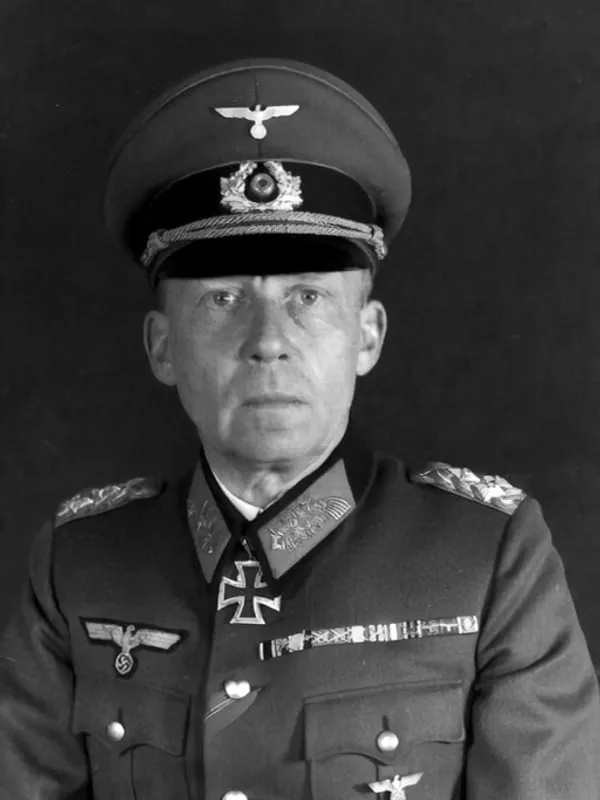
- Born:
- 25 December 1886, Gumbinnen, East Prussia (German Empire)
- Died:
- 10 December 1971, Karlsruhe (West Germany)
- Author:
- Łukasz
- Photo:
- Creator:Ludwig Knobloch, CC BY-SA 3.0 DE, Wikimedia Commons

Gotthard Heinrici was a German colonel general whom many historians regard as the Wehrmacht’s finest specialist in defensive warfare. He made his name with retreats that did not turn into routs and with defensive lines on which Soviet offensives bled for months on end: in the winter of 1941–1942 outside Moscow, in 1943–1944 at Smolensk and Orsha, in the autumn of 1944 in the Carpathians and in the spring of 1945 on the Oder, where at the head of Army Group Vistula he defended the road to Berlin. He was at the same time an officer of an army waging a war of annihilation in the East, and his own letters and diaries show that for a long time he accepted that war.
The pastor’s son from Gumbinnen
Feodor August Gotthard Heinrici was born on 25 December 1886 in Gumbinnen, today Gusev in Russia’s Kaliningrad Oblast, the only son of the Protestant pastor Paul Heinrici and Gisela, née von Rauchhaupt. He came from a family with a long clerical and theological tradition; he himself remained a practising Lutheran all his life, which was to count against him in the Third Reich. He joined the army in 1905 and was commissioned as an infantry lieutenant in 1906.
In August 1914 he fought with his division in Belgium, including at Namur, and was then transferred to the Eastern Front, to East Prussia and Poland. Even then his letters from Poland expressed antisemitic prejudices acquired at home. In 1916 he commanded a company and a battalion at Verdun, where he survived a gas attack; he felt its effects, above all digestive complaints, for the rest of his life. He then served on staffs and ended the war as the first general staff officer of an infantry division.
The Reichswehr and the Third Reich
After the war Heinrici served in volunteer border guard units in the east, and in 1920 he was accepted into the 100,000-strong Reichswehr. He made the typical career of a capable staff officer, including service in the Truppenamt (Troop Office), the disguised general staff. He disliked the Weimar Republic; politically he stood close to the German National People’s Party. Shortly after Adolf Hitler came to power he wrote to his parents that he hoped Germany would at last free itself from the “Marxist-Jewish filth”.
From 1933, as a colonel, he headed a department in the Reichswehr Ministry, later renamed the War Ministry. In 1936 he was promoted to major general and in October 1937 took over the 16th Infantry Division. Heinrici’s wife, Gertrud, née Strupp, had one parent of Jewish origin, so under the Nuremberg Laws their two children, Hartmut and Gisela, were Mischlinge (“mixed-race”). The family obtained from Hitler a special certificate that gave it the same rights as “Aryans” and protected it from discrimination. The Kristallnacht pogrom outraged Heinrici, but – in the judgement of the German historian Johannes Hürter, editor of his letters and diaries – it did not lead him to distance himself from the regime, whose antisemitism he shared in principle. He never joined the NSDAP, and his piety, ostentatious churchgoing and cool detachment from party rhetoric made him an outsider in the Nazi elite, especially in the eyes of Hermann Göring.
From the Maginot Line to Moscow
In September 1939 Heinrici’s 16th Infantry Division was in the west, in the fortifications of the Westwall, not in Poland. In April 1940 he was promoted to General of Infantry and took over XII Army Corps of the 1st Army, part of Wilhelm von Leeb’s Army Group C. During the French campaign his corps broke through the Maginot Line south of Saarbrücken on 14 June 1940.
In Operation Barbarossa Heinrici commanded XXXXIII Army Corps in Fedor von Bock’s Army Group Centre. He fought in the Battle of Białystok–Minsk; in August 1941 – as the citation for his Knight’s Cross emphasised – he crossed the Dnieper “at the head of the infantry in a pontoon boat”; he then took part in the Battle of Kiev and in the advance on Moscow, in October and November near Tula as part of Heinz Guderian’s 2nd Panzer Army. His letters and diaries from that year, published by Hürter, show an officer who accepted the war against the USSR as an ideological war, accepted the Commissar Order and ruthless reprisals against partisans and civilians, while seeing ever more clearly that the army was not prepared for winter and that the front was stretched beyond its strength.
Winter before Moscow: commander of the 4th Army
After the Soviet counter-offensive at Moscow in December 1941 the 4th Army found itself in a critical position: its commander, Günther von Kluge, had taken over Army Group Centre, and Kluge’s successor, General Ludwig Kübler, lasted only a few weeks in the post. At the end of January 1942 Heinrici took command of the army. Soviet troops were pushing into the gaps between its corps, had retaken Medyn, and airborne forces and General Pavel Belov’s cavalry corps were operating in its rear. Despite this he managed to cobble together a continuous defensive line east of Yukhnov and Spas-Demensk and to hold it during the Rzhev–Vyazma offensive. It was there too that he developed the method for which he became famous: before an expected attack he withdrew his main forces from the first line to the second, a few kilometres to the rear, so that the Soviet artillery barrage fell on almost empty trenches and the attacking infantry ran into intact defences.
In the spring of 1942 the 4th Army conducted operations in its rear against paratroopers, Belov’s cavalry and partisans in the Yelnya and Dorogobuzh area. As throughout Army Group Centre, the fight against the partisans struck the civilian population: villages were burnt, suspects shot and inhabitants deported. Hürter, who knows Heinrici’s papers better than anyone, writes plainly that the general’s growing respect for the enemy and compassion for the population of the devastated country “did not alter the fact that war crimes against Red Army soldiers, commissars, prisoners of war, partisans and civilians were also committed in Heinrici’s area of command”. On 1 January 1943 Heinrici became a colonel general.
Smolensk and Orsha
In 1943 the 4th Army fell back step by step: in March, during the evacuation of the Rzhev salient, and from August under the pressure of the Soviet Smolensk offensive. Hitler ordered the troops to leave a “desert” behind them: villages, bridges, crops and stocks were destroyed, and the able-bodied population was driven westwards. Heinrici considered this practice harmful because – as he noted – it demoralised the soldiers and turned the army into a rabble; he could not stop it, however, and his troops carried it out. When the Red Army liberated Smolensk in September, much of the city lay in ruins. According to Heinrici’s own account, and the biographies based on it, he did not carry out the order to burn it to the ground; this version, given lasting currency after the war by Cornelius Ryan, is known mainly from his own words. According to some biographers, Göring complained to Hitler that the 4th Army was not leaving enough scorched earth behind it – which does not alter the fact that Heinrici’s retreating troops laid the country waste.
In the autumn of 1943 the 4th Army’s line stabilised east of Orsha. General Vasily Sokolovsky’s Western Front attacked it from October 1943 to April 1944 in more than a dozen successive operations, each time without breaking through. A special commission of the State Defence Committee, whose report was disclosed only after the fall of the USSR, put the Western Front’s losses in these operations – according to the Russian historians who published it – at more than 280,000 killed and wounded, and brought about Sokolovsky’s dismissal; the 4th Army’s losses were many times smaller. In November 1943 Heinrici received the Oak Leaves to the Knight’s Cross.
In the spring of 1944, convinced that Army Group Centre’s “balcony” jutting far to the east had to be shortened, Heinrici pressed in vain for a withdrawal. Hitler rejected these plans and relied on “fortresses”. In May Heinrici, in poor health and at odds with his superiors, went on sick leave; on 4 June he was formally replaced by General Kurt von Tippelskirch. A few weeks later Operation Bagration destroyed Army Group Centre, and the 4th Army was encircled and smashed east of Minsk. By then Heinrici was no longer at the front.
The Carpathians
In mid-August 1944 Heinrici returned to duty as commander of the 1st Panzer Army, which had fallen back into the Carpathians after the Lwów–Sandomierz offensive. The Hungarian 1st Army was also placed under him; the whole was known as Army Group Heinrici. In the autumn his troops defended the Carpathian passes against the 1st and 4th Ukrainian Fronts. In the fighting at the Dukla Pass, in which the 1st Czechoslovak Army Corps attacked alongside the Red Army, the Germans for almost two months prevented a breakthrough across the mountains and a link-up with the Slovak insurgents, which sealed the fate of the uprising. In the winter of 1944–1945 he fell back through Slovakia towards Moravská Ostrava without letting his troops be encircled. On 3 March 1945 he received the Swords to the Knight’s Cross.
Army Group Vistula
At the turn of January and February 1945 the Red Army reached the Oder and seized bridgeheads near Küstrin and Frankfurt, less than 80 km from Berlin. This sector was to be defended by the hastily formed Army Group Vistula under Reichsführer-SS Heinrich Himmler, who proved an utterly incompetent commander: his troops were defeated in Pomerania, and in mid-March he himself took refuge in a sanatorium at Hohenlychen. At Guderian’s urging, on 20 March 1945 Hitler entrusted the army group to Heinrici, who arrived at its headquarters near Prenzlau on 22 March. The attacks ordered by Hitler to relieve Küstrin (Kostrzyn) on 22 and 27 March collapsed with heavy losses; on 28 March Guderian was dismissed, and on 30 March the fortress fell.
Heinrici had two armies under him: Hasso von Manteuffel’s 3rd Panzer Army on the lower Oder and General Theodor Busse’s 9th Army facing the Küstrin bridgehead. He correctly foresaw that the main thrust of Georgy Zhukov’s 1st Belorussian Front would come along the Küstrin–Berlin road. He held the first line on the Oder only thinly and dug his main forces in on the Seelow Heights, several dozen metres above the flooded Oder valley, with further defensive belts behind them. On the night before the attack he once again withdrew most of his troops from the first line. The enormous Soviet artillery barrage of 16 April therefore largely struck empty ground, and Zhukov took the heights only on 17–18 April, at the cost of heavy losses. This had no effect on the outcome of the Berlin offensive: Soviet superiority was overwhelming, and Ivan Konev broke through the front on the Lusatian Neisse. The 9th Army was encircled and destroyed in the Halbe pocket, and on 20 April Konstantin Rokossovsky’s 2nd Belorussian Front went over to the attack on the lower Oder.
In the final weeks Heinrici worked with the armaments minister Albert Speer to sabotage the Nero Decree, which ordered the destruction of German infrastructure ahead of the enemy’s advance. According to Speer, on 15 April he persuaded the commandant of Berlin, General Hellmuth Reymann, to limit the demolition of bridges in the city.
Dismissal
After Berlin was encircled on 25 April, Hitler and the OKW demanded that Army Group Vistula fight its way through to relieve the capital. Heinrici considered this impossible and sought rather to save his troops from Soviet captivity. When Rokossovsky broke through the 3rd Panzer Army’s front, Heinrici shifted his reserves northwards, against the orders of Field Marshal Wilhelm Keitel and General Alfred Jodl. On 28 April Keitel, having come across divisions marching north, met Heinrici and Manteuffel by the roadside near Neubrandenburg; a heated exchange followed, and on the night of 28–29 April Heinrici was relieved of his command for insubordination. General Kurt Student was appointed his successor, and until Student arrived Tippelskirch was in command.
Captivity and last years
On 28 May 1945 Heinrici was taken prisoner by the British in Schleswig-Holstein. He spent most of his captivity at the Island Farm camp near Bridgend in Wales and was released on 19 May 1948. No charges were brought against him. In the 1950s, like many former generals, he wrote studies on the war on the Eastern Front for the US Army’s Historical Division, and his accounts became the basis for the picture of the Battle of Berlin in Cornelius Ryan’s book The Last Battle (1966). He died on 10 December 1971 in Karlsruhe and was buried with military honours in Freiburg im Breisgau.
Place in the war
Heinrici won no great battle and could not change the outcome of the war, but few did more to delay its end on the Eastern Front. His method of defence in depth, pulling his troops back before the artillery barrage, cost the Red Army hundreds of thousands of killed and wounded at Orsha and on the Oder. The post-war image of a “decent” general who saved Smolensk, opposed scorched earth and refused to defend Berlin at the cost of civilian lives rests, however, largely on his own accounts. The letters and diaries published by Hürter show a commander who accepted the war of annihilation in the East and in whose area of command crimes were committed against prisoners of war, partisans and civilians.
Sources
Commanded in battles
(02)Mentioned in battles
(01)Often appears with
People who appear in the same events.