Italian invasion of France
- Dates:
- 10–25 June 1940
- Front:
- Western Front
- Location:
- The Franco-Italian border in the Western Alps, from Mont Blanc to the Mediterranean: the Little St Bernard Pass and the Isère valley (Tarentaise), the Mont-Cenis pass and the Arc valley (Maurienne, Modane), Briançon and the Montgenèvre pass, the Maddalena pass (Ubaye valley), the Maritime Alps and the Riviera coast (Menton, Cap Martin); air raids on Provence, Corsica, Tunisia and northern ItalyOn the battle map →
- Sides:
- ItalyBenito Mussolini, Umberto II, Rodolfo Graziani, Pietro BadoglioFranceRené Olry
- Result:
- Italian failure. The offensive of 21–24 June came to a halt a few kilometres beyond the border, in front of the main line of French fortifications. The Armistice of Villa Incisa (24 June, in force from 12.35 a.m. on 25 June) gave Italy only the strip of borderland it had occupied, including Menton (about 830 km²), and a 50-kilometre demilitarised zone.
- Author:
- Łukasz
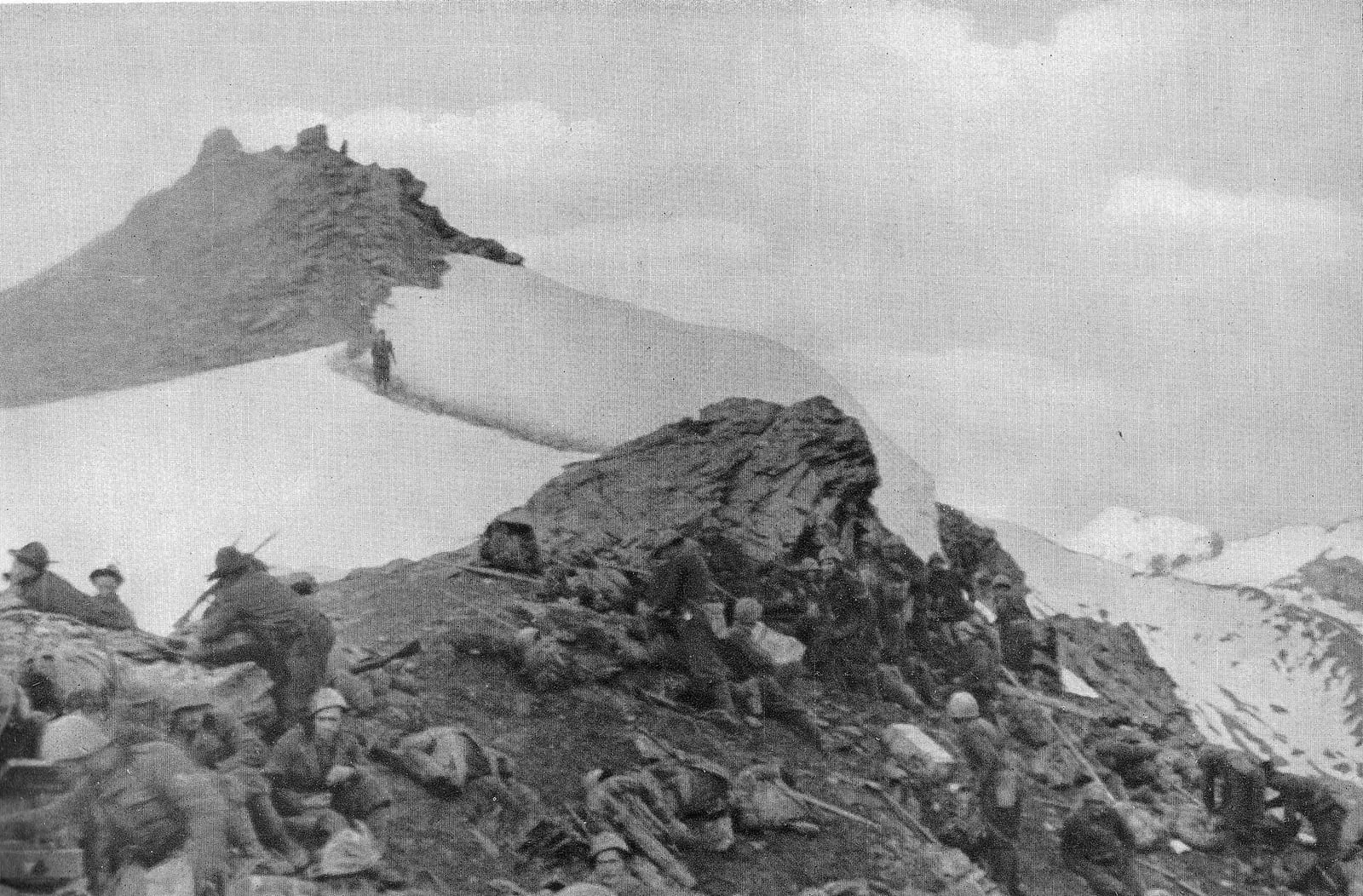
The Italian invasion of France, also known as the Battle of the Alps, was Italy’s first campaign of the Second World War and the last chapter of the French campaign. Benito Mussolini declared war on 10 June 1940, when the French army had already been shattered by the Germans and the government was leaving Paris. He reckoned that a few thousand dead would earn him a seat at the negotiating table and spoils in the form of Nice, Corsica and Tunisia. For the first ten days almost nothing happened on the Alpine frontier. Only when France asked for an armistice did the Duce, on 21 June, throw two armies, some 300,000 men, into an attack against a few tens of thousands of defenders in their forts. In four days, in snowstorms, at altitudes of two and three thousand metres, the Italians advanced a mere few kilometres, and their only significant prize was the seaside town of Menton. General René Olry’s French Army of the Alps did not give up any of its main positions and ended the campaign undefeated.
Name and dates
Italian writers call this fighting the Battle of the Western Alps (battaglia delle Alpi Occidentali), French ones the Battle of the Alps (bataille des Alpes), and English-language ones most often the Italian invasion of France.
It is taken to begin on 10 June 1940, when Italy handed over in Rome a declaration of war that took effect at midnight on 10–11 June. It ended on 25 June, when at 12.35 a.m. both the Franco-German armistice and the Franco-Italian armistice, signed on the evening of 24 June at Villa Incisa near Rome, came into force simultaneously. The actual fighting on land lasted four days, from 21 to 24 June, although isolated attacks on the coast and in the valleys of the Cottian Alps had begun on 20 June.
Background
For years Mussolini had proclaimed that Italy must break out of the “prison” of the Mediterranean, whose bars were Corsica, Tunisia, Malta and Cyprus and whose sentries were Gibraltar and Suez. In November 1938, when the Foreign Minister, Galeazzo Ciano, spoke in the Chamber of Deputies of the “natural aspirations of the Italian people”, Fascist deputies shouted: “Nice! Corsica! Savoy! Tunisia!”. In April 1939 Italy occupied Albania, and in May it concluded the Pact of Steel with Germany, an offensive alliance, although Rome assumed there would be no war before 1942. When Germany invaded Poland in September 1939, Mussolini, aware of his army’s weakness, announced that Italy would not undertake military operations and adopted a stance of “non-belligerence” (non belligeranza).
In the spring of 1940 the Duce prepared ever more openly for war. On 18 March, at the Brenner Pass, he assured Adolf Hitler that Italy would stand at Germany’s side but that he would choose the moment of entry himself. The German victories in May dispelled his hesitations. At the end of May the French and British were still wondering whether concessions might keep Italy out of the war, but the War Cabinet in London rejected the idea, and Mussolini brushed aside the appeals of President Franklin Delano Roosevelt. On 26 May the Duce told Marshals Pietro Badoglio, Chief of the Supreme General Staff, and Italo Balbo that he would enter the war. Both warned that the army was not ready: the divisions were under strength, equipment was lacking and the merchant fleet was scattered across the globe. According to Badoglio’s account, Mussolini replied to him at the beginning of June that he needed “only a few thousand dead” to sit at the peace conference as one who had fought. He expected the war to last a few weeks at most.
On 29 May King Victor Emmanuel III, the constitutional head of the armed forces, agreed to hand operational command to Mussolini. Italian plans, however, did not envisage an attack on France. On the Alpine frontier the army was to stand on the defensive, and on 7 June the army command ordered Army Group West to maintain an “absolutely defensive posture on land and in the air”. At 4.30 p.m. on 10 June Ciano handed the declaration of war to the French ambassador, André François-Poncet, and a quarter of an hour later to the British ambassador, Sir Percy Loraine. François-Poncet called it “a dagger blow to a man who is already down”, and that same day Roosevelt said at Charlottesville that “the hand that held the dagger has struck it into the back of its neighbour”. In the evening Mussolini announced from the balcony of the Palazzo Venezia Italy’s entry into the war against the “plutocratic and reactionary democracies of the West”. France was by then in its death throes: the Germans had broken through the line of the Somme and the Aisne, and the Commander-in-Chief, General Maxime Weygand, who had replaced Gamelin in May, had no reserves left.
Forces and plans
The Franco-Italian border, some 500 kilometres long from Mont Blanc to the Mediterranean, was crossed by only five passes open to motor traffic – the Little St Bernard, Mont-Cenis, Montgenèvre, the Maddalena (Col de Larche) and the Tenda – and by the coast road. In September 1939 it was defended by the Sixth Army with eleven divisions and some 550,000 men, but when Italy stayed out of the war the French gradually withdrew troops from here for the German front and for Norway. In December 1939 the Sixth Army was reduced to the Army of the Alps (Armée des Alpes), whose command was taken over by General René Olry, a gunner who in the First World War had also fought in Italy, on the Piave. In June 1940 he had some 175,000–185,000 men, but only about 85,000 of them stood on the border itself. His main strength consisted of three reserve Alpine infantry divisions (the 64th, 65th and 66th), the fortified sectors of Savoy, the Dauphiné and the Maritime Alps, and several dozen platoons of ski scouts (sections d’éclaireurs-skieurs), picked units of mountaineers. They relied on the so-called Alpine Maginot Line: modern fortress works built in the 1930s and old nineteenth-century forts, with artillery ranged on every approach road. The coastal sector, through which ran the most convenient road to Nice, was the most heavily fortified.
On the Italian side stood Army Group West under the heir to the throne, Umberto of Savoy, Prince of Piedmont (from 1946 briefly King Umberto II). It consisted of General Pietro Pintor’s First Army in the south, from the Monviso massif to the sea, and General Alfredo Guzzoni’s Fourth Army in the north. In reserve were the Seventh Army near Turin and the Army of the Po, then forming, with motorised divisions and the Littorio Armoured Division. On the border stood 18 infantry divisions and 4 Alpine divisions, some 300,000 men in all with about 3,000 guns. Their deployment, however, was defensive: the troops held the mouths of the valleys, and the artillery was meant to strike an enemy who crossed the border. After 10 June direction of operations at the front passed to Marshal Rodolfo Graziani, Chief of Staff of the Army, while Mussolini’s orders, tempered somewhat by Badoglio, were relayed from Rome by his deputy, General Mario Roatta. Graziani, certain that the offensive would fail, had minutes taken of every staff conference so that in the event of defeat he could put the blame on his subordinates and superiors.
The Italians’ numerical superiority was illusory. After General Alberto Pariani’s reforms, Italian divisions had only two infantry regiments and about 7,000 men, fewer than French ones. Most of the artillery dated from the First World War, and some of it was captured Austro-Hungarian material. The tanks were overwhelmingly L3 tankettes armed only with machine guns. There was a shortage of lorries, radios, engineers and winter equipment, and army commanders could not communicate directly with the air force and the navy. An attacker would have to advance uphill, through passes still deep in snow in June, against well-concealed forts.
Course of the campaign: ten days of waiting (10–20 June)
The French had expected war. As early as 26 May Olry warned the prefect that Menton, the largest town on the border, would be evacuated on his orders, and on the nights of 3–4 and 4–5 June its inhabitants were taken away. After the declaration of war the garrisons took up their positions, and the engineers, using 53 tons of explosives, blew up the bridges, roads and tunnels leading across the border. The French ambassador and military attaché, however, made it known in Rome that France had no intention of attacking, and the Army of the Alps never undertook any offensive. Both sides confined themselves to patrols and artillery duels between forts. On 12 June French skiers surprised an Italian outpost on the Maddalena pass.
More happened in the air and at sea. On 11 June Italian bombers began raiding Malta. During the night of 11–12 June British Whitley bombers, flying from Yorkshire and refuelling in the Channel Islands, bombed Turin and Genoa, killing 15 civilians in Turin. On 13 June the Italian air force attacked airfields in Provence, and on 14 June a French squadron from Toulon bombarded industrial plants in Genoa, Savona and Vado Ligure. The damage was slight, but the shelling of the Italian coast on the very day the Germans were entering Paris humiliated Mussolini. On 17 June the Italians bombed Marseille, killing more than 140 people.
The turning point came with the fall of Paul Reynaud’s government. His successor, Marshal Philippe Pétain, asked the Germans on 17 June, and through the Holy See the Italians too, for armistice terms and announced on the radio that “the fighting must cease”. Mussolini realised that the war might end before his army had fired a single shot. As early as 15 June he had ordered an attack to be prepared within three days, which Badoglio considered impracticable, since in his view switching from defence to attack required 25 days. On 16 June Graziani ordered three thrusts to be prepared within ten days: through the Little St Bernard Pass, through the Maddalena pass and along the coast. In the days that followed contradictory orders arrived from Rome: on 18 June, simultaneously, to cease operations at once and to continue preparations. Many soldiers concluded that the war was over and fraternised with the French. That same day, at a meeting in Munich, Hitler gave Mussolini to understand that Italian claims to Nice, Corsica and Tunisia were getting in the way of negotiations with France. He promised, however, that the German armistice would not come into force without the Italian one, and that German armoured columns would strike the Army of the Alps from the rear. The Duce returned to Rome convinced that he had to win something by his own efforts.
From 15 June, moreover, Olry had to defend himself on two fronts. The Germans were advancing down the valleys of the Saône and the Rhône; on 19 June they took Lyon, and General Erich Hoepner’s XVI Panzer Corps was heading for Chambéry and Grenoble, into the rear of the Alpine forts. Against them Olry assembled General Georges Cartier’s group, some 30,000 men drawn from broken units, sailors and reservists, armed with equipment from the depots, and blew the bridges over the Rhône and the Isère. On 18–20 June Italian guns in the fort on the summit of Mont Chaberton, at an altitude of 3,130 metres – called by the French “the battleship of the clouds” – shelled the French forts around Briançon, and on 20 June their fire allowed the Italians to take the village of Montgenèvre.
Course of the campaign: the offensive in the Alps (21–24 June)
On 20 June Mussolini demanded an attack from the following morning because, as he told Badoglio, he did not want “the shame of the Germans taking Nice and handing it over to us”. In the evening Graziani ordered both armies to “attack in depth along the whole front” at 3 a.m. on 21 June. The objective was now to be Marseille, and the immediate targets Albertville and Menton. That same evening Mussolini cancelled the order and then confirmed it again, shifting the weight of the attack to the north. The offensive began at dawn on 21 June in pouring rain and snowstorms. Fresh snow lay on the passes, and fog robbed the gunners and airmen of visibility. Of 285 bombing sorties flown on 21–24 June, fewer than half found their targets, and the bombs could do no harm to forts cut into the rock.
The main blow was delivered by Guzzoni’s Fourth Army. The Alpine Corps attacked through the Little St Bernard Pass towards Bourg-Saint-Maurice. The road was barred by an old redoubt, the Redoute Ruinée, whose garrison of a few dozen chasseurs alpins with machine guns held off one battalion after another for four days. When Guzzoni threw forward the Alpini and the motorised Trieste Division at the same time, a traffic jam formed on the only road that not even ambulances could get through. The Trieste Division’s tankettes got stuck on barbed wire and mines in front of a demolished bridge. The Italians reached Séez and the Isère valley, but they did not take Bourg-Saint-Maurice, nor did they manage to capture the redoubt before the fighting ended. After the armistice its defenders marched out with the honours of war. Further south I Corps attacked through the Mont-Cenis (PL) pass into the Arc valley. The Alpini, descending across trackless country, took Bessans and Lanslebourg, and the Cagliari Division took the village of Bramans, but the forts guarding Modane held, and the column advancing along the road from the pass got stuck on mines and under the fire of Fort de la Turra.
At Briançon a French battery of four 280 mm mortars, hidden at the foot of Fort de l’Infernet, shelled Fort Chaberton from 21 June. Despite interruptions caused by the weather, with a few dozen rounds it knocked out six of the fort’s eight gun turrets, which the French regarded as a symbol of the whole battle. On the Maddalena pass the Acqui Division, which was to advance 60 kilometres along the only road in the valley, left its supplies and artillery far behind and reached the French fortifications in the Ubaye valley only on the evening of 24 June, when the armistice had already been signed. There were more frostbite cases than wounded in its ranks.
On the coast, Pintor’s First Army – Pintor had asked until the last moment for the attack to be postponed – attacked with General Gastone Gambara’s XV Corps. The Saint-Louis border bridge between Ventimiglia and Menton held out to the end: the handful of men in a French outpost blocked the coast road, and the artillery of the forts of Cap Martin and Mont Agel destroyed, among other things, an Italian armoured train. A landing by the San Marco naval infantry regiment behind the French lines was called off because the requisitioned fishing boats and pleasure craft kept breaking down and leaking. Only during the night of 22–23 June, under cover of fog, did units of the Cosseria and Modena Divisions bypass the fort at Cap Martin and enter the eastern districts of Menton. Fierce street fighting followed in the town. The French gradually fell back to the west, and on 24 June an Italian attack on the Carnolès plain was beaten off by artillery. The fort at Cap Martin, though surrounded, kept firing to the end. On the morning of 23 June Italian airmen looking for French guns on Cap Martin bombed their own artillery on Capo Mortola, a few kilometres inside Italy, by mistake.
Meanwhile the Germans were fighting in the rear of the Army of the Alps. On 23 June they took Aix-les-Bains and got close to Chambéry, but their column heading for Grenoble was stopped on 23–24 June at Voreppe by the French artillery of Cartier’s group. They never reached the Italian lines.
The armistice
On 21 June, as Hitler was presenting the German terms to the French at Compiègne, Ciano noted that Mussolini felt humiliated because “our troops have not taken a step forward; today too they were unable to get through and halted before the first French strongpoint that put up resistance”. The earlier demands, put forward in Munich, had included the occupation of France as far as the Rhône, as well as Corsica, Tunisia and French Somaliland. In view of the failures in the mountains and the moderate German terms, Mussolini dropped them and decided to defer his claims to the peace conference. On the afternoon of 23 June the same French delegation that had signed the armistice with Germany the day before, headed by General Charles Huntziger, flew to Rome in German aircraft. The talks took place at Villa Incisa all’Olgiata on the Via Cassia. Mussolini delayed signing in the hope that Gambara might still manage to take Nice.
At 7.15 p.m. on 24 June Huntziger and Badoglio signed the armistice. At Huntziger’s request, and with Mussolini’s consent, a clause on handing over to Italy the Italian political émigrés living in France was struck out at the last moment. Italy kept only what it had occupied: a strip of borderland of about 830 km² with 28,500 inhabitants, most of them in Menton. On the French side of the border a demilitarised zone 50 kilometres deep was created, which meant the dismantling of the Alpine line of fortifications, together with demilitarised zones on the borders of Tunisia, Algeria and French Somaliland. The naval bases at Toulon, Bizerte, Ajaccio and Oran were to be demilitarised, and Italy gained the right to use the port of Djibouti and the French section of the railway to Addis Ababa. Implementation of the armistice was supervised by an Italian armistice commission in Turin. Both armistices came into force at 12.35 a.m. on 25 June. Mussolini bitterly called it an armistice “more political than military, after only fifteen days of war”, which nevertheless gave Italy “a good document in hand”.
Losses
According to the official Italian return of 18 July 1940, compiled while many of the dead still lay under the snow, the Italian forces lost 631 killed (642 in other tallies), 2,631 wounded and 616 missing. In addition, 2,151 soldiers suffered frostbite. Historians assume that most of the missing were killed or taken prisoner. The French probably took about 1,100 Italians prisoner, who were released immediately after the armistice. Various sources put the losses of the Army of the Alps in the fighting against the Italians at 32–40 killed, 42–121 wounded and about 150 prisoners, who after the armistice were forgotten and taken to the camp at Fonte d’Amore near Sulmona. In the fighting against the Germans on the Rhône and the Isère the Army of the Alps also lost about 20 killed, 84 wounded and more than 150 prisoners.
Significance
For France the fighting in the Alps was the only bright spot in the defeat of 1940. The Army of the Alps, weakened and with the Germans in its rear, held almost all its positions, and French memory dubbed it “the undefeated army” (l’armée invaincue). Historians credit this to the fortifications, the mountains and the weather, but also to the leadership of Olry, who acted on his own initiative, independently of the chaos in the government. The declaration of war on an already beaten France, which Roosevelt called a stab in the back, weighed from then on upon Franco-Italian relations and on Italy’s image in the world.
For Italy the campaign was a disgrace, although propaganda proclaimed it a “splendid victory” over an enemy who had supposedly resisted the Italians more fiercely than the Germans. Historians agree that the Italian offensive ended in fiasco: numerical superiority did not make up for poor equipment, lack of preparation and a chaotic command in which Mussolini’s orders changed from hour to hour. No lessons were learned. The same army, with the same shortcomings, attacked Egypt in September 1940 and Greece in October, and in both campaigns suffered defeats that forced Hitler to come to his ally’s aid. Within the alliance with Germany, Italy became an ever more dependent partner. In November 1942, after the Allied landings in North Africa, Italian troops occupied south-eastern France as far as the Rhône, and Corsica. For several months Jews were safer in the Italian zone than in the German one, because the Italian military authorities refused to hand them over to the Germans. After Italy’s capitulation in September 1943 these territories were occupied by the Germans. In the peace treaty of 1947 Italy ceded to France, among other places, Tende and La Brigue, as well as the summit of the Chaberton.