France
Charles Huntziger
Commander of the Second Army (1939–1940) and the Fourth Army Group (1940), head of the armistice delegations (1940), Minister of War of Vichy France (1940–1941)
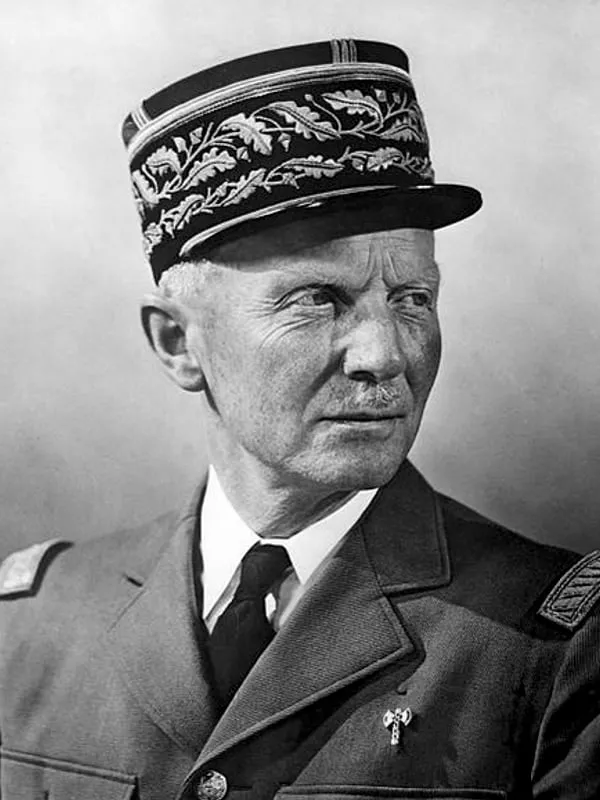
- Born:
- 25 June 1880, Lesneven (France)
- Died:
- 12 November 1941, Bréau-et-Salagosse, near Le Vigan (France)
- Author:
- Natalia
- Photo:
- Anonymous (Keystone-France), domena publiczna, Wikimedia Commons

Charles Huntziger was one of the ablest and most promising French generals of the interwar period. Maurice Gamelin saw him as his successor as Commander-in-Chief. Yet he went down in history for two reasons that brought him no glory. In May 1940 it was his Second Army that held the sector of the Meuse at Sedan where the German panzer divisions broke through the front and decided the campaign. A month later, as head of the French delegation, he signed the armistice with Germany in Foch’s railway carriage in the Forest of Compiègne, and two days later the armistice with Italy near Rome. He then served as Minister of War in Marshal Pétain’s government at Vichy until he was killed in an air crash in November 1941. In France he remains an almost forgotten and at the same time controversial figure.
A Breton from an Alsatian family
Charles Léon Clément Huntziger was born on 25 June 1880 in Lesneven in the Breton department of Finistère. His father, a teacher of music and German, came from Alsace and had left for France after the Franco-Prussian War in 1871 to avoid service in the German army. The son spoke fluent German, was a practising Catholic and played the violin. He attended the lycée in Nantes and in 1898 entered the military academy of Saint-Cyr, graduating in 1900.
He chose the colonial infantry. He served in Madagascar, in West Africa on the Senegal and the Niger, and, after studying at the École Supérieure de Guerre (1909–1911), in Indochina, where on the outbreak of war in 1914 he was commanding a company of Tonkinese Rifles.
The First World War
At his own request he returned to France and from the autumn of 1914 fought on the Somme, then served as a staff officer in Champagne and Lorraine. In January 1918 he was transferred to the staff of the Allied Army of the Orient in Salonika, where he took over the Third Bureau, responsible for planning operations. On the Salonika front he drew up the plan for the offensive which, in September 1918, under the command of General Louis Franchet d’Espèrey, broke through the Bulgarian front at Dobro Pole and led to the armistice with Bulgaria on 29 September. Bulgaria was the first of Germany’s allies to drop out of the war. Franchet d’Espèrey made Huntziger his protégé, had him promoted to lieutenant colonel and took him to Constantinople as deputy chief of staff of the Allied forces. For his war service Huntziger received the Legion of Honour and the British Distinguished Service Order (DSO).
Between the wars
After the war he was regarded as a specialist in Balkan and Eastern affairs. From 1924 to 1928 he commanded the French occupation corps in the concession at Tianjin; in December 1928, aged 48, he was promoted to brigadier general, becoming the youngest general in the French army, and from 1930 to 1934 he headed the French military mission to Brazil. In April 1934 (according to some sources, as early as 1933) he took command of the French forces in the Levant, that is, in mandatory Syria and Lebanon. He took part in negotiating the treaties of 1936, which were meant to lead both countries to independence, and in talks with Turkey on the fate of the Sanjak of Alexandretta, which France ceded to Turkey in 1939 (the Hatay State). Historians have praised his tact and his skill in reconciling conflicting interests.
In 1938 he returned to France, was given the highest general’s rank of général d’armée and joined the Supreme War Council, the body of the army’s future commanders. In the summer of 1939 he conducted military talks with the Turks that paved the way for the Anglo-French-Turkish treaty of mutual assistance of October 1939. He was proposed as High Commissioner in the Levant, but Gamelin preferred to keep him for a major command in France.
Sedan
In September 1939 Huntziger took command of the Second Army, which held the front on the Meuse from Sedan to Longuyon, where the Maginot Line ended, with the wooded Ardennes in front of it. He was then the youngest général d’armée in France. Like the high command, he considered the Ardennes difficult terrain for large formations, and he judged his right wing the most threatened, since there the Germans might outflank the Maginot Line from the rear. That was where he placed his best divisions. The Sedan sector was held by the weak 55th Infantry Division, made up mainly of older reservists. In March 1940 Pierre Taittinger’s parliamentary commission warned that Sedan was a particularly weak point in the French defences. Huntziger replied on 8 April that he saw no need for urgent measures to strengthen the sector. On the evening of 9 May, when intelligence was signalling an imminent attack, he was at Vouziers watching a performance by the front-line theatre he had founded himself.
The next day the Germans attacked in the west, and on 13 May Heinz Guderian’s panzer corps crossed the Meuse at Sedan. Huntziger failed to organise an effective counter-attack: the 3rd Armoured Division, sent to seal off the breach, was on his orders dispersed in small groups along a front of more than ten kilometres. On 14 May he decided that his army should cover the Maginot Line rather than Paris, and pulled his left wing back to the south. The Second Army’s front then held at Stonne (PL), but a gap opened between it and General André Corap’s shattered Ninth Army, through which the Germans drove west towards the English Channel. The blame for the defeat was laid on Corap, who was dismissed. Huntziger, who had influential patrons, kept his command and, thanks to a widely distributed leaflet for the troops, even became popular. Historians such as Julian Jackson judge that his army performed no better than Corap’s. The general’s biographer, Jean-Claude Streicher, defends him by pointing to the weakness of the French armoured divisions. These were the days of the Battle of Sedan.
At the beginning of June General Maxime Weygand entrusted him with the newly formed Fourth Army Group on the Aisne. At that time his name appeared among the candidates for Commander-in-Chief. General Charles de Gaulle, convinced of Weygand’s defeatism, urged the prime minister, Paul Reynaud, to replace him with Huntziger. On 11 June de Gaulle met Huntziger at Arcis-sur-Aube and, according to his memoirs, obtained his agreement to take command and to continue the fight from Africa. Huntziger’s own notes, however, suggest that he answered cautiously that one must fight to the limit of what was possible, but that this limit might be reached very soon.
The armistices
When Marshal Philippe Pétain took over the government and asked the Germans for their armistice terms, Huntziger was placed at the head of the delegation in Bordeaux on 19 June. Pétain instructed him to break off the talks if the Germans demanded the fleet, the occupation of the whole country or part of the colonies. On 21 June in the Forest of Compiègne, in the carriage in which the Germans had accepted Foch’s terms in 1918, Huntziger listened, in the presence of Adolf Hitler, to the preamble read out by Colonel General Wilhelm Keitel. From a tent beside the carriage he dictated the terms by telephone to Weygand in Bordeaux. The Germans tapped and recorded the conversations. The recordings preserve his remark that handing refugees over to the Germans would be contrary to honour, because France was a land of asylum. He also called the German occupation zone a “terrible humiliation”. He obtained only minor changes, however, and on 22 June at 6.36 p.m. German time, on orders from Bordeaux and under the threat that the talks would be broken off, he signed the Armistice of Compiègne with Keitel.
On 23 June the delegation flew to Rome in a German aircraft. There, at the Villa Incisa, the talks with Marshal Pietro Badoglio were brief, because the Italians accepted most of the French requests and any delay postponed the entry into force of the armistice with Germany. On the evening of 24 June Huntziger signed the Franco-Italian armistice, and at 0.35 a.m. French time on 25 June the fighting ceased. He had thus signed both of the documents that ended the Battle of France.
At Vichy
From 26 June to mid-September 1940 he headed the French delegation to the German Armistice Commission in Wiesbaden. Hitler called him one of the shrewdest and ablest French negotiators. He succeeded in having the gendarmerie restored in the occupied zone, but failed to reduce the costs of the occupation or to halt the de facto annexation of Alsace and Lorraine, against which on 3 September he lodged a formal twelve-point protest.
On 6 September 1940 Pétain appointed him Minister of War and Commander-in-Chief of the land forces, that is, of the Armistice Army, which was limited to 100,000 men in metropolitan France. He was on close terms with the Marshal. Towards the Germans he was more cautious than some of his colleagues in the government. Like Weygand, he hoped to rebuild the army and allowed secret preparations for rapid mobilisation in case the war resumed. Yet he was a member of a government that was building an authoritarian state and collaborating with the occupier. On 3 October 1940, together with the other ministers, he signed the first Statute on Jews, which excluded them from the civil service, the army and many professions. In a letter to Weygand of 28 February 1941, cited by historians, he blamed the defeat of 1940 on Jewish soldiers and demanded their removal from the units in North Africa. After the dismissal of Pierre Laval in December 1940, he governed for two months together with Pierre-Étienne Flandin and Admiral François Darlan. On 28 May 1941 he signed the Paris Protocols, military agreements under which Vichy agreed to let the Germans use bases in Syria and Africa. In August 1941 Darlan took over the overarching Ministry of National Defence, and Huntziger lost some of his influence.
Death
In the autumn of 1941 Huntziger made an inspection tour of the troops in North Africa. On 12 November, on the way back from Algiers to Vichy, his Potez 662 aircraft ran into bad weather over the Massif Central, iced up and crashed in the Cévennes, in the forests of the Aigoual massif near Bréau-et-Salagosse, not far from Le Vigan. Everyone on board was killed: the pilot and six passengers. Rumours of sabotage soon spread, but the investigations and his biographers point to the weather conditions. Hitler and Mussolini sent their condolences to Pétain. A state funeral was held at Vichy on 15 November, attended by German and Italian delegations. His family later moved his remains to Passy Cemetery in Paris.
Significance
Huntziger died before Vichy took its gravest decisions on collaboration, and he never stood trial, as Pétain and Laval did. At Pétain’s trial in 1945, however, his decisions at Sedan and Compiègne came up again and again. To some he was a capable officer who lost a battle, like the whole of the French high command, and then, in a hopeless position, obtained from the victor as much as could be obtained. To others he shared responsibility for the defeat at Sedan, which he shifted onto others, and later for the submission to Germany and Vichy’s anti-Jewish policy. The Marxist historian Annie Lacroix-Riz even accused him of taking part in a plot to bring about defeat, but other scholars, including his biographer, regard this thesis as unproven. His name remains for ever linked to his signature on the armistice of 22 June 1940, which to some saved France from total occupation and to others marked the beginning of the road to collaboration.
Sources
Commanded in battles
(01)Mentioned in battles
(03)Often appears with
People who appear in the same events.