Germany
Werner von Fritsch
Chief of the Army Command (1934–1935), commander-in-chief of the army (1935–1938), Colonel General
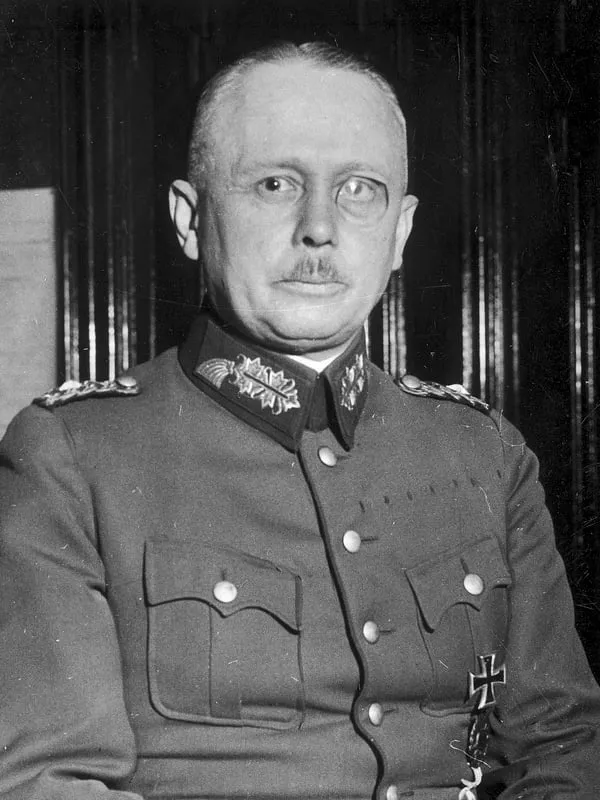
- Born:
- 4 August 1880, Benrath near Düsseldorf (German Empire)
- Died:
- 22 September 1939, Warsaw (Poland)
- Author:
- Łukasz
- Photo:
- autor nieznany, domena publiczna, Wikimedia Commons

Werner von Fritsch commanded the German Army for four years, from February 1934 to February 1938. It was under his direction that the 100,000-strong Reichswehr was transformed into a conscript army of several dozen divisions which attacked Poland in 1939. He was a typical representative of the Prussian officer caste: a professional of narrow horizons, an enemy of the Weimar Republic and an avowed antisemite who welcomed the dictatorship of Adolf Hitler as an opportunity to rebuild Germany’s military power. When in November 1937 he warned against rushing into war, he became an obstacle in Hitler’s eyes. He was removed by means of a fabricated charge of homosexuality, and his fall gave Hitler complete control of the army. He was killed outside Warsaw in September 1939, one of the first German generals to fall in the Second World War. For years after the war he was portrayed as a decent soldier and a victim of the Nazis. More recent research shows him in a far less favourable light.
A General Staff officer
Thomas Ludwig Werner von Fritsch was born on 4 August 1880 in Benrath, today a district of Düsseldorf, into an officer’s family. His father, Georg, rose to the rank of Generalleutnant and brought his son up in a spirit of strict discipline and duty; his mother, Adelheid, came from the von Bodelschwingh family. His biographers agree in describing Fritsch as a reserved man who all his life found it hard to form close relationships. He never married.
In September 1898 he joined a Hessian field artillery regiment in Darmstadt as an officer cadet, and in 1900 he was commissioned as a second lieutenant. In 1907–1910 he studied at the War Academy in Berlin, where he excelled in military history and tactics, and in 1911 he was permanently appointed to the Great General Staff. In August 1914 he was working in the department that had prepared the army’s mobilisation and deployment. He spent the whole of the First World War as a staff officer with divisions, corps and armies on the Western and Eastern Fronts, and for a time also on the staff of the commander of the air service. In 1917 he was wounded in the head by a shell splinter.
In the Reichswehr
After the defeat Fritsch stayed on in the 100,000-strong Reichswehr being created by Hans von Seeckt. He loathed the republic. In a letter written in 1924 to a fellow officer and friend, Joachim von Stülpnagel, he wrote contemptuously of the “black-red-gold” politicians and of the Jewish press, and of pacifists, democrats and Jews as people who wanted to destroy Germany. He hoped that Seeckt would seize power as dictator. The historian Wolfram Wette observed that in this letter an officer who had sworn loyalty to the republic came close to high treason.
At the same time he was rising fast. From 1924 he was chief of staff of the 1st Division in Königsberg, and from 1926 he headed the army department of the Truppenamt (Troop Office), the clandestine general staff. He took part in planning the army’s secret expansion and in the secret cooperation with the Red Army, which he supported. He regarded Poland as the main enemy in the east. In 1928 he took command of the 2nd Artillery Regiment; in 1930 he was promoted to Generalmajor; in 1931 he became commander of the 1st Cavalry Division, and in 1932, by now a Generalleutnant, of the 3rd Division and Military District III in Berlin.
Commander of Hitler’s army
At the end of 1933 the Chief of the Army Command, General Kurt von Hammerstein-Equord, an opponent of the Nazis, resigned. Hitler and the Reichswehr minister, Werner von Blomberg, wanted the pro-Hitler General Walter von Reichenau to replace him, but President Paul von Hindenburg rejected this candidate and opted for Fritsch, whom he saw as a representative of Prussian conservatism. Fritsch took up the post on 1 February 1934 with the rank of General der Artillerie.
He welcomed the new chancellor. Hitler promised what the generals wanted: rearmament, universal conscription, an end to the Versailles restrictions and the army as the sole bearer of arms in the state. The regime’s antisemitism did not trouble Fritsch. In February 1934 he raised no objection to implementing the Aryan paragraph introduced by Blomberg, under which soldiers of Jewish descent were removed from the armed forces, and in December that year he reminded officers that they could choose wives only from “Aryan circles”. When Ernst Röhm’s SA began to threaten the army’s position, Fritsch placed the troops on alert on 25 June 1934, and the Reichswehr provided the SS with weapons and transport for the Night of the Long Knives. The army kept silent when two generals, Kurt von Schleicher and Ferdinand von Bredow, were murdered. Only at the turn of 1934 and 1935 did Fritsch and Blomberg press Hitler into rehabilitating them unofficially among the officer corps. On 2 August 1934, the day Hindenburg died, Fritsch, along with the whole of the armed forces, swore an oath of loyalty to Hitler.
After universal conscription was reintroduced in March 1935, Fritsch and the Chief of the General Staff, Ludwig Beck, directed the expansion of the army, which was to number 36 divisions. From 1 June 1935 Fritsch held the title of commander-in-chief of the army, and on 20 April 1936, when Blomberg became a field marshal, he was promoted to Colonel General. He was regarded as the creator of the new army. He cared about the quality of training and about ensuring that the officer corps did not grow at the expense of professional competence, and so he considered the pace Hitler imposed too fast. He also detested the SS, which was forming its own armed units, the SS-Verfügungstruppe, and openly mocked party dignitaries. Towards Hitler himself he was loyal. In March 1936 the army carried out the remilitarisation of the Rhineland, with whose aim the generals agreed, arguing only about the timing. On 30 January 1937 Hitler presented Fritsch with the Golden Party Badge, which meant admission to the NSDAP.
The conference of 5 November 1937
On 5 November 1937 Fritsch took part in the secret conference at the Reich Chancellery at which Hitler announced that “living space” would be won by force, beginning with Austria and Czechoslovakia, possibly as early as 1938. Together with Blomberg, Fritsch argued that Germany could not afford a war with France and Britain, because the western frontier was poorly defended and the army was not ready. He was disputing the risk and the pace, not the idea of war itself. He asked whether he should cancel his leave in Egypt and was told that the conflict was not that close. Hitler, however, took note that the commander of the army was hesitating.
Downfall
In January 1938 the scandal over Blomberg’s marriage to a woman registered by the police as a prostitute ended the war minister’s career. Fritsch was his natural successor. This was not what Hermann Göring wanted, since he himself hoped for the supreme command, nor Heinrich Himmler, who was hostile to the conservative officer corps. A file was retrieved from the Gestapo archives which Reinhard Heydrich had prepared in 1936 and which Hitler had then set aside. In it a professional blackmailer, Otto Schmidt, claimed that in November 1933 he had caught Fritsch in a homosexual encounter near Wannsee station in Berlin. On 26 January 1938 Hitler confronted the general with Schmidt at the Reich Chancellery. Fritsch gave his word as an officer that it was untrue, but instead of support he was subjected to interrogation by the Gestapo. On 4 February 1938 he was dismissed “for reasons of health”. Hitler assumed supreme command of the Wehrmacht himself and put Walther von Brauchitsch at the head of the army – a man whom Fritsch himself, as it happens, had recommended. Historians call the whole affair the Blomberg–Fritsch affair.
The officers conducting the investigation within the military justice system quickly established that Schmidt had confused the general with a retired cavalry captain (Rittmeister), Achim von Frisch. According to historians’ findings, the Gestapo had known this even before the confrontation. The trial before the Reich Court Martial, presided over by Göring, opened on 10 March, was interrupted by the Austrian crisis, and on 18 March 1938 Fritsch was acquitted. A week earlier the Wehrmacht had marched into Austria, and Hitler’s triumph overshadowed the scandal. Fritsch did not regain his post. In August 1938 his rehabilitation was announced and he was made honorary colonel of the 12th Artillery Regiment in Schwerin. He drew up a challenge to Himmler to fight a duel, but General Gerd von Rundstedt, who was supposed to deliver it, talked him out of it.
The injustice did not change his views. When Ulrich von Hassell tried to draw him into the opposition, Fritsch replied that this man was Germany’s destiny, for good and for ill, and that nothing could be done about it. On 11 December 1938, a month after Kristallnacht, he wrote to a baroness of his acquaintance that soon after the First World War he had come to the conclusion that, to regain its power, Germany had to win three battles: against the workers, which Hitler had already won, against the Catholic Church and against the Jews. “We are in the midst of these battles, and the battle against the Jews is the hardest,” he added. Earlier, in a letter of November 1938, he had written that the struggle against “world Jewry” would lead to war with England and America. These letters destroyed the credibility of the legend of the apolitical general that surrounded him after the war.
Death outside Warsaw
As war approached, Fritsch was given no command. During the September Campaign he accompanied his 12th Artillery Regiment as its honorary colonel, an unusual thing for a Colonel General. On 22 September 1939, during the fighting for Warsaw’s Praga district in the defence of Warsaw, a Polish bullet struck him in the thigh on the approaches to Praga, in the area of today’s Targówek, and severed an artery. According to his adjutant’s report, when the adjutant tried to staunch the bleeding Fritsch said only “Please leave it”, and died a minute later. He was the first Wehrmacht army general to be killed in the war. A rumour quickly spread that, embittered, he had sought death. Wilhelm Keitel maintained that this was untrue and that he had been hit by a stray bullet while talking to staff officers. The question cannot be settled.
On 26 September 1939 he was given a state funeral in Berlin. Hitler, Ribbentrop and Himmler did not attend, and the press was instructed to write about the general in modest terms. Some historians explain this by Hitler’s fear that a soldier regarded by many as the creator of the new army would overshadow the Führer, who himself wished to be seen as the Reich’s first soldier.
Assessment
Fritsch was not a Nazi by conviction, but neither was he an opponent of the Nazis, as he was portrayed in the generals’ post-war memoirs and in some popular accounts. He shared with Hitler a hatred of the Weimar Republic, of Poland and of the Jews, as well as the goal of restoring Germany’s military power. His dispute with Hitler concerned the pace of rearmament and the risk of war with the Western powers, as well as the army’s position vis-à-vis the SS and the party. He built the army that Hitler hurled against Europe, and his fall in 1938 showed that the officer corps was neither able nor willing to defend even its own commander. Without protest he accepted the OKW, Keitel and the subordination of the armed forces to one man, which opened the way to the Anschluss, Munich and war. In Germany Bundeswehr barracks long bore his name, but in recent years they have been renamed – in Pfullendorf, for example, the barracks were named after the Hohenstaufen dynasty.
Sources
Mentioned in battles
(01)Often appears with
People who appear in the same events.