- Category:
- Military operations
- Front:
- Eastern Front
- Date:
- 19 November 1942
- Author:
- Natalia
- Battle:
- Operation Uranus
- Tags:
- Red Army, Wehrmacht, Romania, Aleksandr Vasilevsky
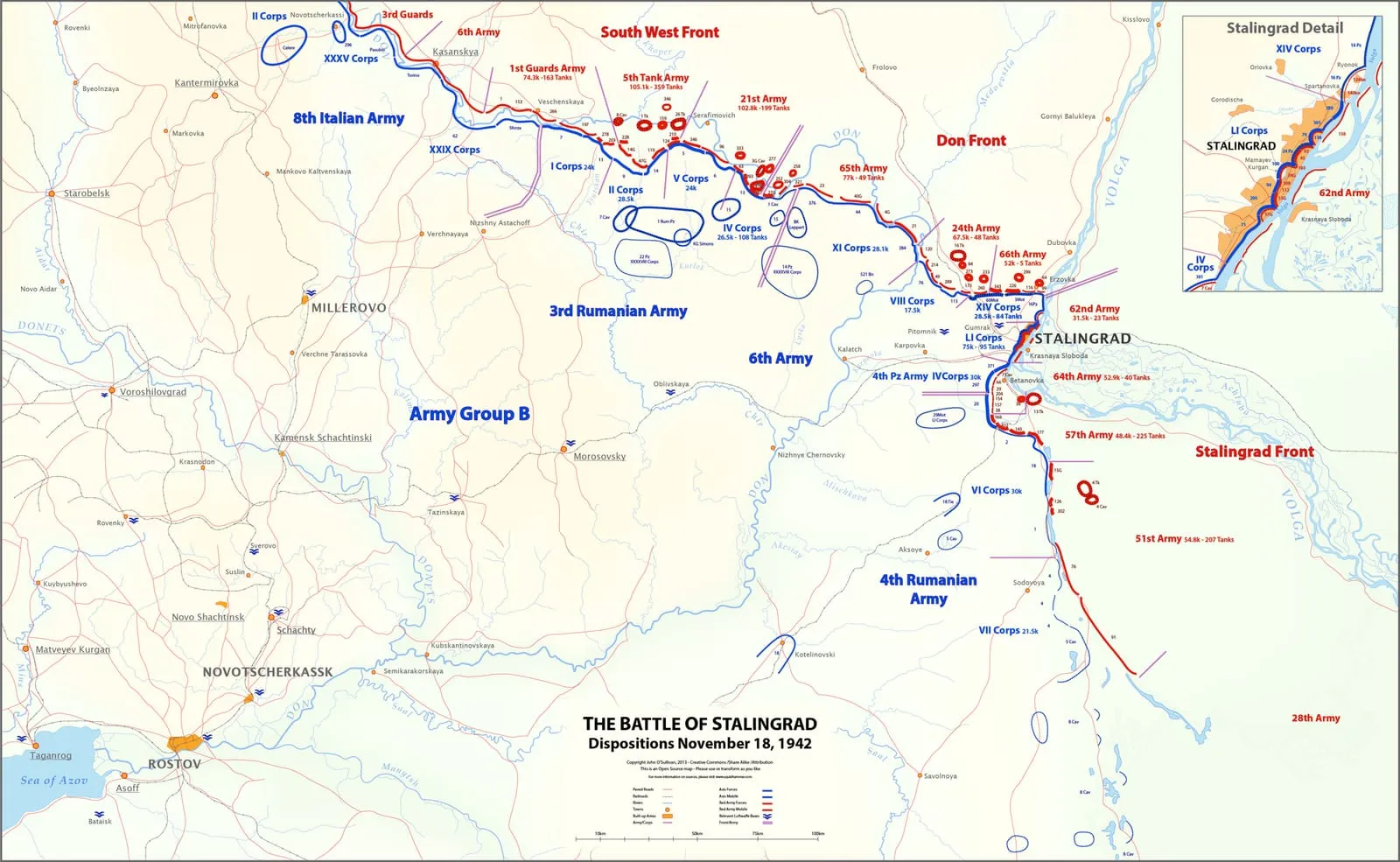
At 7.30 a.m. Moscow time on 19 November 1942, in thick fog over the Don, thousands of Soviet guns and rocket launchers opened fire on the positions of the Romanian 3rd Army north-west of Stalingrad. After eighty minutes of bombardment the infantry and tanks moved off. So began Operation Uranus – the counter-offensive that within four days encircled General Friedrich Paulus’s 6th Army and part of the 4th Panzer Army. The next day the troops south of the city attacked, and by 21 November it was already clear that the Soviet pincers would meet in the Germans’ rear, near Kalach-on-Don.
War chronologies often describe this day by saying that the operation was launched by “forces under the command of General Georgy Zhukov”. That is a simplification. The plan for the counter-offensive was worked out jointly by the Deputy Supreme Commander, General of the Army Georgy Zhukov, and the Chief of the General Staff, Colonel General Aleksandr Vasilevsky, and the blow was delivered by three fronts: General Nikolai Vatutin’s South-Western Front, General Konstantin Rokossovsky’s Don Front and General Andrei Yeremenko’s Stalingrad Front. The operations of all three were coordinated on the spot by Vasilevsky as representative of the Stavka. Zhukov, who had inspected the preparations on the Don at the beginning of November, was by the time Uranus opened already preparing Operation Mars – an offensive at Rzhev against the German Army Group Centre.
Zhukov’s and Vasilevsky’s plan
Since the end of August 1942 Stalingrad had been holding out with its last reserves of strength. General Vasily Chuikov’s 62nd Army now held only narrow strips of ruins along the Volga, and in October and November the Germans took most of the factory district. The last great assault, launched on 11 November, brought them to the river on another stretch, but still did not take the city. The Soviet command sent into it only as many troops as were needed for the defence to survive, and massed its fresh armies elsewhere.
According to Zhukov’s memoirs, in mid-September, as he and Vasilevsky were reporting to Stalin on the failed counter-attacks north of the city, the idea of “another solution” came up: instead of striking head-on at the strongest German grouping, they should go over to a counter-offensive on its flanks, far from the ruins, and encircle all the enemy forces between the Don and the Volga. Historians point out that the log of visitors to Stalin’s office does not confirm a meeting on the date Zhukov gives, and that the idea itself matured in the General Staff throughout the autumn. What is beyond dispute is that in October and early November Zhukov and Vasilevsky travelled between front headquarters, agreeing breakthrough sectors and axes of advance with the commanders. On 13 November they presented the final version of the plan to Stalin, who approved it.
The plan provided for a double envelopment. From bridgeheads on the right bank of the Don, at Serafimovich and Kletskaya, the 5th Tank Army and 21st Army of the South-Western Front and the 65th Army of the Don Front were to strike south-east. South of Stalingrad, from the area of the Sarpa, Tsatsa and Barmantsak lakes, the 51st, 57th and 64th Armies of the Stalingrad Front were to advance north-west. The two thrusts, led by tank and mechanised corps, were to meet in the area of Kalach and Sovetsky, some 60–70 kilometres west of the city. The Don Front was also to pin down the German divisions in the great bend of the Don and cut them off from the 6th Army, while the defenders of Stalingrad were to prevent Paulus from pulling forces out of the ruins.
According to calculations by David Glantz and Jonathan House based on Soviet archives, more than a million soldiers, some 900 tanks, over 13,000 guns and mortars and more than a thousand aircraft were assigned to the operation. Other tallies give somewhat lower tank numbers. The date of the attack was postponed several times because the railways could not bring up troops and ammunition fast enough and the air forces were not ready.
The 6th Army’s weak flanks
The counter-offensive was aimed where the Germans were weakest. When in the summer of 1942 General Maximilian von Weichs’s Army Group B advanced on Stalingrad and Army Group A on the Caucasus, the German front stretched out over hundreds of kilometres. The best German divisions were fighting in the ruins of the city and at the foot of the mountains – as late as the beginning of November the Germans were still trying to reach Ordzhonikidze – and the long flanks on the Don and in the Kalmyk steppe were entrusted to allies. West of Stalingrad, along the Don, stood General Petre Dumitrescu’s Romanian 3rd Army, and beyond it the Italian and Hungarian armies. South of the city, on the steppe, stretched General Constantin Constantinescu-Claps’s Romanian 4th Army, formally subordinate to General Hermann Hoth’s 4th Panzer Army.
The Romanians, sent to the front by Marshal Ion Antonescu, had fought bravely in the summer but had nothing with which to stop tanks. Their standard 37 mm anti-tank guns could not penetrate the armour of the T-34; they received the more powerful German 75 mm guns only after many requests, and then just a few per division. The only Romanian armoured formation, the 1st Armoured Division, had about a hundred light tanks of Czech design. The 3rd Army held a sector some 140 kilometres long, and the 4th Army – according to various calculations – one of 200–270 kilometres. Dumitrescu repeatedly warned that the Russians were massing forces in the bridgeheads on the Don that his troops had been unable to eliminate, and asked for permission to take them and for German reserves.
There were no reserves to spare. Behind the 3rd Army stood only General Ferdinand Heim’s XLVIII Panzer Corps – in reality little more than one weak panzer division. Its German 22nd Panzer Division had a tank regiment on paper, but after weeks standing idle without fuel many of its vehicles could not move; accounts of the division repeat the story of mice nesting in the straw used to camouflage the tanks and gnawing through the wiring insulation. In the south the only reserve was the 29th Panzergrenadier Division. Warnings came from German staffs too. The Chief of the Army General Staff, General Franz Halder, who had drawn attention to the overstretched flanks, was dismissed on 24 September; his successor, General Kurt Zeitzler, also told Hitler about the danger on the Don. Hitler, however, believed that the Red Army was exhausted, and on 8 November, the anniversary of the putsch, he himself assured his audience in Munich – as he had earlier in Berlin’s Sportpalast – that Stalingrad was practically in German hands. That same day his attention was absorbed by the Allied landings in North Africa.
Maskirovka
The preparations lasted almost two months and were kept strictly secret. Only a handful of people in Moscow and at front headquarters knew the plan; not even Chuikov knew it – he was told only to defend the city and to expect help at some point. Orders were passed on orally or by courier, not by radio. Units marched by night and hid by day in ravines and villages. On the Volga, under constant air attack, engineers ferried some 111,000 soldiers, 420 tanks and 556 guns across in three weeks. Troops along the whole front were ordered to build fortifications as if preparing for a winter defence, and in the Moscow area and at Rzhev preparations for a major offensive in the centre were simulated. On the Don dummy bridges were built alongside the real ones.
German intelligence spotted the concentration of troops in the bridgeheads at Kletskaya and Serafimovich and from the beginning of November warned of an attack on the Romanian sector. It underestimated its scale, however, and completely missed the grouping south of Stalingrad. What was expected was rather a local attack to relieve the city’s defenders, while the main Soviet winter offensive was anticipated against Army Group Centre.
The last days before the attack were not calm on the Soviet side either. On 17 November Vasilevsky was summoned to Moscow, where Stalin showed him a letter from the commander of the 4th Mechanised Corps, General Vasily Volsky. Volsky wrote that his corps was not ready and that the operation in its present form would end in disaster. Stalin telephoned him personally; after the conversation the general gave his assurance that he would carry out his task. The operation was not called off, and Volsky was left in his post.
19 November: breakthrough on the Don
The night of 18–19 November was frosty, and towards morning the steppe was covered in thick fog with driving snow. Commanders proposed postponing the bombardment because the gunners could not see their targets, but the front headquarters decided to attack. Shortly after five in the morning a German liaison officer with the Romanian IV Corps telephoned the 6th Army’s headquarters at Golubinsky to warn that the attack would come within a few hours; there had been so many false alarms in those weeks, however, that the duty officer did not wake the chief of staff. At 7.30 a.m. Moscow time (5.30 a.m. German time), on the code word “Siren”, some 3,500 guns, mortars and Katyusha launchers opened up on the breakthrough sectors. Despite the fog, the fire, prepared through weeks of reconnaissance, was accurate: it cut communications and destroyed ammunition dumps and observation posts.
At 8.50 a.m. the infantry of General Prokofy Romanenko’s 5th Tank Army and General Ivan Chistyakov’s 21st Army moved off, and to their left General Pavel Batov’s 65th Army of the Don Front. The Romanians beat off the first attacks and in places even counter-attacked. Around noon, when it became clear that the infantry alone would not break through, the commanders threw in the tank corps before a path had been opened. The 1st and 26th Tank Corps of Romanenko’s army, together with General Andrei Kravchenko’s 4th Tank Corps and General Issa Pliyev’s 3rd Guards Cavalry Corps from the 21st Army, broke through the Romanian lines and turned south, navigating by compass in the fog. The Romanian 37 mm guns could not stop them; the Romanian divisions, outflanked on both sides, began to disintegrate.
The German reaction was late and confused. General Heim, without waiting for orders, sent XLVIII Panzer Corps north-east against the attack from Kletskaya; less than two hours later Army Group B headquarters ordered him to turn north-west against Vatutin’s main thrust. The corps, torn between contradictory orders and short of fuel, went into action piecemeal. The Romanian 1st Armoured Division lost contact with the German command and fought a lonely battle against the 26th Tank Corps. The 6th Army’s headquarters did not decide that day to pull its own panzer divisions out of the city and throw them against the threatened flank.
By evening a gap some 70 kilometres wide yawned in the centre of the Romanian 3rd Army. West of it, around the Cossack village of Raspopinskaya, the remnants of the Romanian IV and V Corps were surrounded – several tens of thousands of soldiers in all, according to various estimates. Command over them was assumed by the commander of the 6th Infantry Division, General Mihail Lascăr.
20 November: the blow from south of Stalingrad
In the south, too, the fog delayed the attack. The Stavka telephoned Yeremenko in the morning to ask whether he would begin on time; he replied that he would move only when the fog lifted. Some of the artillery opened fire at the appointed hour, but the main attack by General Nikolai Trufanov’s 51st Army, General Fyodor Tolbukhin’s 57th Army and General Mikhail Shumilov’s 64th Army began only at about 10 a.m. The Romanian 4th Army broke even faster than the 3rd: many sub-units surrendered or fled, and the German 297th Infantry Division watched its neighbours vanish from its flank. The 13th and 4th Mechanised Corps poured into the breach – the latter being the very corps whose commander had warned of disaster three days earlier.
The Germans threw their only reserve, the 29th Panzergrenadier Division, to the south. Its counter-attack destroyed several dozen Soviet tanks and briefly alarmed the front command, but the division soon had to be shifted elsewhere to plug other gaps. The Soviet mechanised corps advanced cautiously and with pauses, which allowed many Romanian soldiers to escape. On the evening of 20 November Paulus already recognised that the enemy’s aim was to encircle the entire 6th Army, and began withdrawing units from the front in the city to cover the crossings over the Don.
21 November: the pincers tighten
On the third day of the operation – 21 November, when chronologies record that the Soviet encirclement of Stalingrad was “proceeding with evident success” – the two Soviet strike groups were already heading towards each other. In the north the 26th Tank Corps, which the day before had taken Perelazovsky, some 130 kilometres north-west of Stalingrad, was driving south-east towards the Don without stopping for the encircled enemy groups. The 22nd Panzer Division attempted one more counter-attack to break through to the Romanian 1st Armoured Division, but after the fighting little more than a company of tanks remained of it, and it had to fall back to the south-west. Hitler later blamed General Heim for the defeat; he was dismissed, arrested and expelled from the army, and reinstated only in 1944.
In the pocket at Raspopinskaya, General Lascăr’s group rejected a call to surrender. It had been ordered to hold out at all costs and promised help from XLVIII Panzer Corps, which was no longer able to reach it. Its fate was sealed over the following days: on 23 and 24 November the encircled Romanian groupings capitulated, and according to Soviet sources some 27,000–30,000 soldiers in all were taken prisoner. Lascăr was captured. Only a few units managed to break out.
In the south the troops of the Stalingrad Front advanced on 21 November by several dozen kilometres in places. Volsky’s 4th Mechanised Corps was making for Sovetsky, while the 13th Mechanised Corps covered its right flank on the side facing the city. The Romanian 4th Army ceased to exist as a coherent force; its remnants and the German units of the 4th Panzer Army fell back west and south-west, or east towards Stalingrad.
That afternoon Soviet tanks approached Golubinsky on the Don, where the 6th Army’s command post was located. Paulus’s staff had to abandon it in haste, burning documents and leaving stores behind; its officers recalled roads choked with fleeing Germans and Romanians. Paulus and his chief of staff, General Arthur Schmidt, flew to the Cossack village of Nizhne-Chirskaya on the Chir, outside the closing ring. Hitler was spending those days at his Berghof residence in the Alps. On 21 November he sent, through the Army High Command, an order that the 6th Army was to stand fast in its positions “despite the danger of temporary encirclement”. The next day he forbade Paulus to remain outside the pocket and ordered him to return to his troops.
On the night of 21–22 November a Soviet detachment from the 26th Tank Corps approached the bridge over the Don at Kalach. On the morning of 22 November it took the bridge by a ruse, driving up with headlights on like a German column. At about 4 p.m. on 23 November the spearheads of the South-Western Front’s 4th Tank Corps and the Stalingrad Front’s 4th Mechanised Corps met near Sovetsky. The ring around the 6th Army, part of the 4th Panzer Army and the Romanian remnants had closed, and the pocket held, according to various estimates, between about 250,000 and 330,000 men.
Significance
Operation Uranus was the Red Army’s first great encirclement operation to go as planned. For a year and a half it had been the Germans who trapped whole Soviet armies in pockets – at Białystok and Minsk, Kiev, Vyazma and Kharkov. Now the Soviet tank corps did the same, in four days, striking at the places that the Germans, for lack of strength, had left to weaker allies. It was not only the Romanian armies that failed, but also German intelligence, the German reserves and a system of command in which the most important decisions were taken at the Berghof, more than two thousand kilometres from the front.
The most important decisions, however, came after the ring had closed. Hitler, bound by his own pronouncements and by Hermann Göring’s promise that the Luftwaffe would supply the encircled troops by air, forbade the 6th Army to break out and entrusted the relief to Field Marshal Erich von Manstein. The December relief attempt, thwarted by the Soviet Operation Little Saturn on the middle Don, never reached the pocket. Meanwhile the parallel Operation Mars at Rzhev, conducted by Zhukov, ended in a bloody failure that was passed over in silence in the USSR for years. At Stalingrad, on 2 February 1943, the last units of the 6th Army surrendered, and some 91,000 soldiers went into captivity together with Paulus, promoted to field marshal on the eve of the surrender.
Joseph Stalin could for the first time announce a victory that changed the course of the war in the east. Vasilevsky and Zhukov, the authors of the plan, received their marshal’s batons at the beginning of 1943, and the Uranus pattern – a blow against weak flanks, a deep thrust by tank corps, deception, and the meeting of the pincers far in the enemy’s rear – recurred in Soviet offensives until 1945. The Germans lost a whole army at Stalingrad, and Romania, Italy and Hungary within a few months lost almost all the troops they had sent to the Don, which undermined their confidence in Hitler and in the point of the war in the east.
Sources
Meanwhile
(04)Elsewhere, within a week.
- 17 November 1942 · PacificThe fighting for Buna and Gona beginsIn mid-November 1942 the Japanese reinforced their beachheads at Buna, Gona and Sanananda in New Guinea. The first American and Australian attacks stalled.
- 15 November 1942 · MediterraneanThe run for TunisIn mid-November 1942 the British First Army set off from Algeria to forestall the Germans in Tunisia. By late November it was 20–30 km from Tunis, and stuck.
- 14 November 1942 · PacificThe battleship duel off GuadalcanalOn 14 November 1942 aircraft sank most of Tanaka's convoy, and that night Washington destroyed Kirishima. Japan had lost the fight for the sea off Guadalcanal.
- 13 November 1942 · PacificThe night battle off GuadalcanalOn the night of 12–13 November 1942 the Americans stopped Abe's battleships on their way to shell Henderson Field. Admirals Callaghan and Scott died; Hiei sank.
Related events
(04)The same battle, people or subject.
- 22 November 1942 · Eastern FrontThe encirclement of the Sixth Army at StalingradOn 22–23 November 1942 the Soviet pincers closed at Kalach. Hitler forbade Paulus's Sixth Army to break out – it was to hold “Fortress Stalingrad”.
- 12 December 1942 · Eastern FrontOperation Winter Storm beginsOn 12 December 1942 a German relief force for the Sixth Army set out from Kotelnikovo. Hoth's tanks reached the Myshkova but never got through to the pocket.
- 12 November 1942 · Eastern FrontThe last German assault in StalingradOn 11 November 1942 the 6th Army began its last assault in Stalingrad, reaching the Volga by Barrikady and cutting off Lyudnikov, but the 62nd Army held.
- 31 January 1943 · Eastern FrontPaulus surrendersOn 31 January 1943 men of the 64th Army captured Field Marshal Paulus and his staff in a Stalingrad department store basement. The southern pocket fell.