- Category:
- Military operations
- Front:
- Mediterranean
- Date:
- 18 May 1944
- Author:
- Łukasz
- Battle:
- Battle of Monte Cassino
- Tags:
- Poland, Italy, Wehrmacht, Władysław Anders
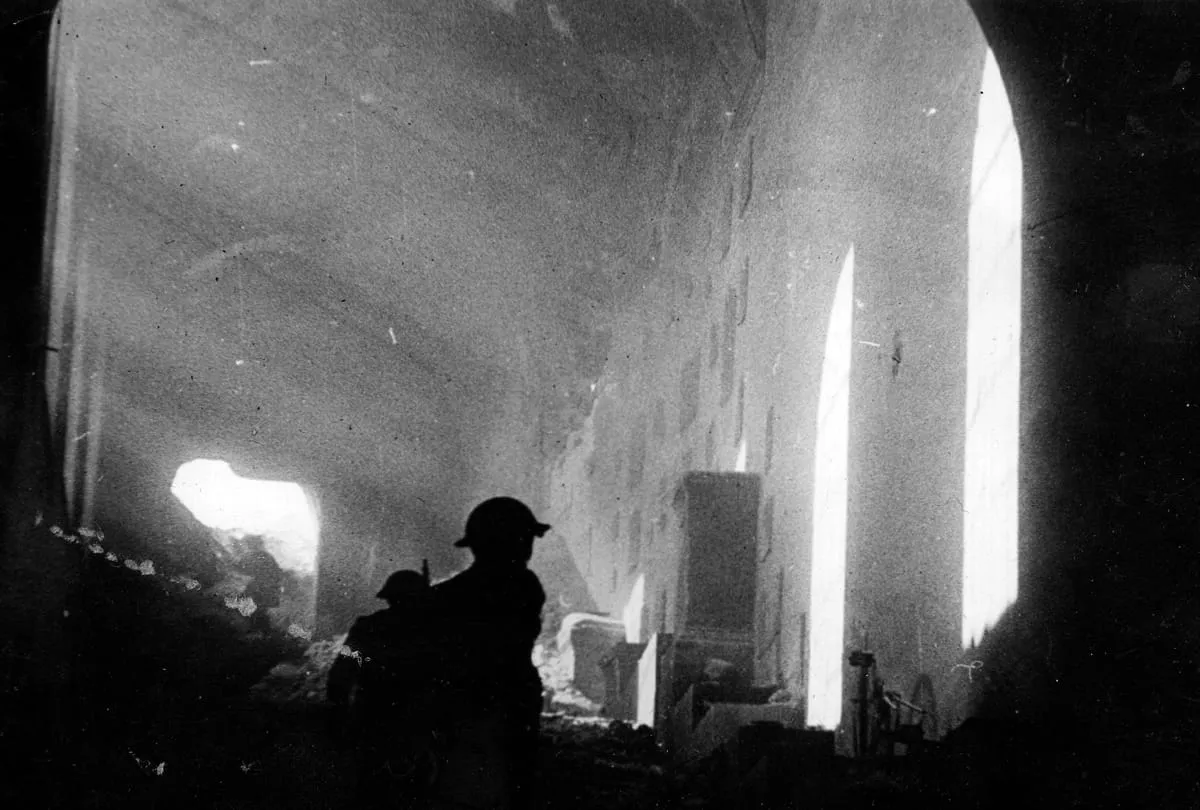
On the morning of 18 May 1944 the pennant of the 12th Podolian Uhlan Regiment was raised on the walls of the shattered Benedictine abbey on Monte Cassino, followed soon afterwards by the Polish flag. The hill, which the Allies had been fighting for since January and against which three earlier attacks had broken, passed into their hands after a week of the heaviest fighting of Operation Diadem. The monastery was not, however, taken in a final assault: the German paratroopers abandoned it on the night of 17/18 May, when the French advance in the Aurunci Mountains and the British advance in the Liri valley threatened to cut them off, and Polish battalions had broken through from the north the ring of hills that shielded the abbey. The uhlan patrol found in the ruins only a dozen or so badly wounded Germans and their medical orderlies.
The capture of the monastery ended the battle of Monte Cassino, which had been under way since 17 January. For the soldiers of General Władysław Anders’s Polish II Corps it was both their greatest success and their hardest ordeal: in a week of fighting for the massif and in the following days for Piedimonte, the corps lost, according to Polish tallies, more than 4,000 killed, wounded and missing. The Germans, meanwhile, were falling back to the next barrier in depth – the Hitler Line, which barred the Liri valley a dozen or so kilometres further west. It is often said that on 18 May the German forces “withdrew to the Hitler Line”, but this needs qualifying: on that day the retreat from the Gustav Line was still in progress, and the Poles would fight for another week for the northern end of the new line at Piedimonte.
The second Polish attack (16–17 May)
The first Polish attack, launched at 1 a.m. on 12 May as part of the fourth battle of Monte Cassino, ended in failure. Battalions of the 3rd Carpathian Rifle Division broke onto Hill 593, and men of the 5th Kresowa Infantry Division onto Phantom Ridge, but fire from mutually supporting heights – Massa Albaneta, Colle Sant’Angelo and Hill 569 – forced them back to their start lines in the afternoon. It cost several hundred killed and wounded, but it tied down a considerable part of the German reserves in the massif at the very moment the battle was being decided further south.
There the breakthrough came. After heavy fighting the British XIII Corps held and expanded its bridgeheads over the Gari, and on 13 May the French 2nd Moroccan Infantry Division took Monte Maio, opening a way through the Aurunci Mountains for General Alphonse Juin’s expeditionary corps. From 14 May the French and the Moroccan goumiers were working round the rear of the Gustav Line, and on 15 May the British 78th Infantry Division entered the battle in the Liri valley, tasked with outflanking Cassino from the west and cutting Highway 6 – the only supply route for the defenders of the town and the monastery.
On the morning of 16 May the commander of the Eighth Army, General Oliver Leese, decided that the Poles would renew their attack. Anticipating it, the 16th Lwów Rifle Battalion of the 5th Kresowa Division seized Phantom Ridge in a raid on the evening of 16 May and held it, taking bunker after bunker. The main assault went in early on the morning of 17 May. The Carpathians took Hill 593 once again, the Kresowa men attacked Colle Sant’Angelo, and the paratroopers replied with counter-attacks supported by heavy mortars firing from the ravines behind the ridge. The fighting was at grenade-throwing range, and several times it came to hand-to-hand combat. When, during one counter-attack, the Polish defence on Sant’Angelo began to crack, Sergeant Marian Czapliński – as Melchior Wańkowicz described it – struck up the national anthem, and the soldiers held their position.
By the evening of 17 May the Poles had taken the northern part of Colle Sant’Angelo and Massa Albaneta, breaking the northern end of the ring of hills that shielded the monastery. Both sides were at the end of their strength. Some German companies were down to a handful of men fit to fight, and the Poles had no reserves left; as Anders later recalled, drivers, sappers and rear-echelon troops were being gathered for an attack the following day. At the same time, in the Liri valley, the British 78th Division cut Highway 6 west of Cassino, and the British 4th Division was tightening the ring around the ruins of the town.
The Germans abandon the monastery
The massif and the ruins of Cassino were still held by General Richard Heidrich’s 1st Parachute Division – the same formation that in March had repulsed the New Zealanders and Indians in the third battle of Monte Cassino. The commander of XIV Panzer Corps, General Fridolin von Senger und Etterlin, had been on leave in Germany when the offensive began, and the defence of the whole sector from Cassino to the sea was directed by the headquarters of General Heinrich von Vietinghoff’s Tenth Army. Once the French had broken the front in the Aurunci Mountains and the British had reached Highway 6, the divisions in the massif faced encirclement. On 16–17 May the commander of German forces in Italy, Field Marshal Albert Kesselring, agreed to abandon the Gustav Line in the Cassino sector (sources differ on the day and hour of his decision). According to some authors, the paratroopers, convinced that they could go on defending the monastery, withdrew only on Kesselring’s explicit personal order.
The Poles intercepted a German message about the withdrawal from the monastery, and Polish artillery shelled the lines of retreat all night. During the night of 17/18 May the paratroopers left the ruins of the abbey and the town. Some fought their way under fire towards Monte Cairo and Piedimonte; others – about a hundred men, according to Polish accounts – headed south into the Liri valley, preferring to surrender to the British. The withdrawal was covered by small groups of riflemen left in position. Only the wounded who could not be evacuated remained in the ruins of the monastery, with a few medical orderlies.
Uhlans in the ruins of the abbey (18 May)
On the morning of 18 May Polish observers spotted a white flag above the ruins of the monastery. A patrol of the 12th Podolian Uhlans – the reconnaissance regiment of the 3rd Carpathian Rifle Division – was sent forward under Second Lieutenant Kazimierz Gurbiel. The uhlans crossed the minefield on the slope without loss and entered the rubble of the abbey, destroyed by bombing on 15 February. They took prisoner the wounded paratroopers and the orderlies caring for them; according to Polish accounts there were sixteen wounded and three orderlies, while English-language sources speak of about thirty men.
The uhlans first planted on the walls the regimental pennant, hastily sewn by Lance Sergeant Jan Donocik. Soon a white-and-red Polish flag was flying beside it, carried throughout the attack in his haversack by Staff Sergeant Ryszard Stachurski, the company sergeant major of the 3rd Company, 5th Carpathian Rifle Battalion. The time it was raised is usually given as around 10.20 a.m. A few hours later, on Anders’s express instruction, a British flag was hoisted beside the Polish one, as a sign that the victory belonged to the whole Eighth Army. At noon Lance Sergeant Emil Czech played the Hejnał mariacki, the trumpet call of Kraków’s St Mary’s Church, over the ruins.
The same day the British 4th Division finally cleared the rubble of Cassino town, and units of the 78th Division made contact with Polish patrols west of the monastery. On the hills of the massif, however, fighting continued: German covering parties held out on the western slopes, and the Poles cleared the last heights, including Colle Sant’Angelo and Hill 575, only on 19 May. That evening the Polish divisions established firm contact with the 78th Division near Santa Scolastica, and on 20 May the commander of 15th Army Group, General Harold Alexander, thanked the Poles for the victory in an order to II Corps.
The Hitler Line and Piedimonte
After losing Monte Cassino, the Tenth Army fell back to the Hitler Line – a belt of fortifications several kilometres deep, built since the winter a dozen or so kilometres behind the Gustav Line. It ran from Monte Cairo through Piedimonte, Aquino and Pontecorvo to Terracina on the coast. In May 1944, at Hitler’s wish, it was renamed the Senger Line (Senger-Riegel), so that a possible breach would not damage the Führer’s prestige. Not every sector could be manned in time: the retreating divisions reached their new positions exhausted and depleted, and Juin’s French corps had taken Esperia on 17 May and was approaching the line’s southern sector near Pico.
The northern anchor of the line was the small town of Piedimonte San Germano on the slope of Monte Cairo, a few kilometres west of the monastery. Its capture was entrusted to the Poles. The task was carried out by an ad hoc battle group (Group “Bob”), while the 15th Poznań Uhlans seized the Passo Corno and the summit of Monte Cairo. After several days of hard fighting Piedimonte fell on 25 May. Meanwhile, on 23 May, I Canadian Corps attacked the Hitler Line in the Liri valley and the US VI Corps broke out of the Anzio beachhead. The Hitler Line, to which the Germans were only just retreating on 18 May, thus held for less than a week.
The price of victory
For the Polish II Corps the fighting for the Monte Cassino massif and Piedimonte lasted just under two weeks, from the night of 11/12 May to 25 May. According to Polish tallies the corps lost 923 killed, 2,931 wounded and 345 missing, most of whom – 251 men – later returned to their units. The losses were concentrated in the infantry battalions of both divisions, which in two attacks went for the same hills; some companies were bled almost white. There was nothing to replace them with: a corps made up of soldiers brought out of the Soviet Union in 1942 had no recruiting base, and the evacuations from the USSR had ended back in 1942. It was precisely for this reason that the Commander-in-Chief, General Kazimierz Sosnkowski, had opposed giving the Poles a frontal assault.
The dead were at first buried in makeshift graves on the slopes. On 18 May Anders decided to establish a cemetery for them on the slope between the monastery and Hill 593. The Polish War Cemetery at Monte Cassino, designed by Wacław Hryniewicz and Jerzy Skolimowski, was opened on 1 September 1945. More than a thousand soldiers lie there, and in 1970, in accordance with his wishes, Anders was buried there too. The obelisk on Hill 593 bears the inscription: “For our freedom and yours, we Polish soldiers gave our souls to God, our bodies to the soil of Italy and our hearts to Poland.”
According to historians’ estimates, the Allies paid for the whole battle of Monte Cassino, from January to May, with about 55,000 killed, wounded and missing; German losses are estimated at about 20,000. The civilians of Cassino and the surrounding villages also suffered heavily, and after the breakthrough in the Aurunci Mountains the people of Ciociaria fell victim to mass rapes and killings committed by soldiers of the French colonial units.
“The Red Poppies on Monte Cassino”
On the night of 17/18 May, while the second Polish attack was under way, the poet and singer Feliks Konarski, known as Ref-Ren, head of the II Corps front-line theatre troupe, wrote the words of the song “The Red Poppies on Monte Cassino”. The composer and conductor Alfred Schütz, whom he woke, set them to music within a few hours. According to the most often repeated version, the song was first performed by Gwidon Borucki on 18 May itself, at an improvised ceremony celebrating the victory; accounts differ as to where. The poppies of the title bloomed in May on the shell-torn slopes. The song became the best-known Polish soldiers’ song of the Second World War, and its words about poppies that “drank Polish blood instead of dew” have kept the memory of the battle alive for generations.
Place in the war
Militarily, the capture of Monte Cassino closed the longest and bloodiest battle of the Italian campaign. The massif, which since January had blocked the entrance to the Liri valley and Highway 6, no longer threatened the Eighth Army’s flank, and the British and Canadians could move against the Hitler Line. Yet the decision came from the offensive of the whole 15th Army Group: the bridgeheads over the Gari and the French march through the Aurunci Mountains did as much to break the Gustav Line, while the Polish attacks – even though the first failed – pinned down in the massif one of the best German divisions just as it was losing the battle in the valley. On 4 June 1944 the US Fifth Army entered Rome, but the German Tenth Army escaped encirclement and withdrew north towards the Gothic Line. The campaign in Italy would last almost another year, and the Polish II Corps fought on in it – along the Adriatic, at Ancona in July 1944 and at Bologna in April 1945.
For the Poles the battle had a significance that went far beyond its military outcome. Anders accepted the task in the hope that victory in a battle the whole world was talking about would strengthen the Polish government’s position towards Stalin and the Western Allies. The capture of the monastery was widely reported in the Allied press, but it did not change decisions already taken at the Tehran Conference, where Churchill and Roosevelt had agreed in principle to shift Poland’s eastern border to the Curzon Line. Most of the corps’ soldiers came from the eastern lands of the Second Polish Republic – from the regions of Wilno and Nowogródek, from Volhynia and from Lwów. After the Yalta Conference in February 1945 their home regions ended up within the borders of the USSR, and many of them never returned to Poland.
In communist Poland the battle was for years passed over in silence or played down, because its heroes were soldiers of an army loyal to the government-in-exile. Only after 1956 did its anniversaries begin to be marked publicly, and full remembrance of the battle returned after 1989. Monte Cassino became one of the most important Polish symbols of the Second World War – a victory bought at a great price that did not bring those who fought for it the free homeland they had gone into battle for.
Sources
Meanwhile
(04)Elsewhere, within a week.
- 18 May 1944 · PacificThe end of the fighting in the Admiralty IslandsOn 18 May 1944 General Krueger declared the Admiralty Islands operation over. Japanese stragglers still hid in the jungle; Seeadler Harbour became a fleet base.
- 21 May 1944 · Western FrontThe locomotive huntOn 21 May 1944 hundreds of Allied fighters attacked trains in France, Belgium and Germany. Before the invasion, aircraft were also destroying the Seine bridges.
- 12 May 1944 · Eastern FrontThe end of the fighting in the CrimeaOn 12 May 1944 the last 17th Army units on the Chersonese surrendered. The Crimea was in Soviet hands; many Axis troops were evacuated, thousands drowned.
- 12 May 1944 · PacificThe Chinese cross the SalweenOn the night of 10/11 May 1944 General Wei Lihuang's Chinese Expeditionary Force began crossing the Salween in Yunnan to reopen the Burma Road.
Related events
(04)The same battle, people or subject.
- 11 May 1944 · MediterraneanThe fourth battle of Monte CassinoAt 11 p.m. on 11 May 1944 the Allies struck the Gustav Line, opening Operation Diadem. On 12 May the Polish II Corps assaulted the Monte Cassino massif.
- 17 January 1944 · MediterraneanThe Battle of Monte Cassino beginsOn 17 January 1944 British X Corps crossed the lower Garigliano at the western end of the Gustav Line. The first Battle of Monte Cassino had begun.
- 4 June 1944 · MediterraneanThe Allies in RomeOn 4 June 1944 the US Fifth Army entered Rome, which the Germans had left without fighting in the city – the first Axis capital taken by the Allies.
- 3 March 1944 · MediterraneanThe Germans go on the defensive at AnzioOn 3 March 1944 the Germans gave up further attacks on the Anzio beachhead. After the failed assault at Cisterna the front froze into static warfare until May.