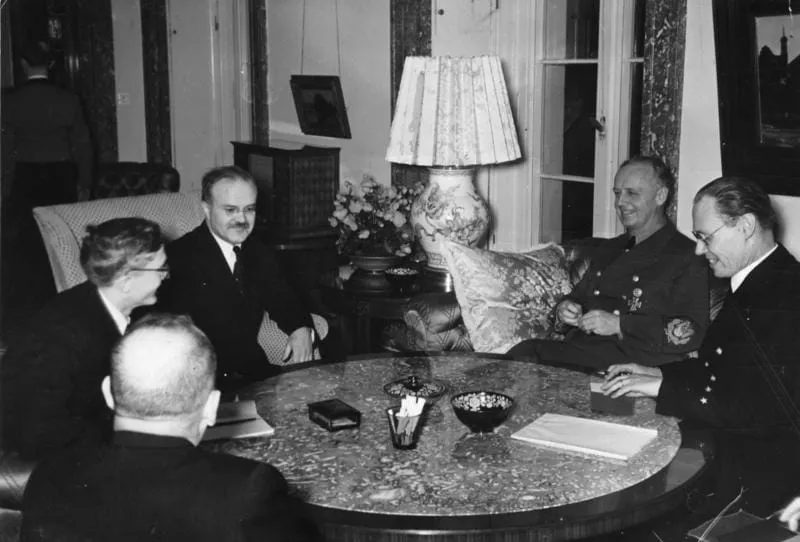
At eleven in the morning on 12 November 1940 a special train from Moscow pulled into Berlin’s Anhalter Bahnhof. Out of it stepped Vyacheslav Molotov, Chairman of the Council of People’s Commissars and People’s Commissar for Foreign Affairs of the USSR, Joseph Stalin’s closest associate. On a platform decked with German and Soviet flags he was welcomed by the Reich Foreign Minister, Joachim von Ribbentrop. Over two days Molotov held two conversations with Ribbentrop and two with Adolf Hitler. The Germans unfolded before him a vision of the world divided among four powers after what they claimed would be Britain’s imminent defeat. Molotov, following Stalin’s instructions, asked about matters closer to home: Finland, Romania, Bulgaria and the Black Sea Straits. His last conversation, with Ribbentrop on the night of 13 to 14 November, took place in an air-raid shelter, because British bombers had appeared over Berlin. On the morning of 14 November he left without any agreement.
It was the only visit by a Soviet head of government to the Third Reich and the high point of the collaboration between the two dictatorships that had begun with the Molotov–Ribbentrop Pact in August 1939. It was also the beginning of its end. In Berlin Hitler became convinced that Stalin could not be diverted from Europe by promises in Asia, and five weeks later he signed the order to prepare an attack on the Soviet Union.
Allies who did not trust each other
A year after the partition of Poland, German–Soviet relations looked exemplary from the outside. Under the economic agreement of February 1940 the Soviet Union supplied the Reich with grain, oil and ores and helped it get round the British blockade. Beneath the surface, however, mistrust was growing. In the summer of 1940, while the Wehrmacht was crushing France, Stalin hastily seized what the secret protocol had granted him on paper: he incorporated Lithuania, Latvia and Estonia into the USSR and took Bessarabia from Romania – and with it northern Bukovina, which the protocol did not mention. Hitler responded on 30 August with the Second Vienna Award: Germany and Italy guaranteed the inviolability of truncated Romania’s borders. Since Hungary had received northern Transylvania at Vienna, and Bulgaria southern Dobruja a week later, the guarantee could in practice protect Romania against only one neighbour: the Soviet Union. In October a German military mission arrived there, and from September, under a transit agreement with Helsinki, trains carrying German troops to Norway were running through northern Finland. Finland, which the 1939 pact had assigned to the Soviet sphere of influence and which in March had been forced to accept the harsh terms of the Moscow Peace Treaty, was looking to Berlin for support. Moscow protested that no one had warned it of this.
Hitler had been thinking about war with the Soviet Union since the summer. On 31 July he told the army command that Russia would have to be smashed in the spring of 1941, and General Franz Halder’s General Staff was already drawing up campaign plans. Britain, meanwhile, refused to be beaten: the Luftwaffe had lost the Battle of Britain, and the invasion had been postponed until the spring of 1941. Ribbentrop then put forward the idea of a “continental bloc”, a coalition stretching from Spain to Japan that would rob London of any hope of allies. Alongside the states of the Tripartite Pact, its pillar was to be the Soviet Union, and the ambitions of all the partners were to be directed “southwards”, at the expense of the British Empire. Hitler agreed to the attempt without enthusiasm. At the Brenner on 4 October he told Benito Mussolini that he would gladly steer Soviet ambitions towards India and the Indian Ocean, though he doubted whether the Russians could be moved in that direction. On 13 October Ribbentrop invited Molotov in a letter to Stalin, in which he wrote of the “historical mission” of the four powers – the USSR, Italy, Japan and Germany – to delimit their interests “on a world-wide scale”. Stalin accepted the invitation but stipulated that these matters must first be discussed bilaterally.
Stalin’s instructions
How seriously Moscow took the journey is shown by documents found in the 1990s in the Archive of the President of Russia. On 9 November Molotov wrote down in his notebook “some directives for the Berlin trip”. The historian Lev Bezymensky believes he took them down at Stalin’s dictation. Molotov was to discover the “real intentions” of the Tripartite Pact powers, the boundaries of the “New Europe” and the “Greater East Asian Sphere” and the place intended for the USSR within them, and also to “sound out” an agreement on a Soviet sphere of interest in Europe and in the Near and Middle East. He was to sign nothing: final arrangements were to be made in Moscow, where Ribbentrop was soon to come.
The list of issues was specific. Finland was to remain in the Soviet sphere, and Germany should withdraw its troops from there and put a stop to anti-Soviet “demonstrations”. The “main problem of the talks” was Bulgaria: Moscow wanted to give it a guarantee on the same basis as Germany and Italy had given one to Romania, and to station its troops there. The fate of Turkey, Romania and Hungary could not be decided without Moscow’s participation.
On the evening of 10 November the train left Moscow. The delegation numbered some 65 people, including the Deputy People’s Commissar for Foreign Affairs, Vladimir Dekanozov, and the deputy head of the NKVD, Vsevolod Merkulov. On the same train travelled the German ambassador in Moscow, Friedrich-Werner von der Schulenburg, the most ardent advocate in German diplomacy of an understanding with the USSR – who was nonetheless not admitted to the talks in Berlin.
Day one: “the beginning of the end of the British Empire”
Molotov was lodged in Bellevue Palace, and at noon Ribbentrop received him. The German records of the talks, published by the US State Department in 1948, are today the main source of knowledge about the visit.
Ribbentrop began with a lecture. The “beginning of the end of the British Empire” had come; England was beaten, and the only question was when she would admit it. America’s entry into the war was of no consequence, because Germany and Italy would never again allow the Anglo-Saxons to land on the Continent. The Axis powers were therefore considering not how to win the war but how quickly to end a war already won. Hitler believed that the four powers should delimit their spheres “in very broad outline” and direct their expansion southwards: Japan towards South-East Asia, Germany towards Central Africa, Italy towards North and East Africa. Might Russia not also turn towards the open sea? Molotov asked which sea he meant. Ribbentrop replied that the most advantageous outlet would probably lie in the direction of the Persian Gulf and the Arabian Sea. He also promised support for a revision of the Montreux Convention on the Turkish Straits. Molotov answered with questions: what exactly did the Tripartite Pact mean, and the vague notion of a “Greater East Asian Sphere”? Ribbentrop admitted that it had been new to him too.
In the afternoon, at the New Reich Chancellery (PL), Hitler spoke at length and in generalities. The British air raids on Berlin were “ridiculous”, and when the weather improved Germany would strike England a “great and final blow”. The Reich needed no Soviet military assistance; it did need raw materials, and so it had to be present where it had no political interest, in Romania, for example. Nor would it allow the British to establish themselves in Greece.
Molotov agreed “in general outline”, noting that what he would say reflected Stalin’s views. The 1939 agreement had been carried out with the exception of one point: Finland. Was it still in force on that matter? He then showered his host with questions. What did the “new order” in Europe and Asia mean, and what role would the USSR play in it? Where did the boundaries of the East Asian sphere lie? How were Soviet interests in Bulgaria, Romania and Turkey to be settled? He declared Soviet participation in the Tripartite Pact “entirely acceptable in principle”, but only as a “partner and not an object”. Hitler broke off the conversation, citing the possibility of an air-raid alarm.
That same day he signed Directive No. 18. It dealt mainly with Gibraltar, North Africa and Greece, but it also contained a sentence about Russia: political discussions had been started to clarify its attitude, but “irrespective of their outcome” all the preparations in the east already ordered verbally were to continue.
Day two: the quarrel over Finland
During the night Stalin sent Molotov his comments in cipher and reminded him about the Straits: the security of the USSR could not be assured “without calm in the area of the Straits”, all the more so since Turkey was tied to England and the British had occupied Greek islands and ports. On the morning of 13 November Molotov met Hermann Göring and Hitler’s deputy in the party, Rudolf Hess. After lunch at the Reich Chancellery the second conversation with Hitler began. It lasted about three and a half hours and was far cooler than the first.
Hitler began by listing Soviet transgressions: the USSR had occupied Bukovina, which the protocol had not mentioned, while Germany had shown Moscow “absolutely benevolent neutrality” during the Winter War and drawn the world’s indignation upon itself. He recognised Finland as a Soviet sphere and had no political interests there, but until the end of the war he needed Finnish nickel and timber and did not want a new war in the Baltic. German soldiers were passing through Finland only in transit to Kirkenes, and the movements would soon end.
Molotov replied that the USSR needed no new agreements: the 1939 agreement had assigned Finland to the Soviet sphere, and Moscow regarded it as its duty to “settle the Finnish question definitively”. There could be no German troops there and no anti-Soviet demonstrations. Asked directly whether Russia intended to declare war on Finland, he answered evasively that all would be well if Helsinki abandoned its equivocal attitude. Asked how he envisaged this settlement, he replied, according to the German record, “on the same scale as in Bessarabia and in the adjacent countries”. From the man who a few months earlier had carried out the annexation of the Baltic states, the meaning was unmistakable. Hitler kept repeating that there must be no war in Finland, because it would draw in Sweden and perhaps America as well.
It is often claimed that Molotov asked Hitler for consent to “liquidate” Finland. That wording is too strong, and it comes from Hitler’s own later statements: in his proclamation of 22 June 1941 announcing the attack on the USSR he presented the talks as proof of Soviet designs on Finland. According to the German record Molotov did not ask outright for consent to a war or an annexation. He demanded that Germany withdraw from Finland and leave Moscow a free hand, such as it had had in 1939 – and his comparison with Bessarabia showed what that free hand might be used for. Molotov himself later admitted in a dispatch to Stalin that the Finnish question had taken up “excessive space” in the talks.
Bulgaria and the Straits
Hitler tried to move the conversation on to “more important problems”. Once England was defeated, the British Empire would be divided up as a “gigantic estate in bankruptcy” of forty million square kilometres, in which Russia would find access to an “ice-free and really open ocean”. All those with an interest in the estate – Germany, France, Italy, Russia and Japan – should stop quarrelling and turn to dividing it. He admitted, too, that he did not like the war the Italians had started against Greece, because it drew forces off to the periphery. The failure of the Italian offensive in Epirus and the British attack on Taranto on the night of 11 to 12 November, in which carrier aircraft had put three Italian battleships out of action, did little to support assurances that the war was already won.
Molotov agreed with everything he “had understood”, and returned to Europe. As a Black Sea power, the USSR regarded the guarantee to Romania, given without consulting it, as directed against Soviet interests and wished it to be revoked. The Straits, he reminded his host, invoking the Crimean War and the intervention of 1918–1919, were the historic gateway through which England had attacked Russia. He asked what Germany would say if the USSR gave Bulgaria a guarantee on the same terms as Germany and Italy had given Romania. He gave assurances that Moscow would not alter Bulgaria’s political system “by a hair’s breadth”. Hitler countered by asking whether Bulgaria had even requested a guarantee, and declared that he could take no position without consulting Mussolini. Molotov returned to the matter several times, asking for at least a “provisional expression of opinion”, and each time heard the same answer. Hitler agreed only to a change in the regime of the Straits, so that Soviet warships alone could pass freely through the Dardanelles. The German record of this conversation says nothing about Soviet bases on the Straits, although Hitler claimed in June 1941 that Molotov had demanded them.
Hitler ended the conversation by pointing to the late hour and the possibility of a British air raid. That evening he did not attend the dinner that Molotov gave at the Soviet embassy on Unter den Linden.
The conversation in the shelter
That evening bombers of RAF Bomber Command came over Berlin. Winston Churchill wrote after the war that the British had known of the conference and, though they had not been invited to it, did not wish to be left out altogether. When the alarm sounded, Ribbentrop took his guest from the dinner to his own shelter, and there, from 9.46 p.m. until midnight, the last conversation took place.
Ribbentrop stipulated that he was presenting only “still rather rough ideas”, and read out the outline of a ten-year agreement among the four powers. In it the Soviet Union would declare its solidarity with the aims of the Tripartite Pact, and the four states would respect one another’s “natural spheres of influence” and support one another economically. A secret protocol would set out the directions of their territorial aspirations: Germany’s in Central Africa, Italy’s in North and North-East Africa, Japan’s to the south of the Japanese islands and Manchukuo, and the USSR’s “south of the territory of the Soviet Union in the direction of the Indian Ocean”. A second protocol envisaged joint pressure on Turkey and a new convention on the Straits. Ribbentrop added that Japan was prepared to recognise Soviet influence in Outer Mongolia and Xinjiang, and that an understanding would also be possible regarding any Soviet aspirations “in the direction of British India”.
Some summaries also state that Hitler “offered India to the Soviet Union”. None of the German proposals went that far. Hitler spoke to Molotov of the British “estate in bankruptcy” and the open ocean; India he mentioned in his conversations with Mussolini. In Berlin the Persian Gulf, the Arabian Sea and “the direction of the Indian Ocean” were mentioned, and India came up only in a cautious remark by Ribbentrop. It was more bait than offer: the aim was to turn Moscow’s attention towards Iran and India, away from the Balkans and the Baltic.
Molotov refused to be diverted. The Montreux Convention was worthless, and the Soviet Union needed “effective guarantees”, not paper agreements. He asked about Bulgaria, Romania and Hungary, about the Axis’s intentions towards Yugoslavia and Greece, about the future of Poland, about Swedish neutrality and about the exit from the Baltic through the Danish straits. Ribbentrop replied that he was being “questioned too closely” and kept returning to one question: was the USSR prepared to cooperate in the “great liquidation of the British Empire”? Molotov retorted that the Germans assumed they had already won the war against England. But if they were engaged in a life-and-death struggle with her, he could only understand it to mean that Germany was fighting “for life” and England “for death”. The great questions of tomorrow could not be separated from the questions of today and the fulfilment of existing agreements, and further talks should be conducted through ambassadors.
The most famous exchange of that night did not find its way into the German minutes. According to the account Churchill heard from Stalin in August 1942 and repeated in his memoirs, when Ribbentrop insisted that England was finished, Molotov asked why, in that case, they were sitting in a shelter, and whose bombs were falling on their heads. The anecdote is probably a reworking of the documented remark about fighting “for life” and “for death”, but it captures the tone of that evening well.
“Nothing to boast about”
On the morning of 14 November Molotov left Berlin. He had already reported to Stalin that the talks of 13 November “did not produce the desired results”: most of the time with Hitler had been taken up by Finland, and Hitler would not discuss Bulgaria without the Italians. “There is nothing to boast about,” he concluded, “but at least I have learned Hitler’s present mood, which will have to be reckoned with.” No one in Berlin mentioned Ribbentrop’s visit to Moscow any more.
Officially, all had gone well. On 15 November the State Secretary, Ernst von Weizsäcker, informed German missions that the talks had been held in an atmosphere of mutual trust, and the press in London and Washington wondered whether the USSR might join the Axis. Hitler drew different conclusions. His adjutant, Major Gerhard Engel, noted that the Führer received the outcome with relief: Molotov had “let the cat out of the bag”, and nothing would remain of the alliance, not even a “marriage of convenience”. Stalin did not want an estate in bankruptcy in Asia, but Finland, Bulgaria, the Straits and a say in the affairs of Romania, Hungary, Yugoslavia and Poland – areas that Germany regarded as its own source of raw materials and its glacis.
Place in the war
The Berlin talks were the last attempt to arrange relations between Germany and the USSR as two powers dividing Europe between them, although for Hitler, as Directive No. 18 shows, they were never more than a sounding. Stalin did not give up, and at the end of November he sent Berlin his conditions for joining the pact, which repeated almost everything Molotov had asked about in Berlin. No reply ever came. On 18 December 1940 Hitler signed Directive No. 21, Operation Barbarossa, ordering the Wehrmacht to be prepared to crush Soviet Russia “in a rapid campaign”.
In the first months of 1941 Germany occupied precisely the positions Molotov had claimed. On 1 March Bulgaria joined the Tripartite Pact and the Wehrmacht marched in; in April Germany conquered Yugoslavia and Greece; and Finland tied itself to the Reich and in June joined the war against the USSR. Stalin avoided conflict to the last: deliveries of raw materials to the Reich continued right up to 22 June 1941, when Germany launched Operation Barbarossa.
After the war Moscow maintained for decades that in Berlin it had merely been probing Hitler’s intentions. The German records published in 1948, and after 1991 Stalin’s directives and the telegrams he exchanged with Molotov, showed that the Kremlin took the talks seriously and was ready to divide the world with Hitler, Mussolini and Japan if it got what it wanted in Europe. Historians still argue over whether Stalin really hoped to join the Axis or was mainly playing for time. What is certain is that in Berlin in November 1940 the two dictators tried for the last time to reach agreement at the expense of other nations, and parted convinced that their interests were irreconcilable.
Sources
Meanwhile
(04)Elsewhere, within a week.
- 13 November 1940 · BalkansThe Battle of PindusOn 13 November 1940 the Greeks cleared the Pindus. The Julia Alpine Division, which took Vovousa on 2 November, was encircled and repulsed with heavy losses.
- 14 November 1940 · Western FrontThe Coventry BlitzOn the night of 14–15 November 1940 hundreds of German bombers razed the centre of Coventry and St Michael's Cathedral. Some 568 people were killed.
- 14 November 1940 · BalkansThe Greek counter-offensiveOn 14 November 1940 the Greek army launched a counter-offensive at Korçë and in Epirus. Within ten days it drove the Italians out of Greece and entered Albania.
- 15 November 1940 · PolandThe Warsaw Ghetto is sealedOn the night of 15–16 November 1940 the Germans sealed the Warsaw Ghetto. Some 400,000 Jews were walled off; hunger and smuggling became daily life.
Related events
(04)The same battle, people or subject.
- 12 October 1940 · Western FrontThe invasion of Britain postponed until springOn 12 October 1940 the OKW announced Hitler's decision to postpone the landing in England until spring 1941. Preparations were now merely a means of pressure.
- 18 December 1940 · Central and Eastern EuropeDirective No. 21: Operation BarbarossaOn 18 December 1940 Hitler signed Directive No. 21, Barbarossa: by 15 May 1941 the Wehrmacht was to be ready to crush the USSR in a rapid campaign.
- 25 November 1940 · DiplomacySoviet terms for joining the Tripartite PactOn 25 November 1940 Molotov gave Germany Soviet terms for joining the pact: Finland, Bulgaria, the Straits, the Persian Gulf. Berlin never replied.
- 27 September 1940 · DiplomacyThe Tripartite PactOn 27 September 1940 in Berlin, Germany, Italy and Japan concluded a ten-year alliance aimed at the United States. It was meant to deter America from war.