- Category:
- Diplomacy
- Date:
- 11 December 1941
- Author:
- Natalia
- Tags:
- Third Reich, Italy, United States, Adolf Hitler
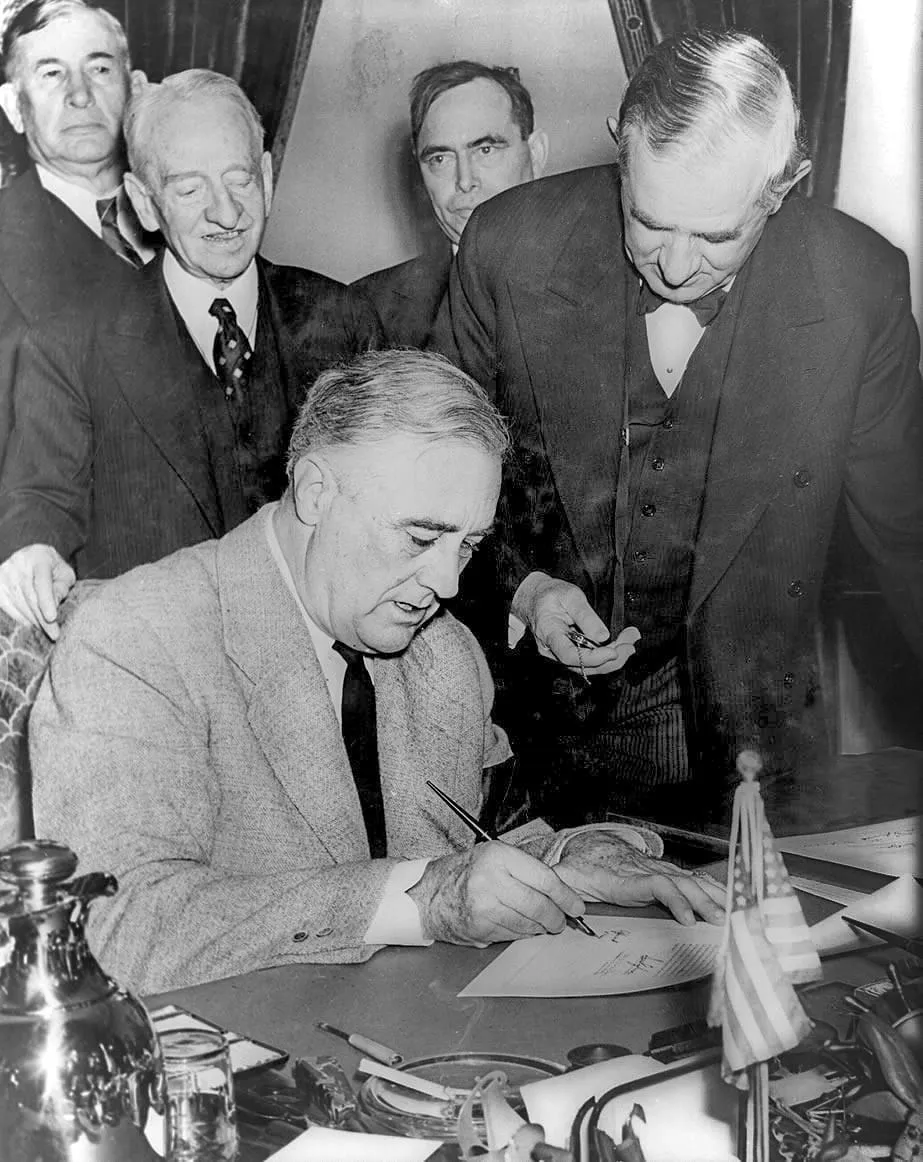
On 11 December 1941, four days after the Japanese attack on Pearl Harbor, the Third Reich and Italy declared war on the United States. In Berlin the foreign minister, Joachim von Ribbentrop, read a note to the American chargé d’affaires, and in the afternoon Adolf Hitler announced the decision in the Reichstag. In Rome Benito Mussolini proclaimed it to the crowd from the balcony of the Palazzo Venezia. That same day Congress in Washington, without a single dissenting vote, declared that the United States was at war with Germany and Italy. In the following days Romania, Slovakia, Hungary, Bulgaria and Croatia followed Berlin’s lead. From that moment the war in Europe, in the Atlantic and in the Pacific was a single war, and America was fighting on all its fronts.
A war already being fought
German–American relations had been deteriorating since the beginning of the war in Europe. The United States was formally neutral, but with every month it sided more openly with Britain: it handed over fifty old destroyers in exchange for bases, passed Lend-Lease in March 1941, took over the protection of Iceland in the summer, and in August President Franklin Delano Roosevelt and Winston Churchill proclaimed the Atlantic Charter, a programme for the peace that was to follow “the final destruction of the Nazi tyranny”. In the autumn Lend-Lease aid was extended to the USSR as well.
In the Atlantic an undeclared war had been under way since the autumn. After the incident involving the destroyer Greer, Roosevelt on 11 September ordered the navy to fire on German warships without warning, and American destroyers began escorting convoys to Iceland. In October a U-boat torpedoed Kearny, and on 31 October U-552 sank Reuben James, with the loss of about a hundred sailors. Throughout 1941, however, Hitler forbade U-boat commanders to attack American warships unless they had to defend themselves, and rejected Admiral Erich Raeder’s requests to lift the restrictions. Until the Wehrmacht had crushed the USSR, he had no need of a war with America.
Formally, too, Germany was under no obligation to help Japan. The Tripartite Pact of September 1940 provided for joint defence only if one of the signatories was attacked by a power not yet at war. In December 1941, however, it was Japan that attacked. Talks on a new commitment had nonetheless been going on for several weeks. According to surviving telegrams, on 28 November Ribbentrop assured the Japanese ambassador in Berlin, Hiroshi Ōshima, that if Japan went to war with the United States, Germany would join in immediately. At the Japanese request for a written undertaking, a draft agreement was prepared at the beginning of December, which also prohibited the conclusion of a separate peace. At the time of the attack on Pearl Harbor it had not been signed, and the Japanese had not told their allies either the date or the target of the strike.
From Pearl Harbor to the decision
News of the attack reached Hitler on the evening of 7 December at his headquarters, the Wolf’s Lair near Rastenburg (Kętrzyn). According to those around him, he received it with enthusiasm. It was also the worst week of the war in the east so far: on 5 and 6 December the Red Army had launched its counter-offensive outside Moscow, and Army Group Centre was for the first time retreating in disorder. On 8 December Hitler lifted all restrictions on the war against American shipping and warships. That same day Ōshima formally asked for a declaration of war on the United States. Also on 8 December Congress declared war on Japan.
On 9 December Hitler came to Berlin. He told Joseph Goebbels that he would announce the war in the Reichstag, and put the session back by a day to prepare his speech. The time was set at 3 p.m., convenient for radio listeners in the Reich and such that the speech would be heard in Tokyo in the evening and in Washington in the morning. Hitler did not call a military conference. General Walter Warlimont of Alfred Jodl’s staff recalled after the war that it was a decision taken entirely alone, without asking the Wehrmacht’s opinion. Ribbentrop later claimed before the Nuremberg tribunal that he had pointed out to Hitler the defensive character of the Tripartite Pact, and that Hitler had dismissed this as irrelevant.
Washington knew what was coming: American intelligence was reading Japanese diplomatic traffic, including Ōshima’s telegrams. On 9 December, in a radio fireside chat, Roosevelt told Americans to remember that Germany and Italy, regardless of any formal declaration of war, already considered themselves at war with the United States. He did not, however, himself ask Congress for war with Germany, although in a Gallup poll of 10 December some 90 per cent of respondents thought he should have done so.
11 December in Berlin
At 2.18 p.m. the United States chargé d’affaires in Berlin, Leland B. Morris, was summoned to Ribbentrop’s office. The interview lasted three minutes. Ribbentrop read out a note in which the Reich government accused the United States of violating every rule of neutrality, of the order to fire on German warships, and of the attacks by Greer, Kearny and Reuben James on U-boats. The note stated that the American government had “virtually created a state of war”, and that Germany was therefore breaking off diplomatic relations and from that day also considered itself at war with the United States. According to George Kennan, then a diplomat at the embassy in Berlin, Ribbentrop shouted at the end: “Your president wanted this war, and now he has it!” The American diplomats were interned at the spa town of Bad Nauheim, from where in the spring of 1942 they were exchanged for German diplomats from America.
In Washington the same text was to be delivered by the German chargé d’affaires, Hans Thomsen. Secretary of State Cordell Hull refused to receive the Germans, and the note was accepted at about 9.30 a.m. Washington time by the head of the State Department’s European Division, Ray Atherton.
At 3 p.m. Hitler spoke in the Kroll Opera House, where the Reichstag had sat since the fire in its own building. He spoke for about an hour and a half. In the first part he reviewed German victories since 1939; he did not mention the crisis outside Moscow. The second part was a personal attack on Roosevelt, whom he accused of unleashing the war in the interests of the “Anglo-Saxon, Jewish-capitalist world”, of betraying neutrality and of driving the world to war to cover up the failure of the New Deal. He thanked Providence for entrusting him with leadership in a historic struggle that would decide the fate of Germany, Europe and the world for five hundred or a thousand years. He announced that Germany, Italy and Japan had that day concluded an agreement in which they undertook to wage the war until victory and not to conclude an armistice or peace with the United States or Britain without mutual consent. The agreement had been signed in Berlin by Ribbentrop, Ōshima and the Italian ambassador, Dino Alfieri.
That same day the Reich’s ambassadors in Budapest, Bucharest, Sofia, Bratislava and Zagreb were instructed to induce the governments of the states that had joined the Tripartite Pact to take the same steps.
Mussolini on the balcony
Italy had no policy of its own in the matter. The American chargé d’affaires in Rome, George Wadsworth, had reported as early as 9 December that in well-informed circles no one doubted that Italy would do what Germany did. At about 2.30 p.m. on 11 December the foreign minister, Galeazzo Ciano, summoned Wadsworth and informed him that Italy was at war with the United States. The American reportedly replied only: “That is very tragic.”
Shortly afterwards Mussolini, in the presence of the Japanese ambassador, Zenbei Horikiri, and the German ambassador, spoke from the balcony of the Palazzo Venezia to the crowd gathered in Piazza Venezia. He spoke for only a few minutes. He announced that Italy and Germany were taking their place “at the side of heroic Japan”, and laid the blame for the war on Roosevelt. In Berlin there was irritation that the Duce had spoken before Hitler. Ciano noted in his diary that the speech was short and sharp and the enthusiasm moderate: it was three in the afternoon, people were hungry and the day was cold. A year and a half after entering the war, Italy, which without German help had been unable to defeat even Greece, was fighting Britain, the USSR and the United States all at once.
Washington’s reply
On the morning of 11 December Roosevelt sent a short message to Congress. “The long known and the long expected has thus taken place,” he wrote, asking for recognition of a state of war with Germany and Italy. Congress met at noon and passed both resolutions without a single dissenting vote: the Senate by 88 to 0 on Germany and 90 to 0 on Italy, the House of Representatives by 393 to 0 and 399 to 0. Congresswoman Jeannette Rankin, who three days earlier had been the only member to vote against war with Japan, this time voted “present”. The resolutions were brought to the White House by Vice President Henry Wallace, and Roosevelt signed them in the afternoon.
Also on 11 December the leaders of the America First Committee, the most important organisation of American isolationists, whose most famous speaker was Charles Lindbergh, decided to dissolve it. The dispute that had divided America for two years ceased to exist. On the same day or in the following days the states of Central America and the Caribbean declared war on Germany and Italy: according to the tallies, Cuba, Costa Rica, the Dominican Republic, Guatemala and Nicaragua on 11 December, Haiti, El Salvador and Panama on 12 December, and Honduras on 13 December. The Dutch government-in-exile proclaimed a state of war with Italy, with which it had not until then been formally at war.
The Axis allies follow suit
The states that had joined the Tripartite Pact in 1940–1941 had no choice. On 12 December Ion Antonescu’s Romania proclaimed a state of war with the United States (it had already been at war with Britain since 7 December), and the government of Jozef Tiso announced that Slovakia was at war with the United States and Britain. On 13 December the Bulgarian National Assembly approved the motion of Prime Minister Bogdan Filov’s government to declare war on Britain and the United States. Bulgaria, which had joined the pact in March, was still not at war with the USSR and regarded this step as a gesture without practical consequences. On 14 December Ante Pavelić’s Independent State of Croatia declared war on both powers. The United States never recognised either Slovakia or Croatia and did not respond to their declarations.
The most tangled case was that of Hungary. On 11 December Prime Minister László Bárdossy broke off diplomatic relations with the United States, hoping that this would suffice. Under German and Italian pressure he announced on 12 December that Hungary considered itself at war with the United States, and on 13 December formally informed the American minister, Herbert Pell. Sources date this step variously, to anywhere between 11 and 15 December, because Bárdossy acted without the consent of parliament and, according to some sources, without that of the Regent, Miklós Horthy, and he finally confirmed the state of war before the parliamentary foreign affairs committee only on 15 December. This was one of the charges at his post-war trial.
Some chronologies state that on 12 December the United States and Britain declared war on Romania, and that on 13 December Britain responded by declaring war on Bulgaria and Hungary. This is only partly accurate. Britain had been at war with Romania and Hungary since 7 December, after an ultimatum that both states, like Finland, had rejected. On 13 December London, together with New Zealand and South Africa, responded with war against Bulgaria alone. The United States declared war on Romania, as on Hungary and Bulgaria, only on 5 June 1942.
Why Hitler did it
The decision of 11 December is regarded as one of Hitler’s most puzzling. He himself justified it on the grounds that the United States was already waging war anyway, and as far as the facts went he had a point: American warships were escorting convoys, hunting U-boats and firing on them, and American supplies were keeping Britain and the USSR going. Ribbentrop repeated that a great power does not wait for war to be declared on it. Hitler believed that Roosevelt would soon do so in any case, and preferred to keep the initiative. Some historians attach a certain importance to the publication by the Chicago Tribune on 4 December of secret American plans for the mobilisation of industry and an army of many millions against Germany.
Strategic calculation also counted. War with America made it possible to unleash the U-boats on American shipping off the coast of the United States before the Americans had organised their defences. Japan, which had just destroyed the Pacific Fleet, could hold down the main US forces in the Pacific and serve Germany as the fleet it did not have. The agreement not to conclude a separate peace was meant to prevent Tokyo from coming to terms with Washington once it had gained what it wanted. The historian Gerhard L. Weinberg stresses that Hitler had long regarded war with America as inevitable and that he now had an ally with one of the largest navies in the world.
Convictions were no less important. Hitler held the economic and military power of the United States in contempt. He saw it as a degenerate state, ruled by Jews, incapable of the effort of a great war. His Luftwaffe adjutant, Nicolaus von Below, recalled being astonished at Hitler’s ignorance of America’s potential. Ian Kershaw described the decision as a characteristic Hitlerian move forward, an attempt to seize the initiative, but a move made from weakness rather than strength, and more irrational than any before it. Joachim Fest saw it as a gesture born of a sudden sense of his own powerlessness, and as Hitler’s last major strategic initiative. Nor was it prepared militarily: the commander of the U-boats, Karl Dönitz, was not warned, and the first boats reached the American coast only in mid-January.
The declaration of war on America coincided with decisions concerning the Jews. On 12 December Hitler addressed the leaders of the Nazi Party and the Gauleiters in his apartment in the Reich Chancellery. Goebbels noted in his diary that Hitler returned to his “prophecy” of 30 January 1939 that a new world war would bring about the annihilation of the Jews: “The world war has come; the annihilation of Jewry must be its inevitable consequence.” Some historians, notably Christian Gerlach, regard this day as the moment of the final decision to murder all the Jews of Europe. Others see it as one stage in a process that had been under way since the summer of 1941. A meeting of officials on the matter, which Reinhard Heydrich had called for 9 December, was postponed and took place on 20 January 1942 as the Wannsee Conference.
Place in the war
In London 11 December was greeted with relief. Churchill had feared two separate wars: a war of Britain and the USSR against Germany in Europe, and a war of America against Japan in the Pacific, in which the United States might turn all its strength against Japan. The economist John Kenneth Galbraith, then an official in Roosevelt’s administration, recalled that after Pearl Harbor the president’s advisers had been terrified that public opinion would demand that every effort be concentrated on the Pacific, and that Hitler’s decision was received as a triumph. Germany’s declaration of war allowed Roosevelt to put into practice the principle agreed in staff talks with the British in the spring of 1941: defeat Germany first. It was confirmed at the conference with Churchill in Washington that began on 22 December, and on 1 January 1942 twenty-six nations signed the Declaration by United Nations, in which they undertook not to make a separate peace with the Axis powers.
The war also took on a strange asymmetry. Germany was fighting the USSR and the United States, and Japan the United States and Britain, but Japan and the USSR, bound by the Neutrality Pact, remained at peace until August 1945. Contrary to Hitler’s hopes, Japan did not strike at Siberia, and Stalin was able to go on moving divisions from the Far East to the west.
In the first months Hitler’s calculation seemed sound. From mid-January 1942, in Operation Paukenschlag (Drumbeat), U-boats sank ships right off the east coast of the United States, and 1942 was the Allies’ worst year of the Battle of the Atlantic. Within a few months Japan occupied Malaya, Singapore, the Philippines and the Dutch East Indies. In the long run, however, the declaration of war on America sealed the Reich’s defeat. The United States, as Roosevelt had promised, became the arsenal of democracy: it produced aircraft, tanks and ships for itself, for Britain and for the USSR. In November 1942 American troops landed in North Africa, and from 1943 they fought in Italy, the first of the Axis states to capitulate. American bombers, together with British ones, wrecked German cities and industry, and in June 1944 American, British and Canadian soldiers landed in Normandy. The war that Hitler declared on 11 December 1941 ended with the capture of Berlin and Germany’s surrender in May 1945.
Sources
Meanwhile
(04)Elsewhere, within a week.
- 11 December 1941 · PacificThe Japanese invasion of Burma beginsIn mid-December 1941 the Japanese took Victoria Point in southern Burma; on 23 and 25 December their bombers struck Rangoon, setting off a flight from the city.
- 10 December 1941 · PacificThe sinking of Prince of Wales and RepulseOn 10 December 1941 Japanese bombers from Indochina sank the battleship Prince of Wales and the battlecruiser Repulse off Malaya. 840 sailors were killed.
- 9 December 1941 · AfricaThe miners’ strike in the Belgian CongoOn 9 December 1941 Force Publique soldiers opened fire on striking Union Minière miners at the football stadium in Élisabethville. Dozens were killed.
- 8 December 1941 · PacificThe Malayan campaign beginsJust after midnight on 8 December 1941 the Japanese landed at Kota Bharu in Malaya and in Thailand. Five days later Yamashita's army beat the British at Jitra.
Related events
(04)The same battle, people or subject.
- 8 December 1941 · DiplomacyThe “Day of Infamy” speechOn 8 December 1941 Roosevelt called Pearl Harbor a day of infamy and Congress declared war on Japan. Within days a dozen or more other states had done the same.
- 7 December 1941 · PacificThe attack on Pearl HarborOn 7 December 1941 aircraft from six Japanese carriers struck Pearl Harbor. 2,403 Americans were killed and four battleships of the Pacific Fleet were sunk.
- 29 April 1942 · DiplomacyThe Hitler–Mussolini meeting at SalzburgOn 29–30 April 1942 Hitler received Mussolini at Klessheim Palace near Salzburg. They discussed the Caucasus offensive, Malta and Italian troops for Russia.
- 11 September 1941 · AtlanticThe shoot-on-sight orderOn 11 September 1941 Roosevelt announced that US ships would no longer wait for U-boats to strike first. Days later the navy began escorting British convoys.