United Kingdom
Edward Wood (Lord Halifax)
Viceroy of India (1926–1931), British Foreign Secretary (1938–1940), ambassador to the United States (1940–1946)
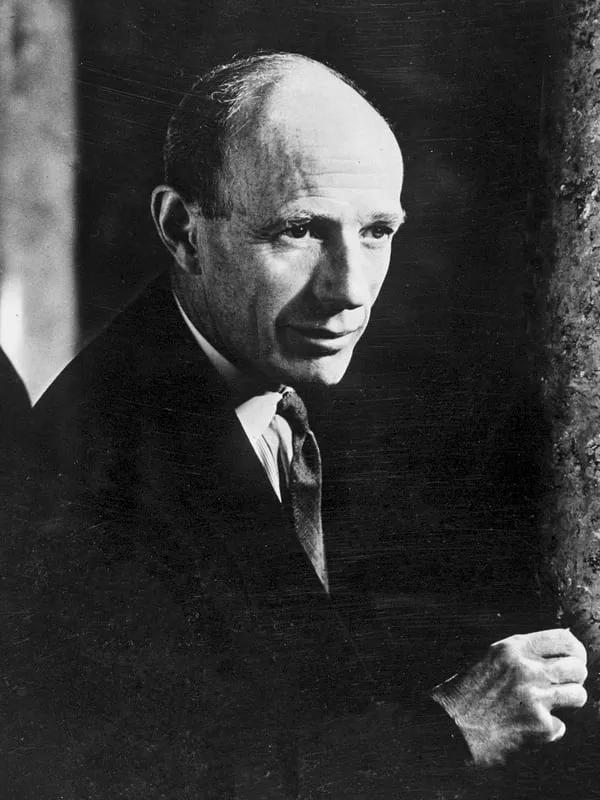
- Born:
- 16 April 1881, Powderham Castle (Devon, England)
- Died:
- 23 December 1959, Garrowby (Yorkshire, England)
- Author:
- Natalia
- Photo:
- Yousuf Karsh, CC BY-SA 3.0 NL, Wikimedia Commons

Edward Frederick Lindley Wood, known successively as Lord Irwin, Viscount Halifax and Earl of Halifax, was one of the most influential British politicians of the 1930s. As Viceroy of India he negotiated with Gandhi; as Foreign Secretary in Neville Chamberlain’s government he helped shape the policy of concessions to Hitler; and then, after Munich and the seizure of Prague, he was one of the authors of the change of course that led to the guarantee to Poland and the declaration of war on Germany in 1939. In May 1940 he could have become Prime Minister, but he stood aside for Winston Churchill. A few weeks later, in the darkest days of Dunkirk, he lost an argument with Churchill over whether to seek peace with Germany through Italian mediation. He spent most of the war as ambassador in Washington. He was nicknamed the “Holy Fox”, a name that combined his deep religious faith, his love of fox-hunting and his political cunning.
The heir
He was born on 16 April 1881 at Powderham Castle in Devon, the home of his maternal grandfather, the Earl of Devon. He was the fourth son of Charles Wood, 2nd Viscount Halifax, a wealthy Yorkshire aristocrat and one of the leaders of the Anglo-Catholic movement in the Church of England. His three elder brothers died in childhood, so at the age of nine Edward became heir to the estate and the title. He was born with an atrophied left arm and no left hand. He wore an artificial hand with a spring-operated thumb that allowed him to hold the reins, and this did not prevent him from becoming a keen rider and huntsman. From his father he also inherited a deep faith that stayed with him all his life.
He was educated at Eton College and then at Christ Church, Oxford, where he took a first in modern history. From 1903 to 1910 he was a fellow of All Souls College; he toured the Empire, from South Africa to India and Australia, and wrote a biography of the clergyman John Keble. In 1909 he married Lady Dorothy Onslow, daughter of the Earl of Onslow. They had five children, one of whom died in infancy.
Member of Parliament and minister
In January 1910 he became Conservative MP for Ripon in Yorkshire, a seat he held until 1925. During the First World War, despite his disability, he served as an officer in a volunteer cavalry regiment, the Yorkshire Dragoons, from 1916 at the front in France, and was mentioned in dispatches. From 1917 he worked at the Ministry of National Service on manpower recruitment. In 1919 he signed an appeal by MPs demanding harsh peace terms for Germany.
In 1921 he became Under-Secretary of State at the Colonial Office, then headed by Churchill. The acquaintance did not begin well: Wood reportedly burst into his superior’s office and declared that he expected to be treated like a gentleman. In October 1922 he supported the break-up of the coalition with David Lloyd George and entered the Cabinet of Andrew Bonar Law as President of the Board of Education. In 1924–1925 he was Minister of Agriculture in Stanley Baldwin’s government. Baldwin, whose protégé Wood was, valued him for his calm and good judgement.
Viceroy of India
In 1925, at the suggestion of King George V, he was offered the post of Viceroy of India. His grandfather had been Secretary of State for India in the 19th century. After some hesitation he accepted, was created Baron Irwin and moved to the House of Lords. In April 1926 he arrived in Bombay. Lord Irwin, who stood nearly two metres tall, was more sympathetic to Indians than his predecessors and from his very first speeches called for an end to the fighting between Hindus and Muslims. He made a serious mistake, however, in recommending that the commission under Sir John Simon, which was to examine India’s future constitution, should consist solely of Britons. The Indian National Congress boycotted the commission, and riots broke out across the country.
Trying to retrieve the situation, Irwin obtained the consent of Ramsay MacDonald’s Labour government for a declaration in October 1929 in which he announced that the goal of British policy was dominion status for India. This caused outrage on the Tory right, while in India it proved too little. In 1930 Mahatma Gandhi launched a civil disobedience campaign and with the Salt March broke the government’s salt monopoly. The Viceroy responded with repression: a ban on public meetings and the imprisonment of Congress leaders, Gandhi himself among them. At the beginning of 1931 he changed course, released Gandhi and held a series of talks with him. On 5 March 1931 they concluded an agreement known as the Gandhi–Irwin Pact: Congress suspended the civil disobedience campaign and the boycott of British goods and agreed to take part in the Round Table Conference in London, while the government released political prisoners convicted of non-violent activities. Irwin wrote to his father that talking to Gandhi was like talking to someone who had stepped off another planet, yet the two men respected each other as deeply religious people. In April 1931 he returned to England and was awarded the Order of the Garter.
In the National Government
In 1931 he declined the Foreign Office, but in 1932 he again became President of the Board of Education. In 1933 he was elected Chancellor of the University of Oxford. In January 1934, on the death of his 94-year-old father, he inherited the title of Viscount Halifax. He helped with the Government of India Act of 1935, and in June 1935 he became Secretary of State for War for a few months. From November 1935 he was Lord Privy Seal and Leader of the House of Lords. In December 1935, when the Hoare–Laval Pact, which handed a large part of Ethiopia to Italy, came to light, Halifax was among the ministers who forced the resignation of Samuel Hoare. Anthony Eden became the new Foreign Secretary, and Halifax informally acted as his deputy.
In May 1937, when Chamberlain became Prime Minister, Halifax took the post of Lord President of the Council. Like most of the British elite, he believed that many German demands stemmed from the injustice of the Treaty of Versailles and that an understanding with Germany had to be reached. In a letter to Baldwin he wrote that nationalism and racialism were a powerful force but that he could not feel them to be either unnatural or immoral, and he regarded the Nazis above all as sincere enemies of communism.
In November 1937, taking up an invitation from Hermann Göring to a hunting exhibition in Berlin, Halifax travelled to Germany, and on 19 November he met Hitler at the Berghof near Berchtesgaden. According to a well-known anecdote, as he got out of the car he almost handed his coat to Hitler, mistaking him for a footman. He did not know that two weeks earlier, at a secret conference in the Reich Chancellery, Hitler had spoken to his commanders about taking Austria and Czechoslovakia. Halifax assured his host that Britain did not rule out changes to the European order concerning Gdańsk (Danzig), Austria and Czechoslovakia, provided they came about peacefully. In Berlin this was read as acquiescence. Eden, increasingly frustrated by the Prime Minister’s interference in foreign policy, resigned on 20 February 1938 in a dispute over talks with Italy. The next day Halifax took his place. Chamberlain thanked God for “a steady unruffled Foreign Secretary”.
Foreign Secretary
A few weeks later Germany carried out the Anschluss of Austria. Halifax accelerated rearmament, but on Czechoslovakia he shared the Prime Minister’s conviction that neither Britain nor France could defend it, and he pressed Prague to make concessions to the Sudeten Germans. In April 1938 London concluded an agreement with Italy, and in May, at the League of Nations, Halifax secured acceptance that each state could decide for itself whether to recognise the Italian conquest of Ethiopia. During the Sudeten crisis he remained in London while Chamberlain flew to see Hitler. The turning point came on 25 September 1938: under the influence of the Permanent Under-Secretary, Alexander Cadogan, Halifax spoke out in Cabinet against the demands Hitler had presented at Bad Godesberg and persuaded his fellow ministers to reject them. After the Munich Conference he defended the agreement in the House of Lords as the lesser evil rather than a triumph, and he advised the Prime Minister against an early general election, urging him instead to broaden the government by bringing in Churchill, Eden and the opposition.
Kristallnacht shook him deeply. From then on, as his biographer Andrew Roberts argues, he came out ever more clearly in favour of a policy of deterrence: rearmament, support for the states of Central and Eastern Europe, and staff talks with France. In January 1939 he accompanied Chamberlain to Rome. After the occupation of Bohemia and Moravia in March 1939 and alarming reports of German pressure on Romania, he was one of the chief architects of the change of course: on 31 March Chamberlain announced in the House of Commons the guarantee to Poland, and after the seizure of Albania guarantees were extended to Romania and Greece. Halifax grasped sooner than the Prime Minister that an agreement with the Soviet Union was needed, although he did not trust Stalin and was repelled by the atheism of the Soviet regime. The talks in Moscow were, however, conducted sluggishly, and the government hoped rather that their mere continuation would keep the USSR from drawing closer to Germany. On 23 August Molotov and Ribbentrop signed their pact.
In June 1939, at Chatham House, Halifax said that Britain would resist any attempt at domination by force, which applied to Gdańsk as well. On 25 August, together with the Polish ambassador Edward Raczyński, he signed the Anglo-Polish Agreement of Mutual Assistance in London. In the last days of peace he described the German demand that a Polish plenipotentiary be sent immediately as “completely unreasonable”. When Germany attacked Poland on 1 September, he received Raczyński at 10.30 a.m. and agreed to warning notes rather than an ultimatum. Together with Chamberlain he delayed the declaration of war while waiting for the French, until a revolt by ministers and the House of Commons forced the ultimatum of 3 September. When the Red Army entered Poland on 17 September, Halifax explained to Raczyński that, under the secret protocol, the agreement applied only to Germany.
The Phoney War
In the War Cabinet Halifax was responsible for foreign policy. He tried to prevent the USSR from going over to the German side and to keep Italy out of the war. He opposed bombing Germany, so as not to provoke retaliation. In October 1939 he helped draft the reply to Hitler’s peace offer, and he also knew of the intelligence contacts with a supposed German opposition that ended in the kidnapping at Venlo. Responding to Swedish soundings, he stated that peace with Hitler in power was impossible. In December, in an exchange of letters with Edvard Beneš, he recognised the Czechoslovak National Committee, and in February 1940 he rebuffed Norwegian protests after the Altmark incident.
May 1940
After the Norway Debate of 7–8 May 1940, Halifax was the natural candidate to succeed Chamberlain. Most Conservatives supported him, the opposition was willing to accept him, and, as is widely believed, so was King George VI. Lord Beaverbrook later remarked wryly that everyone wanted Halifax, including Halifax himself. The last part was untrue. On 9 May, in talks with Chamberlain and Churchill, Halifax declined. The official reason was that as a peer he did not sit in the House of Commons. In his diary he wrote that, with Churchill running the war, he would speedily become “a more or less honorary Prime Minister, living in a kind of twilight just outside the things that really mattered”. He confided to Cadogan that the very thought of the premiership had given him a stomach ache. On 10 May Churchill became Prime Minister, and Halifax remained Foreign Secretary and a member of the five-man War Cabinet.
In the last days of May, as the British Expeditionary Force fell back on Dunkirk and France was tottering, Halifax concluded that it was necessary to find out whether terms of peace preserving the independence of Britain and the Empire could be obtained through Mussolini. On 25 May he spoke with the Italian ambassador, and over the following days he pressed the case in the War Cabinet. There were sharp clashes with Churchill, and on 27 May Halifax threatened to resign. When, however, on 28 May Chamberlain sided with the Prime Minister and the ministers outside the War Cabinet enthusiastically backed his determination to fight on, Halifax gave way (the War Cabinet crisis). On 22 July 1940, after the victory over France, it was he who, in a radio broadcast, rejected the “appeal to reason” that Hitler had addressed to Britain in the Reichstag. The pamphlet Guilty Men, published in the summer of 1940, nonetheless counted him among the politicians responsible for the country’s unpreparedness for war.
Ambassador in Washington
In December 1940, after the sudden death of the ambassador to the United States, Lord Lothian, Churchill, who had become leader of the Conservatives after Chamberlain’s death, sent Halifax to Washington and gave his place at the Foreign Office to Eden. It was in effect an elegant exile, although Halifax kept the right to attend Cabinet meetings when he was in London. In January 1941 he sailed to the United States aboard the battleship HMS King George V, and President Franklin Delano Roosevelt, breaking with protocol, sailed out on his yacht into Chesapeake Bay to greet him.
The beginnings were difficult. Aristocratic and reserved, Halifax made several gaffes, and isolationists accused him of meddling in the disputes over the Lend-Lease bill. In time, however, he learned public diplomacy, toured the country and met ordinary Americans, and even being pelted with eggs by isolationists turned to his advantage. He maintained good relations with Roosevelt and his adviser Harry Hopkins. After Pearl Harbor he became a popular figure in Washington. The war touched him personally: in October 1942 his son Peter was killed in Egypt, and at the beginning of 1943 his youngest son, Richard, was gravely wounded and lost both legs. In 1944 Halifax was made an earl. In 1945 he was one of the British delegates to the San Francisco Conference, which adopted the Charter of the United Nations. At the request of the Labour Foreign Secretary Ernest Bevin, he stayed on in Washington until May 1946 and helped negotiate the large American loan to Britain.
Last years
After returning to England he declined to rejoin the inner leadership of the Conservative Party. In 1947 he supported in the House of Lords the plan to grant India independence and won over many wavering peers. He held numerous honorary posts: he was Chancellor of the Order of the Garter, Chancellor of the University of Oxford and of the University of Sheffield, and chairman of the BBC’s General Advisory Council. In 1956 he criticised the government for the Suez intervention, which damaged relations with the United States. In 1957 he published his memoirs, Fulness of Days, which were regarded as evasive: in them he presented himself as Chamberlain’s loyal subordinate and passed over his own role in the change of course in the spring of 1939. He died of a heart attack on 23 December 1959 at Garrowby, the family estate in Yorkshire.
Assessment
For decades after the war Halifax was seen as the embodiment of appeasement, alongside Chamberlain, Hoare and John Simon. The opening of the archives in the 1970s revealed a more complex picture. Halifax, like Chamberlain, long failed to understand Hitler’s nature and overestimated what negotiation could achieve, and his visit to the Berghof in 1937 confirmed the Germans in their belief that London would accept changes in Central Europe. Yet it was he who, in the autumn of 1938, was the first in the Cabinet to draw a line against Hitler’s demands, and it was he who, in the spring of 1939, pushed the government towards the policy of deterrence expressed in the guarantee to Poland.
The most contested moment of his career remains May 1940. His refusal of the premiership, which his biographer David Dutton considered the most important decision of Halifax’s life, opened the way for Churchill. Some see the dispute over Italian mediation as readiness for a second Munich, others as a rational attempt to find out whether the country could preserve its independence without risking defeat. Whatever one’s verdict, Halifax lost it to a man who understood that merely opening talks would break the will to fight. In Washington, on the other hand, he helped to build the alliance that decided the outcome of the war.
Sources
Mentioned in battles
(01)Often appears with
People who appear in the same events.
On the timeline
(48)The 40 most important of 48 events. All tagged “Edward Wood (Lord Halifax)” (1) →
1937
1939
March
April
June
July
August
- 25
- Key eventThe Anglo-Polish allianceOn 25 August 1939 Raczyński and Halifax signed a mutual assistance agreement in London. A secret protocol stated that the “European Power” meant Germany.
- Hitler halts the attack on PolandOn 25 August 1939 Hitler ordered an attack on Poland for the next dawn, but that evening revoked it after news of the London alliance and Mussolini's refusal.
September
- 01
- Hitler’s Reichstag speechOn 1 September 1939 Hitler told the Reichstag at the Kroll Opera House that since 5.45 Germany had been “returning fire”. He cast the war as self-defence.
- Britain and France demand a German withdrawal from PolandOn the evening of 1 September 1939 Henderson and Coulondre demanded that Germany withdraw from Poland. The notes were a warning, not an ultimatum.
- 03
- Key eventBritain and France declare war on GermanyOn 3 September 1939 Britain at 11 a.m. and France at 5 p.m. found themselves at war with Germany. Warsaw cheered, but no real help arrived.
- Chamberlain’s War CabinetOn 3 September 1939 Chamberlain formed a nine-man War Cabinet with Churchill at the Admiralty, conscription for men aged 18–41 began and Gort took over the BEF.