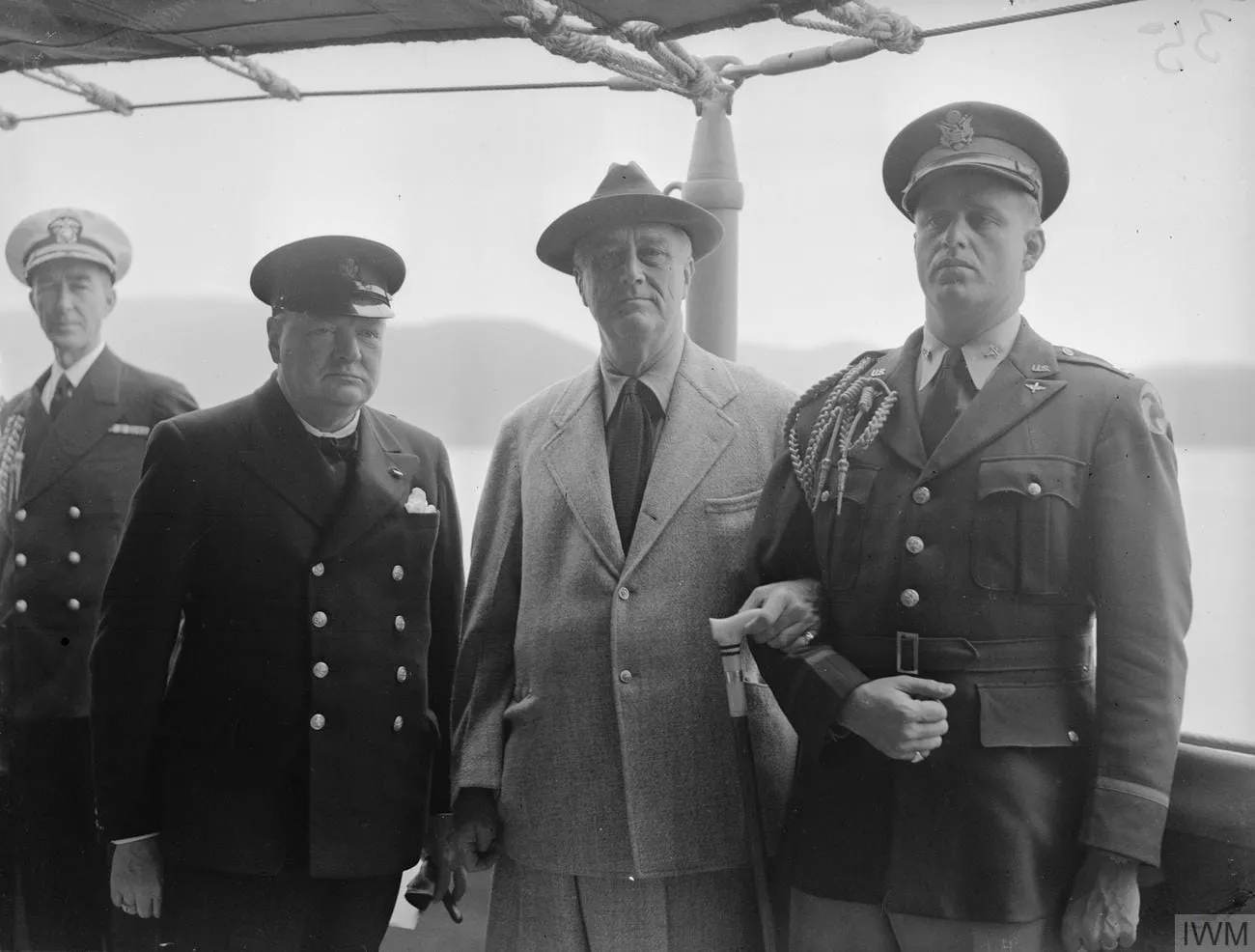
On the morning of 9 August 1941 the British battleship HMS Prince of Wales entered Placentia Bay in Newfoundland and dropped anchor near the American heavy cruiser USS Augusta. Aboard the battleship was Prime Minister Winston Churchill; waiting on the cruiser was President Franklin Delano Roosevelt. For four days, until 12 August, the two leaders and their advisers conferred aboard the ships anchored off Argentia, where an American naval base had been under construction for several months. It was their first meeting of the war. Its most lasting result proved to be a short declaration of eight “common principles” of the two countries’ policy, announced on 14 August and soon called the Atlantic Charter.
Some chronologies record under 9 August that the Atlantic Charter was “drawn up, signed and released to the world press” that day. This needs correcting. On 9 August the talks were only beginning; the text was agreed over the following days and announced on 14 August, simultaneously in London and Washington. Nor was the Charter a signed document. The text was sent to both capitals by telegram, and a signed original never existed.
A meeting postponed since the winter
The idea of a personal meeting between the leaders arose at the beginning of 1941. When the President’s closest adviser, Harry Hopkins, flew to London in January, he was to tell Churchill that Roosevelt would gladly see him. According to a note by the President, the Prime Minister voiced the same idea before Hopkins had a chance to mention it. Roosevelt, however, was kept in Washington by work on the Lend-Lease Act, and Churchill by the war in Greece and on Crete. The matter was settled at the end of July, during Hopkins’s second stay in England. A date was set for 8–10 August, and a place: Placentia Bay, where the Americans were building their base at Argentia under the destroyers-for-bases agreement.
The summer of 1941 was a time of great uncertainty for Britain. The British had lost Greece and Crete, Rommel stood on the Egyptian frontier, and on 22 June Germany had attacked the Soviet Union. Few in London or Washington believed that the Red Army would hold out for more than a few weeks. Churchill had concluded an agreement on joint action with Stalin. In the Far East, Japan had moved into southern Indochina in July, to which the United States, Britain and the Netherlands responded by freezing Japanese assets, and on 1 August Washington blocked oil exports to Japan. London feared a Japanese strike against British and Dutch possessions.
The United States was formally still neutral, but less so with each passing month. Since March it had been supplying arms under the Lend-Lease Act, in April it had taken Greenland under its protection, and in July its troops had landed in Iceland. Churchill sailed to the meeting hoping to bring America closer to the war, or at least to obtain more supplies and a firm warning to Japan. Roosevelt wanted to learn British plans and to hear an assurance that London had concluded no secret territorial agreements of the kind that had discredited the Allies in the First World War. Cadogan assured Welles that there were no such agreements.
Two voyages in secret
Both leaders travelled in strict secrecy. Roosevelt set out on 3 August aboard the presidential yacht Potomac, officially for a few days’ fishing off the coast of New England. The next day, far from the journalists, he transferred to Augusta, flagship of the Atlantic Fleet under Admiral Ernest King. He was accompanied by the Chief of Naval Operations, Admiral Harold Stark, the Army Chief of Staff, General George Marshall, and the chief of the Army Air Forces, General Henry H. Arnold. When the President learned that Churchill was bringing the Permanent Under-Secretary at the Foreign Office, Sir Alexander Cadogan, he summoned Under Secretary of State Sumner Welles and Averell Harriman, the Lend-Lease supply coordinator in London. Secretary of State Cordell Hull stayed in Washington.
Churchill sailed from Scapa Flow on 4 August in one of Britain’s newest battleships – the same one alongside which, in the action with Bismarck in May, Hood had been sunk. He took with him the First Sea Lord, Admiral Dudley Pound, the Chief of the Imperial General Staff, General John Dill, and Air Chief Marshal Wilfrid Freeman, Vice-Chief of the Air Staff. Also on board was Hopkins, who on 30 and 31 July had talked with Stalin in Moscow and brought what the meeting needed most: a first-hand assessment that the Russians would fight on, and a list of their needs.
Four days in Placentia Bay
When Prince of Wales anchored in the bay on the morning of 9 August, Churchill went across to Augusta and handed the President a letter from King George VI. The two men had corresponded regularly since September 1939, and now for the first time they could talk face to face. In the evening the President gave a dinner aboard the cruiser, after which Churchill spoke at length about the war situation.
On Sunday 10 August Roosevelt came aboard Prince of Wales. On the quarterdeck, beneath the battleship’s guns, a joint service was held for the sailors of both fleets. Churchill himself chose the hymns, among them “Onward, Christian Soldiers” and “Eternal Father, Strong to Save”, the sailors’ hymn. Churchill later wrote that it was a great moment, and that nearly half of those singing on deck were soon to die. Prince of Wales was sunk by Japanese aircraft four months later.
The chiefs of staff discussed supplies, strategy and American help in the Atlantic, and Marshall and Dill struck up an acquaintance that later greatly eased cooperation between the two staffs. The leaders conferred with Hopkins, Welles and Cadogan taking part. The Minister of Supply, Lord Beaverbrook, who had flown in from Britain, joined the final talks. On the afternoon of 12 August the ships weighed anchor.
How the eight points came about
The idea of a joint declaration came from Roosevelt, who at the dinner on 9 August had already proposed announcing at the end of the meeting the principles by which the two countries would be guided. The first draft, however, was prepared on Churchill’s instructions by Cadogan, who handed it to Welles on 10 August, before Sunday lunch. It had five points, and the first three – on the renunciation of aggrandisement, on border changes in accordance with the wishes of the peoples concerned, and on the right to choose one’s government – passed into the final text almost unchanged. The last one promised a peace that, through an “effective international organisation”, would give security to all.
Welles reworked this text on the morning of 11 August, and the President approved his version. Two issues caused the most dispute. The first was trade. The American draft spoke of access for all nations to the markets and raw materials of the world “without discrimination”. Churchill at once asked whether this referred to the Ottawa agreements of 1932, that is, to tariff preferences within the British Empire. Welles replied that of course it did. The Prime Minister answered that he was himself an opponent of preferences, but that he could not agree to this without the consent of the Dominions, whose views he could not learn for at least a week. Hopkins held that the declaration could not be held up for such a reason. In the end a reservation was inserted that the two countries would act “with due respect for their existing obligations”, which in practice protected imperial preference. The dispute over the meaning of these words went on for several more weeks.
The second issue was a future international organisation. Roosevelt wanted no mention of it, fearing that in America it would be read as heralding a return to the League of Nations and that the isolationists would accuse him of secret commitments. He believed that after the war the United States and Britain would for a time have to keep order themselves. It ended in a compromise: the disarmament of states threatening aggression was deemed essential “pending the establishment of a wider and permanent system of general security”. Churchill also added to the point on the right of peoples to choose their government a phrase about restoring “sovereign rights” to those who had been forcibly deprived of them. The text, sent to London on 11 August, was accepted by the War Cabinet overnight, with the further proposal of a point on social security, which was adopted.
The final version opened with the statement that the President of the United States and Prime Minister Churchill, representing His Majesty’s Government in the United Kingdom, “deem it right to make known certain common principles in the national policies of their respective countries on which they base their hopes for a better future for the world”. There were eight principles:
- Their countries seek no aggrandisement, territorial or other.
- They desire no territorial changes that are not in accord with the freely expressed wishes of the peoples concerned.
- They respect the right of all peoples to choose the form of government under which they wish to live, and they wish to see sovereign rights and self-government restored to those who have been forcibly deprived of them.
- With due respect for their existing obligations, they will strive to ensure that all states, great or small, victor or vanquished, have access on equal terms to the trade and raw materials of the world needed for their prosperity.
- They desire the fullest cooperation among all nations in the economic field, in order to secure for all better labour conditions, economic advancement and social security.
- After the final destruction of the Nazi tyranny, they hope for a peace that will enable all nations to live in safety within their own borders and assure that all people in all lands may live free from fear and want.
- Such a peace should enable all to traverse the seas and oceans freely.
- All the nations of the world, for practical as well as spiritual reasons, must abandon the use of force. Since peace cannot be maintained while states that threaten aggression outside their borders retain land, sea and air armaments, their disarmament is essential until a wider and permanent system of general security is established. The two countries will also support every other practicable measure that will lighten for peace-loving peoples the crushing burden of armaments.
Many of these formulations sounded familiar. They recalled the Fourteen Points of President Woodrow Wilson of 1918, while freedom from fear and want repeated two of the “Four Freedoms” that Roosevelt had proclaimed in his message to Congress in January 1941. The fourth point, promising equal access to trade even to the vanquished, was a rejection of the punitive peace of 1919.
Japan, Russia and the Atlantic
The meeting also produced decisions that mattered more at the time than the declaration. Churchill pressed for a joint, parallel warning to Japan by the United States, Britain and the Netherlands: any further Japanese encroachment in the South-West Pacific would compel these countries to take countermeasures, even if these might lead to war. Roosevelt wanted to leave Tokyo a path to negotiations, and in Washington Hull softened the warning further. On 17 August the President told Ambassador Kichisaburō Nomura that if Japan took further steps towards dominating neighbouring countries by force or the threat of force, the United States would be compelled to take immediately all steps necessary to safeguard its rights and interests. The word “war” did not appear in the text.
Aid to the Soviet Union was also agreed. While still in Placentia Bay, Roosevelt and Churchill prepared a joint message to Stalin, delivered to him in Moscow on 15 August, proposing a conference in Moscow on supplies. In the Atlantic the Americans agreed to take over the escort of convoys on the western part of the route, as far as Iceland, including when the convoys contained ships not under the American flag. On his return Churchill reported to the War Cabinet that the President had said he would wage war but not declare it, and that he would become more and more provocative towards Germany.
The communiqué of 14 August
On 14 August, when both leaders were already far from the bay, Deputy Prime Minister Clement Attlee read the communiqué on the radio in London, while in Washington it was released to the press. It opened with the statement that the President and the Prime Minister had “met at sea”, accompanied by representatives of both governments, including senior officers of the army, navy and air force. It spoke of supplies under the Lend-Lease Act, including to the Soviet Union, of the dangers of the policy of conquest pursued by “the Hitlerite government of Germany and other governments associated therewith”, and of the agreed joint declaration. Roosevelt had wanted it to deny explicitly that any military commitments had been made, but Churchill persuaded him that this would dishearten occupied Europe. Beneath the text stood the names of Roosevelt and Churchill.
Neither the communiqué nor the declaration was signed. Roosevelt later told journalists that no copy of the Charter existed, and that the nearest thing to an original was the dispatches of the radio operators of Augusta and Prince of Wales. Churchill, however, speaking in the House of Commons on 9 September, called it a declaration signed by President Roosevelt and himself on 12 August. The title was modest: “Joint Declaration by the President and the Prime Minister”. The name “Atlantic Charter” was coined by the Labour newspaper the Daily Herald, and politicians quickly took it up.
On the way back Prince of Wales put in at Iceland. On 16 August Churchill visited Reykjavík, where he took the salute at a parade of British and American troops. On 21 August Roosevelt sent the text of the declaration to Congress, and on 24 August Churchill described the meeting in a radio broadcast in which he spoke of the German killings in the East as “a crime without a name”.
“Primarily the nations of Europe now under the Nazi yoke”
The third point caused the most trouble. In India, Burma and other countries of Asia people immediately asked whether the Charter applied to them too. On 9 September Churchill declared in the House of Commons that the declaration in no way altered the government’s policy on the development of constitutional government in India, Burma or other parts of the Empire. At Placentia Bay, he said, “we had in mind, primarily, the restoration of the sovereignty, self-government and national life of the States and nations of Europe now under the Nazi yoke”, as well as the principles governing any changes of frontiers.
Roosevelt understood the Charter more broadly and returned to the question of the colonies many times during the war, but he did not want to put pressure on an ally fighting for survival. Leaders of independence movements in Asia and Africa, from Mahatma Gandhi to Moroccan nationalists, would invoke it regardless. Churchill’s reservation showed from the outset that each signatory would read the Charter’s general principles in its own way.
Poland and the Charter
The Polish government-in-exile received the declaration with mixed feelings. It welcomed above all its political significance: the United States, though neutral, had publicly taken its stand beside Britain and proclaimed common aims for the war against Hitler. Polish diplomats quickly noticed, however, that some points might be turned against Poland. The principle that border changes must accord with the freely expressed wishes of the population stood in the way of the idea of attaching to Poland East Prussia, Gdańsk (Danzig) and part of Silesia, which Polish study bureaux were considering as security and compensation. Nor did the Charter say anything about reparations for the victims of aggression, or about any difference between states that had resisted from the start and those that had come to terms with Germany.
Reservations were voiced confidentially. Prime Minister Władysław Sikorski, who on 30 July had signed the agreement with the USSR, told Anthony Biddle, the American ambassador to the governments-in-exile, on 26 August that the Allied conference that was to endorse the declaration had been postponed at the request of the governments of Yugoslavia, Czechoslovakia, Greece and Poland and of the Free French, who wanted to study the text. Poland, he said, would have to examine each point in the light of its own interests and set out any “mental reservations” in a confidential memorandum. The ambassador in London, Edward Raczyński, who in August had taken charge of foreign policy after the departure of August Zaleski, assured Biddle that the Poles welcomed the declaration “with deep satisfaction” as a guarantee of victory, but that its abstract character might not fit reality. He pointed out that the mass expulsions in Poland made the principle of self-determination difficult to apply, and spoke of the need to secure Poland’s position on the Baltic and to eliminate the “East Prussian enclave”. On 12 September the Polish Embassy in Washington handed the State Department a note asking Washington and London to agree on a satisfactory interpretation of these points.
Poland received no separate interpretation of the Charter, and soon it began to invoke the Charter itself in defence of its eastern border. The principle that borders must not be changed against the will of the peoples concerned was, after all, the strongest argument against the Soviet demand to keep the lands seized in 1939.
Place in the war
On 24 September 1941, at the second meeting of representatives of the Allied governments at St James’s Palace in London, the governments of Belgium, Czechoslovakia, Greece, Luxembourg, the Netherlands, Norway, Poland, Yugoslavia and the Soviet Union, together with representatives of General de Gaulle’s Free French, unanimously declared their adherence to the principles of the declaration. The Soviet ambassador, Ivan Maisky, added the reservation that the practical application of these principles would have to take account of the circumstances, needs and historical peculiarities of particular countries. This formula left Moscow a free hand over the Baltic states and the border with Poland. On 1 January 1942, after America’s entry into the war, 26 states signed the Declaration by United Nations in Washington, adopting the programme set out in the Atlantic Charter. From it grew, in 1945, the United Nations Organisation.
The meeting in Placentia Bay did not give Churchill what he had hoped for most: America did not enter the war, and American public opinion remained opposed to it. But it gave a great deal. A formally neutral state had proclaimed, together with a belligerent one, the aim of “the final destruction of the Nazi tyranny”; the American fleet soon began escorting convoys; and supplies to Britain and the USSR gathered momentum. In Tokyo the declaration was read as heralding an alliance against Japan, which strengthened the advocates of war.
For years the Atlantic Charter became the yardstick against which the post-war order was measured, and a cause of disappointment. Its points on borders and on the right to choose one’s government could not be reconciled with the fate of the Baltic states or of Central Europe after 1945. The Poles, who in 1941 had feared that the Charter would deprive them of East Prussia, invoked it in vain in 1943–1945 in defence of Lwów and Wilno. At the same time its ideas passed into the Charter of the United Nations and became one of the foundations of the post-war world.
Sources
Meanwhile
(03)Elsewhere, within a week.
- 11 August 1941 · Far EastRaids on Chongqing in August 1941In August 1941 the Japanese bombed Chongqing day and night to wear the city down. On 30 August bombs fell on Chiang Kai-shek's residence.
- 12 August 1941 · Eastern FrontHitler changes the direction of the offensiveOn 12 August 1941 Hitler supplemented Directive No. 34; on 21 August he turned Guderian's tanks to Ukraine. The march on Moscow was delayed over a month.
- 5 August 1941 · Eastern FrontThe end of the Smolensk pocketOn 5 August 1941 Bock declared the Smolensk pocket battle over, claiming over 300,000 prisoners. Days later the Germans also closed the Uman pocket.
Related events
(04)The same battle, people or subject.
- 22 December 1941 · DiplomacyThe Arcadia ConferenceOn 22 December 1941 Churchill arrived in Washington to confer with Roosevelt. They agreed on “Germany first” and set up a joint Allied command.
- 12 July 1941 · DiplomacyThe Anglo-Soviet AgreementOn 12 July 1941 Cripps and Molotov signed an agreement on joint action in the Kremlin. Britain and the USSR pledged mutual help and ruled out a separate peace.
- 30 October 1941 · DiplomacyLend-Lease for the USSROn 30 October 1941 Roosevelt approved the supplies agreed in Moscow and offered Stalin an interest-free credit of a billion dollars under Lend-Lease.
- 1 January 1942 · DiplomacyThe Declaration by United NationsOn 1 January 1942 the USA, Britain, the USSR and China signed the Declaration by United Nations. A day later 22 more states, Poland among them, joined.