Equipment
The Bristol Blenheim
A light bomber faster than RAF fighters in 1936, obsolete by 1940: it flew the RAF's first combat sortie of the war and paid dearly for daylight raids.
- Role:
- light bomber
- State:
- United Kingdom
- Maker:
- Bristol Aeroplane Company
- First flight:
- 25 June 1936
- Built:
- between about 4,400 and over 5,000, depending on how they are counted
- Author:
- Łukasz
- Updated:
- 1 November 2026
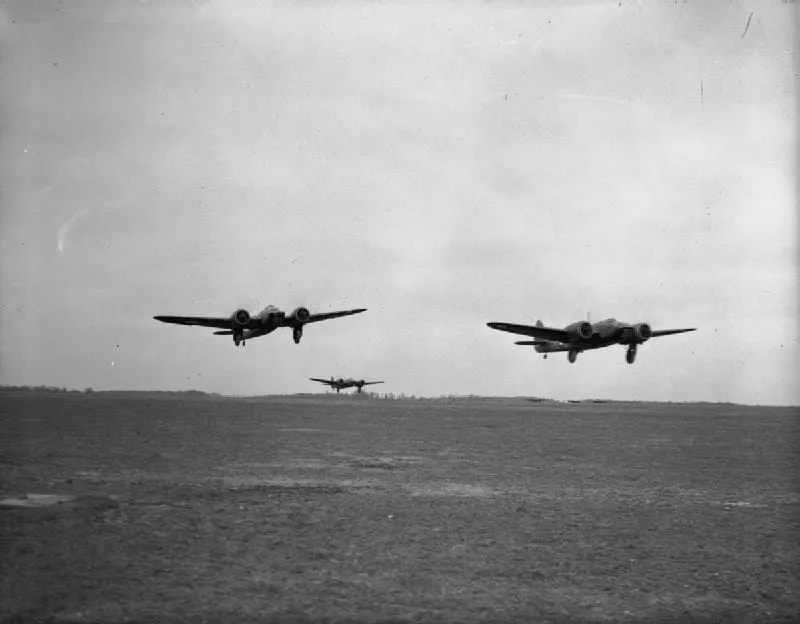
In the mid-1930s the Bristol Blenheim was a sensation: a twin-engined bomber which in trials proved faster than the fighters the RAF then had in its squadrons. By the time war broke out other air forces had caught up with it and overtaken it, and a light bomber with a crew of three, a small bomb load and two machine guns had to fly by day over targets defended by Messerschmitts. For the first three years of the war the RAF sent it wherever it needed a bomber, a long-range fighter or a reconnaissance aircraft, and nowhere could it give it enough fighter cover. Its story is largely one of the courage of its crews and of losses that could not be sustained for long.
The newspaper’s aircraft
It began with a private order. In 1934 Lord Rothermere, owner of the Daily Mail, wanted the fastest airliner in Europe and ordered it from the Bristol company at Filton. The Type 142, named “Britain First”, flew on 12 April 1935, and in military trials it proved faster than the biplane fighters the RAF was then flying. Rothermere presented the aircraft to the nation, and the Air Ministry, in the middle of a hurried rearmament against Germany, ordered a bomber version in September 1935 without waiting for a prototype. That took off on 25 June 1936, and in March 1937 No. 114 Squadron received the first Blenheims. The improved Mark IV had a longer, glazed nose for the navigator and more powerful engines. The first foreign customer, in 1936, was Finland, which later built Blenheims under licence; in the Winter War the British sent it more, and Finnish Blenheims flew until 1958.
The first sorties of the war
On 3 September 1939, the day war was declared, a Blenheim of No. 139 Squadron photographed the German fleet off Wilhelmshaven. It was the RAF’s first combat sortie of the war. The next day, in the first RAF raids, fifteen Blenheims were sent against warships; ten reached the target, several bombs hit the Admiral Scheer but failed to explode, and five aircraft did not return. About two hundred Blenheims were converted into heavy fighters with a pack of machine guns under the fuselage. By day they were no match for single-engined fighters, but they were the first British aircraft to receive airborne radar, and one night in early July 1940 one of them used it to shoot down a Dornier. In the Battle of Britain, though, they were more often targets than a threat: the Luftwaffe destroyed them on their airfields, and on Eagle Day more than a dozen burned on the ground at Detling.
May 1940 and the daylight raids
The real test was the Battle of France. Blenheims and Fairey Battles were thrown against bridges and columns in broad daylight, through German flak and fighters. On 12 May, 10 of the 24 Bomber Command aircraft sent against the Meuse bridges at Maastricht did not return. On 14 May over Sedan, 40 of 71 Battle and Blenheim bombers were shot down, and three days later at Gembloux No. 82 Squadron lost 11 of its 12 aircraft. On 13 August the same squadron sent twelve Blenheims against the airfield at Aalborg in Denmark; one turned back, and none of the others returned.
In 1941 No. 2 Group of Bomber Command attacked shipping off occupied Europe by day, flying just above the water, and from April to June lost 36 aircraft in these operations. On 4 July Hughie Edwards, commanding No. 105 Squadron, led a low-level raid on Bremen for which he received the Victoria Cross, and on 12 August 12 of the 54 Blenheims sent against power stations near Cologne failed to return. In November the commander of Bomber Command judged the aircraft unsuitable for such work, and in Western Europe it was replaced by American Bostons and later by Mosquitoes. In 1942 Blenheims took part in one more great operation: during the thousand-bomber raid they attacked the airfields of German night fighters.
Malta, the desert and Greece
In the Mediterranean the Blenheim fought from the first day of the war with Italy. On 28 June 1940, after one of its raids on Tobruk, Italian anti-aircraft gunners waiting for the next attack shot down the aircraft of Italo Balbo. Blenheims from Aden supported the defence of British Somaliland, those from Egypt bombed Italian airfields during Operation Compass, and in November 1940 four squadrons, three of them flying Blenheims, hurried to the aid of Greece. In the summer of 1941 Edwards’s No. 105 Squadron flew to Malta and attacked ships bound for Libya at masthead height, which brought accurate hits and terrible losses.
The Far East and the end
When Japan struck, the Blenheim was the main British bomber in Asia. In the Malayan campaign they were lost on the ground and in the air, and for a lone attack on the Japanese airfield at Singora on 9 December 1941 Arthur Scarf received a posthumous Victoria Cross. From Burma in January 1942 they bombed Bangkok. On 9 April 1942, during the Japanese raid into the Indian Ocean, nine unescorted Blenheims reached the carrier Akagi, missed her, and five were shot down by fighters.
A developed Mark V, the Bisley, still went to North Africa in 1942, but it was heavier and slower than its predecessor. In 1943 the Blenheims disappeared from front-line units, while in Canada the Bolingbrokes, the licence-built version made by Fairchild, served longer on patrols and in schools. The total number built depends on how the versions are counted: sources give between about 4,400 and over 5,000 in Britain, plus 676 Bolingbrokes and several dozen Finnish and Yugoslav aircraft. No British-built Blenheim survives complete; the museum examples are mostly rebuilt Canadian machines.
Sources
Battles
(07)- 12–15 May 1940Battle of Sedan (1940)On 12–15 May 1940 Guderian’s panzer corps forced the Meuse at Sedan after hours of Luftwaffe bombing, repelled counter-attacks and tore open the French front.
- 3–19 August 1940Italian invasion of British SomalilandBetween 3 and 19 August 1940 Italian forces overran British Somaliland. After the battle of Tug Argan the British evacuated some 7,000 men from Berbera to Aden.
- 9 December 1940 – 9 February 1941Operation CompassFrom 9 December 1940 to 9 February 1941 the Western Desert Force destroyed Italy's Tenth Army at Sidi Barrani, Bardia, Tobruk and Beda Fomm and took Cyrenaica.
- 27–29 March 1941Battle of Cape Matapan27–29 March 1941. Forewarned by Bletchley Park, Cunningham’s fleet damaged the Vittorio Veneto and at night sank three Italian cruisers and two destroyers.
- 2–31 May 1941Anglo-Iraqi WarFrom 2 to 31 May 1941 the British defeated Rashid Ali's army: they held RAF Habbaniya, took Fallujah and reached the outskirts of Baghdad.
- 15–17 June 1941Operation BattleaxeOn 15–17 June 1941 the British tried to defeat Rommel on the Egyptian frontier and relieve Tobruk. They lost more than 90 tanks and fell back.
- 31 March – 10 April 1942Indian Ocean raidFrom 31 March to 10 April 1942 Nagumo's carriers struck Ceylon and sank Hermes and two cruisers, but Somerville's Eastern Fleet survived.
In the chronicle
(40)1940
- 14 February 1940Volunteers for Finland
- 16 March 1940The Scapa Flow raid and the first civilian death
- 30 March 1940British reconnaissance flights over Baku
- 10 May 1940The Battle for The Hague
- 13 May 1940The breakthrough at Sedan
- 15 May 1940The RAF begins bombing the Ruhr
- 28 June 1940The death of Italo Balbo
- 10 July 1940The Battle of Britain begins
- 12 July 1940Air raids on Wales and Scotland
- 4 August 1940The Italians invade British Somaliland
- 13 August 1940Adlertag
- 13 September 1940The Italians invade Egypt
- 16 November 1940British aid to Greece
- 22 November 1940The Greeks take Korçë
- 16 December 1940The raid on Mannheim
1941
- 21 January 1941The capture of Tobruk
- 28 March 1941The Battle of Cape Matapan
- 27 April 1941New Hurricanes for Malta
- 30 April 1941The Iraqi siege of Habbaniya
- 2 May 1941The Anglo-Iraqi War begins
- 13 May 1941Fliegerführer Irak at Mosul
- 16 May 1941Operation Brevity
- 6 June 1941Operation Rocket
- 5 July 1941Swordfishes over Tobruk
- 17 July 1941Operation Substance
- 11 August 1941Malta in August 1941
- 13 November 1941The sinking of the Ark Royal
- 1 December 1941The thousandth air raid on Malta
- 27 December 1941The Vågsøy raid
1942
- 7 January 1942Malta under air attack in January 1942
- 25 January 1942Thailand declares war on the Allies
- 7 March 1942The first Spitfires over Malta
- 5 April 1942The Easter Sunday raid on Colombo
- 9 April 1942The attack on Trincomalee
- 30 May 1942The thousand-bomber raid on Cologne
- 2 June 1942The thousand-bomber raid on Essen
- 25 June 1942The thousand-bomber raid on Bremen
- 4 December 1942The first American raid on Naples