Battle of Sedan (1940)
- Dates:
- 12–15 May 1940
- Front:
- Western Front
- Location:
- The Meuse valley between Donchery and Wadelincourt near Sedan, the heights of La Marfée, Bulson and Chémery and the Stonne plateau (Ardennes department, France); parallel crossings at Monthermé and Dinant (Belgium)On the battle map →
- Sides:
- Nazi GermanyHeinz Guderian, Ewald von KleistFranceCharles Huntziger, Henri Lafontaine
- Result:
- German victory. XIX Corps established a bridgehead across the Meuse, beat off French counter-attacks and on 15 May broke out into open country, tearing the front apart between the French Second and Ninth Armies.
- Author:
- Łukasz
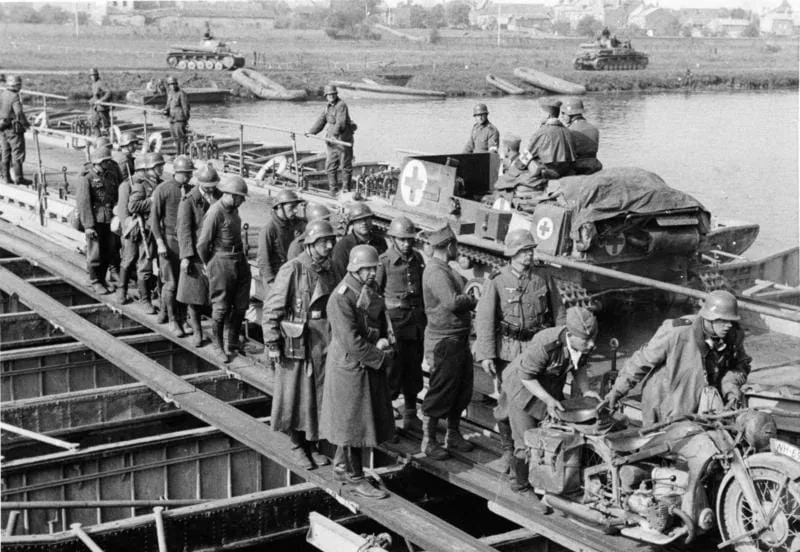
The Battle of Sedan in May 1940 was the turning point of the whole campaign in the West and one of the most momentous clashes of the Second World War. In four days the three panzer divisions of General Heinz Guderian, which had crossed the wooded Ardennes faster than anyone on the French side thought possible, forced the Meuse at Sedan, shattered the reserve 55th Infantry Division holding that sector and beat off belated French counter-attacks. On 13 May, after eight hours of uninterrupted Luftwaffe air attacks, infantry and engineers crossed the river in rubber boats. On 14 May the tanks crossed the Meuse over a single pontoon bridge, and the British light bombers that tried to destroy it lost more than half their aircraft. On 15 May the Germans broke out into open country west of the river. At the same time, further north, the crossings at Monthermé and Dinant opened two more breaches in the line of the French Ninth Army. Through a gap several dozen kilometres wide the panzer divisions drove towards the English Channel, into the rear of the Allied armies in Belgium.
Name and dates
The French speak of the “breakthrough at Sedan” (percée de Sedan), the Germans of the Battle of Sedan or the “armoured breakthrough at Sedan” (Panzerdurchbruch bei Sedan), and the British sometimes of the Second Battle of Sedan. The first was the French defeat of 1–2 September 1870, which ended with Emperor Napoleon III taken prisoner. The name therefore carried symbolic weight for both sides: for the Germans it was an old emblem of victory, for the French the place where, for the second time in seventy years, the defeat of the state began.
The battle is dated 12–15 May 1940. On the evening of 12 May Guderian’s first units entered Sedan and reached the Meuse, and on 15 May XIX Corps broke through the last French positions west of the river and emerged into open country. Some studies, especially German ones, confine the battle to 13–15 May, that is, to the crossing itself and its expansion. The fighting for the village of Stonne south of the bridgehead, which grew out of it, went on until 17 May and beyond, but it was of a different nature: it shielded the flank of the armoured corridor rather than deciding the breakthrough. All times are given in German time. French clocks were an hour behind, hence the discrepancies between the accounts of the two sides.
Background
The plan to strike through the Ardennes
After the Mechelen incident in January 1940, when documents of the original Case Yellow plan fell into Belgian hands, Hitler postponed the offensive in the West until spring and ordered it to be rebuilt from scratch. The concept that General Erich von Manstein had been pressing since the autumn, and which Hitler adopted in February, shifted the main thrust from the plains of central Belgium to the Ardennes. General Fedor von Bock’s Army Group B was to attack the Netherlands and northern Belgium and draw the Allies there, while General Gerd von Rundstedt’s Army Group A was to pass through the forests and hills of Luxembourg and the Belgian province of Luxembourg, force the Meuse between Dinant and Sedan and wheel west towards the mouth of the Somme.
The spearhead of this thrust was General Ewald von Kleist’s panzer group, the first operational formation in history made up of five panzer divisions and several motorised ones. Its core was Guderian’s XIX Army Corps (Motorised) with the 1st, 2nd and 10th Panzer Divisions and the elite Großdeutschland infantry regiment, which was to cross at Sedan itself. To its north General Georg-Hans Reinhardt’s XLI Corps was to cross the Meuse at Monthermé, and further north still, outside Kleist’s group, General Hermann Hoth’s XV Corps of the Fourth Army, with the 5th and 7th Panzer Divisions, was to cross at Dinant. In the winter war games Guderian had already argued that tanks could reach the Meuse through the Ardennes in a few days, and according to his memoirs the orders for 13 May were copied almost word for word from those exercises.
The French defence on the Meuse
The French high command expected the main blow in Belgium and had prepared the Dyle Plan to meet it: on 10 May the best, motorised armies of the left wing, together with Lord Gort’s British Expeditionary Force, advanced deep into Belgium. The Ardennes were regarded as terrain that large armoured formations could not cross quickly. In 1934 Marshal Philippe Pétain told the Senate army committee that the sector was “not dangerous” and that armies venturing into the Ardennes would be “pinched off” as they came out. The Commander-in-Chief, General Maurice Gamelin, and the commander of the North-Eastern Front, General Alphonse Georges, assumed that even if the Germans got through the Ardennes they would need several days to bring up their artillery before attempting to force the Meuse, as in the First World War. There was no shortage of warnings. In 1938 General André-Gaston Prételat held an exercise in which “German” panzer divisions crossed the Ardennes and smashed the defences on the Meuse, and he reportedly estimated that the enemy would reach the river in about sixty hours. In the event it took the Germans not much less. In the spring of 1940 the deputy Pierre Taittinger, rapporteur of the army committee of the Chamber of Deputies, warned after a visit to the front that the defences at Sedan were wholly inadequate.
The Sedan sector belonged to General Charles Huntziger’s Second Army, whose right wing rested on the western end of the Maginot Line near La Ferté, some twenty kilometres east of the town. The boundary with the neighbouring Ninth Army of General André Corap, strung out along the Meuse as far as Namur, ran west of Sedan, in the valley of the little River Bar. It was precisely at the junction of two armies, held by the weakest divisions in the whole deployment, that the main blow was to fall. Sedan itself and the course of the Meuse from Donchery to the area of Pont-Maugis were defended by General Pierre-Paul Grandsard’s X Corps, and the front line was held by General Henri Lafontaine’s 55th Infantry Division. This was a category B reserve division, made up mostly of reservists over thirty, with very few regular officers. All winter its men had spent more time building fortifications than training, and its regiments had been repeatedly reshuffled and mixed. There was a shortage of anti-tank and anti-aircraft guns, and no minefields had been laid, although mines lay in the depots. Of the several dozen concrete bunkers along the river, many still lacked armoured doors or embrasure shields, and some had only just had their formwork removed. Between the bunkers at Glaire and by the Pont-Neuf bridge at Torcy yawned a gap almost two kilometres wide. All communications ran over telephone cables, largely laid on the surface.
The defence’s trump card was its artillery. The 55th Division and the neighbouring 71st, which from 10 May was being slotted into the line between the 55th Division and the 3rd North African Infantry Division, had over 170 guns between them, more than Guderian could set against them. The guns stood on the heights of La Marfée south of Sedan and further back, as far as Bulson and Chémery. The regrouping, however, had not been completed before the Germans arrived.
Course of the battle
Through the Ardennes to the Meuse (10–12 May)
At dawn on 10 May Kleist’s vanguards crossed the borders of Luxembourg and Belgium. In the Belgian Ardennes they were held up for a few hours by the men of the 1st Chasseurs Ardennais Division (PL), who fought among other places at Bodange and Martelange, and by demolished roads and bridges. The French light cavalry divisions that Huntziger and Corap had sent into Belgium on 10 May to delay the enemy’s advance ran not into the advance guards they expected but into entire panzer divisions, and by 12 May they had fallen back with heavy losses behind the Semois and then behind the Meuse.
On the morning of 12 May General Friedrich Kirchner’s 1st Panzer Division crossed the Semois at Bouillon, and in the afternoon its battle groups came down to the Meuse through Saint-Menges and Floing. French engineers blew the bridges at Sedan once the last cavalry units had crossed to the left bank. In the evening the Germans took the town itself, which lies mainly on the right bank, without a fight. General Ferdinand Schaal’s 10th Panzer Division reached the Meuse at Bazeilles, east of Sedan, while General Rudolf Veiel’s 2nd Panzer Division, held up in traffic jams on the Ardennes roads, was still on the move. That same day Guderian flew in a liaison aircraft to Kleist’s headquarters and received the order to attack across the river at 4 p.m. on 13 May, even though the corps had neither the 2nd Division nor most of its artillery in place. Aircraft were to make up for the missing guns.
At Dinant and Monthermé, too, the Germans reached the Meuse on 12 May. In the evening the advance guard of the 5th Panzer Division found an intact weir and lock near the island of Houx, north of Dinant, over which motorcyclists and infantry crossed to the left bank during the night of 12–13 May. This was the first German bridgehead across the Meuse, won before the French 18th Infantry Division, marching on foot from France, had managed to occupy its sector.
The air attack (13 May)
By agreement with General Bruno Loerzer, commander of II Air Corps, Guderian wanted the air force not to deliver a single massed raid just before the assault but to attack the French positions throughout the day in waves of small formations. Kleist and the commander of Air Fleet 3, General Hugo Sperrle, planned otherwise, but the order changing the plan reached the squadrons too late, and Loerzer carried out the attack as Guderian wished. The bombers and fighters of Air Fleet 3 were joined by units of General Albert Kesselring’s Air Fleet 2 and by General Wolfram von Richthofen’s VIII Air Corps with its Junkers Ju 87 dive bombers. According to figures cited by the German historian Karl-Heinz Frieser, some three hundred bombers and two hundred Stukas operated over the Sedan sector alone that day, flying more than a thousand sorties. It was the heaviest air attack on a battlefield the world had yet seen.
The bombardment lasted from morning until afternoon, roughly from 8 a.m. to 4 p.m., reaching its climax just before the assault. The physical damage proved surprisingly slight: not a single concrete bunker was destroyed by a direct hit, and casualties were light. The psychological effect, however, was devastating. The howl of the sirens of the Stukas diving on every target they spotted, and the ceaseless explosions over eight hours, broke the spirit of the reservists, and the gunners, on whom the whole defence rested, took cover in their shelters and stopped firing. The bombs severed the telephone cables laid on the surface, so that the forward positions lost contact with their headquarters and could not call down defensive fire.
The crossing (13 May)
At 4 p.m., along a stretch several kilometres long between Donchery and Wadelincourt, engineers and infantry pushed rubber boats into the water. The most important task fell to the 1st Panzer Division, reinforced by the Großdeutschland regiment, an assault engineer battalion and the artillery of the other divisions. It crossed in the loop of the Meuse west of the town, between Glaire and Torcy, at a point the French called Gaulier. The first attempts collapsed under fire from the surviving bunkers. Only when an 8.8 cm anti-aircraft gun, brought forward to the right bank and firing over open sights, silenced the bunker by the Pont-Neuf bridge, and the infantry located and destroyed another machine-gun post on the flank, did the first companies of Großdeutschland cross the river and begin taking the bunkers one by one. By evening the regiment had captured Hill 247 above Torcy and had pushed several kilometres into the French defences.
To their west Lieutenant Colonel Hermann Balck’s 1st Rifle Regiment crossed near Glaire and struck towards Bellevue and Frénois. Assault engineers with flamethrowers took bunker after bunker, often from the rear, where they had no embrasures. Some units strayed into the 2nd Panzer Division’s sector and knocked out the positions at Donchery from behind. The late-arriving 2nd Division, without its own heavy artillery and under fire from French batteries, including those near Charleville-Mézières, could not cross the river all afternoon and reached the far bank only in the evening. Balck pressed on despite the exhaustion of his men. At about 10 p.m. his riflemen took Hill 301 above Frénois, a key position on the La Marfée ridge from which the French artillery dominated the valley. The last bunkers in the area surrendered late in the evening.
The 10th Panzer Division, east of Sedan, had the hardest time. The air force had concentrated on the 1st Division’s sector, so the French artillery and machine guns at Wadelincourt were left untouched. Their fire destroyed most of the boats prepared for the crossing; the attack of one rifle regiment collapsed and the other got across only with small forces. The breach was opened by a handful of men: a party of a dozen or so engineers and riflemen under Sergeant Walter Rubarth crossed the river and took several bunkers in turn, after which further companies crossed behind them. By evening the 10th Division, too, had a bridgehead, though a much shallower one than the others.
At nightfall on 13 May the Germans held a bridgehead several kilometres deep on the left bank of the Meuse. The tanks were still on the other bank: in the evening the engineers got the first ferry working and around midnight completed a pontoon bridge at Gaulier, but the first tanks did not cross it until the morning of 14 May. In the bridgehead only infantry, engineers and light guns were fighting, worn out after five days of marching. During the night the advance came to a halt.
The Bulson panic
Meanwhile, behind the French line, a drama was unfolding that mattered no less than the crossing itself. On the evening of 13 May, at about 6 or 7 p.m., an artillery officer who saw shells bursting near his batteries took them for tank fire and reported German tanks. Passed on in garbled form, the report turned into a rumour that the tanks were already at Bulson, some ten kilometres south of Sedan. The X Corps artillery commander, Colonel Poncelet, prematurely ordered his batteries to withdraw, and the order spread panic among the gunners, drivers and supply columns, and then among the infantry. Masses of men of the 55th Division fled south, abandoning their guns and equipment. The panic also gripped part of the neighbouring 71st Division. In reality not a single German tank had yet crossed the Meuse. A few days later Colonel Poncelet took his own life.
The “Bulson panic” destroyed the 55th Division as a fighting unit before its remnants could organise a defence of the second line. Worse still, the crowds of fugitives blocked the roads along which the X Corps reserves were to move up to the bridgehead during the night. General Lafontaine had had a plan since the evening for a counter-attack with two infantry regiments and two battalions of light tanks, but he waited for many hours for orders from the corps commander and issued the orders to attack only at about 5 a.m. on 14 May.
The race for Bulson and the failed counter-attack (14 May)
When the French columns set off towards Bulson on the morning of 14 May, German tanks were already beginning to cross the bridge at Gaulier. The left-hand French group, the 213th Infantry Regiment with the 7th Tank Battalion (light FCM 36 tanks), attacked alone, because the right-hand group, the 205th Regiment with the 4th Tank Battalion, got stuck on the way and reached its start line when the battle was already over. Forewarned by reconnaissance aircraft, Kirchner threw forward the first tank company he had on the far side of the river. It reached the ridge at Bulson a few minutes ahead of the French. There, under fire from French artillery and anti-tank guns, it lost all its vehicles but one, but the tank companies arriving one after another, the Großdeutschland infantry, engineers and 8.8 cm anti-aircraft guns turned the fight around. Before noon the French counter-attack had been smashed, the 7th Tank Battalion had lost most of its tanks, and the Germans had taken Chémery and the undamaged bridges over the Ardennes Canal and the River Bar at Malmy.
Around midday Guderian, who had crossed into the bridgehead himself, took a decision on which, in the view of many historians, the fate of the whole campaign depended. Instead of halting to consolidate the bridgehead, as his superiors expected, he left the 10th Panzer Division and the Großdeutschland regiment to cover it from the south and sent the 1st and 2nd Divisions in full strength west across the bridges.
The day of the fighters (14 May)
The French high command grasped the gravity of the situation late, but on 14 May it threw everything it had in the air against the bridgehead. The commander of the 1st Army Group, General Gaston Billotte, is said to have declared that victory or defeat would pass over those bridges. In the morning the few, already depleted French bombers attacked. In the afternoon the bombers of the British Advanced Air Striking Force went in, mostly obsolete Fairey Battles and Bristol Blenheims. Over Sedan dozens of Messerschmitt Bf 109s and more than three hundred anti-aircraft guns of the panzer divisions, massed around the bridges, lay in wait for them. According to British figures, of the 71 bombers that took off in the afternoon, 40 failed to return. It was the highest loss rate for an operation of that size in the history of the RAF. In all, according to various tallies, the Allies lost between 150-odd and nearly two hundred aircraft over Sedan that day, and the single bridge at Gaulier, over which the tanks of the 1st and 2nd Divisions crossed, remained intact. Loerzer called 14 May “the day of the fighters”.
A wasted chance and Huntziger’s withdrawal
The most serious threat to Guderian was General Jean Flavigny’s XXI Corps, with the newly formed 3rd Armoured Division (3e division cuirassée), equipped among other things with heavy Char B1 tanks, and the 3rd Motorised Infantry Division. On the morning of 14 May Huntziger ordered it to counter-attack northwards from the Mont-Dieu woods, through Chémery and Bulson, towards Sedan. The tanks, however, arrived late and without fuel, and when they were ready in the afternoon Flavigny, seeing roads full of fleeing soldiers and having heard officers of the shattered 213th Regiment talk of hundreds of German tanks, called off the attack. He ordered the tanks dispersed along a front of a dozen or more kilometres as “corks” to block the roads. On 15 May an attempted counter-attack was repeated with the same result.
On the evening of 14 May Huntziger, convinced that the Germans would turn south into the rear of the Maginot Line and towards Paris, pulled the left wing of his army back to the south. He did so to keep contact with the fortifications, but it opened a wide gap between the Second and Ninth Armies, through which the 1st and 2nd Panzer Divisions moved out westwards. Meanwhile on 15 May the 10th Panzer Division and Großdeutschland took the village of Stonne on a high plateau south of Sedan, from which the French could threaten the bridgehead. The Battle of Stonne (PL) began, in which the village reportedly changed hands more than a dozen times. On 16 May the heavy tank Eure of Captain Pierre Billotte destroyed, according to French sources, more than a dozen German tanks and came out of the fight despite numerous hits. The Großdeutschland regiment lost several hundred killed and wounded in this fighting before infantry divisions relieved it. The French, however, wore out their tanks in battles for a single village and never mounted a co-ordinated counter-attack on Sedan.
Dinant and Monthermé
The breakthrough at Sedan was not an isolated one. At Dinant General Erwin Rommel’s 7th Panzer Division crossed at Bouvignes and Leffe on 13 May under fire from the French 18th Infantry Division. Rommel directed the crossing in person, crossed to the far bank himself and organised the ferrying of tanks. At the same time the 5th Panzer Division was enlarging the bridgehead at Houx. On 14 May Rommel’s division broke out of the Meuse valley at Onhaye, and on 15 May it reached Philippeville. That same day at Flavion the 5th Panzer Division, with part of Rommel’s forces, routed the French 1st Armoured Division, caught while refuelling.
At Monthermé XLI Corps had the hardest attack of all. General Werner Kempf’s 6th Panzer Division crossed on 13 May in boats and over the remains of the demolished bridge onto a narrow peninsula in a bend of the river, but at its neck it was held for two days, mainly by Malagasy soldiers of the 42nd Colonial Machine-Gun Demi-Brigade of the 102nd Fortress Division. Only on the morning of 15 May, when the engineers had built a bridge and the tanks had crossed the river, did the defence collapse, and that day a battle group of the 6th Division covered nearly sixty kilometres, as far as Montcornet.
On the evening of 14 May General Corap ordered the Ninth Army to fall back from the Meuse to a line further west. Withdrawal under pressure from tanks and air attacks turned into the disintegration of the army. On 15 May Corap was relieved and General Henri Giraud took command.
The breakthrough (15 May)
On 15 May, west of the Ardennes Canal, the 1st Panzer Division ran into the last organised French positions. At La Horgne the 3rd Spahi Brigade, made up of Algerian and Moroccan cavalrymen fighting on foot, held out all day. Its commander was taken prisoner and the commanders of both its regiments were killed. At Bouvellemont Balck’s riflemen, utterly exhausted, took the village only when their commander went forward to attack alone and his men followed him. By evening resistance was over. On the morning of 16 May Guderian’s divisions were already driving west through open country towards Montcornet without meeting any organised defence, and with them went Reinhardt and Hoth. Between Namur and the Maginot Line the French front had ceased to exist across a width of several dozen kilometres.
On the evening of 15 May Kleist, worried about his exposed flanks, ordered Guderian to halt. Guderian won permission to continue the advance for another twenty-four hours, and the dispute between them was to erupt in full force two days later.
Losses
Exact losses in the battle itself are hard to establish, because the fighting on the Meuse passed without a break into the pursuit. German losses in the crossing were, contrary to the high command’s fears, moderate: on some stretches the engineers and riflemen paid a high price, but Guderian’s corps did not lose its ability to keep advancing. According to E.R. Hooton, the Luftwaffe lost only a handful of aircraft over Sedan on 13 May. The fighting for Stonne cost the Germans most, with the Großdeutschland regiment losing, according to German figures, about 570 killed, wounded and missing.
On the French side the 55th Infantry Division practically ceased to exist: its remnants were gathered in the rear only several days later. Thousands of men of the 55th and 71st Divisions and of the Ninth Army were taken prisoner during the retreat, often without a fight. Many units, however, fought to the end, such as the garrisons of some bunkers, the spahis at La Horgne and the defenders of Monthermé, and the French divisions at Stonne suffered heavy losses. On 14 May the Allied air forces lost about half the aircraft sent to attack the bridgehead, and the British bomber force in France ceased to count as a striking force.
Significance
The breakthrough at Sedan decided the 1940 campaign. The Dyle Plan, which had sent the best Allied armies deep into Belgium, became a trap: on 16 May in Paris Gamelin admitted, in the presence of Prime Minister Paul Reynaud and Winston Churchill, that he had no strategic reserve that could close the breach. On the morning of 15 May Reynaud had telephoned Churchill to say that France had lost the battle. The counter-attacks from both sides of the corridor, including the attack by Colonel Charles de Gaulle’s 4th Armoured Division at Montcornet on 17 May, were too weak and too late. On 20 May Guderian’s tanks reached the Channel at Abbeville, cutting off in Belgium and northern France the Belgian army, the British Expeditionary Force and the French First Army together with the remnants of the Seventh and Ninth Armies. After the evacuation from Dunkirk, the capitulation of Belgium and the June offensive on the Somme and the Aisne, France signed an armistice on 22 June. General Huntziger, whose army had defended Sedan, headed the French delegation at Compiègne and later became minister of war in the Vichy government.
The battle became the model of what the press and posterity called blitzkrieg: a concentrated blow by tanks, motorised infantry, engineers and aircraft at a single point, with commanders leading from the front and taking decisions on their own initiative. Historians, Karl-Heinz Frieser above all, stress, however, that this was not a course of events planned in advance. The German high command had envisaged rather a cautious widening of the bridgeheads. Success was decided by the improvisation and disobedience of Guderian and his officers, who exploited the enemy’s momentary collapse, and by the luck that the bridge at Gaulier survived the air attacks. On the French side the battle laid bare the weaknesses of the whole system: faith in the impassability of the Ardennes, weak reserve divisions in a key sector, cable communications, a slow, methodical style of command and the dispersal of tanks. The historian Marc Bloch, who lived through the defeat as a staff officer, called it a “strange defeat”.
Sedan also mattered for the later course of the war. The German leadership, with Hitler at its head, came to believe that armoured armies supported by aircraft could crush any opponent on the Continent in a few weeks. That conviction underlay the plans for war against the Soviet Union in 1941.