- Category:
- Military operations
- Front:
- Western Front
- Date:
- 13 May 1940
- Author:
- Łukasz
- Battle:
- Battle of Sedan (1940)
- Tags:
- France, Wehrmacht, Luftwaffe, Heinz Guderian
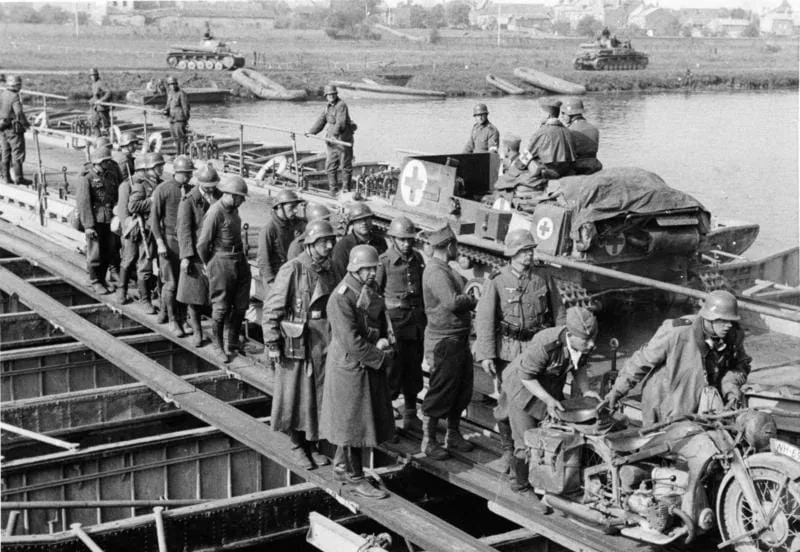
On 13 May 1940, Whit Monday, at 4 p.m., German assault engineers and riflemen pushed their inflatable boats into the water and set off across the Meuse at Sedan. For the previous eight hours hundreds of Luftwaffe aircraft had bombed the French positions on the left bank of the river without a break. By evening the infantry of General Heinz Guderian’s XIX Corps had taken the heights above the town and driven several kilometres deep into the French defences, and panic had broken out in the rear of the 55th Infantry Division, which held that sector. The same day General Erwin Rommel’s 7th Panzer Division crossed the Meuse at Dinant, and General Georg-Hans Reinhardt’s corps gained a foothold on the far bank at Monthermé. Over the next two days the Germans beat off French counter-attacks and shot down dozens of bombers that tried to destroy their bridges, and on 15 May their panzer divisions burst out of the Meuse valley into open country, heading for the English Channel. The breakthrough at Sedan decided the 1940 campaign in the west.
War chronologies associate two dates with this event. Under 13 May they record that Guderian’s panzer corps broke through the front at Sedan, and under 15 May that German troops crossed the Meuse. The first statement needs only qualifying: on 13 May the Germans forced the river and established a bridgehead, but the front was finally broken only on 15 May, when the last French positions west of Sedan fell. The second is inaccurate. The Meuse was crossed in three places as early as 13 May, and at Houx, north of Dinant, the first Germans got across during the night of 12–13 May. The 15th of May, on the other hand, was the day on which the defence collapsed along the whole stretch from Dinant to Sedan, Reinhardt’s corps broke out of its bridgehead at Monthermé, and columns of tanks rolled across the river on pontoon bridges. That date therefore marks the moment when the crossing turned into a breakthrough, not the crossing of the river itself.
Through the Ardennes to the Meuse
The thrust at Sedan was the heart of the plan that Hitler adopted in February 1940 at the urging of General Erich von Manstein. Army Group B was to attack the Netherlands and northern Belgium and draw there the best Allied troops, which under the Dyle Plan would advance deep into Belgium at the first news of a German attack. Meanwhile Colonel General Gerd von Rundstedt’s Army Group A was to pass through the wooded Ardennes in Luxembourg and southern Belgium, force the Meuse between Dinant and Sedan and strike westwards into the rear of the Allied armies.
The spearhead of this offensive was the panzer group of General of Cavalry Ewald von Kleist, the first formation in history to bring several panzer corps under a single command. On the left, southern wing was Guderian’s XIX Corps, with the 1st, 2nd and 10th Panzer Divisions and the Großdeutschland infantry regiment, which was to strike at Sedan. On the right, General Georg-Hans Reinhardt’s XLI Corps, with the 6th and 8th Panzer Divisions, was making for Monthermé. Behind them came the motorised divisions of XIV Corps. Further north still, outside Kleist’s group, General Hermann Hoth’s XV Corps of Colonel General Günther von Kluge’s Fourth Army, with the 5th and 7th Panzer Divisions, was heading for Dinant.
On 10 May Kleist’s spearheads passed through Luxembourg and entered the Belgian Ardennes. The Belgian Chasseurs Ardennais, demolished roads and the French cavalry sent forward to meet them delayed them by a few dozen hours at most. A greater problem was the traffic jams on the narrow forest roads, which Allied aircraft hardly tried to exploit. On the evening of 12 May, less than three days after crossing the border, the 1st Panzer Division entered Sedan, which lies mostly on the right bank of the river, without a fight. French engineers blew up the bridges once the last units of the retreating cavalry had crossed them.
The French command did not believe that this was already the main thrust. The Commander-in-Chief, General Maurice Gamelin, and the commander of the North-Eastern Front, General Alphonse Georges, assumed that the Germans, as in the previous war, would need several days to bring up their artillery before attacking across the river. The Sedan sector belonged to General Charles Huntziger’s Second Army, and the Meuse line itself was held by General Henri Lafontaine’s 55th Infantry Division, a reserve division made up largely of reservists in their thirties, poorly trained and poorly armed. A short distance west of Sedan ran the boundary with General André Corap’s Ninth Army, which was stretched along the Meuse as far as Namur. The blow thus fell on the junction of two armies, at a point held by the weakest divisions in the entire French line-up.
On the German side, too, there were disputes. Kleist wanted the main thrust to fall somewhat further west, at Flize, where there would be no need to force the Ardennes Canal after the Meuse and where the junction of the two French armies lay. Guderian persuaded him that regrouping would cost a day and that the flank of the attack would come within range of the guns of the fortress of Charleville-Mézières. On the afternoon of 12 May Kleist ordered the crossing at Sedan for 4 p.m. the following day, although the 2nd Panzer Division was still stuck in traffic and most of the corps artillery had not arrived. Air power was to make up for the missing guns.
Eight hours under the bombs
Guderian agreed with the commander of II Air Corps, General Bruno Loerzer, that the air force would not deliver a single short, concentrated raid just before the assault, but would attack the French positions throughout the day in waves of small formations, so that the defenders would not have a moment’s respite. Kleist and the commander of the 3rd Air Fleet, General Hugo Sperrle, planned otherwise, but their order reached the units too late, and on 13 May Loerzer carried out the attack according to the original plan. His bombers were joined by units of General Albert Kesselring’s 2nd Air Fleet and by Junkers Ju 87 dive-bombers of General Wolfram von Richthofen’s VIII Air Corps.
The raids began at around 8 a.m. and continued, with short pauses, until 4 p.m. According to German returns, more than a thousand sorties were flown that day over a few kilometres of river. It was the heaviest air attack on a battlefield that the world had yet seen. Its physical effects turned out to be surprisingly modest. Not a single concrete bunker was destroyed by a direct hit, and there were few killed and wounded. The psychological effect, by contrast, was devastating. The wail of the sirens of the Stukas diving on every position they spotted and the ceaseless roar of explosions for eight hours broke the reservists’ nerve. The gunners, on whom the whole defence depended, took cover in their shelters and stopped firing. The bombs severed the telephone cables, many of which had been laid on the surface, and the forward positions lost contact with their headquarters.
The crossing
At 4 p.m. three panzer divisions began crossing along the stretch between Donchery and Wadelincourt. The most important task fell to General Friedrich Kirchner’s 1st Panzer Division, reinforced by the Großdeutschland regiment, assault engineers and the artillery of the neighbouring divisions. It crossed in the loop of the Meuse west of the town, between Glaire and Torcy. The first boats turned back under fire from bunkers that had survived. Only when an 88 mm anti-aircraft gun brought down to the bank silenced the bunker by the bridge at Torcy with direct fire, and the infantry knocked out another machine-gun nest, did the Großdeutschland companies get across the river and begin taking the bunkers one by one. By evening the regiment had captured Hill 247 above Torcy.
To its west the 1st Rifle Regiment of Lieutenant Colonel Hermann Balck crossed. Engineers with flamethrowers and demolition charges took the bunkers, often from the rear, where they had no embrasures, and some of the men pushed into the sector of the neighbouring 2nd Panzer Division and took from behind the positions near Donchery that had prevented that division from crossing all afternoon. Balck drove on despite the exhaustion of his men, who had barely slept for five days. Late in the evening, at around 10 p.m., his riflemen took Hill 301 on the La Marfée ridge above the village of Frénois, from which the French artillery dominated the whole valley.
The 10th Panzer Division had the hardest time, at Wadelincourt east of the town, where the air force had barely attacked. French artillery destroyed most of the boats prepared for the crossing. The breach was opened by a handful of engineers and riflemen under Sergeant Walter Rubarth, who crossed the river and took several bunkers in succession, and further companies followed them. By nightfall the Germans held a bridgehead several kilometres deep on the left bank, but the tanks were still standing on the other side of the river. The engineers began building a pontoon bridge at Gaulier, which was completed at around midnight.
Dinant and Monthermé
Sedan was not the only crossing point. At Dinant, in Belgium, the Meuse flows through a deep, rocky gorge, and the left bank was to be held by the French 18th Infantry Division of the Ninth Army, which was marching on foot from France and had not managed to occupy all its positions. On the evening of 12 May motorcyclists of the 5th Panzer Division found an undamaged weir and lock by the island of Houx, north of the town, and during the night crossed by them to the other bank. On the morning of 13 May the 7th Panzer Division began crossing at Bouvignes and Leffe. The attack stalled under the fire of French machine guns and artillery. Rommel, who had commanded the division only since February, appeared at the river in person. He had houses set on fire so that the smoke would screen the crossing, took command of one of the battalions, crossed to the other bank himself in a boat, and then directed the construction of ferries on which the first tanks were carried over during the night.
At Monthermé, where the Meuse forms a tight bend in a rocky valley, the 6th Panzer Division of Reinhardt’s corps crossed on 13 May, in boats and over the remains of the demolished bridge, onto a narrow peninsula. But it got no further. At the neck of the peninsula it was held up for two days by soldiers of the 102nd Fortress Division, mainly Malagasy colonial infantry of a machine-gun half-brigade. It was the sector on which the French defence performed best.
A night of panic
On the evening of 13 May, roughly between 6 and 7 p.m., panic broke out in the rear of the 55th Division, later known as the “Bulson panic”. An artillery officer mistook shells bursting near his batteries for tank fire, and his report, passed on in an ever more distorted form, turned into a rumour that German tanks were already at the village of Bulson, about ten kilometres south of Sedan. An order to withdraw the batteries, issued in these circumstances, set the gunners, drivers and supply trains to flight, and then the infantry. Thousands of soldiers fled south, abandoning their guns, and the panic also spread to part of the neighbouring 71st Division. In reality not a single German tank had yet crossed the Meuse. The crowds of fugitives blocked the roads along which French reserves were to approach the bridgehead during the night, and General Lafontaine, who had a counter-attack plan ready, waited for many hours for orders from his superiors.
News reached the French staffs with a delay of many hours. At Gamelin’s headquarters near Paris, on the evening of 13 May, there was talk of a “rather serious hitch” at Sedan. General André Beaufre, then a staff officer to General Georges, described after the war the scene he found at around three in the morning of 14 May at the front commander’s headquarters: Georges, white as a sheet, said that the front at Sedan had been broken and that “there have been failures”, then sank into an armchair and wept.
The bridge at Gaulier
On the morning of 14 May French columns with the 213th Infantry Regiment and a battalion of light tanks at last set off towards Bulson to push the Germans back into the river. They were a few minutes too late. The first tanks of the 1st Panzer Division were already crossing the bridge at Gaulier, and they were the first to reach the ridge. By midday the counter-attack had been smashed, and the Germans had taken Chémery and the undamaged bridges over the Ardennes Canal. The stronger French XXI Corps, with the heavy tanks of the 3rd Armoured Division, which was to strike from the south, arrived late and short of fuel, and its commander, alarmed by the sight of fleeing troops, called off the attack and dispersed his tanks along the roads as roadblocks.
That day the Allies threw everything they had in the air against the bridges at Sedan. In the morning the already depleted French bombers attacked; in the afternoon, British Fairey Battle and Bristol Blenheim light bombers of the RAF forces in France. Over the bridgehead German fighters and several hundred anti-aircraft guns of the panzer divisions lay in wait for them. According to British figures, of the 71 bombers that took off in the afternoon about 40 did not return. It was the highest rate of loss the RAF ever suffered in an operation of that size. In all, according to various tallies, the Allies lost more than a hundred aircraft over Sedan that day, and the bridge at Gaulier survived. Loerzer called 14 May “the day of the fighters”.
At around midday Guderian, who had crossed to the far bank, took a decision on which, in the view of many historians, the fate of the campaign depended. He left the 10th Panzer Division and the Großdeutschland regiment to cover the bridgehead to the south and sent the 1st and 2nd Divisions westwards across the Ardennes Canal. In the evening Huntziger, convinced that the Germans would swing south, into the rear of the Maginot Line and towards Paris, pulled back the left wing of his army. A gap opened between the Second and Ninth Armies through which the German tanks would pour. That same evening Corap ordered the Ninth Army to fall back from the Meuse to a new line further west.
15 May: into open country
On 15 May the retreat of the Ninth Army, under the blows of tanks and aircraft, turned into its disintegration. At Monthermé Reinhardt’s engineers built a bridge during the night; in the morning the tanks of the 6th Panzer Division crossed the Meuse and the defence collapsed. That day the division’s battle group covered nearly sixty kilometres, as far as Montcornet. At Flavion, west of Dinant, German tanks caught the French 1st Armoured Division, which was meant to seal the breach, while it was refuelling, and destroyed it within a few hours. Rommel reached the outskirts of Philippeville. Corap was dismissed, and the Ninth Army was taken over by General Henri Giraud, for whom there was nothing left to save.
At Sedan, Guderian’s divisions ran into the last organised French positions that day. At La Horgne the 3rd Spahi Brigade, made up of Algerian and Moroccan cavalrymen fighting on foot, held out all day and suffered heavy losses. At Bouvellemont Balck’s exhausted riflemen went into the attack only when their commander set off towards the village alone. To the south of the bridgehead, the 10th Panzer Division and Großdeutschland took the village of Stonne (PL), over which bitter fighting raged for the following days. By evening resistance west of Sedan was over. The French front had been torn open across several dozen kilometres, and there was no reserve in the rear that could close the breach.
That morning Prime Minister Paul Reynaud telephoned Winston Churchill, who had been Britain’s prime minister for five days, and told him that France had lost the battle. The German command was equally taken aback, though for a different reason. Kleist, Rundstedt and Hitler himself feared a French blow against the exposed southern flank of the armoured corridor and wanted the tanks to wait for the infantry. On the evening of 15 May Kleist ordered Guderian to halt. Guderian, as he wrote in his memoirs, extracted from him over the telephone permission to advance for one more day.
Place in the war
The breakthrough at Sedan and the simultaneous crossings at Dinant and Monthermé decided the campaign in the west less than a week after it began. On that same 13 May, while the Germans were crossing the Meuse, Churchill was promising the House of Commons “blood, toil, tears and sweat”, not yet knowing how soon the test would come. On 16 May in Paris Gamelin admitted to him that he had no strategic reserve at all. On 17 May Kleist briefly relieved Guderian of his command for insubordination, but after his superiors intervened Guderian pressed on, and on 20 May his tanks reached the English Channel near Abbeville. The Belgian army, Lord Gort’s British Expeditionary Force and the best French armies were cut off in Belgium and Flanders. At the end of May Belgium capitulated, and the British evacuated most of their soldiers from Dunkirk, abandoning almost all their equipment. On 22 June France signed the armistice at Compiègne. The French delegation was led by General Huntziger, the commander of the army that had defended Sedan.
Sedan carried a symbolic meaning for both sides. At this same town, in September 1870, the Germans had taken Emperor Napoleon III prisoner, and in May 1940 France’s defeat began here for the second time in seventy years. The defeat laid bare the weaknesses of the French army: faith in the impassability of the Ardennes, weak reserve divisions in a key sector, communications that relied on telephone cables, slow, methodical command from distant headquarters, and the dispersal of its tanks. On the German side the breakthrough became the model of what the press called Blitzkrieg. Historians, however, notably the German scholar Karl-Heinz Frieser, stress that this was not a course of events planned in advance, but an improvisation by panzer commanders who pressed forward despite the fears of their superiors, helped by the enemy’s mistakes and by the luck that the only bridge at Gaulier survived the air attacks. Hitler and his generals drew from this victory the conviction that panzer divisions and air power could crush any opponent on the Continent within a few weeks. On it they based their plan for the invasion of the Soviet Union in 1941.
Sources
Meanwhile
(04)Elsewhere, within a week.
- 14 May 1940 · SocietyThe Local Defence VolunteersOn 14 May 1940 Anthony Eden called on men aged 17–65 by radio to join the Local Defence Volunteers. Five days earlier conscription was extended to men up to 36.
- 10 May 1940 · PoliticsChurchill becomes Prime MinisterOn 10 May 1940, the day of the German offensive in the West, Chamberlain resigned and the King asked Churchill to form a coalition government.
- 10 May 1940 · AtlanticThe British occupy IcelandOn 10 May 1940 some 750 Royal Marines occupied Reykjavík without a fight. An army brigade arrived on 17 May, and the marines soon sailed home.
- 16 May 1940 · DiplomacyChurchill in ParisOn 16 May 1940 Churchill flew to Paris. Gamelin admitted he had no reserve, archives burned at the Foreign Ministry and London agreed to send more fighters.
Related events
(04)The same battle, people or subject.
- 10 May 1940 · Western FrontGermany attacks in the WestOn 10 May 1940 the Wehrmacht struck the Netherlands, Belgium and Luxembourg. The Allies advanced into Belgium as Kleist's tanks entered the Ardennes.
- 20 May 1940 · Western FrontThe Germans reach the English ChannelOn 20 May 1940 Guderian's tanks took Abbeville and that evening reached the sea at Noyelles. The Allied armies in Belgium and Flanders were cut off.
- 24 May 1940 · Western FrontThe halt order before DunkirkOn 24 May 1940 Hitler approved halting the tanks before Dunkirk. By 26 May the Allies had strengthened their defence, and the Germans took Boulogne and Calais.
- 14 June 1940 · Western FrontThe Germans enter ParisOn 14 June 1940 German troops entered Paris, declared an open city, without a fight. A swastika flag was hoisted over the Eiffel Tower.