Equipment
The battleship HMS Warspite
A Jutland veteran who fought from Narvik to Walcheren: she hit the Giulio Cesare at 24 km, wrecked cruisers at Matapan and survived the Fritz X.
- Role:
- battleship
- State:
- United Kingdom
- Maker:
- HM Dockyard Devonport
- Launched:
- 26 November 1913
- Author:
- Łukasz
- Updated:
- 1 November 2026
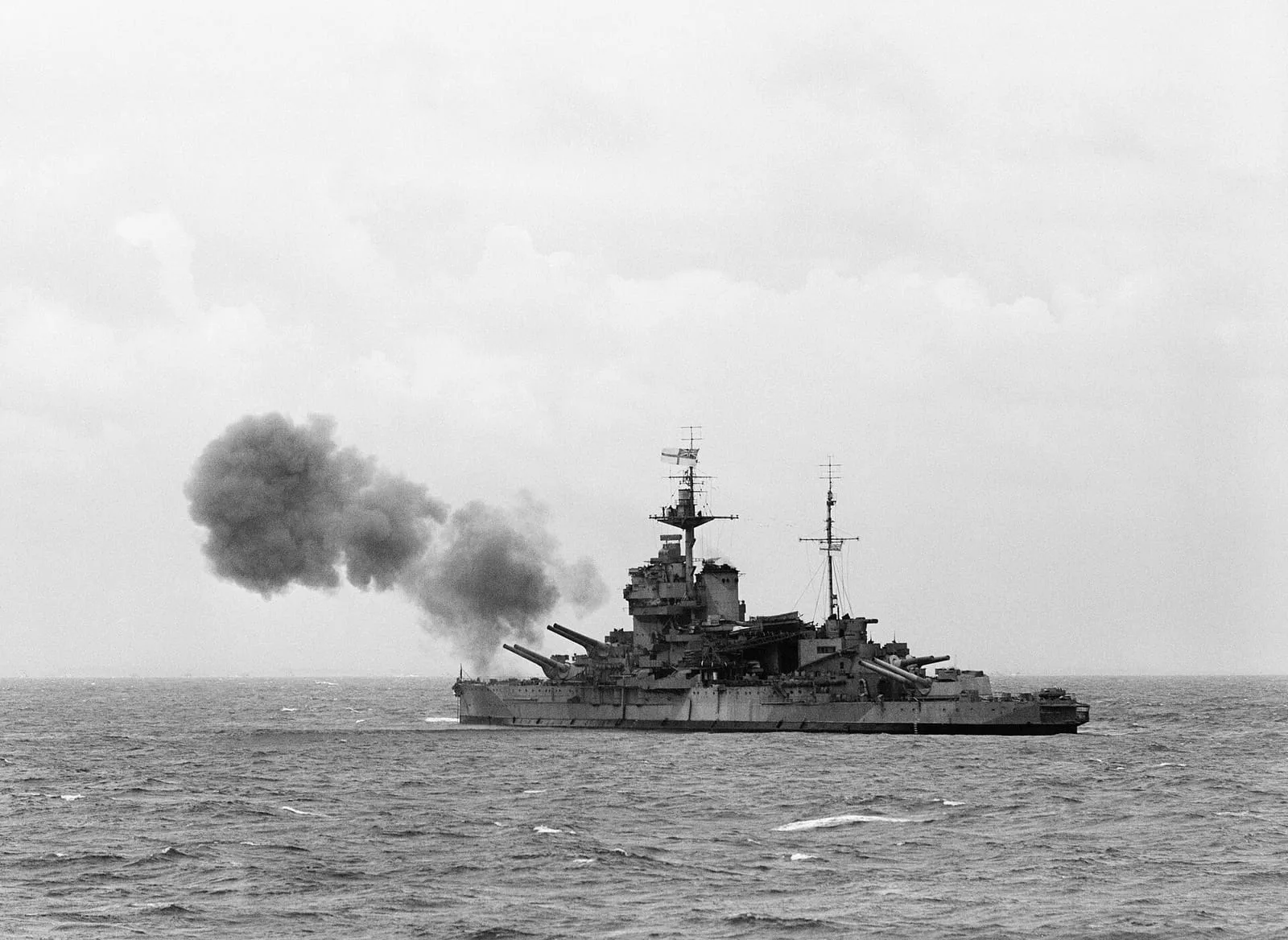
In 1939 HMS Warspite was an old ship: a Queen Elizabeth-class battleship, built before the First World War, with eight 381 mm (15-inch) guns. Even so, few British capital ships fought in the Second World War for so long and in so many places. She destroyed German destroyers at Narvik, was flagship of the Mediterranean Fleet in its finest period, covered the landings in Sicily, at Salerno and in Normandy, and bombarded French and Dutch ports until November 1944. Sailors called her the “Old Lady” and were fond of her, even though since Jutland her rudder had a tendency to jam.
From Jutland to reconstruction
Warspite was launched on 26 November 1913 at the naval dockyard in Devonport. At the Battle of Jutland in 1916 a shell jammed her rudder and the ship circled twice under the fire of German battleships, taking more than a dozen hits; she survived, but the trouble with her steering stayed with her for good. In the mid-1930s she was rebuilt at Portsmouth in a reconstruction that lasted until 1937 and cost over two million pounds. She received new boilers and turbines, stronger deck armour, guns with greater elevation and range, a tall enclosed forward superstructure, and a hangar and catapult for floatplanes. From outside she looked like a new ship. In June 1939, at Alexandria, the new commander of the Mediterranean Fleet, Admiral Andrew Cunningham, hoisted his flag in her.
Narvik
At the end of 1939 the battleship was brought home to the Home Fleet. In April 1940, during the Norwegian campaign, the Admiralty decided to finish what the destroyers had begun in the first battle of Narvik. On 13 April Warspite entered the Ofotfjord with nine destroyers under Vice-Admiral William Whitworth. Ahead of the ships flew her Swordfish floatplane, which scouted for German warships and sank the submarine U-64 with bombs. In the second battle of Narvik all eight German destroyers left in the fjords were destroyed or forced to scuttle; one of them, the Erich Koellner, was wrecked by the battleship’s guns. German submarines fired at Warspite several times, but their torpedoes failed. On 24 April the ship bombarded Narvik once more, but the town remained in German hands.
Cunningham’s flagship
In May 1940 Warspite returned to Alexandria and again flew Cunningham’s flag. On 9 July, in the battle off Punta Stilo, she drew ahead of the slower British battleships and hit the Italian flagship Giulio Cesare at a range of about 24 kilometres. It was one of the longest-range hits on a moving ship in the history of naval gunnery; the Italians broke off and withdrew behind smoke. In November the battleship covered the attack on Taranto from a distance, in January 1941 she shelled Italian positions at Bardia, and a few days later Cunningham watched from her bridge as Stukas wrecked the Illustrious.
On the night of 28–29 March 1941, in the battle of Cape Matapan, Warspite, Valiant and Barham closed to three kilometres of the Italian heavy cruisers going to the aid of the damaged Pola and within a few minutes turned Zara and Fiume into wrecks. Two months later, during the fighting for Crete, on 22 May a bomb from a German fighter-bomber hit the battleship, killing 38 men. Repairs at Alexandria were impossible, so the ship crossed the Indian Ocean and the Pacific to the yard at Bremerton in the United States, which she left at the end of 1941 with new guns and radar.
The Indian Ocean and back to Europe
In March 1942 Warspite became flagship of Admiral James Somerville’s Eastern Fleet. During the Japanese raid into the Indian Ocean in April she led the fast Force A. Somerville hoped for a night air strike on the five carriers of Chūichi Nagumo but could not find them, and he carefully avoided a daylight encounter in which he might have lost his whole fleet. The battleship never saw the enemy.
In 1943 she returned to the Mediterranean. During the invasion of Sicily she bombarded Catania on 17 July, and Cunningham, pleased with the speed at which the old ship had reached her station, signalled that when the old lady lifted her skirts she could run. On 10 September Warspite and Valiant met the surrendering Italian fleet off the Algerian coast and escorted it to Malta. Six days later, off Salerno, the battleship was hit by Fritz X guided bombs: one exploded in a boiler room, the other right alongside. Nine sailors were killed, the ship lost her propulsion and tugs dragged her to Malta.
Normandy and the end
Only partly repaired, with one main turret unable to fire, Warspite took part in the Normandy landings. On 6 June 1944 she was among the first ships to open fire, on a German battery at Villerville east of Sword Beach. On 13 June, on her way to Rosyth, she struck a mine off Harwich, and after makeshift repairs, with three working shafts, she went on to bombard batteries at Brest and Le Havre. On 1 November 1944 she supported the landing on Walcheren; it was the last time her guns fired at the enemy.
In 1945 the ship was placed in reserve, and in 1946 she was sold for scrap. In April 1947, on her way to the breakers, she broke her tow in a gale and went aground in Prussia Cove in Cornwall, where she was broken up where she lay over many years. According to British reckoning, the fifteen battle honours she earned in the two wars are the most awarded to any single ship of the Royal Navy.
Sources
Battles
(06)- 9 April – 8 June 1940Battles of NarvikFrom 9 April to 8 June 1940 Dietl’s Germans fought British, Norwegians, French and Poles for the iron-ore port. The Allies retook Narvik on 28 May.
- 9 April – 10 June 1940Norwegian CampaignFrom 9 April to 10 June 1940 Germany conquered Norway. Norwegians, British, French and Poles fought at Trondheim and Narvik, but were defeated.
- 9 December 1940 – 9 February 1941Operation CompassFrom 9 December 1940 to 9 February 1941 the Western Desert Force destroyed Italy's Tenth Army at Sidi Barrani, Bardia, Tobruk and Beda Fomm and took Cyrenaica.
- 27–29 March 1941Battle of Cape Matapan27–29 March 1941. Forewarned by Bletchley Park, Cunningham’s fleet damaged the Vittorio Veneto and at night sank three Italian cruisers and two destroyers.
- 31 March – 10 April 1942Indian Ocean raidFrom 31 March to 10 April 1942 Nagumo's carriers struck Ceylon and sank Hermes and two cruisers, but Somerville's Eastern Fleet survived.
- 9–16 September 1943Battle of SalernoFrom 9 to 16 September 1943 Clark's Fifth Army held the Salerno beachhead. German counter-attacks almost drove the Allies into the sea, but it held.