Equipment
The Heinkel He 111
A bomber posing as an airliner: the Luftwaffe's main force over Warsaw, Rotterdam and London, later a torpedo bomber, transport and V-1 carrier.
- Role:
- medium bomber
- State:
- Germany
- Maker:
- Heinkel
- First flight:
- 24 February 1935
- Built:
- between about 6,500 and 7,300
- Author:
- Natalia
- Updated:
- 1 November 2026
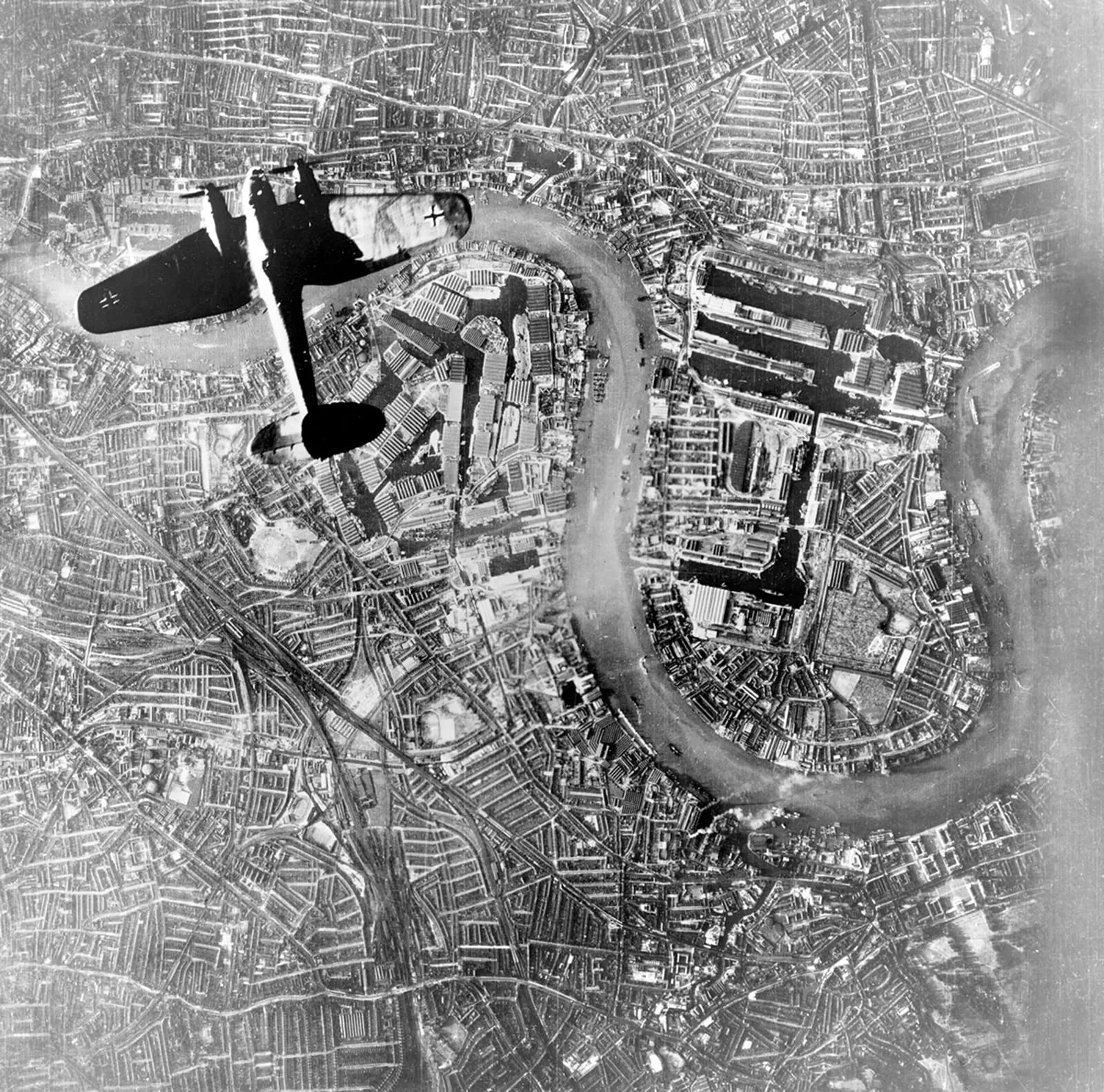
The Heinkel He 111 was the bomber with which the Luftwaffe went to war, and the aircraft Europe remembered from the war’s first years. Its glazed nose hung over Warsaw, Rotterdam, London and Coventry. The Battle of Britain showed that without strong fighter cover it was an easy target, and the successor meant to replace it never materialised. So the He 111 served to the end of the war in every role that could be devised for a twin-engined aircraft: night bomber, torpedo bomber, transport, glider tug and flying launch pad for V-1 missiles.
An airliner with a bomb bay
The Treaty of Versailles forbade Germany to build bombers, so the Luftwaffe’s first bombers were designed as transport aircraft. In 1933 Albert Kesselring, then head of administration of the secretly forming air force, persuaded Ernst Heinkel to build a new works at Rostock and to produce on a large scale. The brothers Siegfried and Walter Günter enlarged their record-breaking single-engined He 70 into a twin, keeping its elliptical wing. The first He 111 took off on 24 February 1935. A few later flew in Lufthansa colours, with a smoking compartment fitted where the military version had its bomb bay. The first military series was so underpowered that the Luftwaffe rejected it and sold it to China; only stronger Daimler-Benz and then Junkers Jumo engines turned the He 111 into a real bomber. In 1937 a new factory began work at Oranienburg (PL).
After the death of Walther Wever in 1936 the Luftwaffe gave up heavy bombers and relied on medium types such as the He 111, the Dornier Do 17 and the Junkers Ju 88. In the spring of 1937 the first production Heinkels went to Spain with the Condor Legion. They outran the Republican fighters and seemed almost untouchable, which Berlin took as proof that they needed no stronger defensive armament. An experimental He 111 squadron took part in the bombing of Guernica.
Poland, the Netherlands, Norway
On 2 September 1939, according to a German count, the Luftwaffe had 787 He 111s, several hundred of them the new H versions with Jumo engines. In the September campaign the Heinkels attacked airfields, railway junctions and roads, and from the first days of the war also Warsaw, up to the great raid of 25 September. The first experience over Poland led the Germans to add more machine guns in the cabin.
Before the campaign in the West, He 111s of KG 26 were already flying over Scapa Flow and the Scottish firths, and in April 1940 the wing fought in Norway in Hans Geisler’s corps. On 10 May 1940 three Heinkels that had lost their way bombed German Freiburg, taking it for a French town. Four days later He 111s of KG 54 dropped their bombs on the centre of Rotterdam while talks on the city’s surrender were already under way; according to recent research more than 700 inhabitants were killed, and the Netherlands capitulated that same evening.
Over England: from day to night
In the Battle of Britain the He 111 was the most numerous German bomber, and it was there that its weaknesses came to light: a few machine guns with hand-changed magazines could not beat off attacking Hurricanes and Spitfires. Kampfgeschwader 26 learned this most painfully: on 15 August, Black Thursday, it came from Norway over northern England without single-engined fighters, and according to most accounts the raid from Norway lost one aircraft in six. According to figures cited in the literature the Germans lost about 250 Heinkels over Britain between July and October 1940.
In the autumn the He 111 turned to night raids and became the main instrument of the Blitz. Its most dangerous form was the aircraft of Kampfgruppe 100, fitted with the X-Gerät radio guidance system: on the night of 14–15 November 1940 they dropped the first incendiaries on Coventry, marking the target for the several hundred bombers that followed them. From the H-4 version onwards the aircraft could carry bombs of 1,000 and even 1,800 kilograms under the fuselage, as well as sea mines.
Torpedo bomber, transport, launcher
After 1941 the He 111 fought on every front in Europe, though more and more often in auxiliary roles. In May 1941 a handful to a dozen or so Heinkels in Iraqi markings were sent to Mosul to help Rashid Ali. In 1942, in northern Norway, torpedo-carrying He 111s of KG 26 attacked the convoys to the Soviet Union; in September about ninety of them, together with Ju 88s, were gathered there against convoy PQ 18. In the East they bombed cities and railways, and on 23 August 1942 they bombed Stalingrad.
A few months later the Heinkels returned over the same city as transports. During the airlift to the encircled Sixth Army they carried even less than the Junkers Ju 52, and according to the most often cited figures 165 were lost there, more than half the Luftwaffe’s bombers on the Eastern Front. In June 1944 the night raid by He 111s and Ju 88s on Poltava during Operation Frantic was one of the last great successes of German bombers in the East.
Production ended in September 1944, when the Reich switched its factories to fighters. Figures for 1939–1944 give 5,656 aircraft, and with pre-war and licence-built machines the total reaches between about 6,500 and 7,300. The last combat task was launching V-1 missiles: from July 1944 to January 1945 the Heinkels fired about 1,200 flying bombs at England from over the North Sea. After the war Spain built its own version, the CASA 2.111 (PL), which, with British Rolls-Royce Merlin engines, played the German bombers in the 1969 film Battle of Britain.
Sources
Battles
(04)- 10–17 May 1940Dutch CampaignFrom 10 to 17 May 1940 Germany conquered the Netherlands. The airborne assault on The Hague failed, but after Rotterdam was bombed the Dutch army surrendered.
- 10 July – 31 October 1940Battle of BritainFrom 10 July to 31 October 1940 the Luftwaffe tried to destroy the RAF ahead of an invasion of Britain. It failed, and Hitler postponed the landing.
- 7 September 1940 – 11 May 1941The BlitzFrom 7 September 1940 to May 1941 the Luftwaffe bombed London and other British cities by night. Over 40,000 civilians died, but the country did not break.
- 2–31 May 1941Anglo-Iraqi WarFrom 2 to 31 May 1941 the British defeated Rashid Ali's army: they held RAF Habbaniya, took Fallujah and reached the outskirts of Baghdad.
In the chronicle
(42)1939
1940
- 16 March 1940The Scapa Flow raid and the first civilian death
- 10 May 1940Germany attacks in the West
- 14 May 1940The bombing of Rotterdam
- 3 June 1940Operation Paula
- 30 June 1940The Germans occupy the Channel Islands
- 10 July 1940The Battle of Britain begins
- 12 July 1940Air raids on Wales and Scotland
- 15 August 1940Black Thursday
- 18 August 1940The Hardest Day
- 25 August 1940The first RAF raid on Berlin
- 7 September 1940The Blitz begins
- 15 September 1940Battle of Britain Day
- 14 October 1940The Balham station disaster
- 14 November 1940The Coventry Blitz
- 22 December 1940The Manchester Blitz
- 29 December 1940The Second Great Fire of London
1941
- 10 January 1941The attack on HMS Illustrious
- 10 February 1941Malta under the bombs
- 14 February 1941Rommel in Tripoli
- 16 April 1941The Belfast Blitz
- 19 April 1941The London raid of 19 April
- 10 May 1941The last night of the Blitz
- 13 May 1941Fliegerführer Irak at Mosul
- 21 July 1941The first air raid on Moscow