- Category:
- Diplomacy
- Date:
- 2 August 1945
- Author:
- Łukasz
- Tags:
- Germany, Poland, Soviet Union, reparations
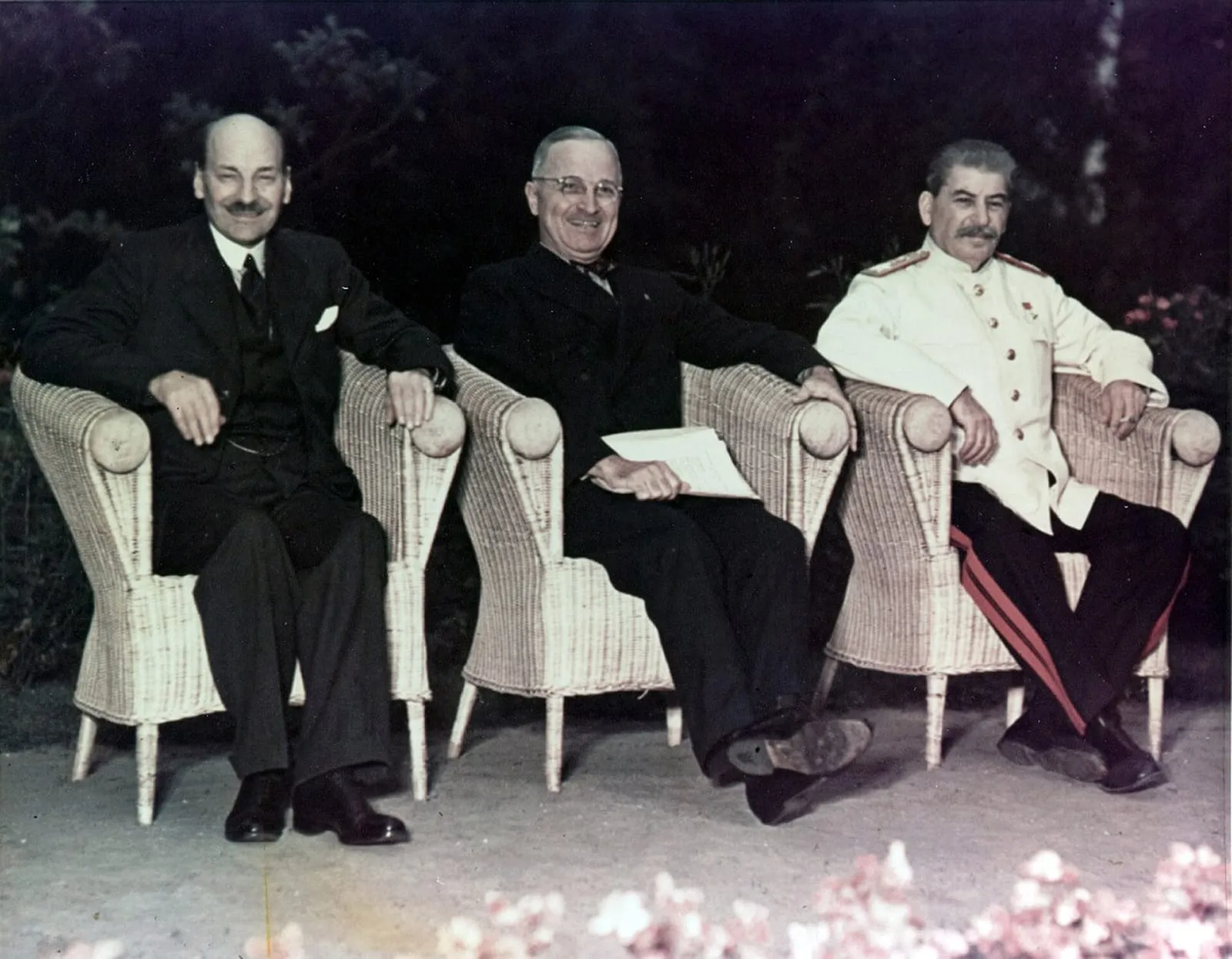
Late in the evening of 1 August 1945 the thirteenth and final plenary session of the conference of the heads of government of the three great powers met in Cecilienhof Palace. The session, which opened at 10.40 p.m., ran on past midnight. The President of the United States, Harry Truman, the Soviet leader, Joseph Stalin, and the new British Prime Minister, Clement Attlee, signed two documents: a lengthy protocol of the proceedings, dated 1 August, and a shorter communiqué, released to the world on 2 August. Together they are known as the Potsdam Agreement. So ended the conference that Truman, Stalin and Winston Churchill had opened on 17 July – the last wartime summit of the Big Three.
War chronologies sum up the day by saying that the Potsdam Agreement “ordered” the expulsion of Germans from “the eastern quarter of Germany” and from other countries of Eastern Europe. This needs qualifying. At Potsdam the powers did not order the expulsions; they recognised that the transfer to Germany of the German population “remaining in Poland, Czechoslovakia and Hungary” would have to be undertaken, and stipulated that it should be carried out “in an orderly and humane manner”. By then the expulsions had already been going on for several months, and the powers called on the governments in Warsaw and Prague and on the Allied Control Commission in Hungary to suspend them until the Control Council had prepared a plan. The lands east of the Oder and the Lusatian Neisse – together roughly a quarter of the territory of the Reich in its 1937 borders – were placed “under the administration of the Polish State”, with the exception of the northern part of East Prussia, which went to the USSR, and with the proviso that the final delimitation of the frontier would take place at a peace conference.
The last week of talks
The first part of the conference ended on 25 July. Churchill and the Labour leader Attlee then flew to London for the declaration of the results of the 5 July election. On 26 July it emerged that Labour had won the election by a large margin; Churchill resigned and Attlee became Prime Minister. On the same day the Potsdam Declaration was issued in the name of the United States, Britain and China – an ultimatum calling on Japan to surrender unconditionally. On 28 July Attlee returned to Potsdam as head of the British delegation, and the place of Anthony Eden was taken by the new Foreign Secretary, Ernest Bevin, a former leader of the transport workers’ union and Minister of Labour in the wartime government. The change in London brought no turn in British policy: Attlee had taken part in the conference from the start, and Bevin quickly showed himself to be a negotiator at least as tough with the Russians as Eden had been.
At 10.30 p.m. on 28 July the tenth plenary session met. Stalin announced that the Japanese had renewed their request for Soviet mediation and for Moscow to receive a mission led by Prince Fumimaro Konoe, and read out their note; the Soviet Union, which had not signed the Potsdam Declaration, was still formally neutral. For the next two days there were no plenary sessions. Stalin – suffering from a cold, according to the official explanation – did not leave his residence, and on 29 July Truman received Vyacheslav Molotov in Babelsberg.
It was in these days that the hardest issues were settled. Secretary of State James F. Byrnes proposed to Molotov a package whose parts were to be accepted together or not at all. The United States would agree to a Polish frontier on the Oder and the Lusatian Neisse – that is, to the full demand of Warsaw and Moscow, for as late as 29 July the Americans had been proposing a line along the Eastern (Kłodzko) Neisse, which would have left most of Lower Silesia to Germany. In return the USSR was to accept the American formula on reparations, without a sum fixed in advance, and to agree to a common position on Italy and the Reich’s former allies – their future peace treaties and admission to the United Nations. On 31 July, at the eleventh plenary session, Stalin accepted the package after haggling over the Soviet percentage share of industrial equipment from the Western zones. A delegation of the Provisional Government of National Unity was again in Potsdam at the time, and American and British diplomats held talks with it.
On 1 August the leaders met twice: at 4 p.m. and in the evening. They agreed the final wording – on German external assets, on war criminals, on Romania and Bulgaria – and the text of the communiqué, on which a special subcommittee had been working for several days. Stalin wanted, for example, the communiqué to name the chief war criminals, with Hermann Göring at their head; Truman and Attlee considered this premature, and in the end it was merely recorded that the first list of defendants would be published before 1 September. According to the American record, Truman closed the proceedings by declaring the Berlin conference adjourned and expressing the hope that the next meeting would be held in Washington, to which Stalin added, “God willing.” No such meeting ever took place. On the morning of 2 August Truman flew from Gatow airfield to England, lunched with King George VI aboard HMS Renown at Plymouth, and then set off for home aboard the cruiser USS Augusta.
Germany under occupation
The longest part of the protocol concerned Germany. The document confirmed that supreme authority there was exercised – in accordance with the Berlin Declaration of 5 June – by the commanders-in-chief of the forces of the four powers, each in his own zone, and jointly in matters affecting Germany as a whole, in the Allied Control Council. The political principles of the control period are summed up as the four Ds: demilitarisation, denazification, democratisation and decentralisation. Germany was to be completely disarmed and its armaments industry dismantled; the Nazi Party and its organisations were to be dissolved, active Nazis removed from public office and positions of responsibility, and war criminals brought to trial. Local self-government was to be restored and democratic political parties permitted, but no central German government was envisaged for the time being – only a few central administrative departments (finance, transport, communications, foreign trade and industry) under the supervision of the Control Council.
The economic principles provided that during the occupation Germany would be treated as a single economic unit. The economy was to be decentralised and the excessive concentration of economic power in cartels and combines broken up, with the emphasis placed on agriculture and peaceful industries. The German standard of living was not to exceed the average of the European countries, excluding Britain and the USSR. This provision, aimed at the Reich’s war potential, soon collided with the reality of a ruined country short of food and coal.
The chapter on reparations was the fruit of the compromise of 31 July. Each power was to meet its claims primarily from its own zone and from German external assets. The USSR was to receive in addition from the Western zones 15 per cent of the industrial equipment unnecessary for the peacetime economy, in exchange for an equivalent value of food, coal, potash, timber and other goods from the Soviet zone, and a further 10 per cent without any payment. The amount of equipment to be dismantled was to be determined within six months, and the dismantling completed within two years. The Soviet Union renounced its claims to German shares in enterprises in the Western zones and to gold captured by the Western armies, while the Americans and British renounced theirs to shares in the Soviet zone and to German assets in Bulgaria, Finland, Romania, Hungary and eastern Austria. The USSR undertook to settle Poland’s reparation claims out of its own share. It was decided not to exact reparations from Austria.
The German surface fleet – including ships under construction that could be completed within a few months – was divided equally among the three powers. Most of the submarines were to be sunk, with no more than thirty preserved and divided for experimental purposes. The German merchant fleet was also divided equally, with the proviso that Britain and the United States were to hand over ships from their shares to other Allies that had suffered losses, and the USSR from its share to Poland. On war criminals, the leaders took note of the talks under way in London among the four powers on how the major war criminals were to be tried, and declared that the trial should begin as soon as possible. The London Agreement establishing the International Military Tribunal was signed on 8 August, and in the autumn the Nuremberg trials began.
A separate chapter concerned East Prussia. The conference agreed “in principle” to the Soviet proposal for the final transfer to the USSR of Königsberg and the area adjacent to it, with a frontier running from the Bay of Danzig north of Braniewo and Gołdap to the meeting point of the frontiers of Lithuania, Poland and East Prussia. Truman and Attlee undertook to support this settlement at the future peace conference.
Poland and the Oder–Neisse frontier
The chapter on Poland opened with a declaration in which the three powers noted “with satisfaction” the formation of the Provisional Government, recalled that Britain and the United States had recognised it on 5 July, and stated that the Polish government in London “no longer exists”. Polish state property abroad was to pass under the control of the Provisional Government, and the powers promised to help those Poles who wished to return home to do so, including members of the Polish Armed Forces and the merchant navy, on the understanding that those returning would have the same rights as other citizens. The Provisional Government’s undertaking to hold “free and unfettered elections” as soon as possible, with the participation of all democratic and anti-Nazi parties, and to allow foreign journalists to work freely was also recorded.
The second part concerned the western frontier. The powers recalled that they had heard representatives of the State National Council and the Provisional Government – a delegation that included Bolesław Bierut and Stanisław Mikołajczyk – and reaffirmed that the final delimitation of Poland’s western frontier should await the peace settlement. Until then the former German territories east of a line running from the Baltic just west of Świnoujście, along the Oder to the confluence of the western Neisse and along the Lusatian Neisse to the Czechoslovak border, together with the part of East Prussia not assigned to the USSR and the area of the former Free City of Danzig, were to remain “under the administration of the Polish State” and were not to be considered part of the Soviet occupation zone. In practice a Polish administration had already been operating in these lands since the spring; the Russians had handed over to it Szczecin, which lies on the west bank of the Oder, on 5 July, and the exact course of the frontier around the city was agreed with the Soviet authorities only in the autumn.
The wording about “administration” pending a peace conference became a source of dispute for decades. The Polish and Soviet authorities treated it from the outset as a definitive transfer of the lands – in Poland they soon came to be called the Recovered Territories – whereas the Western powers saw it as a provisional arrangement. A peace conference with Germany never took place. The frontier was recognised by East Germany in 1950 and – with reservations – by West Germany in 1970, and it was finally confirmed only by the Two Plus Four Treaty and the Polish–German border treaty of 1990 (the Oder–Neisse frontier).
The transfer of the German population
Linked to the frontier decision was the chapter on the “orderly transfers of German populations” – Chapter XIII in the published communiqué, Chapter XII in the full protocol. In it the three governments recognised that the transfer to Germany of German populations, or elements thereof, remaining in Poland, Czechoslovakia and Hungary “will have to be undertaken”, and agreed that any transfers should be effected “in an orderly and humane manner”. Since the influx of millions of people was placing a heavy burden on the occupation authorities, the Control Council was first to establish how many Germans had already arrived and at what rate, and to which zones further arrivals could be directed. Until then the governments of Poland and Czechoslovakia and the Control Commission in Hungary were asked to suspend further expulsions.
This provision did not start the expulsions; it sanctioned a process that had been going on for months. Millions of Germans had fled or been evacuated ahead of the Red Army in the winter and spring of 1945. In the summer the Polish and Czechoslovak authorities carried out the so-called “wild expulsions” – the removal of the population by the army and the militia, often within a few hours, without the consent of the powers and in harrowing conditions. The call from Potsdam only partly checked them. On 20 November 1945 the Control Council adopted a plan to receive 6.65 million people, including 3.5 million from Poland, and from 1946 the expulsions of Germans were carried out in an organised manner. Altogether, according to the most commonly cited estimates, flight, evacuation and expulsion affected 12–14 million Germans from the whole of Central and Eastern Europe. The number of deaths remains disputed: older West German estimates spoke of more than two million, while more recent research by German and Polish historians speaks of several hundred thousand confirmed deaths. At the same time Poles were arriving in the vacated lands, among them people displaced from the eastern territories of the Second Polish Republic annexed by the USSR.
Other provisions
The first item of the protocol was the establishment of a Council of Foreign Ministers of Britain, the USSR, China, France and the United States, with its seat in London. Its first meeting was to be held no later than 1 September, and its task was to prepare peace treaties with Italy, Romania, Bulgaria, Hungary and Finland, and in the longer term with Germany as well. The powers declared that once the treaties had been concluded they would support the admission of these states to the United Nations, giving priority to Italy. At the same time they made clear that they would not support the candidacy of Spain under General Franco, whose regime had been established with the help of the Axis powers. As regards Romania, Bulgaria and Hungary, it was announced that the working conditions of the Western representatives on the Allied control commissions there, chaired by the Russians, would be improved.
The remaining chapters were short and for the most part referred matters to further talks. The question of extending the authority of the Austrian provisional government to the whole country was deferred until Western troops had entered Vienna. It was agreed that the Montreux Convention on the Black Sea straits needed revision, and that each of the three powers would discuss the matter directly with Turkey. The immediate withdrawal of Allied troops from Tehran was agreed, while further withdrawal from Iran was to be discussed by the Council of Foreign Ministers. The fate of the former Italian colonies was deferred to the treaty with Italy, and the question of the international zone of Tangier to a conference with French participation. The protocol did not deal with Japan: its last chapter merely recorded that meetings of the chiefs of staff of the three powers had been held during the conference.
Reactions
The communiqué was published simultaneously in the three capitals on 2 August. The full text of the protocol, including the chapters left out of the communiqué, was published in the United States only in 1947. The French government, which had not been invited to Potsdam, received an invitation to join the Council of Foreign Ministers and a request to accept the decisions. In a note of 7 August General Charles de Gaulle’s government accepted the invitation but made it clear that it did not agree in advance to the re-establishment of a central German government. The French also refused to accept Germans expelled from the east into their zone. In the Control Council France subsequently blocked the creation of common German departments at every turn.
In Poland the decisions were hailed as a great success. The authorities stressed that the country had gained Silesia, Pomerania, the mouth of the Oder and Gdańsk (Danzig), broad access to the sea and compensation for the eastern lands lost to the USSR. On 16 August in Moscow the Provisional Government signed with the USSR an agreement on the state frontier and a reparations agreement under which Poland was to receive 15 per cent of the reparations due to the Soviet Union, and in return to supply it with coal at prices far below market rates. The Western promises of free elections, on the other hand, had no mechanism of enforcement. In Germany, where the communiqué was published in the Control Council’s official gazette, the document long remained synonymous with the loss of the eastern territories.
Significance
The Potsdam Agreement was not a peace treaty but a record of arrangements made by the three victors, adopted without the participation of France, the Germans or the Poles, though it concerned them directly. It provided the framework for the occupation of Germany, assigned to Poland and the USSR lands in the east of the Reich, sanctioned the expulsion of millions of Germans and created the Council of Foreign Ministers, which in 1946–1947 prepared the peace treaties with the Reich’s allies. Yet it left many questions open or wrapped in compromise formulas that each side could read in its own way. Reparations by zone meant in practice a separate economic policy in each zone, and the principle of Germany’s economic unity soon remained a dead letter. Within two years disputes over the implementation of the Potsdam decisions had led to the breakdown of cooperation in the Control Council, the division of Germany and the Cold War.
The conference also closed the era of the Big Three. Neither Truman nor Attlee ever met Stalin again. When the protocol was signed the war in the Far East was still going on, and Truman was returning home with the decision to use the atomic bomb already taken. The Japanese government had brushed aside the Potsdam Declaration, and the Soviet Union was preparing to enter the war in accordance with its secret undertaking at Yalta. The decisions that on the night of 1–2 August still concerned only Europe were within a few weeks complemented by the decisions that ended the war in Asia.
Sources
Meanwhile
(04)Elsewhere, within a week.
- 30 July 1945 · PacificThe sinking of the “Indianapolis”On 30 July 1945 the Japanese submarine I-58 sank the cruiser Indianapolis, which had delivered atomic bomb parts to Tinian. 316 of 1,195 men survived.
- 30 July 1945 · PacificAttacks on Kobe and NagoyaBy late July 1945 Kobe and Nagoya were attacked only by fighters and carrier aircraft – B-29s had already burned both cities in the spring.
- 8 August 1945 · Far EastThe USSR declares war on JapanOn 8 August 1945 Molotov handed Japan's ambassador a declaration of war. A few hours later, on 9 August local time, the Red Army entered Manchuria.
- 9 August 1945 · PacificThe atomic bombing of NagasakiOn 9 August 1945 the B-29 Bockscar dropped the plutonium bomb Fat Man on Nagasaki. Estimates put the deaths by the end of the year at 40,000–74,000.
Related events
(04)The same battle, people or subject.
- 17 July 1945 · DiplomacyThe Potsdam Conference beginsOn 17 July 1945 Truman, Churchill and Stalin opened the last Big Three conference at Cecilienhof Palace in Potsdam, devoted to Germany and Poland.
- 18 June 1945 · PolandThe Trial of the SixteenOn 18–21 June 1945 a Soviet military court in Moscow tried the leaders of the Polish Underground State, seized by deceit, including Okulicki and Jankowski.
- 16 August 1945 · PolandThe Polish–Soviet border agreementOn 16 August 1945 Poland’s Provisional Government and the USSR signed a Curzon Line border deal, leaving Lwów and Wilno in the USSR, and a reparations pact.
- 28 June 1945 · PolandThe Provisional Government of National UnityOn 28 June 1945 the Provisional Government of National Unity was formed in Warsaw under Osóbka-Morawski, with Gomułka and Mikołajczyk as deputies.