Equipment
The Junkers Ju 87 "Stuka"
Germany's dive bomber, the emblem of Blitzkrieg in Poland and France, helpless in the Battle of Britain, then a support aircraft and tank hunter in the east.
- Role:
- dive bomber
- State:
- Germany
- Maker:
- Junkers
- First flight:
- 17 September 1935
- Built:
- between about 5,700 and 6,500
- Author:
- Natalia
- Updated:
- 1 November 2026
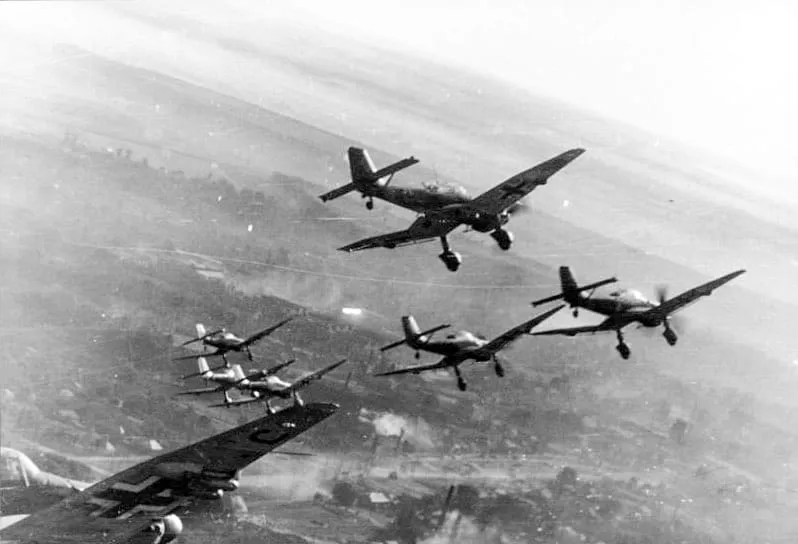
The Junkers Ju 87, called the Stuka from the German Sturzkampfflugzeug, an aircraft built to bomb in a dive, was the best-known machine of the first years of the war. Slow, with a fixed undercarriage and wings cranked like a gull’s, it could put a bomb almost exactly on target because it fell on it nearly vertically. In Poland and France, where the enemy had few fighters, it became both the instrument and the emblem of Blitzkrieg. Over England it turned out to be easy to shoot down, and from then on its story is that of an aircraft that could work only where the sky belonged to the Germans.
Udet’s idea
The dive bomber was not a German invention. Ernst Udet, a First World War ace and aerobatic pilot, saw the Curtiss Hawk II biplane attacking targets in a dive in the United States, and in the autumn of 1933 two of them, bought with money Göring found for him, arrived in Germany for trials. At the same time Germany launched its own programme for a dive bomber, and the Junkers works at Dessau produced a two-seat all-metal monoplane. The first prototype flew on 17 September 1935; in January 1936 it crashed, killing the test pilot, and later machines were given a single fin and rudder.
The programme hung by a thread. In June 1936 Wolfram von Richthofen, then a technical official at the air ministry, wanted to stop it, believing that diving a large aircraft was too risky. Udet, who was just taking over the technical office after the death of Walther Wever, reversed the decision and declared the Ju 87 the winner of the competition. From 1937 the A series reached the units, and a few were tried out in Spain with the Condor Legion; in 1939 improved Ju 87Bs joined them there. Shortly before the war, on 15 August 1939, thirteen Stukas flew into the ground during a demonstration at Neuhammer, because the cloud base over the range had dropped almost to the ground and nobody had warned the crews. The Luftwaffe changed nothing as a result.
September 1939 and May 1940
On the eve of the attack on Poland the Luftwaffe had, according to German returns, between 336 and 366 Ju 87s ready for action. In the September campaign they struck among the first: on the morning of 1 September three aircraft attacked the sappers’ positions at the bridges in Tczew, and groups of Stukas bombed Wieluń, a town with no troops and no anti-aircraft defence. The hour of that raid remains disputed (Polish tradition says 4.40, the German flying records 5.40), and most historians regard it as a war crime. On 2 September about sixty Ju 87s bombed Westerplatte, and off Hel they sank the destroyer Wicher and the minelayer Gryf. Less famous was their daily work: breaking up columns, bridges and artillery positions ahead of the advancing divisions. The campaign cost the Germans about thirty Stukas.
In the spring of 1940 the Ju 87 reached the height of its fame. At Sedan on 13 May, according to figures cited by Karl-Heinz Frieser, some two hundred Stukas dived on the French positions above the Meuse for eight hours. Losses were few, but the reservists and gunners, stunned by the explosions, stopped resisting and the Germans crossed the river. Part of the effect came from wind-driven sirens which, from the B version on, were fitted to the undercarriage legs. German propaganda made them the aircraft’s trademark, and in Poland they became known as the “trumpets of Jericho”. The idea is credited to Udet, although not all sources agree.
Defeat over England
In the summer of 1940 the Stukas attacked convoys in the Channel, ports, radar stations and airfields. At sea they did well; over land they met an organised fighter defence. The Ju 87 was the slowest combat aircraft of the Battle of Britain: it lost speed in the dive and in pulling out, and the gunner’s single rear machine gun could not protect it from Spitfires and Hurricanes. The escorting Messerschmitts, much faster, struggled to stay with it. On 18 August, the Hardest Day of the battle, the Stukas lost sixteen aircraft over Sussex and Hampshire. Since the start of the battle nearly sixty had been lost, and the command withdrew them from the main fighting. The fear they caused among the defenceless meant nothing against a defence with radar and modern fighters.
The Mediterranean
The Ju 87 was moved to where Allied air power was weak. On 10 January 1941 Stukas of X Air Corps, sent to Sicily, hit the carrier Illustrious with six bombs, and she barely limped into Malta. From then on besieged Malta, its harbours and its convoys were among the main targets of German and Italian Ju 87s; the Italians, who bought several dozen, called them Picchiatello. In May 1941, during the landing on Crete, Richthofen’s dive bombers did most to sink the cruiser Gloucester and several destroyers, which showed that a fleet without fighter cover could not operate close to land. Over Tobruk they forced the British to supply the fortress at night with fast warships.
The Eastern Front and the end
The Ju 87 fought longest and hardest against the Soviet Union. On 23 September 1941, at Kronstadt, Stukas sank the Soviet battleship Marat. In 1942 they bombed the forts of Sevastopol, and in the autumn the ruined factory districts in the Battle of Stalingrad, flying several hundred sorties a day over a few city blocks. The new D version carried more bombs and better armour but was just as slow, and Soviet fighters and anti-aircraft guns took a bigger toll every year.
From 1943 the Ju 87G, with two 37 mm cannon under the wings, hunted tanks; a few of them fought at Prokhorovka. The best-known pilot of this version was Hans-Ulrich Rudel, credited by German records with more than 2,500 combat sorties and 519 tanks destroyed; those figures cannot be checked. Towards the end of the war more and more Stukas were converted for night harassment, since by day they had no chance. Production ended in 1944, and in January 1945 a little over a hundred Ju 87s remained in the combat units. The total built depends on whether only aircraft accepted by the Luftwaffe are counted: sources give between about 5,700 and 6,500. Two complete examples survive today, in London and in Chicago.
Sources
Battles
(18)- 1 September – 2 October 1939Battle of HelFrom 1 September to 2 October 1939 some 3,000 soldiers and sailors held the Hel Peninsula, the last Polish centre of resistance on the Baltic.
- 1–7 September 1939Battle of WesterplatteFrom 1 to 7 September 1939 some 200 Polish soldiers held the Westerplatte depot against a battleship, naval infantry, Danzig police and Stukas.
- 12–15 May 1940Battle of Sedan (1940)On 12–15 May 1940 Guderian’s panzer corps forced the Meuse at Sedan after hours of Luftwaffe bombing, repelled counter-attacks and tore open the French front.
- 26 May – 4 June 1940Battle of DunkirkFrom 26 May to 4 June 1940 the Allies held a perimeter around Dunkirk while a fleet of over 800 vessels evacuated 338,000 troops to England.
- 11 June 1940 – 20 November 1942Siege of MaltaFrom June 1940 to November 1942 Italy and Germany bombed and blockaded Malta. The island held out and became a base for attacks on Axis convoys to Africa.
- 10 July – 31 October 1940Battle of BritainFrom 10 July to 31 October 1940 the Luftwaffe tried to destroy the RAF ahead of an invasion of Britain. It failed, and Hitler postponed the landing.
- 24 March – 15 April 1941Rommel’s first offensive24 March – 15 April 1941. In three weeks Rommel retook Cyrenaica from the British, captured three generals and reached Egypt’s border. Tobruk held out.
- 6–17 April 1941Invasion of YugoslaviaBetween 6 and 17 April 1941 Germany, Italy and Hungary crushed the Yugoslav army in eleven days. Belgrade was bombed and the kingdom carved up by the victors.
- 6–30 April 1941German invasion of GreeceIn April 1941 the Germans broke through Greece's defences from Bulgaria, cut off its army in Albania and took Athens. The British evacuated some 50,000 men.
- 10 April – 27 November 1941Siege of TobrukFrom 10 April to 27 November 1941 Australians, Britons, Poles and Czechoslovaks held Tobruk against Rommel. Supplied by sea, the fortress never fell.
- 30 October 1941 – 4 July 1942Siege of Sevastopol (1941–1942)30 October 1941 – 4 July 1942: the German-Romanian 11th Army besieged Sevastopol, base of the Black Sea Fleet. It beat off two assaults and fell to the third.
- 26 December 1941 – 19 May 1942Fighting on the Kerch Peninsula (1941–1942)26 December 1941 – 19 May 1942. The Red Army retook the Kerch Peninsula, but its offensives failed; in May Manstein crushed the Crimean Front in Trappenjagd.
- 12–28 May 1942Second Battle of KharkovOn 12–28 May 1942 Timoshenko's offensive on Kharkiv ended in a German counter-attack and the destruction of three Soviet armies in the Barvenkovo pocket.
- 26 May – 21 June 1942Battle of GazalaOn 26 May – 21 June 1942 Rommel outflanked the Gazala Line, beat Eighth Army in the Cauldron and took Bir Hakeim and Tobruk with some 33,000 prisoners.
- 10–15 August 1942Operation PedestalOn 10–15 August 1942 the Pedestal convoy fought its way to Malta. Five of 14 ships arrived, including the tanker Ohio, and their cargo saved the island.
- 19 February – 15 March 1943Third Battle of KharkovOn 19 February – 15 March 1943 Manstein smashed the overextended Soviet armies between the Donets and the Dnieper and retook Kharkiv, then Belgorod on 18 March.
- 8 September – 22 November 1943Dodecanese campaignBetween 8 September and 22 November 1943 the Germans took Rhodes, Kos, Leros and Samos from the British and Italians. Luftwaffe air supremacy decided it.
- 9 June – 9 August 1944Vyborg–Petrozavodsk offensiveFrom 9 June to 9 August 1944 the Red Army attacked Finland in Karelia. It took Viipuri and Petrozavodsk but failed to destroy the Finnish army.
In the chronicle
(60)1939
1940
- 9 April 1940The sinking of the Blücher in the Drøbak Narrows
- 10 April 1940The sinking of the Königsberg
- 10 May 1940The capture of Fort Eben-Emael
- 12 May 1940The Battle of Hannut
- 13 May 1940The breakthrough at Sedan
- 13 May 1940The battles of the Grebbeberg and the Afsluitdijk
- 24 May 1940The halt order before Dunkirk
- 26 May 1940Operation Dynamo
- 10 July 1940The Battle of Britain begins
- 13 August 1940Adlertag
- 15 August 1940Black Thursday
- 18 August 1940The Hardest Day
1941
- 10 January 1941The attack on HMS Illustrious
- 31 March 1941Rommel takes Mersa Brega
- 6 April 1941Germany attacks Greece
- 10 April 1941The siege of Tobruk begins
- 24 April 1941The evacuation from Greece
- 20 May 1941The airborne invasion of Crete
- 28 May 1941The evacuation from Crete
- 5 July 1941Swordfishes over Tobruk
- 17 November 1941The suicide of Ernst Udet
- 17 December 1941The second assault on Sevastopol
1942
- 1 March 1942The Crimean Front offensive
- 8 April 1942The end of Force K
- 20 April 1942Operation Calendar
- 8 May 1942Operation Trappenjagd
- 9 May 1942Operation Bowery
- 12 May 1942The Kharkov offensive
- 23 May 1942The Barvenkovo pocket
- 31 May 1942The Cauldron at Gazala
- 1 June 1942The destruction of the 150th Brigade
- 10 June 1942The defence of Bir Hakeim
- 11 June 1942Operation Harpoon
- 12 June 1942The third assault on Sevastopol
- 21 June 1942The fall of Tobruk
- 15 August 1942The Ohio reaches Malta
- 23 August 1942The bombing of Stalingrad
- 3 September 1942The fighting for Stalingrad begins
- 18 September 1942The fighting for the grain elevator in Stalingrad
- 19 September 1942Operation Agreement
- 12 October 1942The fighting in Stalingrad's factory district
- 15 November 1942The run for Tunis
- 2 December 1942The Battle of Tebourba