Germany
Wolfram von Richthofen
Chief of staff and commander of the Condor Legion (1937–1939), commander of VIII Air Corps (1939–1942), Air Fleet 4 (1942–1943) and Air Fleet 2 (1943–1944)
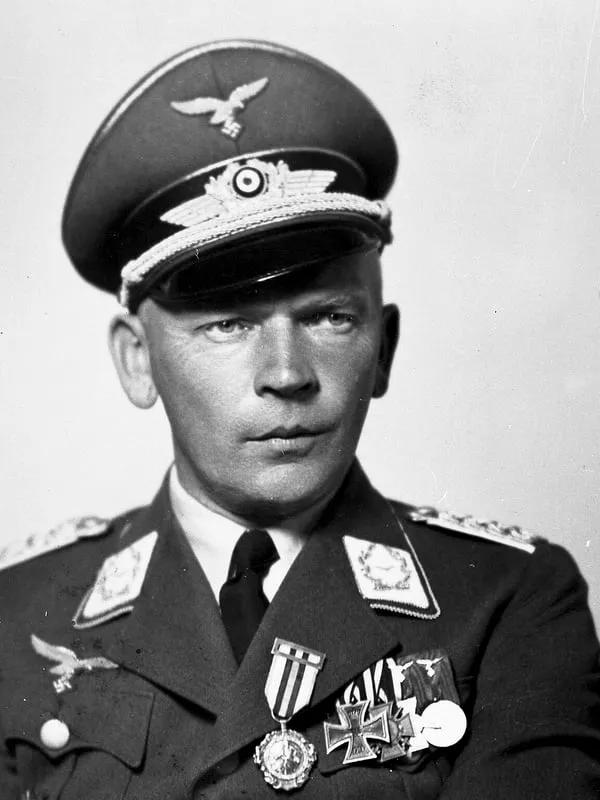
- Born:
- 10 October 1895, Barzdorf (Bartoszówek) near Strzegom, Silesia (German Empire)
- Died:
- 12 July 1945, Bad Ischl (Austria)
- Author:
- Natalia
- Photo:
- autor nieznany, domena publiczna, Wikimedia Commons

Wolfram von Richthofen was the German airman who, more than anyone else, shaped the way the Luftwaffe supported the army on the ground. His dive bombers went ahead of the tanks in Poland, France, the Balkans and Russia, and army commanders came to see him as the partner they most wanted in the air. The same efficiency with which he destroyed fortifications and columns of troops served him in bombing cities: his name is tied to Guernica, Wieluń, besieged Warsaw and Stalingrad. He was a cousin of the famous “Red Baron”, and in 1943, at the age of 47, he became one of the youngest field marshals of the Reich.
Hussar, airman, engineer
Wolfram Freiherr von Richthofen was born on 10 October 1895 on the Barzdorf estate (today Bartoszówek) near Strzegom in Lower Silesia, into a landowning family with military traditions. After cadet school at Lichterfelde he joined the 4th Hussar Regiment in 1913. He began the First World War as a cavalryman in the west, then fought in the east, and in 1917 transferred to the air service. In the spring of 1918 he joined the fighter squadron Jasta 11, in which his distant cousin Manfred von Richthofen flew; Manfred was killed on 21 April, during one of Wolfram’s first combat flights. By November the younger Richthofen had shot down eight aircraft.
After the war he did something rare among officers: he went to university. In Hanover he qualified as a mechanical engineer, and in 1923 he returned to the Reichswehr and worked on air armament, which the Treaty of Versailles prohibited. In 1929 he took a doctorate in aeronautical engineering in Berlin and went to Rome as an unofficial air attaché. In 1933 he moved to the emerging Luftwaffe and took charge of the development of new aircraft at the Air Ministry. For a long time he had no faith in the Junkers Ju 87 dive bomber, which would later make his name, and in 1936 he wanted to halt its development, but just then Ernst Udet, with whom Richthofen did not get on, arrived at the technical office.
Spain and Guernica
In the autumn of 1936 Richthofen went to Spain, where the Condor Legion was supporting General Franco’s forces. In January 1937 he became chief of staff to the Legion’s commander, Hugo Sperrle, and in practice directed air operations on the northern front. It was there that he worked out the methods that became his hallmark: liaison officers with the units at the front, radio links between the ground and the aircraft, and relentless shuttle raids on a narrow sector of the attack.
On 26 April 1937 the Legion’s aircraft bombed Guernica. Richthofen’s staff prepared the attack; according to his diary, the target was the bridge and the roads along which the Basques were retreating. The bombs, however, burned down the whole town centre and killed, according to modern research, around 150–300 people. Richthofen noted the burning town in his diary without a trace of compassion and judged the raid a technical success. At the end of 1938, by then a major general, he took command of the Legion and led it until Franco’s victory in the spring of 1939.
Wieluń and Warsaw
In September 1939 Richthofen commanded a special-purpose close-support air group, subordinated to Alexander Löhr’s Air Fleet 4 and supporting Walter von Reichenau’s Tenth Army. On the first day of the war his dive bombers destroyed the centre of Wieluń, a town without troops or anti-aircraft defences. Historians disagree about why: Hans-Erich Volkmann regards the raid as a crime and a test of a new weapon on a defenceless target, while Rolf-Dieter Müller believes the airmen were meant to hit Polish troops and struck the town in the morning fog.
In the second half of the month Richthofen directed air operations over besieged Warsaw. He pressed for permission to mount a massed raid on the city, which in a signal to his superiors he himself called a last opportunity for a large experiment in devastation and terror. On 25 September, “Black Monday”, several hundred German aircraft, his dive bombers among them, flew more than a thousand sorties over the capital; whole districts burned. His biographer, the American historian James Corum, calls it a cruel act of war, while pointing out that the law of the time did not forbid bombing a defended city.
From Sedan to Crete
From October 1939 Richthofen commanded VIII Air Corps, made up mainly of dive bombers. In the French campaign he supported Reichenau’s troops in Belgium, part of his forces attacked the French at Sedan, and then over Dunkirk he tried to hinder the British evacuation. In May 1940 he received the Knight’s Cross, and in July he was promoted, skipping one rank, to General of the Air Force. In the Battle of Britain Richthofen’s Ju 87s attacked convoys, ports and airfields, but in August they suffered such heavy losses to British fighters that they were withdrawn from the fighting.
In the spring of 1941 Richthofen’s corps, based in Bulgaria, supported the invasion of Yugoslavia and of Greece, and in May the Battle of Crete. Over the island his bombers sank or damaged many ships of the Royal Navy, which was evacuating and supplying the defenders, among them the cruisers Gloucester and Fiji.
The Eastern Front: from Smolensk to Sevastopol
In Operation Barbarossa VIII Air Corps supported Army Group Centre in the battles of Białystok, Minsk and Smolensk; in July 1941 Richthofen received the Oak Leaves to the Knight’s Cross. In August Adolf Hitler moved the corps to Leningrad, and in the autumn back to Moscow. On 1 February 1942 Richthofen became a colonel general.
In the spring of 1942 he was given a task that showed his method to the full. In the Crimea he worked with Erich von Manstein’s Eleventh Army in Operation Trappenjagd, which in May destroyed the Crimean Front on the Kerch Peninsula. Richthofen concentrated hundreds of aircraft on a narrow sector, built a network of forward airfields just behind the front, and gave Manstein an air superiority the Wehrmacht had not enjoyed since the summer of 1941. In June his aircraft bombed Sevastopol without pause; according to German figures, the corps dropped around 20,000 tonnes of bombs there in a month.
Stalingrad
In July 1942 Richthofen took over Air Fleet 4 from Löhr, at the time the strongest formation of the Luftwaffe, which supported Operation Blue. On 23 August, when German tanks reached the Volga, his aircraft bombed Stalingrad, reducing a large part of the city to rubble; the number of civilians killed is disputed to this day, with estimates ranging from several thousand to several tens of thousands. Throughout the autumn Air Fleet 4 dominated the skies over Stalingrad by day.
After the Sixth Army was encircled in November 1942, Richthofen believed from the outset that the air force could not supply it, and he urged his superiors to let the army break out. Hermann Göring, however, promised Hitler an airlift, and Richthofen had to organise it. In frost and fog, with ever fewer airfields, the transport aircraft delivered only a fraction of the supplies needed, and the Luftwaffe lost several hundred aircraft over the pocket. Richthofen criticised Hitler’s decisions in his diary and in conversations with his superiors, but he carried them out.
Field marshal in Russia and Italy
On 16 February 1943 Richthofen was made a field marshal. In February and March his air fleet supported Manstein’s counterstroke, which culminated in the Third Battle of Kharkov; Richthofen gathered his surviving units on the few airfields available and for several weeks held an air superiority over the battlefield that contributed greatly to the German success.
In June 1943 he was transferred to Italy, where he replaced Albert Kesselring at the head of Air Fleet 2. Facing Allied air superiority, all he could do was sting: on 2 December 1943 his bombers carried out a successful raid on the port of Bari, but the landing at Anzio in January 1944 took him by surprise, and his aircraft could not stop the Allied raids on the rear of the front. In June 1944 his eldest son, a pilot, went missing over Romania.
Illness, death and judgement
From the spring of 1944 Richthofen suffered from severe headaches. In the autumn doctors diagnosed a brain tumour; an operation at the end of October only slowed the disease. Relieved of his command, he was transferred to the reserve in November. The end of the war found him in the Luftwaffe hospital at Bad Ischl (PL) in Austria, where he became an American prisoner. He died there on 12 July 1945 and never stood trial.
His biographers agree that he was one of the ablest air commanders of the war: an engineer and organiser who turned air support into a precise instrument of lightning war. Corum describes him as a competent but ruthless practitioner who never showed moral qualms or sympathy for the people on whom his bombs fell. The German historian Wolfgang Schmidt, in the “Neue Deutsche Biographie”, sees him as a model officer of the Nazi military elite: a specialist steady in a crisis who, even when he criticised Hitler’s decisions, remained a loyal executor of his will. He openly admired Hitler and accepted large secret supplements to his pay from the regime.
Sources
Mentioned in battles
(12)Often appears with
People who appear in the same events.
On the timeline
(29)1936
1937
1939
1940
1941
February
April
- 06
- Key eventGermany attacks YugoslaviaOn 6 April 1941 Germany invaded Yugoslavia without declaring war and the Luftwaffe bombed Belgrade. The partly mobilised army quickly fell apart.
- Key eventGermany attacks GreeceOn 6 April 1941 the 12th Army struck Greece from Bulgaria. The Metaxas Line forts beat off the first attacks; at night an ammunition ship blast wrecked Piraeus.