France
Albert Lebrun
Minister of the Colonies (1911–1914), Minister of Blockade and of the Liberated Regions (1917–1919), President of the Senate (1931–1932), President of France (1932–1940)
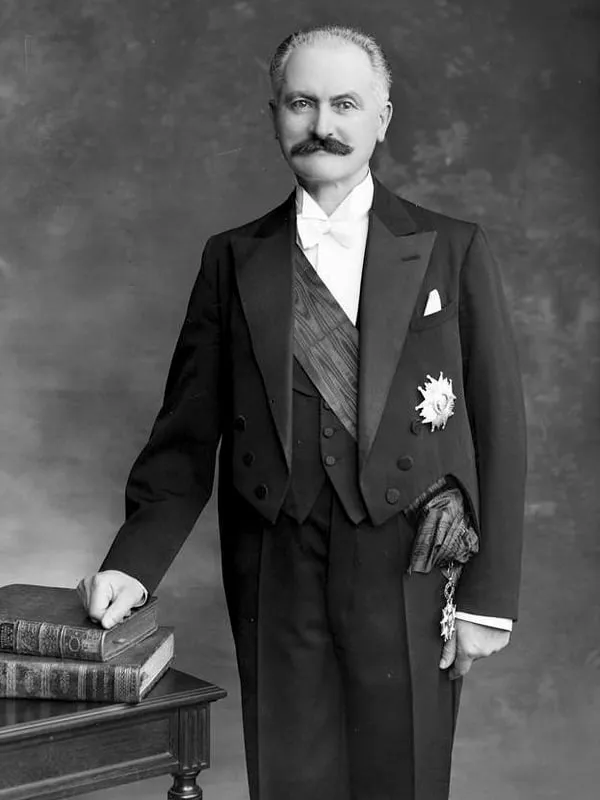
- Born:
- 29 August 1871, Mercy-le-Haut (France)
- Died:
- 6 March 1950, Paris
- Author:
- Łukasz
- Photo:
- Agence de presse Meurisse, domena publiczna, Wikimedia Commons

Albert Lebrun was the last president of the Third Republic. A Lorraine engineer from a peasant family and the top student of his year at the École polytechnique, he spent forty years building a career as a moderate republican – deputy, minister and President of the Senate – and in 1932, after the assassination of President Paul Doumer, he became head of state. In a system in which executive power lay with the prime minister, the president was above all an arbiter and a symbol. Lebrun played this role through the years of the economic crisis, the riots of 6 February 1934, the Popular Front and Munich, and in 1939 he became the first president in half a century to be elected to a second term. In June 1940, at the moment of defeat, he argued for continuing the war from North Africa, yet it was he who entrusted the government to Marshal Pétain, and in July he signed the law that brought the republic to an end. He never resigned, and he never returned to power.
A Lorrainer from Mercy-le-Haut
He was born on 29 August 1871 in Mercy-le-Haut, a village in northern Lorraine, into the family of a farmer who was also the mayor of the commune. He came into the world a few months after France’s defeat in the war with Prussia. His village escaped annexation to the German Empire by a hair’s breadth: the border drawn by the Treaty of Frankfurt ran right past it, and Mercy-le-Haut found itself in the new department of Meurthe-et-Moselle. Until 1873 Prussian soldiers were stationed there, waiting for France to pay off its war indemnity. Lebrun later recalled that his child’s eyes had opened on “a spectacle of infinite sadness”. The loss of Alsace-Lorraine and the dream of Metz and Strasbourg returning to France stayed with him all his life.
Exceptionally able, he won a place at the lycée in Nancy and, in 1890, at the École polytechnique. He was admitted near the bottom of the list and graduated first in his year. He then graduated, again first, from the École des Mines in Paris. He did a placement at the ironworks of the Donets Basin in Russia, and from 1896 he worked as a mining engineer in Vesoul and Nancy, dealing among other things with the iron ores of Lorraine. In 1902 he married Marguerite Nivoit, with whom he had a son and a daughter. He was a practising Catholic, which was not the rule in his political camp.
Deputy and minister
In 1898 he became a member of the general council of Meurthe-et-Moselle, and in 1906 its president, a post he held without interruption for 26 years. In December 1900, at the age of 29, he won a by-election to the Chamber of Deputies for the Briey constituency and became the youngest member of the French parliament. He sat in the Chamber until 1920, from 1913 as its vice-president. He belonged to the moderate centre associated with the Democratic Republican Alliance, a party that drifted to the right over time. He voted for the separation of Church and State in 1905, for income tax and for three-year military service in 1913.
From 1911 to 1913 he was Minister of the Colonies in the governments of Joseph Caillaux and Raymond Poincaré, his friend and fellow Lorrainer. During the Agadir crisis (PL) of 1911 he supported the compromise under which France ceded part of the Congo to Germany in exchange for a free hand in Morocco. In January 1913 he headed the War Ministry for a few days, and from December 1913 to June 1914 he was again Minister of the Colonies, in Gaston Doumergue’s government. During the First World War he served as an artillery officer, and from November 1917 he sat in the government of Georges Clemenceau, first as Minister of Blockade and then as Minister of the Liberated Regions, responsible for rebuilding the devastated departments of the north and east. In 1919 he left the government after a dispute with the prime minister over a joint electoral list with Louis Marin, who had voted against the Treaty of Versailles.
Senator and President of the Senate
In 1920 Lebrun moved to the Senate as senator for Meurthe-et-Moselle. He represented France at the League of Nations, and from 1926 to 1931 he headed the state sinking fund, which under Poincaré helped to rescue the franc. In 1931 the senators elected him President of the Senate; he defeated Jules Jeanneney by 147 votes to 139. He was regarded as conscientious, hard-working, courteous and cautious, without great ideological ambitions.
President
On 6 May 1932 a Russian émigré, Paul Gorguloff (Pavel Gorgulov), shot President Paul Doumer, who died the following day. On 10 May the National Assembly – the two chambers of parliament sitting together – elected Lebrun president in the first round, with 633 votes out of 777. His first term fell in the years of the Great Depression and constant changes of government. After the bloody riots outside the Chamber of Deputies on 6 February 1934, Lebrun appointed a government of national unity under the former president Doumergue, in which Marshal Philippe Pétain became Minister of War. In 1936, after the victory of the Popular Front, he entrusted the government, “with death in his soul”, as he himself wrote, to the socialist Léon Blum. He signed the new majority’s laws but did not conceal his criticisms from the ministers. When the Spanish Civil War broke out, he was among those who advised Blum against helping the Republic, and he supported the policy of non-intervention. In 1937 Blum resigned when the Senate refused him emergency powers.
The president had little say in foreign policy, and Lebrun did not try to change that. He watched Hitler’s rearmament with unease but kept silent in public. He represented France at ceremonies and on visits: in 1936 he attended the funeral of George V in London, in July 1938 he received King George VI in Paris, and in March 1939, in the days after the German seizure of Prague, he paid a return visit to London that was meant to demonstrate the unity of the two powers.
On 5 April 1939, with war in the air, parliament re-elected him with 506 votes out of 904. He was the first president of the Third Republic to be elected to a second term since Jules Grévy in 1885. What told in his favour was precisely that he was seen as a guarantee of continuity and calm.
The war
On 1 September 1939 Lebrun signed the decree on general mobilisation, and on 3 September France declared war on Germany. In October he signed a decree suspending Communist mayors and deputies after the Communist Party, obedient to Moscow, failed to condemn Hitler’s pact with Stalin. After the fall of Édouard Daladier’s cabinet in March 1940 he asked Paul Reynaud to form a government. On 9 May Reynaud, unable to force through the dismissal of General Maurice Gamelin, announced that his cabinet would resign; the next morning, when the Germans struck in the West, Lebrun persuaded him to stay.
When the front collapsed, Lebrun left Paris on 10 June and took up residence at the Château de Cangé near Tours. At the cabinet meetings he chaired there on 12 and 13 June, General Maxime Weygand demanded an armistice and Pétain backed him. Lebrun sided with Reynaud and the ministers who wanted to fight on. On 14 June he arrived in Bordeaux. Over the following days he, together with Reynaud, the presidents of the two chambers, Jules Jeanneney and Édouard Herriot, and the minister Georges Mandel, favoured moving the authorities to North Africa and continuing the war with the colonial empire and the fleet. Yet when, on the evening of 16 June, Reynaud resigned after being outvoted by the supporters of an armistice, Lebrun, on the advice of the outgoing prime minister and the presidents of the chambers, entrusted the government to Pétain. That same night the Marshal asked the Germans for their armistice terms.
In the following days the departure of the president, the presidents of the chambers and some of the ministers for Africa was still under consideration. On 21 June, as Lebrun was preparing to leave, Pierre Laval called on him with a group of parliamentarians and firmly demanded that he stay; they regarded departure as flight and treason. Lebrun gave way. Only 27 parliamentarians sailed for Morocco on the Massilia, among them Mandel and Daladier, whom the authorities later accused of desertion. On 22 June the Armistice of Compiègne was signed. At the end of the month Lebrun signed a decree that revoked de Gaulle’s promotion to general and retired him from the army.
The end of the republic
On 1 July the government moved to Vichy, and Lebrun took up residence there in the Pavillon Sévigné. On 10 July the two chambers, meeting as the National Assembly in the Vichy casino, passed by 569 votes to 80 a constitutional law that gave the government under Pétain’s authority full powers to promulgate a new constitution. Lebrun signed it the same day. On 11 July the Marshal proclaimed himself Head of the French State, and the office of President of the Republic ceased to exist. Lebrun did not resign. No one asked him to, and he himself later maintained that there would have been no one to whom he could have tendered his resignation. He left Vichy and went to live with his son-in-law in Vizille in the Alps.
After November 1942 Vizille lay in the Italian occupation zone. When the Germans were taking over the region after Italy’s capitulation, they arrested Lebrun on 27 August 1943 and took him to Itter Castle in the Tyrol, where they held prominent French prisoners, among them Daladier, Reynaud and Gamelin. Because of his poor health he was allowed to return to Vizille in October 1943, and he remained there under surveillance until the liberation in August 1944.
After the war
On 11 October 1944 he met Charles de Gaulle, head of the Provisional Government, in Paris and acknowledged his leadership. According to the general’s memoirs, Lebrun told him that he had never formally resigned but was placing himself at his disposal. The press then reported that he had stepped down from office, which Lebrun denied in a letter to de Gaulle. He did not return to power and, by his own account, did not seek to. In 1945 he testified at the trials of Pétain and Laval, and he published his memoirs, Témoignage (Testimony), in which he described June 1940 day by day. He spent his last years lecturing on the Third Republic and the steel industry. He died of pneumonia in Paris on 6 March 1950. After a state funeral in Notre-Dame Cathedral he was buried in his native Mercy-le-Haut.
Assessment
Lebrun was an honest and hard-working servant of the republic at a time that called for a leader. The constitution of the Third Republic gave the president little power, and he never tried to push its limits, either in the 1930s or in June 1940, when the decision to leave for Africa also depended on his determination. Historians point out that it was he who signed Pétain’s appointment and the law of 10 July, which ended the republic, even though he opposed the armistice. His defenders stress that he acted in accordance with the will of the majority of the government and parliament, and that a refusal would not have changed the course of events. De Gaulle summed him up in his memoirs with a sentence that has clung to him ever since: as head of state he had lacked two things – that he should be a head, and that there should be a state.
Sources
Often appears with
People who appear in the same events.