- Category:
- Military operations
- Front:
- Western Front
- Date:
- 15 August 1944
- Author:
- Łukasz
- Battle:
- Operation Dragoon
- Tags:
- United States, France, Wehrmacht, Lucian Truscott
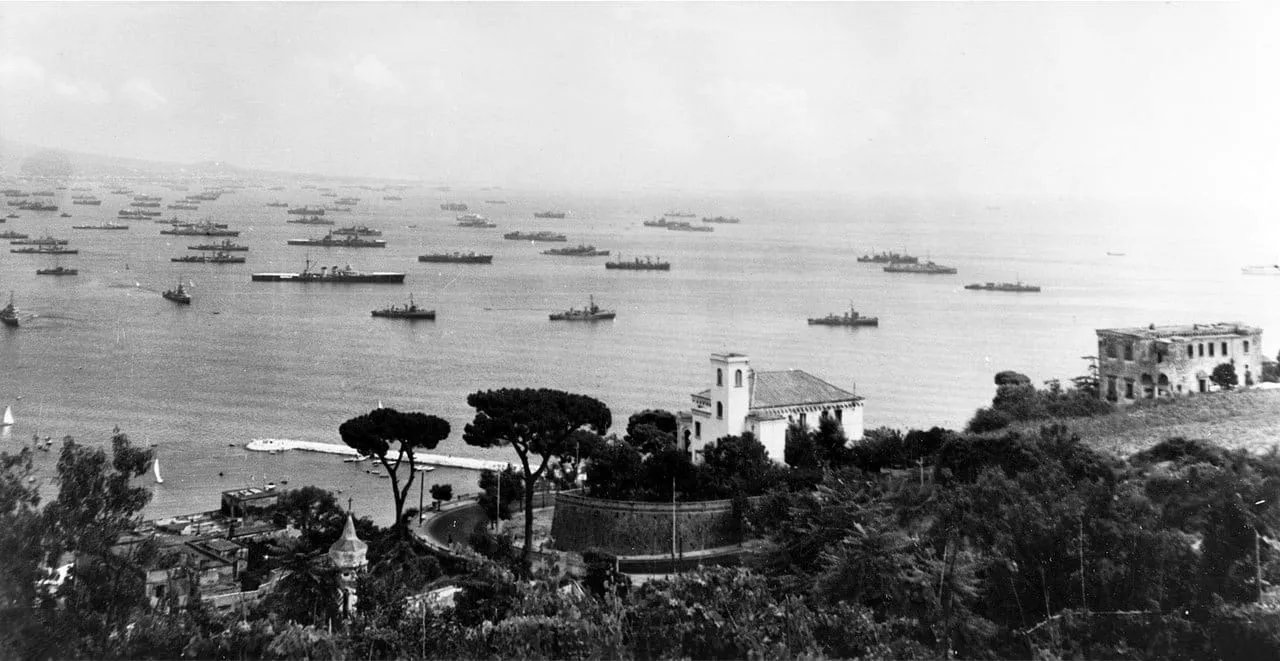
On 15 August 1944, nine weeks after the Normandy landings, the Allies opened a second invasion front in France. At dawn three American divisions of General Lucian Truscott’s VI Corps came ashore on the Côte d’Azur in the Var department, between Cavalaire-sur-Mer and Saint-Raphaël. A few hours earlier paratroopers and gliders had landed in the valley of the Argens around Le Muy, and commandos had struck at the offshore islands and the outlying headlands. The operation, planned for many months under the code name Anvil, had been called Dragoon since the beginning of August. The French refer to it simply as the débarquement de Provence – the landing in Provence.
The landing went far more easily than expected. The German coastal defence, overstretched and manned largely by second-rate units, collapsed within a few hours, and the attackers’ losses on the first day were counted in hundreds, not thousands. Much harder was the dispute that preceded the operation – one of the bitterest in the whole history of Anglo-American cooperation.
The quarrel over Anvil
The idea of a landing in the south of France originated in the American staff, and its most persistent champion was the US Army Chief of Staff, General George Marshall. At the Tehran Conference in November 1943 the plan won the support of Joseph Stalin, who preferred the Western Allies to strike in France rather than in the Balkans. Anvil was originally to be launched simultaneously with the Normandy invasion, to split the German reserves. It soon became clear, however, that there were not enough landing craft and ships for two amphibious operations at once – especially after the plan for Operation Overlord was enlarged from three to five divisions in the first wave. Then there was the fighting in Italy: the Allies were stuck at Cassino, and the Anzio beachhead tied down for four months the forces that were to have been used in Provence. Anvil was therefore postponed time and again.
After the capture of Rome and the successful landing in Normandy the dispute flared up again with renewed force. The British – Prime Minister Winston Churchill and his Chiefs of Staff, and in the Mediterranean theatre General Henry Maitland Wilson and General Harold Alexander – wanted to exploit the momentum of the offensive in Italy. In their view the experienced divisions that were to be taken from the Italian front should instead break through the German defences in the Apennines and advance north-east towards Istria, Ljubljana and on into Austria and Hungary. Some historians also attribute a political idea to Churchill: the entry of the Western Allies into Central Europe ahead of the Red Army. The prime minister himself, in his memoirs, presented the matter primarily as a dispute about the best use of forces; historians still differ on how much of his argument was military strategy and how much post-war calculation.
The Americans – Marshall, President Franklin Delano Roosevelt and the Supreme Allied Commander in Europe, General Dwight Eisenhower – stood by the plan. They argued that it had been agreed with the Russians at Tehran, that Normandy needed additional ports because the capacity of the harbours and artificial ports there was insufficient, and that the more than 40 divisions waiting in the United States for shipment to Europe had to be landed somewhere. General Charles de Gaulle was also in favour of the landing: most of the French army rebuilt in North Africa was to take part in the operation, and the liberation of the south of the country by French divisions was of immense political importance to him.
At the beginning of July 1944 the Combined Chiefs of Staff issued their final directive: the landing was to take place in August. Churchill did not give up. On 4 August, eleven days before the date, he proposed that the forces earmarked for Dragoon be sent to Brittany, where the US Third Army was just breaking into the German rear after Operation Cobra. Eisenhower, backed by Roosevelt, refused, despite long and stormy discussions with the prime minister on 5 and 9 August. An often repeated anecdote credits Churchill with the remark that the name Dragoon had been chosen because he himself had been “dragooned” into the operation – whether or not he actually said it, it captures his attitude to the enterprise well. On 15 August, however, the prime minister watched the landing from the deck of a British destroyer.
The opposing forces
The landing was prepared in Italy, North Africa and Corsica, from which most of the supporting aircraft flew. The ground forces were commanded by General Alexander Patch, commander of the US Seventh Army. The first wave consisted of Truscott’s VI Corps – veterans of Sicily, Salerno and Anzio: General John O’Daniel’s 3rd Infantry Division, General John Dahlquist’s 36th Infantry Division and General William Eagles’s 45th Infantry Division. Behind them, from the second day of the operation, General Jean de Lattre de Tassigny’s French Army B was to come ashore – several divisions made up largely of soldiers from North and West Africa: Algerians, Moroccans, Tunisians and Senegalese, with French cadres and volunteers. Its task was to capture two great ports – Toulon and Marseille.
The invasion fleet was led by Vice Admiral Henry Kent Hewitt, commander of the US Eighth Fleet, who had already directed the landings in Morocco, Sicily and at Salerno. According to French figures, some 880 British and American warships, 34 French ones and about 1,370 landing craft took part in the operation. Fire support was provided by, among others, the American battleships Nevada, Texas and Arkansas, the British Ramillies and the French Lorraine, more than a dozen cruisers and dozens of destroyers, while aircraft from escort carriers operated over the beaches. Several thousand aircraft flew from airfields in Corsica, Sardinia and Italy; in the days before the landing they bombed coastal batteries, bridges over the Rhône and railway junctions.
On the other side stood General Johannes Blaskowitz’s German Army Group G. On the Mediterranean coast it had only one army – General Friedrich Wiese’s Nineteenth Army. For months the south of France had been a hinterland from which the Wehrmacht drew its reserves: after 6 June division after division left for Normandy. In August the Nineteenth Army nominally had several infantry divisions, some of them “static”, that is, without their own transport. Each division had on average several dozen kilometres of coast to cover. Its ranks included many older reservists, convalescents and soldiers of the Ost battalions – former prisoners of war and volunteers from the USSR (the so-called Eastern Legions), often armed with captured French, Soviet or Polish weapons. The only strong formation was General Wend von Wietersheim’s 11th Panzer Division, which was, however, stationed west of the Rhône. The coastal defence relied on shore batteries, including heavy 340 mm guns removed from French battleships, and on minefields.
Blaskowitz knew that he could not repel a serious landing. He had earlier considered withdrawing inland, but after the 20 July plot at Hitler’s headquarters the very word “withdrawal” had become dangerous. German intelligence expected a landing but did not know where it would come; only on 13 August did Blaskowitz begin moving the 11th Panzer Division to the east bank of the Rhône. The division was too late to play any part in the fighting for the beaches.
The French Resistance was an important ally of the Allies. Strong units of the French Forces of the Interior (FFI) were active in the south of France, supported by arms drops and liaison teams from the British SOE and the American OSS. On the night before the landing and in the following days they cut telephone lines, blew up bridges and railway tracks, and attacked German posts and columns.
A night of commandos and paratroopers
The operation began on the evening of 14 August on the Îles d’Hyères. The American-Canadian 1st Special Service Force landed on the islands of Levant and Port-Cros, whose batteries could have shelled the fleet’s approach routes. On Levant the menacing battery turned out to consist largely of well-camouflaged dummies; on Port-Cros the German garrison held out in an old fort until 17 August, when it was shelled by the battleship Ramillies. On the western flank, at Cap Nègre, French commandos of Lieutenant Colonel Georges-Régis Bouvet’s African Commando Group destroyed the German gun positions above the beaches, while on the eastern flank a French naval assault group was to block the coast road from the direction of Cannes – this raid ended in a minefield, and several dozen of its men were taken prisoner. At the same time, as a diversion, landings were simulated near La Ciotat and between Cannes and Nice; hundreds of dummy paratroopers were dropped over land.
Before dawn on 15 August transport aircraft of General Robert T. Frederick’s 1st Airborne Task Force arrived over the Argens valley – an improvised formation made up of American parachute and glider battalions and the British 2nd Independent Parachute Brigade. In all, some 9,000–10,000 men were dropped or landed by glider. Fog and cloud scattered some of the paratroopers far from their drop zones, but most of them assembled quickly, seized the hills around Le Muy and the villages in the valley, and cut the roads leading to the beaches. In the afternoon gliders arrived with guns and vehicles; several dozen men were killed in glider-landing and parachuting accidents. Le Muy itself, defended by a German garrison, was taken only the following day.
The beach landings
At dawn Hewitt’s ships took up their positions. Around 6 a.m. the first of some 1,300 bombers from Italy, Sardinia and Corsica appeared over the coast; then for almost half an hour the battleships, cruisers and destroyers kept up their fire. At 8 a.m. the first waves of landing craft reached the shore. The beaches shelved steeply and the tides were small, so the Germans had placed no obstacles in the water but had mined the beaches themselves; rocket ships fired on them to detonate the mines before the infantry arrived.
On the left flank, in the Alpha sector in the Bay of Cavalaire and on the Saint-Tropez peninsula, the 3rd Infantry Division landed. In the centre, in the Delta sector in the Gulf of Saint-Tropez near Sainte-Maxime, the 45th Division came ashore. On the right flank, in the Camel sector near Saint-Raphaël, the 36th Division went in. In Alpha and Delta resistance was weak: soldiers of the Ost battalions surrendered en masse, and mines proved to be the greatest danger. The troops quickly pushed inland, took Saint-Tropez – where members of the Resistance had already joined the fighting – and that same day made contact with the paratroopers.
The heaviest fighting took place near Saint-Raphaël. Camel Red beach in the Gulf of Fréjus was defended by well-sited guns and anti-aircraft positions. Neither a raid by some 90 B-24 bombers nor naval gunfire broke the defence; in the afternoon the commander of the assault force abandoned the attack on this beach and diverted the following waves to the neighbouring Camel Green and Camel Blue beaches, where the landing succeeded. Fréjus and Saint-Raphaël were taken from the landward side over the following days.
In the evening a few German bombers appeared carrying Henschel Hs 293 guided glide bombs – one of which sank the American landing ship LST-282. At sea off Port-Cros the destroyer USS Somers sank two German escort vessels. That was the end of the German response at sea and in the air.
According to American figures, VI Corps’ losses on the day of the landing amounted to about 95 killed and 385 wounded – very few compared with Normandy. By evening tens of thousands of soldiers and thousands of vehicles had been put ashore, and the first thousands of Germans had been taken prisoner.
The first days ashore
For many hours the German command did not know what was happening. The FFI and the air forces had cut communications, and the headquarters of General Ferdinand Neuling’s LXII Corps at Draguignan had been cut off by the paratroopers. Wiese tried to organise a counter-attack with hastily assembled battalions, but on 16 August General Richard von Schwerin’s improvised battle group was repulsed near Les Arcs, and elements of the 148th Infantry Division that were to strike at the beaches became bogged down fighting the Resistance. On 18 August Draguignan was liberated, and Neuling and his staff were taken prisoner.
On 16 August the first divisions of the French Army B began landing on the beaches – among them the 1st Free French Division and the 3rd Algerian Infantry Division – and over the following days Moroccan goumiers as well. Most of these soldiers had fought in Italy, and two months earlier the 9th Colonial Infantry Division had taken Elba. The French passed through the American lines to the left flank of the beachhead, heading for Toulon. For many of them it was their first step on French soil since 1940 – or the first ever.
The decision came faster than anyone expected. On the night of 16–17 August, as the Falaise pocket was closing in the north, Hitler approved an OKW plan for the withdrawal of all forces from southern and south-western France apart from the fortress garrisons. Toulon and Marseille were to hold out to the end and destroy their ports, while the rest of the Nineteenth Army was to fall back up the Rhône valley towards Dijon to link up with the forces in the north. Thanks to decrypted German signals (Ultra), the Allies quickly learned of this intention. Truscott, for his part, had been preparing a pursuit from the outset: from motorised elements he formed a task force under General Frederic Butler, which was to strike north through the Alps of Provence, overtaking the retreating Germans.
Significance
The landing in Provence was one of the most successful amphibious operations of the war. Compared with the Anzio landing, where Truscott’s VI Corps had fought for four months for the survival of its beachhead, and with the bloody first days in Normandy, losses here were light and progress lightning-fast. Several factors contributed: the weakness and dispersal of the Nineteenth Army, the Allies’ overwhelming superiority in the air and at sea, careful preparation drawing on the experience of Sicily, Salerno and Anzio, and the operations of the French Resistance, which paralysed the German rear from the very first night.
In the days that followed, the operation delivered what had been argued over for a year. Task Force Butler passed through Digne, Sisteron and Gap within a few days; on 22 August Americans and FFI entered Grenoble, and at Montélimar on the Rhône a battle lasting several days was fought over the Nineteenth Army’s line of retreat. Contrary to the plans, de Lattre’s Army B attacked Toulon and Marseille almost simultaneously and took both ports at the end of August – several weeks ahead of schedule. Their quays, although wrecked by the Germans, were quickly brought back into service; in the autumn roughly a third of the supplies for the Allied armies on the Western Front came through the ports of southern France. In September the forces from Provence took Lyon and linked up with General George Patton’s Third Army in Burgundy, and on 15 September General Jacob Devers’s headquarters took command of the new 6th Army Group, made up of the US Seventh Army and the French First Army.
The dispute over the value of Dragoon did not die down after the war, however. Supporters of the operation, chiefly American military historians, point to the ports, the rapid liberation of southern France and the heavy losses inflicted on the Germans. Critics – among them some British commanders and writers, including Bernard Montgomery – argued that weakening the Italian front threw away the chance of a quicker advance towards Vienna, and that a large part of the Nineteenth Army managed to escape north-east into the Vosges. For the French, the landing in Provence, in which the French army – largely colonial – played the leading role, became, alongside Paris, a symbol of the country’s liberation by its own forces; its anniversary on 15 August is still commemorated today.
Sources
Meanwhile
(04)Elsewhere, within a week.
- 17 August 1944 · Eastern FrontThe Red Army at the border of East PrussiaOn 17 August 1944 divisions of the Soviet 5th Army reached the Šešupė on the East Prussian border, standing on the Reich's frontier for the first time.
- 19 August 1944 · Eastern FrontUluots's appealOn 19 August 1944, as the Red Army advanced on Tartu, Jüri Uluots called on Estonians by radio to fight. That day volunteers from Finland returned to Paldiski.
- 20 August 1944 · Eastern FrontThe Jassy–Kishinev offensive beginsOn 20 August 1944 the 2nd and 3rd Ukrainian Fronts struck at Iași and Bender. Within days they encircled the German Sixth Army and Romania left the Axis.
- 10 August 1944 · PacificThe raid on PalembangOn the night of 10–11 August 1944 B-29s from Ceylon attacked the Pladjoe refinery at Palembang and mined the Musi River. The refinery suffered little damage.
Related events
(04)The same battle, people or subject.
- 30 April 1944 · Western FrontPreparations for D-DayBy late April 1944 southern England was a vast camp. The Allies massed troops, landing craft and artificial harbours and fooled the Germans with a ghost army.
- 12 September 1944 · DiplomacyThe Second Quebec ConferenceOn 12 September 1944 Roosevelt and Churchill met in Quebec to discuss Japan and Germany's fate. They agreed occupation zones and initialled the Morgenthau Plan.
- 10 September 1944 · Western FrontThe armies meet near DijonOn 10–12 September 1944 the forces from Provence linked up in Burgundy with Patton's Third Army. The Allied front now ran from the Channel to Switzerland.
- 30 January 1945 · MediterraneanThe Malta ConferenceOn 30 January 1945 British and American chiefs of staff met on Malta to agree the plan for the attack on Germany before Yalta. Roosevelt joined on 2 February.