Soviet Union
Anastas Mikoyan
People's Commissar for Foreign Trade of the USSR (1938–1946), Deputy Chairman of the Council of People's Commissars (1937–1946), member of the State Defence Committee (1942–1945)
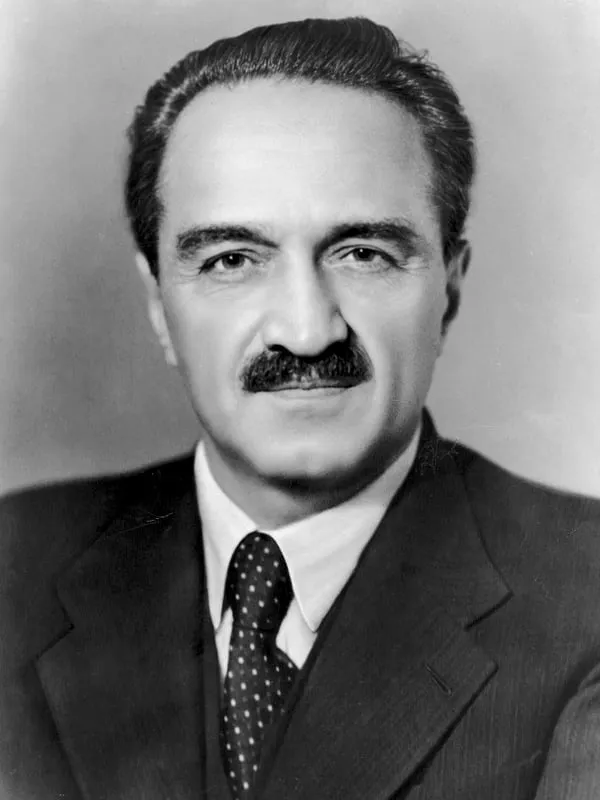
- Born:
- 25 November 1895, Sanahin, Tiflis Governorate, Russian Empire (Armenia)
- Died:
- 21 October 1978, Moscow (Soviet Union)
- Author:
- Łukasz
- Photo:
- Grigorij Wajl, TASS, domena publiczna, Wikimedia Commons

Anastas Mikoyan was the man who, throughout the era of Joseph Stalin, was responsible for what the Soviet Union traded, what it ate and what it supplied its army with. An Armenian from Transcaucasia and a former seminarian, in 1939–1941 he ran the economic exchange with the Third Reich, which supplied the Germans with grain and oil and in return gave Moscow machinery and weapons. On 5 March 1940 he put his signature to Lavrentiy Beria’s proposal to shoot Polish prisoners of war and detainees, which became the basis of the Katyn massacre. During the war with Germany he directed the supply of food and uniforms to the Red Army, received the deliveries from the Western Allies and, from February 1942, sat on the State Defence Committee. He outlived Stalin, became one of Nikita Khrushchev’s closest associates and, like few men of that era, stayed at the summit of power for more than forty years.
Seminarian and Baku commissar
He was born on 25 November 1895 (13 November in the Julian calendar) in the village of Sanahin in the mountains of northern Armenia, then in the Tiflis Governorate of the Russian Empire. He studied at an Armenian school in Tiflis and then at the theological seminary in Echmiadzin, seat of the Armenian Church; he later claimed that it was his theological studies that made him an atheist. In 1915 he joined the Bolsheviks. After the revolution he was active in Baku, where in 1918 he helped run the Baku Commune (PL) led by Stepan Shaumian and fought against the advancing Turks. When the city fell, the commune’s leaders were evacuated across the Caspian Sea to Krasnovodsk, where the Socialist Revolutionary authorities arrested them and on 20 September 1918 shot twenty-six of them in the desert. Mikoyan, who was with them, survived because his name was not on the list of leaders. The death of the 26 Baku Commissars became one of the legends of Soviet propaganda, and Mikoyan, released in February 1919, was one of its few living witnesses.
Commissar for trade
In the 1920s Mikoyan headed party organisations in Nizhny Novgorod and the North Caucasus, joined the Central Committee in 1923 and after Lenin’s death backed Stalin against the Left Opposition. In August 1926 he replaced Lev Kamenev as People’s Commissar for Trade and, as the youngest member of the government, became a candidate member of the Politburo. He went on to head the commissariats for supply and for the food industry, and in February 1935 he became a full member of the Politburo. In the summer of 1936 he spent about two months in the United States, visited among other places the Ford works, and brought back to the USSR ideas for industrial ice cream, hamburgers and cornflakes; better foodstuffs were afterwards called “Mikoyan’s” in Moscow.
During the Great Purge Mikoyan was not among the most zealous executors of the terror, but he did not stand aside. He signed lists of the condemned prepared by the NKVD, and in the autumn of 1937 he went to Yerevan, where at a stormy plenum of the Armenian Central Committee he led the attack on the local leadership; more than a thousand people were arrested at the time. On occasion he saved individuals: according to Russian biographers, his intercession protected among others Ivan Bagramyan, later a marshal, from arrest. In July 1937 Mikoyan became Deputy Chairman of the Council of People’s Commissars, and in January 1938 People’s Commissar for Foreign Trade.
Trading with Hitler
When Moscow moved closer to Berlin in the summer of 1939, Mikoyan oversaw the economic talks that preceded the Molotov–Ribbentrop Pact: a credit agreement worth 180 million marks was signed on 19 August. In the autumn he was present at the talks in which Molotov forced Estonia to agree to Soviet bases. On 11 February 1940 he signed the economic agreement under which the USSR supplied Germany with grain, oil, cotton and ores, and in return received machinery, industrial equipment and military hardware, including the unfinished heavy cruiser Lützow. The German negotiator Karl Schnurre noted that on many matters Mikoyan had to turn directly to Stalin. On 10 January 1941 Mikoyan and Schnurre extended the exchange to August 1942 (border and commercial agreement). Soviet grain and oil travelled to Germany until the last weeks before the invasion. At the same time Stalin instructed Mikoyan to build up secret reserves of scarce raw materials in case of war.
On 5 March 1940 Mikoyan was one of four members of the Politburo, together with Stalin, Kliment Voroshilov and Vyacheslav Molotov, who signed in their own hand Beria’s proposal to shoot, without trial, nearly 26,000 Polish prisoners of war and detainees; Mikhail Kalinin and Lazar Kaganovich voted for it without signing (the decision to shoot the Polish prisoners). On this basis the NKVD murdered some 22,000 people in the spring of 1940 in the Katyn massacre.
War: supplying the army
The German attack of 22 June 1941 found Mikoyan in the inner circle of the leadership. His memoirs are the main source for the crisis at the end of June, when after the fall of Minsk (Battle of Białystok–Minsk) Stalin, following a row at the Defence Commissariat, shut himself away in his dacha. According to Mikoyan, on 30 June members of the Politburo drove out to him with a proposal to set up a State Defence Committee; Stalin received them with the words “Why have you come?”, and it crossed Mikoyan’s mind that the leader expected to be arrested. Stalin agreed to head the committee and soon returned to work (Stalin’s speech of 3 July).
Mikoyan himself did not join the committee at that point, but from the first days of the war he was given tasks that made him one of its most important executors. He chaired the committee for supplying the Red Army with food and uniforms and sat on the Evacuation Council, which moved factories east from threatened areas, and later he was also responsible for fuel supplies. On 16 August 1941 he signed with Stafford Cripps the British–Soviet agreement on supplies and credit. In October, during the panic in Moscow, he went to the rebellious workforce of the Stalin motor works to convince the workers that the authorities had not fled. On 4 December he sat at the table at the Kremlin dinner given in honour of Władysław Sikorski.
On 3 February 1942 Mikoyan became a member of the State Defence Committee and remained one until its dissolution in September 1945. There he was responsible for supplying the forces with food, fuel and clothing, and his commissariat received and distributed the deliveries sent under Lend-Lease from America and Britain. Matters as mundane as the vodka ration also passed through his hands: from June 1942 it was issued daily only to soldiers in the front line. On 30 September 1943 he was made a Hero of Socialist Labour for “special merit” in supplying the army. From 1943 he also sat on the committee for the restoration of the economy in the areas recovered from the Germans.
The war struck his family. Three of Mikoyan’s five sons became airmen. One of them, the eighteen-year-old pilot Vladimir, was killed in 1942 at Stalingrad (Battle of Stalingrad). Anastas’s younger brother, Artem, co-founded the design bureau that built the MiG fighters. According to some historians, Mikoyan was the only member of the leadership to express doubts about the deportation of the Chechens and Ingush in 1944.
After the war
In 1946 Mikoyan became Deputy Premier and Minister of Foreign Trade; his ministry oversaw the dismantling of factories in the Soviet occupation zone of Germany as reparations. In Stalin’s last years he fell out of favour, and in October 1952 the dictator attacked him at a plenum of the Central Committee. Stalin’s death in March 1953 put an end to the plans for a new purge of which Mikoyan was to be a victim. Mikoyan supported Beria’s arrest and then became one of the closest allies of Nikita Khrushchev: at the Twentieth Congress in 1956 he was the first to criticise the cult of Stalin, and in 1957 he backed Khrushchev against the “Anti-Party Group”. In the autumn of 1956 he travelled to Budapest; according to some historians he opposed the armed suppression of the Hungarian uprising but was unable to prevent it. In November 1962 he negotiated with Fidel Castro the withdrawal of the Soviet missiles from Cuba. From July 1964 to December 1965 he was Chairman of the Presidium of the Supreme Soviet, the formal head of state. He died on 21 October 1978 in Moscow and was buried in the Novodevichy Cemetery.
Assessment
Mikoyan was regarded as the most pragmatic and least cruel of Stalin’s men, and in Moscow it was joked that he had gone “from Ilyich to Ilyich”, from Lenin to Brezhnev, without a heart attack or a stroke. The historian Sheila Fitzpatrick called him the great survivor of Soviet politics. That talent for survival came at a price, however: Mikoyan shared responsibility for the terror of the 1930s in Armenia, and his signature on the proposal of 5 March 1940 makes him one of the men directly responsible for the Katyn massacre. For the war against Germany he mattered above all as an organiser: in 1939–1941 his trade fed the German war economy, and from 1941 his administrative abilities helped to feed and clothe an army of many millions in a country that had lost its most fertile lands.
Sources
Mentioned in battles
(01)Often appears with
People who appear in the same events.