Soviet Union
Ivan Bagramyan
Chief of staff of the South-Western Direction and Front (1941–1942), commander of the 16th (11th Guards) Army (1942–1943), the 1st Baltic Front (1943–1945) and the 3rd Belorussian Front (1945)
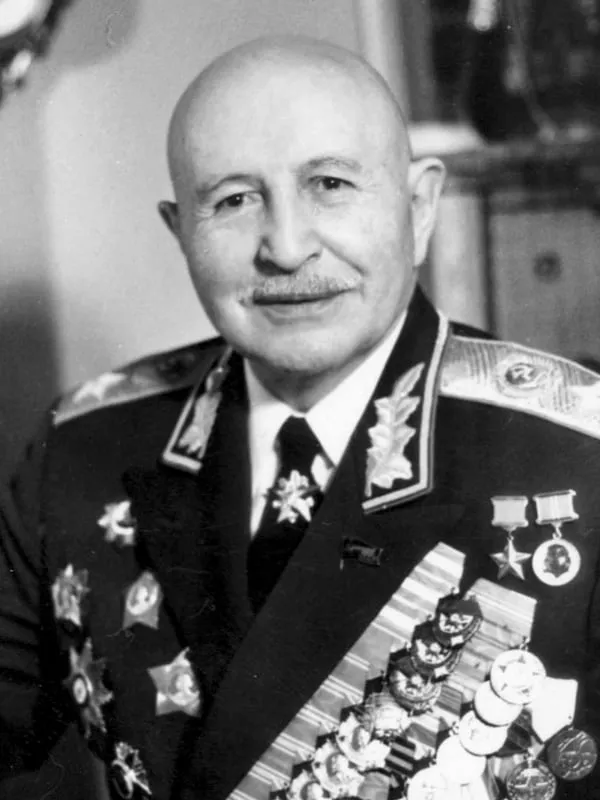
- Born:
- 2 December 1897, Elizavetpol, Elizavetpol Governorate (Russian Empire, now Ganja in Azerbaijan)
- Died:
- 21 September 1982, Moscow (Soviet Union)
- Author:
- Łukasz
- Photo:
- autor nieznany, CC BY 4.0, Wikimedia Commons

Ivan Bagramyan was the only Armenian among the Soviet front commanders, and one of the few who lived through both a catastrophe and a great victory, playing a leading part in each. In 1941, as an officer on the staff of the South-Western Front, he carried the order to retreat from Kiev and escaped from the encirclement in which his commander was killed. In May 1942 he was one of the authors of the offensive at Kharkov that ended with the loss of more than a dozen divisions, and Stalin held him chiefly to blame. Two years later his 1st Baltic Front broke the German defences at Vitebsk in the first days of Operation Bagration, and in the autumn of 1944 it reached the Baltic and cut off the whole of Army Group North in Courland. He died in 1982 as the last surviving front commander of that war.
From Transcaucasia to the Red Army
He was born on 2 December 1897 (20 November in the Julian calendar) into a poor Armenian railwayman’s family in Elizavetpol, today’s Ganja in Azerbaijan; he was christened Hovhannes Khachaturovich. He finished a railway school and a technical school in Tiflis, but in October 1915 he volunteered for the Russian army. He fought on the Caucasus front and in Persia, and in 1917 he graduated from the ensigns’ school in Tiflis.
After the revolution he joined the Armenian party Dashnaktsutyun and served in the army of the independent Republic of Armenia, fighting the Turks as a company and squadron commander. In December 1920, when the Red Army entered Armenia, he went over to the Bolsheviks and commanded a squadron of Armenian cavalry. This past weighed on him all his life: during the Great Purge compromising material was gathered against him, and according to Russian biographers it was the intercession of Anastas Mikoyan that saved him from arrest. He joined the Communist Party only in 1941.
Cavalryman and lecturer
Until 1931 he commanded a cavalry regiment in the Armenian division. In 1924, on cavalry courses in Leningrad, he met Georgy Zhukov, Konstantin Rokossovsky and Andrei Yeryomenko. In 1934 he graduated from the Frunze Military Academy and became chief of staff of the 5th Cavalry Division in the Kiev Military District, and in 1938 from the General Staff Academy, where he stayed on as a lecturer. For two years, while his classmates were being promoted to general, he remained a colonel. Only in September 1940 did he go to the staff of the 12th Army, and in November he became head of the operations department of the Kiev Special Military District.
Kiev, 1941
When war broke out, the district became the South-Western Front of General Mikhail Kirponos, with Bagramyan as its chief of operations. He prepared the counter-attacks by mechanised corps at Dubno and Lutsk, which failed to stop the German 1st Panzer Group. In September, when the front’s armies were caught in the jaws of Guderian and Kleist, Bagramyan flew to Kirponos with a verbal order from Marshal Semyon Timoshenko to abandon Kiev and break out to the east. Kirponos, remembering Stalin’s prohibition, would not act without written confirmation, which came too late. In the Battle of Kiev several hundred thousand soldiers were killed or captured, and Kirponos himself was killed on 20 September. Bagramyan and a group of staff officers managed to get out of the pocket. In August he had been promoted to major general.
In the winter he helped plan the successful counter-attack at Rostov and the operation at Yelets during the Battle of Moscow. In December 1941 he was promoted to lieutenant general and became chief of staff of Timoshenko’s South-Western Direction, and from April 1942 of the South-Western Front as well.
Disaster at Kharkov
In the spring of 1942 Timoshenko, the member of the military council Nikita Khrushchev and Bagramyan persuaded Stalin to launch an offensive on Kharkov from the Barvenkovo salient, against the warnings of the General Staff. The attack began on 12 May, and five days later Kleist struck the base of the salient. The request to call off the offensive came when it was already too late, and more than 200,000 soldiers were trapped in the Barvenkovo pocket, most of whom were killed or captured. The Second Battle of Kharkov opened the way for the Germans to the Volga and the Caucasus.
Stalin made Bagramyan the scapegoat. In a letter to the front’s military council of 26 June 1942 he accused him of being unfit not only as chief of staff but even as an “informant”, compared the defeat to the disaster of Samsonov’s and Rennenkampf’s armies in 1914, and demoted him to chief of staff of the 28th Army. According to Russian biographers it was Zhukov who saved him from a court martial, reminding Stalin that part of the blame lay with Moscow.
From army to front
In July 1942 Zhukov took him to the Western Front, where on 13 July Bagramyan took over the 16th Army from Rokossovsky. For its fighting in the winter of 1943 the army was renamed the 11th Guards Army in April. At a conference at the Stavka he won Stalin over to his plan for attacking the Orel salient. On 12 July 1943, while the Germans were bleeding themselves white on the Kursk salient, his army attacked from the north and within a few days had broken in several dozen kilometres, threatening the only railway line supplying two German armies. Walter Model managed to stop it, but in August the Germans had to give up Orel. Bagramyan was made a colonel general, and in November a general of the army and commander of the 1st Baltic Front.
In the winter of 1943–1944 his front fought at Gorodok and Vitebsk without a decision. Vitebsk was still in German hands.
Vitebsk, Šiauliai and Courland
In Operation Bagration Bagramyan pushed through a plan to launch the main blow not from a convenient bridgehead but across wooded, swampy ground where the Germans did not expect it. On 23 June 1944 his armies broke through the defences north-west of Vitebsk, and together with Ivan Chernyakhovsky’s 3rd Belorussian Front they closed the ring round LIII Corps; the city fell on 26–27 June. The front then took Polotsk and on 27 July Šiauliai, and at the end of July its spearheads reached the Gulf of Riga near Tukums, cutting off Army Group North for the first time. On 29 July Bagramyan was made a Hero of the Soviet Union.
In August the Germans re-opened a narrow corridor. In the Baltic offensive the Stavka therefore decided to shift the front’s main effort from Riga to Šiauliai. Over a few nights Bagramyan moved several armies up to 200 kilometres, leaving dummy positions behind in the old ones. On 5 October he struck a thinly held sector and on 10 October reached the Baltic at Palanga and Memel. Ferdinand Schörner’s Army Group North was cut off in Courland, where it held out until the surrender in May 1945. This manoeuvre is regarded as his greatest achievement.
Königsberg
In February 1945 the front was disbanded, and Bagramyan, commanding the Zemland group of forces and serving as deputy to Marshal Aleksandr Vasilevsky, fought in the East Prussian operation. On 6 April the assault on Königsberg began, and after three days the fortress commander, General Otto Lasch, surrendered. At the end of April Bagramyan took over command of the 3rd Belorussian Front from Vasilevsky and finished the fighting on the Samland peninsula.
After the war
After the war he commanded the Baltic Military District, in 1955 he was made a Marshal of the Soviet Union, he was commandant of the General Staff Academy and for ten years deputy minister of defence and head of the rear services of the armed forces. During the Cuban Missile Crisis he directed the planning of the movement of troops to Cuba. In 1977 he received a second Gold Star of a Hero. He died on 21 September 1982 in Moscow, and the urn with his ashes was placed in the Kremlin Wall. In Armenia he is a national hero.
Bagramyan was a rare combination in the Red Army of a good staff officer and a field commander. His share in the Kharkov disaster is beyond dispute, although the decisions were taken above all by Timoshenko, Khrushchev and Stalin himself. In 1944–1945, however, he commanded with sweep and precision, and the shift of his front from Riga to Šiauliai was taught for years in Soviet academies as a model manoeuvre.
Sources
Commanded in battles
(04)Mentioned in battles
(02)Often appears with
People who appear in the same events.