United Kingdom
Stafford Cripps
Ambassador to the USSR (1940–1942), Lord Privy Seal (1942), Minister of Aircraft Production (1942–1945), Chancellor of the Exchequer (1947–1950)
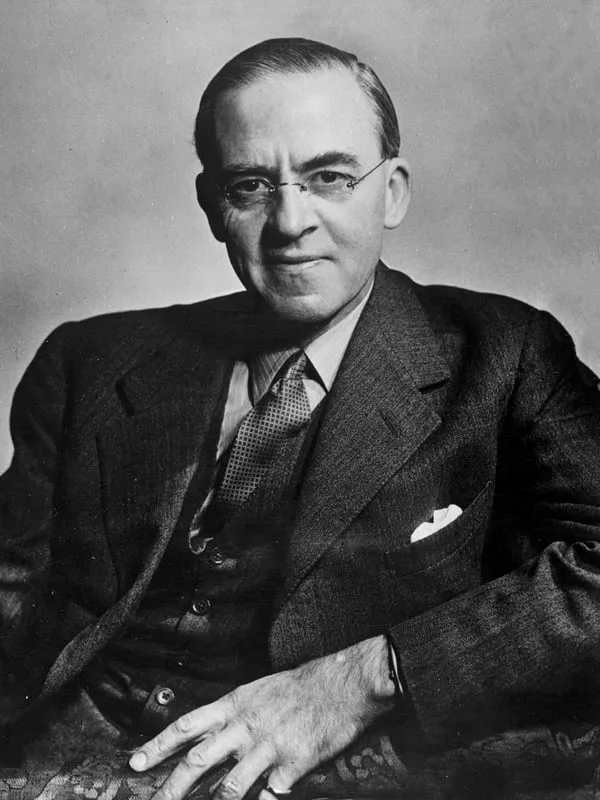
- Born:
- 24 April 1889, Chelsea (London, England)
- Died:
- 21 April 1952, Zurich (Switzerland)
- Author:
- Łukasz
- Photo:
- Yousuf Karsh, CC0, Wikimedia Commons

Sir Stafford Cripps was one of the most unusual figures in British politics in the first half of the 20th century: a wealthy patent barrister, a devout Anglican, a vegetarian and an ascetic who in the 1930s led the far left of the Labour Party and was expelled from it for campaigning for a popular front with the communists. In May 1940 Winston Churchill sent him to Moscow as ambassador, hoping that a socialist would find common ground with Stalin more easily. For a year Cripps tried in vain to draw the Soviet Union away from Germany, and after Hitler’s attack on the USSR he signed with Vyacheslav Molotov the Anglo-Soviet Agreement of 12 July 1941, the first act of the alliance that would defeat Germany. In 1942 he briefly enjoyed popularity at home almost equal to the Prime Minister’s and conducted unsuccessful negotiations with India’s leaders, and after the war, as Chancellor of the Exchequer in the government of Clement Attlee, he became the symbol of the age of austerity.
The chemist who became a lawyer
Richard Stafford Cripps was born on 24 April 1889 in Chelsea, London, the son of Charles Cripps, a prosperous barrister and Conservative MP, later Lord Parmoor, who in the 1920s went over to Labour and sat in its governments. His mother, Theresa Potter, was a sister of Beatrice Webb, one of the leading figures of British Fabian socialism. She died when the boy was four, and his stepmother, the Quaker Marian Ellis, had a great influence on his upbringing.
Cripps was educated at Winchester College and then studied chemistry at University College London under the Nobel laureate William Ramsay. He abandoned science for the law, however, and in 1913 was called to the bar at the Middle Temple. In 1911 he married Isobel Swithinbank, with whom he had four children. During the First World War he drove a Red Cross ambulance in France and then worked in a government explosives factory. Overwork damaged his health: for the rest of his life he suffered from colitis.
In the 1920s he built a brilliant career as a patent specialist and was among the best-paid barristers in the country. In 1927 he took silk, becoming a King’s Counsel.
On the left wing of the Labour Party
Towards the end of the 1920s Cripps moved markedly to the left, and in 1930 he joined the Labour Party. That same year the Prime Minister, Ramsay MacDonald, appointed him Solicitor General, a post that carried the customary knighthood. In January 1931 Cripps won a by-election to the House of Commons in Bristol East. When in the summer of 1931 MacDonald formed a National Government with the Conservatives and Liberals, Cripps refused to serve in it, and in the October election he was one of only three former Labour ministers to hold their seats, along with George Lansbury and Attlee.
The débâcle of 1931 convinced him that capitalism had to be replaced by socialism quickly and without compromise. In 1932 he co-founded and became leader of the Socialist League, which brought together left-wing intellectuals. He argued that a Labour government, once in power, should rule by emergency powers and abolish the House of Lords. He opposed appeasement but also, for a time, the rearmament carried out by the Conservative government.
At the turn of 1936 and 1937 Cripps was the driving force behind the Unity Campaign, a joint effort of the Socialist League, the Independent Labour Party and the Communist Party of Great Britain against the right and against fascism. When the Labour leadership threatened to expel its members, he dissolved the League but kept the weekly Tribune, which he had founded at the time. After Munich he went further and called for a popular front against the policy of Neville Chamberlain, stretching from the communists to the Conservative opponents of appeasement. In January 1939 Labour expelled him for it. As an independent MP, in October 1939 in the debate on Hitler’s peace offer he called it unacceptable while demanding that the government clearly state its own war aims.
In the autumn of 1939 Cripps set off on a journey round the world lasting several months. In India he talked with Mahatma Gandhi, Jawaharlal Nehru and Muhammad Ali Jinnah, in China with Chiang Kai-shek, and in February 1940 in Moscow with Molotov; he then returned home via the United States in April.
Ambassador in Moscow
In May 1940, after the fall of Chamberlain’s government, the new Prime Minister, Churchill, and the Foreign Secretary, Lord Halifax, decided to send Cripps to Moscow. They hoped that a man of the left would be better received there than a career diplomat. At first he was to go as a special envoy for trade talks, but the Soviet side refused to accept such a mission, and Cripps became an ordinary ambassador. He arrived in Moscow on 12 June 1940, in the days of France’s defeat, and on 1 July Stalin received him. Cripps argued that a victorious Germany would become a threat to the USSR, but Stalin replied that he saw no danger of German hegemony, and Molotov later passed the content of the conversation on to the German ambassador. In those same weeks the Germans published documents on the Allied plans to bomb the Caucasian oilfields, which did not make his task any easier.
For the next year Cripps remained in Moscow in near isolation. Molotov received him rarely, and Stalin not at all. On 22 October 1940 he presented the Soviet side with a memorandum in which Britain, in return for benevolent Soviet neutrality, was prepared to recognise de facto Soviet sovereignty over the Baltic states, Bessarabia, northern Bukovina and the Polish lands occupied in 1939 until a final settlement after the war, and also gave assurances that it would not attack Baku and Batumi. Moscow did not take up the offer, and its later disclosure alarmed the Polish government. In April 1941 he twice acted as intermediary for letters from Churchill: he handed the Japanese Foreign Minister, Yōsuke Matsuoka, a letter from the Prime Minister on the occasion of the conclusion of the Neutrality Pact, while Churchill’s personal warning to Stalin about a German attack he passed on late, and through the Deputy Commissar Andrey Vyshinsky, judging that he had himself already sent a similar letter. Churchill held this against him for a long time.
At the beginning of June 1941 Eden called him back to London for consultations. At the time of the German attack on the USSR Cripps was therefore in England, and on 27 June he returned to Moscow with a British military and economic mission. This time the doors of the Kremlin were open to him. On 8 July he delivered Churchill’s first message to Stalin and heard a proposal for a joint declaration of mutual assistance and of not concluding a separate peace, and on 12 July he signed with Molotov the agreement that gave it effect. Churchill thanked him in the House of Commons for having tirelessly brought the matter to a speedy conclusion. On 16 August Cripps concluded an agreement on supplies and credit with the People’s Commissar for Foreign Trade, Anastas Mikoyan.
As ambassador, however, he felt increasingly sidelined. The most important matters were settled directly in Churchill’s correspondence with Stalin or through special envoys: at the turn of September and October 1941 the supply conference in Moscow was conducted by Lord Beaverbrook and the American Averell Harriman. In October, as the Germans approached Moscow, the embassy and the other diplomatic missions were evacuated to Kuibyshev on the Volga. Cripps pressed London to give Moscow more than Britain could or would give, while in Moscow he defended the British position against increasingly sharp Soviet demands for a second front. In December 1941 he accompanied Anthony Eden in talks with Stalin, in which the master of the Kremlin demanded recognition of the Soviet Union’s frontiers of June 1941. In January 1942 Cripps left the Soviet Union.
Churchill’s rival and the mission to India
Cripps returned to London just as Britain was suffering a series of defeats in the Far East, and his name was associated with a fighting ally that had triumphed at Moscow. His radio broadcast on the Soviet war effort in February 1942 met with an enormous response, and although he had no party behind him, in the polls and the press he became one of the most popular politicians in the country. Some commentators saw him as a possible successor to Churchill. The Prime Minister preferred to have him inside the government rather than outside it: on 19 February 1942 Cripps entered the War Cabinet as Lord Privy Seal, replacing Attlee, and as Leader of the House of Commons.
In March Churchill sent him to India. After the fall of Singapore and in the face of the Japanese advance in Burma, London needed the support of India’s leaders for the war effort. Cripps brought a proposal that he had largely drafted himself: after the war India was to receive dominion status with the right to leave the British Commonwealth, a constitution drawn up by an elected assembly and the right of provinces to stay outside the new union, while for the duration of the war Indian representatives were to take part in the Viceroy’s government. The Indian National Congress rejected the offer because it gave it no real power, including over defence, there and then. Gandhi is credited with calling it a “post-dated cheque”. The Muslim League did not accept it either. For Churchill and the Viceroy, Lord Linlithgow, on the other hand, the proposals went too far. The mission ended in failure in April, and in August Congress launched the “Quit India” campaign, to which the authorities responded with mass arrests.
Cripps’s popularity soon faded. His stern calls for sacrifice and for efficiency in the conduct of the war irritated his colleagues, and a dispute with Churchill over the organisation of the war leadership brought him to the brink of resignation in the autumn of 1942. After the victory at El Alamein, in November 1942, he left the War Cabinet and took over the Ministry of Aircraft Production. Cripps ran it efficiently until May 1945, during the period of the greatest expansion of the British bomber force, and publicly defended Arthur Harris’s strategic bombing of Germany. In February 1945 he was readmitted to the Labour Party.
The Chancellor of austerity
After Labour’s election victory in July 1945 Attlee put him in charge of the Board of Trade, the second most important economic office in the government. In 1946 Cripps went to India once more, this time as a member of the three-man Cabinet Mission, whose plan to preserve the country’s unity collapsed amid disputes between Congress and the Muslim League, bringing the partition of India in 1947 closer. In September 1947 he became Minister for Economic Affairs and, six weeks later, after the resignation of Hugh Dalton, Chancellor of the Exchequer.
As Chancellor he kept wartime rationing, froze wages, raised taxes and promoted exports to balance trade and save the pound. With Marshall Plan aid and American loans he financed reconstruction and the expansion of the welfare state, including housebuilding and the new National Health Service. In September 1949, however, he had to devalue the pound from 4.03 to 2.80 dollars. The British remembered him as the embodiment of the “age of austerity”, but also as a politician widely respected for his integrity and competence.
Cripps’s health had been deteriorating for years. In October 1950 he resigned his office and his seat, and in Bristol South East he was succeeded at the by-election by the young Tony Benn. He went to Switzerland for treatment and died in Zurich on 21 April 1952, three days before his 63rd birthday. Cripps’s grandson, the son of his daughter Peggy and the Ghanaian politician Joseph Appiah, is the philosopher Kwame Anthony Appiah.
Significance
For the history of the Second World War Cripps is above all the ambassador who for a year tried in vain to pull the Soviet Union out of Germany’s orbit and then, within a few weeks, signed Britain’s first alliance agreement with the USSR. His mission showed the limits of diplomacy towards Stalin: as long as the Molotov–Ribbentrop Pact was in force, no offers, not even a readiness to recognise the Soviet gains of 1939–1940, changed the Kremlin’s policy. Only Hitler’s attack did that. Cripps was one of the few Britons who believed that the USSR would survive the onslaught, and one of the most ardent advocates of aid to it. His readiness to make concessions on frontiers, expressed as early as 1940, also foreshadowed the dilemma that would weigh on the Polish question throughout the war: how to reconcile the alliance with the USSR with obligations to the states whose lands the Soviet Union had seized in 1939–1940.
The failed mission to India in 1942 became one of the stages on the road to the independence of India and Pakistan, and after the war Cripps, as Chancellor of the Exchequer, helped shape the economy of post-war Britain.
Sources
Often appears with
People who appear in the same events.