Bulgaria
Boris III
Tsar of Bulgaria (1918–1943)
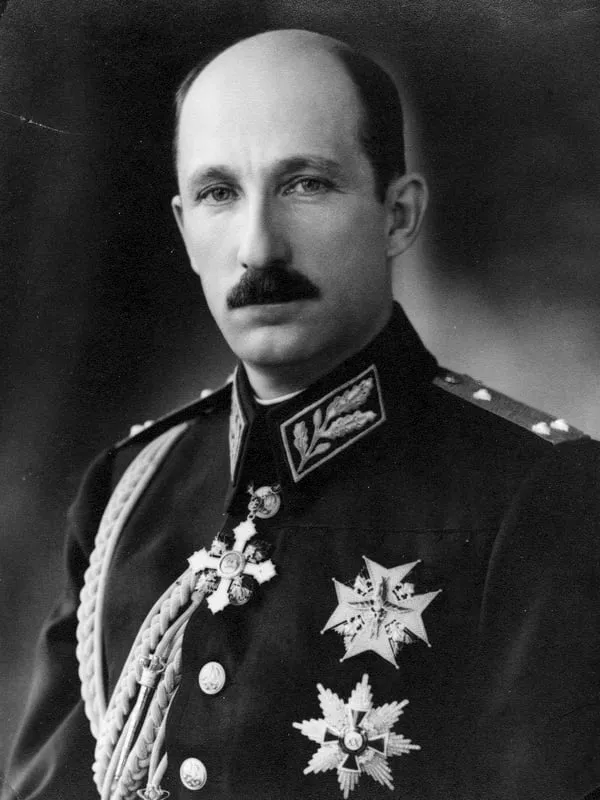
- Born:
- 30 January 1894, Sofia (Principality of Bulgaria)
- Died:
- 28 August 1943, Sofia
- Author:
- Łukasz
- Photo:
- Dimitar Karastoyanov, domena publiczna, Wikimedia Commons

Boris III came to the throne of Bulgaria in October 1918, when his father abdicated after the lost war, and reigned until his death in August 1943. For his first fifteen years or so he was a weak monarch, under whom governments changed through coups and assassinations; from 1935 he exercised what was in practice personal rule. In foreign policy he wanted to recover the lands lost after the First World War while avoiding another defeat. For a long time he evaded an alliance with Hitler, but in 1941 he took Bulgaria into the Tripartite Pact, opened the way to Greece for the Wehrmacht and was rewarded with Macedonia and Thrace. At the same time he never sent troops against the Soviet Union, and in 1943 the Bulgarian authorities, with his consent, handed over to the Germans the Jews of the occupied territories, but not those of Bulgaria proper. This duality is why his record remains contested to this day.
Heir to the throne
He was born in Sofia on 30 January 1894 (18 January in the Julian calendar), the eldest son of Prince Ferdinand of Bulgaria, of the German house of Saxe-Coburg and Gotha-Koháry, and his wife Marie Louise of the Bourbon-Parma family. He was named after Boris I, who had brought Christianity to Bulgaria in the ninth century. He was baptised a Catholic, but his baptism soon became a political matter. Ferdinand, whose election as prince in 1887 had not been recognised by Russia, sought reconciliation with St Petersburg and in February 1896 had his son rebaptised in the Orthodox Church. Tsar Nicholas II became his godfather, Russia recognised Ferdinand, and Pope Leo XIII excommunicated the prince. Boris’s mother died at the beginning of 1899, just after giving birth to her fourth child. Boris was educated at the palace school his father had founded for his sons and then graduated from the military school in Sofia.
In 1908 Ferdinand proclaimed Bulgaria’s independence and took the title of tsar. In the Balkan Wars of 1912–1913 the young heir served as a liaison officer. The second of these wars, in which Bulgaria attacked its former allies Serbia and Greece, ended in defeat and the loss of most of its gains, including southern Dobruja. In 1915 his father took the country into the Great War on the side of Germany and Austria-Hungary, hoping to win Macedonia. Boris was a liaison officer of the general staff on the Macedonian front and, in 1916, with the army group of Field Marshal August von Mackensen in the campaign against Romania. He won the respect of the German commanders and the Prussian order Pour le Mérite. By 1918 he held the rank of major general.
Tsar of a defeated country
In September 1918 the Macedonian front collapsed under the Entente’s assault, mutinous soldiers marched on Sofia, and on 29 September Bulgaria concluded the Armistice of Salonica, the first of the Central Powers to do so. On 3 October Ferdinand abdicated and left the country, and the 24-year-old Boris became tsar. He was the only monarch of the defeated states to keep his throne. It helped that no one held him responsible for the war, but the new tsar’s position was weak: the country was exhausted and republican sentiment ran high.
The peace treaty signed at Neuilly in November 1919 took from Bulgaria Western Thrace, with its access to the Aegean Sea, and strips of land in the west, imposed huge reparations and limited the army to 20,000 men. For the time being the country was governed by Prime Minister Aleksandar Stamboliyski, leader of the Bulgarian Agrarian National Union, who shut the tsar out of any influence on policy and sought an understanding with the neighbouring states.
On the night of 8–9 June 1923 officers of the Military League (PL), together with the right-wing opposition and Macedonian nationalists of IMRO, overthrew Stamboliyski’s government, and a few days later IMRO fighters murdered the prime minister. The tsar’s role in this coup remains disputed. Some historians believe he had known of the conspiracy since the spring; others that he was presented with a fait accompli. What is certain is that after several hours of hesitation he signed the decree appointing the government of Aleksandar Tsankov, thereby sanctioning the coup. The communist uprising of September 1923 was crushed with great brutality. On 14 April 1925 the tsar’s car was ambushed at the Arabakonak Pass, and on 16 April communist terrorists blew up the St Nedelya Church in Sofia during the funeral of a murdered general. More than 150 people were killed, according to some sources over 200; Boris survived because he arrived late at the church. The government responded with a terror in which several thousand communists and agrarians were killed.
In October 1925, after a border incident, Greek troops entered the Petrich district for a few days, withdrawing at the demand of the League of Nations. From 1926 the regime grew milder; in 1930 the powers reduced Bulgaria’s reparations, and after the Great Depression payments practically ceased.
Marriage and personal rule
On 25 October 1930, in the Basilica of St Francis in Assisi, Boris married Princess Giovanna of Savoy, daughter of King Victor Emmanuel III of Italy. The Catholic wedding was conditional on the children being brought up as Catholics, but two weeks later the marriage was also blessed in the Orthodox cathedral in Sofia, and when a daughter, Marie Louise, was born in 1933, she was baptised in the Orthodox Church, provoking a protest from the Vatican. In 1937 the heir to the throne, Simeon, was born. The marriage brought Bulgaria closer to the Italy of Benito Mussolini, who supported Bulgarian revisionism.
On 19 May 1934 power was seized by officers of the Military League and the political group Zveno, gathered around Colonel Kimon Georgiev and Colonel Damyan Velchev. The coup of 19 May suspended the constitution, dissolved the political parties and broke IMRO, which for a decade had been committing murders at home and abroad. The tsar approved the new government, but Georgiev’s circle included supporters of a republic, and Boris soon came to see them as a threat to the dynasty. Skilfully playing the military factions against each other, he forced Georgiev to resign in January 1935 and appointed a government under General Pencho Zlatev; in April he replaced him with a civilian, Andrey Toshev, and in November the head of the royal chancellery, Georgi Kyoseivanov, became prime minister. Velchev, accused of a republican conspiracy, was sentenced to death, but the tsar commuted the sentence to life imprisonment.
From then on Bulgaria was a royal dictatorship. The parties remained banned, the press was censored and political opponents were interned. The parliament elected in 1938 without the participation of parties obeyed the government, and the prime ministers carried out the tsar’s will. Boris ruled cautiously and without fanfare, travelled without an escort, and had a passion for railways: he was a qualified engine driver and drove trains himself. Many foreigners considered him one of the most sensible monarchs in Europe, although behind this modesty lay power subject to no control whatever.
Between Berlin, Rome and Moscow
The aim of the tsar’s foreign policy was revision of the Treaty of Neuilly without war. Bulgaria was the only state in the region not to join the Balkan Pact of 1934, which guaranteed its neighbours’ borders. In January 1937 Boris concluded a pact of “eternal friendship” with Yugoslavia, and in July 1938 at Salonica the states of the Balkan Entente agreed to release Bulgaria from the military restrictions of the Treaty of Neuilly. The army was armed mainly by Germany, which by 1939 accounted for about two-thirds of Bulgaria’s foreign trade, but the tsar concluded no alliance with the Reich before the war.
When war broke out in 1939, Bulgaria declared its neutrality. The Nazi–Soviet pact spared the tsar the hardest choice, for sympathy for Russia, the liberator of 1878, ran deep in society, and sympathy for Germany in the officer corps. In February 1940 the pro-German archaeologist Bogdan Filov became prime minister. After the fall of France neutrality began to pay: on 7 September 1940, under the Treaty of Craiova, concluded under German pressure and with Moscow’s acquiescence, Romania ceded southern Dobruja to Bulgaria. It was the only gain of Bulgarian revisionism to survive the war.
In the autumn of 1940 the pressure became irresistible. In October the tsar turned down Mussolini, who had proposed a joint attack on Greece, and in a letter to Hitler asked him not to force Bulgaria to abandon a neutrality which, in his view, served Germany well too. On 18 November Hitler received him at the Berghof and urged him to join the Tripartite Pact. Boris refused, citing his fear of Turkey and the Soviet Union and the weakness of his army, but privately agreed that Germany could use Bulgaria as a base for an attack on Greece. A week later Moscow sent Arkady Sobolev, Secretary General of the People’s Commissariat for Foreign Affairs, to Sofia with the offer of a mutual assistance pact. When the communists made the offer public and gathered hundreds of thousands of signatures in support of it, the government saw this as pressure from the street and rejected it. Moscow, which had already laid claim to Bulgaria in Berlin, included it in its conditions for joining the pact.
Alliance with the Reich
In the winter of 1940–1941 Boris played for time: he let German officers and signals personnel into the country in civilian clothes but publicly denied their presence, and put off joining the pact, pleading the threat from Turkey. When on 17 February 1941 Bulgaria and Turkey issued a declaration of non-aggression, this argument ceased to work, and the German divisions on the Danube were only waiting for the date. On 1 March 1941 Filov signed Bulgaria’s accession to the Tripartite Pact in Vienna, and the next day the Wehrmacht crossed the Danube. Britain broke off diplomatic relations with Bulgaria.
On 6 April the Germans struck from Bulgaria at Yugoslavia and Greece. The Bulgarian army took no part in the fighting, but once both armies had been crushed it entered, on 19 and 20 April, most of Yugoslav Macedonia, the Pirot district in eastern Serbia, and Greek Western Thrace and eastern Macedonia, including Kavala. Bulgarians greeted this as the fulfilment of their dream of national unification, and the tsar was given the sobriquet “the Unifier”. In Thrace the Bulgarian authorities drove out the Greek inhabitants and settled Bulgarians.
From June 1941 Boris resisted a further demand. He refused to take part in the war against the Soviet Union, would not agree even to a volunteer legion on the model of the Spanish Blue Division, and maintained diplomatic relations with Moscow. He argued that the army was too weak, that the soldiers would not fight the Russians, and that Bulgaria was in any case guarding the Axis flank against Turkey. Bulgarian divisions did, however, relieve the Germans in occupied Yugoslavia and Greece by fighting the partisans. On 25 November 1941 Bulgaria joined the renewed Anti-Comintern Pact, and on 13 December 1941 it declared war on Britain and the United States. This was regarded as a “symbolic” war, but in 1943–1944 Allied aircraft bombed Sofia heavily. In 1942 the communists, Zveno and some of the agrarians formed the opposition Fatherland Front.
The tsar and the Holocaust
The most difficult chapter of Boris’s reign concerns the Jews. In December 1940 parliament passed, and in January 1941 the tsar approved, the Law for the Protection of the Nation. Modelled on the German Nuremberg Laws, it stripped Jews of most of their civil rights, banned mixed marriages and excluded them from many professions. Yellow stars, forced labour and confiscations followed later. The authors of the law were Filov and the Interior Minister Petar Gabrovski. According to some historians the tsar did not share the antisemitic convictions of the law’s authors but believed that a milder law of Bulgaria’s own was better than a harsher one that the Germans might impose.
On 22 February 1943 Adolf Eichmann’s envoy Theodor Dannecker and the Bulgarian Commissar for Jewish Affairs, Aleksandar Belev, signed an agreement on the deportation of 20,000 Jews. In March 1943 the Bulgarian army and police rounded up 11,343 people in occupied Thrace, Macedonia and the Pirot district who had been denied Bulgarian citizenship, and handed them over to the Germans, who transported them – some via the Danube port of Lom and Vienna, some by rail from Skopje – to the Treblinka extermination camp. Almost all of them perished. The Bulgarian part of the plan came to nothing. When news of the waiting wagons reached Kyustendil, a delegation with the Deputy Speaker of parliament, Dimitar Peshev, forced Gabrovski on 9 March to halt deportations from within the country’s old borders. Peshev then collected the signatures of several dozen deputies on a protest, for which he lost his post, and leaders of the Orthodox Church, intellectuals and the opposition also spoke out against the deportations. The final decision to stop the transports lay with the tsar. In April Ribbentrop reported that Boris had agreed only to the deportation of the Jews from Macedonia and Thrace, and that from Bulgaria proper he wished to hand over only a small number of “Bolshevik elements”, needing the rest for road building. In May the authorities expelled some 20,000 Jews from Sofia to the provinces, but around 48,000 Jews in Bulgaria within its pre-war borders survived the war.
The tsar’s role is disputed. For years he was regarded as the saviour of the Bulgarian Jews, and in 1996 a memorial to him was erected in Israel. Historians stress, however, that the same monarch approved the anti-Jewish laws and sent the Jews of the occupied territories to their deaths, and that the rescue came above all from the protests of society, politicians and the Church, and from political calculation at a time when, after Stalingrad, Germany had stopped winning. In 2003 a commission chaired by the former Israeli Supreme Court justice Moshe Bejski concluded that the memorial should be removed, precisely because of the deportations from Thrace and Macedonia.
Death
By the summer of 1943 Boris, like Hitler’s other allies, was already cautiously seeking contact with the Allies. On 14 August he flew at Hitler’s summons to the Wolf’s Lair. According to Filov the talks concerned Bulgarian divisions in the Balkans; other accounts speak of a stormy dispute over the war with the USSR and over the Jews. A few days after returning to Sofia the tsar fell seriously ill, and he died in the afternoon of 28 August 1943. The doctors, among them some summoned from Germany, gave heart disease as the cause of death. The sudden death of a 49-year-old gave rise to rumours of poisoning, attributed variously to the Germans, the Russians, the British and the Italians, but no evidence has ever been found.
After ceremonies in the Alexander Nevsky Cathedral, Boris was buried in the Rila Monastery. The six-year-old Simeon II became tsar, and a regency council ruled in his name: the late tsar’s brother Prince Kiril, Filov and General Nikola Mihov. In September 1944 the Soviet Union declared war on Bulgaria, the Red Army crossed the border, and on 9 September the Fatherland Front seized power. On 1 February 1945, on the verdict of the so-called People’s Court, the regents, including Prince Kiril and Filov, were shot along with dozens of ministers and deputies. In 1946 the monarchy was abolished by referendum, and Simeon left the country with his mother. The communists removed the tsar’s coffin from the monastery and hid it; after the fall of communism only his heart was found, and in 1993 it was laid to rest again in the Rila Monastery.
Significance
Boris III was the ruler of a small, defeated country who for twenty-five years tried to survive between the great powers and to recover what Bulgaria had lost in 1913 and 1919. His dexterity allowed him to postpone the decision to ally with Hitler by a few months, but not to reverse it. By taking his country into the Tripartite Pact in March 1941 he opened the way to Greece and Yugoslavia for the Wehrmacht, and in return for a share in their partition bound Bulgaria’s fate to the Reich. His refusal to fight the USSR spared the Bulgarians the Eastern Front, but not defeat. The gains of 1941 had to be given up in 1944, and the borders as they stood before 1 January 1941, including southern Dobruja, were confirmed by the Paris peace treaty of 1947. The dispute over Boris – the “Unifier Tsar”, Hitler’s ally, the protector of some Jews who handed over others – continues in Bulgarian memory to this day.
Sources
Often appears with
People who appear in the same events.