United States
Frank Knox
Republican candidate for Vice President of the United States (1936), Secretary of the Navy of the United States (1940–1944)
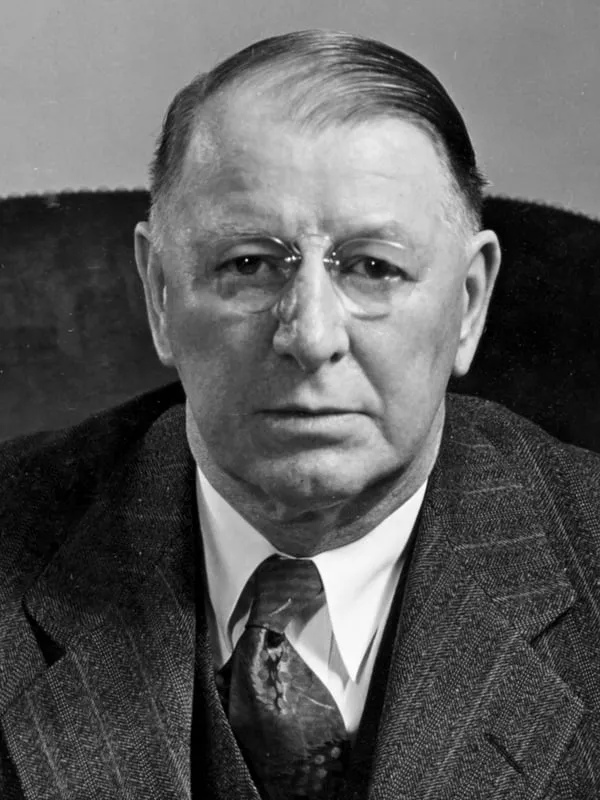
- Born:
- 1 January 1874, Boston (Massachusetts, United States)
- Died:
- 28 April 1944, Washington (United States)
- Author:
- Łukasz
- Photo:
- U.S. Navy, domena publiczna, Wikimedia Commons

Frank Knox was a politician and a journalist, not a sailor, yet it was during his term of office that the United States Navy became the largest fleet in the world. A Republican who in 1936 had run for Vice President against Franklin Delano Roosevelt, four years later he accepted from him the post of Secretary of the Navy. He was one of the loudest advocates in America of aid for Britain and a hard line towards Germany at a time when most of his party clung to isolationism. He headed the Navy at the time of the attack on Pearl Harbor and in the first years of the war in the Pacific and the Atlantic. His decisions concerning Americans of Japanese descent and Black sailors are judged critically today. He died in office in the spring of 1944, a few weeks before the Normandy landings.
Roosevelt’s private
William Franklin Knox was born on 1 January 1874 in Boston (PL) to a family that had come from Canada. He grew up in Grand Rapids (PL), Michigan. He studied at Alma College, but in 1898, in his final year, he broke off his studies and volunteered for the war with Spain. He served as a private in the volunteer cavalry regiment known as the Rough Riders (PL), commanded by Leonard Wood and Theodore Roosevelt, and took part in the charge up San Juan Hill in Cuba. The college later awarded him a degree with the class of 1898. In December of that year he married Annie Reid. He remained attached to his old commander all his life.
Publisher and politician
After returning from Cuba he went to work on the Grand Rapids Herald as a political reporter, and soon ran its city desk and its circulation. It was around then that he began to call himself Frank. Next he bought a paper of his own in Sault Ste. Marie in northern Michigan and turned it into a daily. He was active in the Republican Party, and in 1912 he backed Theodore Roosevelt when the latter broke with the party and ran for President on the ticket of the new Progressive Party. The same year he moved to Manchester (PL), New Hampshire, where he founded the Leader and in 1913 merged it with the local Union.
In 1917, after the United States entered the First World War, Knox, already forty-three, completed an officers’ course and joined the 78th Division as a captain. In France his ammunition train supplied artillery batteries during the offensives at Saint-Mihiel and in the Argonne. He ended the war as a major and later rose to colonel in the reserve, which is why Americans called him “Colonel Knox”. In 1927 he became general manager of the newspaper empire of William Randolph Hearst, and in 1931, with a partner, he bought a controlling interest in the Chicago Daily News, whose publisher he remained for the rest of his life.
As a publisher Knox criticised the New Deal in the 1930s. In 1936 he sought the Republican presidential nomination, and when he lost to the Governor of Kansas, Alf Landon, the convention chose him as its candidate for Vice President. He later recalled hearing of his nomination on the car radio on the drive home. In November Roosevelt won by a landslide: the Republicans carried only two states, Maine and Vermont.
In Roosevelt’s cabinet
In foreign policy Knox was closer to Roosevelt than to his own party. From the outbreak of war in Europe he supported aid for France and Britain and the build-up of the armed forces. After the fall of France the President decided to strengthen his government with men from the opposition, and on 20 June 1940, on the eve of the Republican convention, he announced that Henry Stimson would become Secretary of War and Knox Secretary of the Navy. Many Republicans, especially isolationists, regarded both as renegades from the party. The Senate confirmed the nomination on 10 July, and on 11 July Knox was sworn in at the White House. As his deputy he brought in the banker James Forrestal, who took over procurement and industrial matters in the department.
Knox took over the department just as Congress passed the Two-Ocean Navy Act, and it fell to him to carry out the great shipbuilding programme. In the summer of 1940 he took part in the talks that produced the destroyers-for-bases deal; at first he proposed that Britain should in return sell America some of its possessions in the western hemisphere. In January 1941, together with Stimson, he defended the Lend-Lease bill before Congress. In the cabinet he was one of the “hawks” who pressed the President to have the Navy escort convoys and fire on U-boats, and in 1941 he supported the order to shoot without warning. On 24 January 1941 he signed a letter to Stimson warning that war with Japan might begin with a surprise attack on the fleet at Pearl Harbor, above all from the air. On the President’s order, on 1 November 1941 the Coast Guard came under his authority.
Pearl Harbor
On 7 December 1941 it was Knox who telephoned Roosevelt with the news of the attack on Hawaii. On 9 December he flew to Pearl Harbor to see for himself what had happened. On his return he declared publicly that, apart from Norway, nowhere in this war had a “fifth column” worked as effectively as in Hawaii, and in his report to the President he accused the Japanese of Hawaii of helping the attacker. Naval intelligence, the FBI and the army found no evidence for this, but Knox went on for a long time demanding the removal of most of the Japanese population from Oahu. His statements contributed to the climate in which in February 1942 Roosevelt signed Executive Order 9066 on the removal of Americans of Japanese descent from the West Coast.
After the inspection Knox and Roosevelt decided to recall Admiral Husband Kimmel, commander of the Pacific Fleet, and replace him with Admiral Chester Nimitz. At the head of the whole fleet they placed Admiral Ernest King. From then on naval strategy was settled by King and the President, while Knox dealt mainly with administration, shipbuilding and relations with the press and Congress. In his speech of 11 December 1941 declaring war on the United States, Hitler named him among the men around Roosevelt whom he blamed for the war.
The Navy at war
When Knox took office the Navy and the Marine Corps together numbered fewer than 190,000 men, and the Navy had just over two thousand aircraft. At the time of his death more than three million people were serving in the naval forces, including the Coast Guard, and naval aviation had more than 40,000 aircraft. The fleet gained new battleships, more than a dozen large carriers, dozens of escort carriers and hundreds of destroyers and escort ships. Knox travelled frequently on inspections, including to the Pacific, North Africa and Europe. He agreed to the creation of the Navy’s construction battalions, the famous Seabees.
His attitude to Black sailors was conservative. He held that racial segregation in the armed forces had to be maintained, and for a long time he defended the rule that Black men could serve in the Navy only as stewards or cooks. Only under pressure from the President, in the spring of 1942, did he agree to accept them into other branches and into the Marine Corps, which until then had not taken them at all – though still in separate units. In April 1943 the shooting down of Admiral Isoroku Yamamoto’s aircraft gave rise to the legend that Roosevelt had given the order through Knox. No document confirms this, and according to most accounts Knox left the decision to Nimitz.
Death and assessment
On 23 April 1944, at the funeral of his former partner from Manchester, Knox suffered a heart attack. Further attacks followed over the next days, and on 28 April 1944 he died at his home in Washington. On 1 May he was buried with military honours in Arlington National Cemetery. He was succeeded by Forrestal. The destroyer USS Frank Knox, commissioned in December 1944, bore his name, and in 1945 President Harry Truman awarded him the Medal for Merit posthumously. His widow endowed fellowships in his name at Harvard University for students from Commonwealth countries.
Historians see Knox above all as a symbol of the bipartisan defence policy which in 1940 allowed Roosevelt to prepare the country for war despite the resistance of the isolationists. He was a capable administrator but had no significant influence on strategy, which was shaped by King and the Joint Chiefs of Staff. His unfounded accusations against the Japanese of Hawaii after Pearl Harbor and his defence of segregation in the Navy are among the dark sides of his tenure.
Sources
Mentioned in battles
(01)Often appears with
People who appear in the same events.