United States
Harold Stark
Chief of the Bureau of Ordnance (1934–1937), Chief of Naval Operations (1939–1942), Commander US Naval Forces Europe (1942–1945) and Twelfth Fleet (1943–1945)
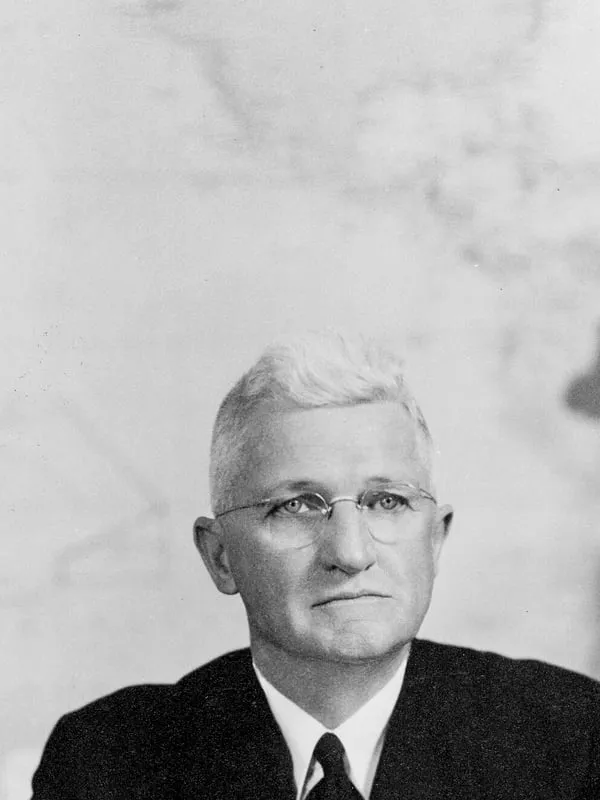
- Born:
- 12 November 1880, Wilkes-Barre, Pennsylvania (United States)
- Died:
- 20 August 1972, Washington (United States)
- Author:
- Łukasz
- Photo:
- US Navy, domena publiczna, Wikimedia Commons

Harold Stark was the senior officer of the United States Navy in the years in which the United States moved from neutrality to war. As Chief of Naval Operations from August 1939 to March 1942 he prepared the fleet for a war on two oceans, and in the memorandum known as Plan Dog he was the first American commander to set out the principle that would govern the whole of Allied strategy: Germany first, then Japan. It was he who on 27 November 1941 sent the fleet commanders in the Pacific the dispatch containing the “war warning”, and after the attack on Pearl Harbor he shared with Admiral Husband Kimmel the responsibility for the disaster. Moved out of Washington, he represented the Navy in London for three years, where his diplomatic talent proved invaluable.
“Betty” from Wilkes-Barre
Harold Raynsford Stark was born on 12 November 1880 in Wilkes-Barre (PL), Pennsylvania. In 1899 he entered the Naval Academy at Annapolis. There he acquired the nickname he kept for the rest of his life: upperclassmen made him recite the cry attributed to his namesake, John Stark, a general of the War of Independence, who before a battle was said to have declared that if he lost, Betty Stark would be a widow. From then on he was “Betty”. He graduated in 1903 and, after the two years at sea then required, was commissioned ensign in 1905.
From 1907 to 1909 he served in the battleship Minnesota, which took part in the Great White Fleet’s cruise around the world. Then for years he commanded torpedo boats and destroyers. From this period comes an anecdote that was later often retold: in 1914 the Assistant Secretary of the Navy, Franklin Delano Roosevelt, was aboard Stark’s destroyer and asked to take the helm in a narrow channel. The young lieutenant refused, because he was responsible for the ship, and took it through the dangerous waters himself. Roosevelt evidently did not hold it against him. In 1917 Stark led a flotilla of the Asiatic Fleet’s small, old destroyers from the Philippines to the Mediterranean, halfway round the world, and in November of that year he joined the staff of Admiral William Sims, who commanded the American naval forces in European waters.
Between the wars
After the war he was executive officer of the battleships North Dakota and West Virginia, attended the Naval War College, commanded the ammunition ship Nitro and worked on ordnance. In the 1920s and early 1930s he served as chief of staff to the commander of the Battle Fleet’s destroyers and as aide to the Secretary of the Navy, and then commanded the battleship West Virginia. From 1934 to 1937, as a rear admiral, he headed the Navy’s Bureau of Ordnance; from 1937 he commanded a cruiser division and from 1938, as a vice admiral, all the cruisers of the Battle Force.
On 1 August 1939, four weeks before the German attack on Poland, Roosevelt appointed him Chief of Naval Operations, the Navy’s most senior officer, passing over many admirals senior to him. Stark was a hard-working intellectual and organiser, courteous and well liked, rather than a stern fighting commander. The President found him easy to work with.
A fleet for two oceans
The fall of France in June 1940 changed the position of the United States. Stark then asked Congress for about 4 billion dollars to enlarge the battle fleet by roughly 70 per cent, which was granted in July in the Two-Ocean Navy Act. The new ships, however, would arrive only after several years, while Britain needed help at once. In the summer of 1940 Stark therefore had to certify, as the law required, that the fifty old destroyers handed over to the British under the destroyers-for-bases agreement were not essential to the defence of the country. He found it hard, because at the same time he was fighting for every new ship.
In November 1940 he submitted to the Secretary of the Navy, Frank Knox, a memorandum on strategy in the event of war. In it he considered four options, labelled A to D. The fourth, D for “Dog” in the radio alphabet of the time, provided that in a war with Germany and Japan the United States would concentrate its forces in the Atlantic and in Europe and stay on the defensive in the Pacific. The historian Craig Symonds called it one of the most consequential documents ever submitted to the government by a naval officer. On its basis, early in 1941, American and British staff officers agreed in Washington on the joint war plan ABC-1.
Throughout 1941 Stark’s Navy waged an increasingly open war in the Atlantic. In July, on his orders, a Marine brigade sailed for Iceland; in August Stark accompanied the President to his meeting with Winston Churchill in Placentia Bay, where the Atlantic Charter was drawn up. After the incident with the destroyer Greer in September, American warships began escorting convoys in the western Atlantic and were ordered to fire on German submarines. After the destroyer Kearny was torpedoed in October, Stark wrote that whether the country knew it or not, it was already at war.
War warning
In the Pacific, Stark and the Army Chief of Staff, General George Marshall, were above all trying to gain time, because neither the fleet nor the army was ready yet. On 16 October 1941, after the fall of Prince Konoe’s cabinet, Stark warned the commanders of the Pacific and Asiatic Fleets that a “grave situation” had arisen. On 24 November he told them that a Japanese attack was possible in any direction, and on 27 November, after the Hull note had been handed to the Japanese, he sent a dispatch that began by saying it was to be considered a war warning. It named the Philippines, the Malay Peninsula or Borneo as possible targets and ordered an appropriate defensive deployment. Pearl Harbor was not on that list; few people in Washington or in Hawaii thought it the most likely target.
On 7 December Japanese carrier aircraft sank or damaged the battleships of the Pacific Fleet. A few hours after the attack Stark ordered unrestricted air and submarine warfare against Japan, including attacks on merchant ships without warning, which the London treaty signed by the United States prohibited. That order opened the submarine campaign that in the following years destroyed the Japanese merchant fleet.
Leaving Washington
After Pearl Harbor Roosevelt decided to place the conduct of the war at sea in other hands. On 20 December 1941 Admiral Ernest King became Commander in Chief of the United States Fleet. For the following months the Navy had two chiefs with partly overlapping powers. Stark still took part in the Arcadia conference and in the first meetings of the Joint Chiefs of Staff, where together with Marshall he confirmed that the Atlantic and Europe remained the main theatre of the war. Together with King he also decided that Wake should be evacuated rather than reinforced. In the eyes of some politicians and of the public, however, he shared the blame for the disaster in Hawaii. On 26 March 1942 King took over his post of Chief of Naval Operations as well.
London
In April 1942 Stark went to London as commander of US naval forces in Europe. His task was less glamorous than commanding a fleet, but important: he directed the naval part of the great build-up of American forces in the British Isles, the bases, the training and cooperation with the Royal Navy. The British adored him. He also kept good relations with the governments in exile and with Charles de Gaulle, with whom the Americans had many difficulties; according to some historians it was largely thanks to him that American-British-French cooperation worked at all. In 1943 he was additionally given command of the Twelfth Fleet, and in June 1944 he supervised the US Navy’s part in the Normandy landings. A photograph survives of him walking on Utah Beach a few days after the landing.
Inquiries and assessment
The Pearl Harbor affair kept returning throughout the war. In 1944 the Navy convened a court of inquiry, which found that Kimmel had acted properly in the light of what he knew, and that Stark had not passed on to him enough information about the growing danger, though he had not been derelict in his duty. The Secretary of the Navy, James Forrestal, considered the verdict too lenient and stated that neither Kimmel nor Stark had shown the judgement their posts required. King gave Stark a very harsh endorsement. Only in 1948 did he ask for it to be removed from the record, which according to his biographers was the only time he admitted he had been wrong. The joint congressional committee that investigated the affair in 1945–1946 did not bring any formal charge against Stark either.
From August 1945 Stark served in Washington; in April 1946 he retired, and he lived in the capital until his death. He died on 20 August 1972 (the Naval Academy gives 21 August) and was buried at Arlington National Cemetery. His name was carried by the frigate Stark, which was hit by Iraqi missiles in the Persian Gulf in 1987.
Opinions of Stark are still divided. Critics such as Kimmel’s intelligence officer Edwin Layton reproached him for not passing on to Hawaii what Washington knew from decrypted Japanese traffic, for letting his head of war plans, Admiral Richmond Turner, take over the assessment of intelligence, and for being too soft towards Japan. The Secretary of War, Henry Stimson, considered him a timid adviser to the President. His defenders, led by his biographer B. Mitchell Simpson, call him the “architect of victory”: the man who built the fleet with which the United States won the war, and who was the first to say clearly that it had to be won in Europe first.
Sources
Mentioned in battles
(01)Often appears with
People who appear in the same events.
On the timeline
(14)1939
1940
1941
February
July
August
September
October
November
- 26
- Key eventThe Kidō Butai sails for HawaiiOn 26 November 1941 Vice-Admiral Chūichi Nagumo’s six carriers left Hitokappu Bay in the Kurils, sailing under radio silence to strike Pearl Harbor.
- The Hull noteOn 26 November 1941 Cordell Hull handed the Japanese a note demanding withdrawal from China and Indochina. It set no deadline, but Tokyo saw it as an ultimatum.