United States
Ernest King
Commander of the Atlantic Fleet (1941), Commander-in-Chief of the United States Fleet (1941–1945), Chief of Naval Operations (1942–1945), Fleet Admiral (from 1944)
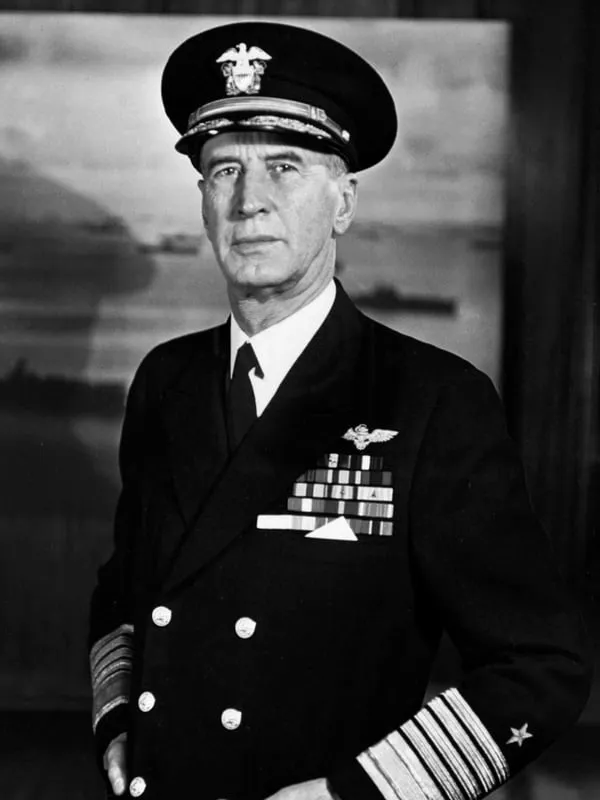
- Born:
- 23 November 1878, Lorain (Ohio, United States)
- Died:
- 25 June 1956, Kittery (Maine, United States)
- Author:
- Natalia
- Photo:
- United States Navy, domena publiczna, Wikimedia Commons

Ernest Joseph King ran the American Navy throughout the war against Japan and Germany. He is the only man in history to have combined the Navy’s two highest posts, Commander-in-Chief of the United States Fleet and Chief of Naval Operations, and he also sat on the Joint Chiefs of Staff alongside General George Marshall. He accepted the principle that Germany had to be defeated first, but he constantly demanded ships, aircraft and men for the Pacific, and it was largely thanks to him that the Americans went over to the offensive there as early as the summer of 1942. He was considered one of the ablest strategists and organisers of his age, and at the same time a gruff, suspicious man who was hard to work with, especially for the British and for army commanders.
From cadet to aviator
He was born on 23 November 1878 in Lorain (PL) on Lake Erie, the son of a Scottish immigrant and an English-born mother. In 1897 he entered the Naval Academy at Annapolis. In the summer of 1898, while still a cadet, he sailed in the cruiser San Francisco during the war with Spain. In 1901 he graduated fourth of 67. Over the following years he served in battleships and cruisers, taught at the academy and worked on staffs, and in 1914 he got his first command, a destroyer. From December 1915 he was on the staff of Admiral Henry Mayo, commander of the Atlantic Fleet, with whom he travelled to Britain during the First World War. In September 1918, not yet forty, he was promoted to captain.
After the war he commanded a submarine flotilla and the base at New London. He directed the raising of two sunken submarines, S-51 in 1925–1926 and S-4 two years later, and was decorated for it. Then he made the turn that decided his career: in May 1927, aged 48, he qualified at Pensacola as a naval aviator. From 1930 to 1932 he commanded the aircraft carrier Lexington, and in 1933, after Admiral William Moffett was killed in the crash of the airship Akron, he became chief of the Navy’s Bureau of Aeronautics as a rear admiral. In 1938, as a vice admiral, he took command of the aircraft of the Battle Force, that is, of all the American carriers. During the 1938 manoeuvres his aircraft staged a mock raid on Pearl Harbor, which showed how exposed the base was to attack from the air.
Passed over and brought back
In 1939 King hoped to become Chief of Naval Operations, but President Franklin Delano Roosevelt chose Admiral Harold Stark. King, reduced to rear admiral, was sent to the Navy’s General Board, usually the last stop before retirement. The war in Europe brought him back to active service. At the end of 1940 he took over the patrol force in the Atlantic, and on 1 February 1941, when it was turned into the Atlantic Fleet, he became its commander with the rank of admiral.
Throughout 1941 his ships waged an undeclared war against Germany in the Atlantic. In August Roosevelt sailed in his flagship, the cruiser Augusta, to the meeting with Churchill at which the Atlantic Charter was proclaimed. From July King’s ships escorted shipping to Iceland, and from September British convoys in the western Atlantic as well. After the incident with the destroyer Greer in September 1941 an order to fire on German warships without warning was in force.
At the head of the whole fleet
After the attack on Pearl Harbor the Secretary of the Navy, Frank Knox, and Roosevelt decided to put the fleet in the hands of an energetic and ruthless man. On 20 December 1941 King was appointed Commander-in-Chief of the United States Fleet, and he took up the post on 30 December. He insisted that his headquarters be in Washington, not on board ship, and that he have authority over the Navy Department’s bureaus. He changed the abbreviation of his title from CINCUS, which sounded like “sink us”, to COMINCH. In March 1942 he also replaced Stark as Chief of Naval Operations. From February 1942 he sat on the Joint Chiefs of Staff with Marshall and Henry Arnold, and from July also with Admiral William Leahy, the President’s chief of staff.
The first half of 1942 brought the gravest charge against King. In Operation Paukenschlag German U-boats sank ships off the east coast of the United States and in the Gulf of Mexico, and for several months the Navy did not introduce coastal convoys. King argued that a convoy without adequate escort was worse than no convoy; the British experience had been the opposite. Some historians lay much of the blame for the losses on him, while others point to the real shortage of escorts and aircraft. The coastal convoy system started in May 1942, and by the summer losses had fallen. In March 1943 King convened in Washington a convoy conference which divided responsibility for the Atlantic routes among the Allies, and in May he created the Tenth Fleet, a staff without ships that directed the whole American fight against the submarines.
The Pacific
King’s greatest influence, however, was on the war against Japan. From the first weeks he ordered the line linking Hawaii with Australia to be held and garrisons to be placed on Samoa, New Caledonia and the New Hebrides, and he pressed the new commander of the Pacific Fleet, Admiral Chester Nimitz, to attack despite his weakness. The idea of the Doolittle Raid on Tokyo in April 1942 came from King’s staff. After the victory at Midway King pushed through the first American offensive of the war, the landing on Tulagi and Guadalcanal in August 1942, although the army and the British believed that forces should be saved for Europe. The Guadalcanal campaign lasted half a year and nearly ended in disaster, but it stopped the Japanese. In October 1942 King agreed to the replacement of Vice Admiral Robert Ghormley by Admiral William Halsey.
From 1943 King demanded a second road to Japan, across the central Pacific, alongside General Douglas MacArthur’s advance through New Guinea. He was particularly keen on the Marianas, which were to cut Japan’s lines of communication and force the Imperial fleet to give battle. This strategy led to Tarawa, the Marshall Islands and the landing on Saipan, and in June 1944 to the Battle of the Philippine Sea. When aviators criticised Admiral Raymond Spruance for not pursuing the Japanese carriers, King took his side. He lost, on the other hand, the dispute over the way forward: in the summer of 1944 he wanted to bypass Luzon and strike at Formosa, but in the end the plan of MacArthur and Nimitz was adopted – the Philippines, then Iwo Jima and Okinawa.
A difficult ally
At the Allied conferences King was the most unbending of the American chiefs of staff. In 1942, together with Marshall, he opposed the landing in North Africa, and in the face of further British plans in the Mediterranean he threatened that if the invasion of France receded, more forces would go to the Pacific. After the disaster of convoy PQ-17 in July 1942 he soon recalled to the Pacific the American ships that had been supporting the British Home Fleet in Arctic waters. In the autumn of 1944, at the second Quebec Conference, he reluctantly accepted the participation of a British fleet in the last phase of the war against Japan; the President accepted Churchill’s offer over his head, and King stipulated that the British must be self-sufficient. For this reason many contemporaries and historians called him an Anglophobe. Others stress that he was simply a hard defender of his own Navy’s interests, and that he was on good terms with Field Marshal John Dill and Admiral James Somerville.
He could be ruthless with subordinates. A saying attributed to him had it that when America is in trouble it sends for the “sons of bitches”; King himself denied having said it, but added that he would have done if he had thought of it. In 1945, against Nimitz’s opinion, he had Captain Charles McVay, commander of the sunken cruiser Indianapolis, brought before a court-martial.
After the war
On 17 December 1944 King received the newly created rank of Fleet Admiral, the second after Leahy. After Japan’s surrender he himself proposed abolishing the post of Commander-in-Chief of the Fleet, which was done in October 1945, and on 15 December 1945 he handed over the office of Chief of Naval Operations to Nimitz. He opposed the unification of the armed forces under a single department. In August 1947 he suffered a severe stroke and spent his last years in naval hospitals. In 1952 he published memoirs written together with the historian Walter Muir Whitehill. He died on 25 June 1956 in the naval hospital at Kittery (PL) in Maine and was buried in the Naval Academy cemetery at Annapolis.
Historians judge him in two ways. He was one of the architects of victory at sea: he took over a fleet shattered at Pearl Harbor and within four years made it the largest in the world, brought naval aviation to the fore and set the direction of the Pacific offensive, which proved right. His biographer Thomas Buell called him a master of sea power. At the same time critics hold him partly responsible for the sinking of hundreds of ships off the American coast in 1942, when he delayed coastal convoys, and his gruffness made cooperation with the Allies harder.
Sources
Mentioned in battles
(08)Often appears with
People who appear in the same events.