France
Louis Barthou
Prime Minister of France (1913), Minister of War (1921–1922), President of the Reparation Commission (1922–1926), Foreign Minister (1917, 1934)
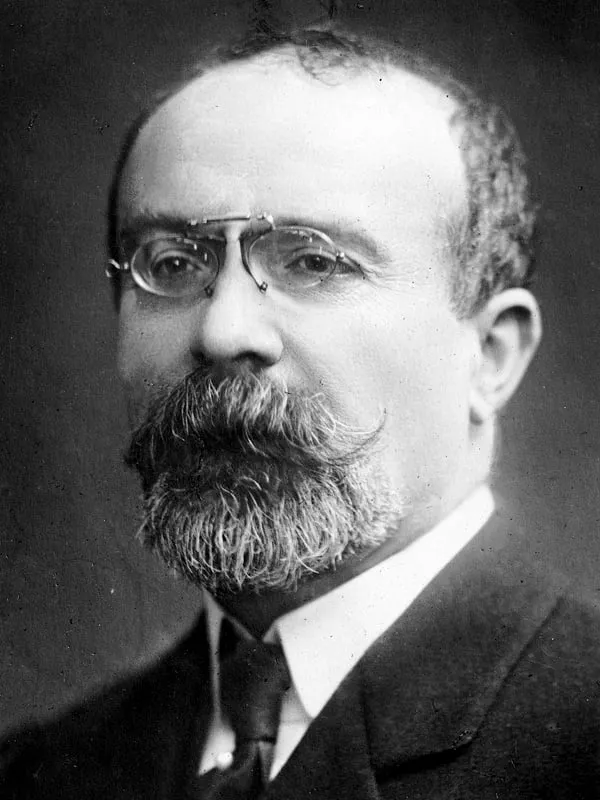
- Born:
- 25 August 1862, Oloron-Sainte-Marie (France)
- Died:
- 9 October 1934, Marseille
- Author:
- Łukasz
- Photo:
- George Grantham Bain Collection (Library of Congress), domena publiczna, Wikimedia Commons

For forty years Louis Barthou was one of the most experienced politicians of the Third Republic: he sat in fifteen governments, was Prime Minister in 1913, a member of the Académie française and a bibliophile, and the author of books on Mirabeau, Lamartine, Victor Hugo and Wagner. He went down in history, however, thanks to the last eight months of his life. When he took over the Foreign Ministry in 1934, he was one of the few Western politicians who immediately recognised Adolf Hitler’s Germany as a mortal threat. He refused to legalise German rearmament, toured France’s allies, proposed an Eastern Pact and brought the USSR into the League of Nations. On 9 October 1934 he was killed in Marseille at the side of the King of Yugoslavia, most probably by a police bullet. His successors chose the path of concessions.
A lawyer from the Pyrenees
He was born on 25 August 1862 in Oloron-Sainte-Marie in the Pyrenees, the son of an ironmonger. He studied law in Bordeaux and in Paris, where he took his doctorate, and then practised as a barrister in Pau and edited a local newspaper. In 1889, at the age of 27, he was elected deputy for the Basses-Pyrénées department as a moderate republican. He held the seat without interruption until 1922, when he moved to the Senate.
His ministerial career began early. In 1894, at the age of 32, he became Minister of Public Works; from 1896 to 1898 he was Minister of the Interior in Jules Méline’s government, from 1906 to 1909 Minister of Public Works again, and then Minister of Justice in the governments of Aristide Briand. He belonged to the centre-right wing of the republicans and opposed the socialists, but he was a skilful parliamentarian who knew how to win over different camps.
Prime Minister of the Three-Year Law
On 22 March 1913 President Raymond Poincaré, a friend of many years, asked Barthou to form a government. His most important task was to steer through parliament a law extending military service from two years to three. This was France’s response to the expansion of the German army. The socialists and some of the Radicals fought the bill, and Jean Jaurès campaigned against it throughout the country. Barthou succeeded in forcing it through: in the summer of 1913 the Chamber of Deputies passed the law by 358 votes to 204. His government also introduced the first allowances for large families and protection for women workers before and after childbirth. It fell on 2 December 1913, after losing a vote on a loan to cover the cost of rearmament.
The Great War was a personal tragedy for him. On 14 December 1914 his eighteen-year-old son Max was killed near Thann in Alsace. For several years Barthou withdrew from the front line of politics. He returned in 1917 as Minister of State in Paul Painlevé’s government, and from October to November 1917 he was Foreign Minister. In 1918 he was elected to the Académie française. After the war he was rapporteur of the Chamber’s committee on the Treaty of Versailles and published a book about it.
Guardian of the treaty
In the 1920s Barthou was among the staunchest advocates of enforcing the Treaty of Versailles. In Briand’s government of 1921 he was Minister of War, and in January 1922 he joined Poincaré’s government as Minister of Justice. In the spring of 1922 he led the French delegation to the economic conference in Genoa, during which Germany and Soviet Russia surprised the Western powers with the Treaty of Rapallo. In the autumn of 1922 he became President of the Reparation Commission. Under his direction the commission declared Germany in default on its deliveries, giving France and Belgium grounds for the occupation of the Ruhr in January 1923. He chaired the commission until 1926 and was then once again Minister of Justice in Poincaré’s government until 1929.
In 1921 he received the Polish Order of the White Eagle. In this period he was guided by a simple principle: France’s security depended on Germany abiding by the treaty, and the alliances with Poland, Czechoslovakia, Romania and Yugoslavia were there to compel it to do so.
Foreign Minister in 1934
After the bloody riots in Paris on 6 February 1934, a government of “national unity” was formed under the former President Gaston Doumergue. On 9 February Barthou, then a seventy-one-year-old senator, became its Foreign Minister. Hitler had been Chancellor for a year, and in October 1933 Germany had left the League of Nations and the Disarmament Conference. Britain was proposing a compromise that would in practice have permitted limited German rearmament. On 17 April 1934 Barthou replied with a note stating that the French government solemnly refused to legalise German rearmament and would henceforth see to France’s security by its own means. The note caused irritation in London, but it put an end to the illusion that disarmament could be agreed with Hitler.
Barthou then set off on a tour of allied capitals. In April he came to Warsaw, where he met Marshal Józef Piłsudski, President Ignacy Mościcki and Foreign Minister Józef Beck, and then went on to Prague to see Edvard Beneš. In June he visited Bucharest and Belgrade. The atmosphere in Warsaw was cool, because a few months earlier Poland had concluded a declaration of non-aggression with Germany and feared that France intended to reach an understanding with the USSR over its head.
And indeed Barthou took up the talks, already begun in Paris, with the Soviet People’s Commissar for Foreign Affairs, Maxim Litvinov. Their fruit was the Eastern Pact, also known as the “Eastern Locarno”: a regional mutual assistance treaty to be joined by the USSR, Germany, Poland, Czechoslovakia and the Baltic states, supplemented by Franco-Soviet guarantees. Barthou had no sympathy for communism. He reasoned like a diplomat of the old school, for whom Russia was a counterweight to Germany regardless of who ruled it. Germany rejected the project on 11 September 1934, and Poland, bound by its declaration with Berlin and reluctant to accept Soviet guarantees, did so a few weeks later. His second undertaking, however, succeeded: on 18 September 1934 the Assembly of the League of Nations admitted the USSR as a member.
Barthou also wanted to win over Italy. After the murder of the Austrian Chancellor Engelbert Dollfuss in July 1934, Benito Mussolini had sent troops to the Brenner Pass and seemed an ally in defending Austrian independence. The obstacle was Italy’s dispute with Yugoslavia, France’s ally. Barthou therefore invited King Alexander I to France in order to agree with him the terms of a settlement before travelling to Rome.
Death in Marseille
On 9 October 1934 Barthou welcomed the King in the port of Marseille and sat beside him in an open car. A quarter of an hour or so later, a gunman from the Macedonian organisation IMRO, acting on behalf of the Croatian Ustaše, shot Alexander dead. In the shooting Barthou was hit in the arm. The bullet severed an artery, the tourniquet was badly applied, and the minister bled to death in hospital that same afternoon. A ballistics report drawn up in 1935 and made public only in 1974 showed that he had been killed by an 8 mm bullet from a revolver of the type carried by the French police. Barthou thus most probably fell victim to the chaotic reaction of his own security detail. After a state funeral he was buried in Paris’s Père Lachaise cemetery. Six days after his death his friend Poincaré died.
The Marseille assassination speeded up work on the League of Nations conventions on the prevention of terrorism and on an international criminal court, signed in Geneva in November 1937. Neither of them ever entered into force.
Significance
Barthou was succeeded by Pierre Laval, who kept his predecessor’s policy in name only. In January 1935 Laval concluded an agreement with Mussolini that Italy took as a licence to conquer Ethiopia. He signed the Franco-Soviet Treaty of Mutual Assistance on 2 May 1935, but without a military convention and without any intention of carrying it out, and the Eastern Pact in the form Barthou had envisaged never came into being. The ratification of the treaty with the USSR in February 1936 served Hitler as a pretext for remilitarising the Rhineland.
Historians differ on how much Barthou might have achieved had he lived longer. His plan rested on the assumption that Poland and Czechoslovakia, the USSR and Italy could be brought together in a single front, which was hardly realistic, as Warsaw’s refusal and Mussolini’s later aggression against Ethiopia showed. He was nevertheless the last French Foreign Minister before 1939 who regarded Hitler without illusions and tried to answer his policy with the strength of alliances rather than with concessions. After his death France looked more and more to London, and the policy of concessions led it, by way of the Rhineland, the Anschluss and Munich, to war in 1939 in the worst possible conditions.
Sources
Often appears with
People who appear in the same events.