Japan
Raizō Tanaka
Commander of Destroyer Squadron 2 (1941–1942), commander of the 13th Special Base Force in Burma (1943–1945), vice admiral (1944)
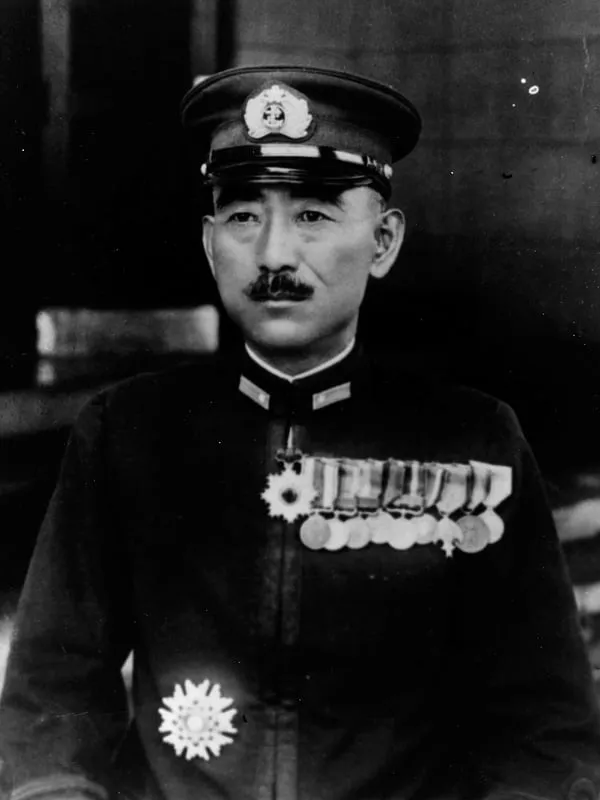
- Born:
- 27 April 1892, Kagawa, Yamaguchi Prefecture (Japan)
- Died:
- 9 July 1969
- Author:
- Natalia
- Photo:
- autor nieznany, domena publiczna, Wikimedia Commons

Raizō Tanaka was a Japanese admiral who was rated more highly by his enemies than by his superiors. As commander of Destroyer Squadron 2 he spent half a year of the Guadalcanal campaign leading the night runs of warships carrying troops and supplies that the Americans called the Tokyo Express, and on 30 November 1942, in the Battle of Tassafaronga, he routed a stronger American cruiser force with eight destroyers. Samuel Eliot Morison, the historian of the US Navy, called him “the redoubtable Tanaka”, and in American books he became known as “Tenacious Tanaka”. In the Japanese navy he was judged far more harshly: he was accused of lacking fighting spirit, he quarrelled with the Eighth Fleet command, and at the end of 1942 he was sent to the rear, where he spent the rest of the war.
Torpedo man
He was born on 27 April 1892 in the village of Kagawa, now part of the city of Yamaguchi (PL), the third son of the Honma family; he took the name Tanaka in 1920, when he was adopted into another family, a common practice in Japan. In December 1913 he graduated from the naval academy at Etajima, 34th of the 118 graduates of the 41st class. At the end of the First World War he served in the Japanese squadron sent to the Mediterranean, where destroyers escorted Allied transports against German submarines.
Throughout his career he was a torpedo man. He completed the advanced course of the torpedo school with distinction, taught there himself, and served in destroyers and on the staffs of cruiser divisions. In the Japanese fleet this was an elite calling: the Imperial Navy counted on making up for the superiority of the stronger American fleet in a future war through night torpedo attacks by destroyers and cruisers, and in the 1930s it introduced an oxygen-fuelled torpedo that was much faster and had a far longer range than any other of its time. In 1930–1932 Tanaka commanded the destroyers Tachikaze and Ushio, then a destroyer division, in 1937–1938 the light cruiser Jintsū, and in 1939–1940 the battleship Kongō. In September 1941 he took over Destroyer Squadron 2, whose flagship was once again the Jintsū, and on 15 October he was promoted to rear admiral.
The Philippines, Java and Midway
After the outbreak of war his squadron covered landings in the Philippines, among others at Legazpi on Luzon and on Mindanao, and then in the Netherlands East Indies, where convoys of troops moved from island to island. On 27 February 1942 the Jintsū and Tanaka’s destroyers fought in the Battle of the Java Sea, in which the Japanese destroyed Admiral Doorman’s force of Allied cruisers. Although the battle was a victory, Tanaka was criticised for firing his torpedoes from very long range instead of closing in as the commanders of some other divisions did; his defenders point out that long-range fighting was then the official doctrine of the Japanese fleet.
At the end of May 1942 Tanaka escorted from Saipan the transports carrying the troops that were to take Midway. After the defeat of Admiral Nagumo’s carriers in the Battle of Midway the convoy turned back without firing a shot.
Guadalcanal: summer
When the Americans landed on Guadalcanal on 7 August, Destroyer Squadron 2 sailed for Truk, and from there Tanaka led a convoy with the second echelon of Colonel Ichiki’s detachment. The first echelon, landed from destroyers, had meanwhile been wiped out at the Tenaru River. The convoy received conflicting orders from the Eighth Fleet command of Vice Admiral Gun’ichi Mikawa and from the 11th Air Fleet command: one moment it was told to turn back, the next to press on. On 24 August the Imperial fleet covering the convoy clashed with the American carriers in the Battle of the Eastern Solomons. The next morning marine dive-bombers from Henderson Field hit the Jintsū in the bow, killing 24 sailors, and sank a transport, and American B-17s finished off a destroyer that was rescuing its crew. Tanaka, stunned and slightly wounded, shifted his flag to the destroyer Kagerō, and the convoy turned back.
These experiences convinced him that without air cover nobody should approach Guadalcanal by day. From then on his destroyers entered the channel between the islands that the Americans called the Slot at night, landed men and cargo, and were out of range of the aircraft from Henderson Field before dawn. The Japanese called these runs “rat transport”. Tanaka, however, believed that destroyers could not replace transports and that convoys without air cover were bound to suffer losses. When on 28 August aircraft sank one destroyer and badly damaged two others, he accepted another division’s decision to turn back and cancelled a further run. In his signals to Rabaul he questioned the point of such expeditions and proposed moving the ships further from the front. The Combined Fleet Chief of Staff, Matome Ugaki, noted the disputes with Destroyer Squadron 2 in his diary, and the Emperor’s brother, Prince Takamatsu, a naval officer, wrote of Tanaka as a commander who lacked determination. At the end of August Mikawa took the command of the transport force away from him and gave it to Rear Admiral Shintarō Hashimoto.
Guadalcanal: autumn
In September and October Tanaka’s squadron, reinforced with new destroyers of the Yūgumo class, operated from Truk: it screened the battleships of Takeo Kurita, which on the night of 13–14 October bombarded Henderson Field, and fought with Admiral Nobutake Kondō’s fleet in the Battle of the Santa Cruz Islands. On 5 November Tanaka again took command of the transport force in the Shortland Islands.
In mid-November he was to bring in the largest convoy of the campaign: eleven transports with about 7,000 soldiers. After the night action of 13 November his ships set out for the island without a carrier, covered by only a few fighters. On 14 November they were attacked all day long by aircraft from Henderson Field and from the carrier Enterprise. Six transports were sunk and a seventh, damaged, turned back. Tanaka, circling the burning ships with his destroyers, rescued survivors and did not abandon the run. When on the night of 15 November American battleships sank the Kirishima, he decided that the only chance was to run the four surviving ships aground at Tassafaronga. Mikawa was against it, but the Combined Fleet agreed with Tanaka. About 2,000 soldiers got ashore with part of the ammunition and rice, and the rest of the cargo was destroyed during the day by aircraft and artillery. The Naval Battle of Guadalcanal settled that the Japanese would no longer bring large forces to the island.
Tassafaronga
So the starving soldiers of the 17th Army began to be supplied with food in drums: destroyers were to drop drums tied together with rope off the shore at night, and the soldiers would haul them out of the water. Tanaka led the first such run himself. On the night of 30 November–1 December his eight destroyers, with the Naganami as flagship, were detected by the radar of Rear Admiral Carleton Wright’s force of five cruisers and several destroyers. The Americans had superiority and surprise, but they fired their torpedoes from too great a range and concentrated their gunfire on a single destroyer, the Takanami, which sank. Tanaka ordered the unloading stopped and the attack begun. Japanese torpedoes hit four cruisers: the Northampton sank, and the Minneapolis, New Orleans and Pensacola were out of service for many months. It was one of the worst defeats of the US Navy in the Pacific.
The Battle of Tassafaronga made Tanaka famous in the United States, but in Japan it was seen differently. No food had been delivered, and the 17th Army command immediately demanded that the run be repeated. The official Japanese war history reproaches Tanaka because his Naganami fired its torpedoes and was the first to leave the battle, so that the fighting was in fact conducted by individual divisions and ships. Masatake Okumiya, an air staff officer, thought the credit belonged rather to Captain Torajirō Satō, whose destroyers made the decisive attack. Tanaka himself said years later that he had done nothing but give the order to attack, and owed the rest to his destroyer captains.
The drum runs continued. On 3 December 1,500 drums were dropped, but the soldiers managed to haul in only 310. On 11 December Tanaka led eleven destroyers with his flag in the new anti-aircraft destroyer Teruzuki. Off the shore of Guadalcanal American PT boats caught him; two torpedoes hit the Teruzuki, which had to be abandoned in the night and sank on 12 December. Tanaka, slightly wounded in the foot, moved to the Naganami. Of the 1,200 drums dropped, 220 reached the shore.
Sidelined
On 29 December 1942 Tanaka handed Destroyer Squadron 2 over to Rear Admiral Tomiji Koyanagi. He moved to the Naval General Staff, in February 1943 took command of the guard force of the port of Maizuru, and in October 1943 of the 13th Special Base Force in Burma, based in Rangoon. In Japan this was widely seen as banishment. When the end of the fighting on Guadalcanal in February 1943 closed the campaign, the navy leadership needed someone to blame, and Tanaka, who had so often questioned orders, was a convenient candidate. In October 1944 he was promoted to vice admiral. In the spring of 1945, when the British took Mandalay and advanced on Rangoon, his base withdrew to Moulmein and then to Thailand.
After the war and assessment
In 1946 Tanaka retired, and in 1947 he was caught by the purge that excluded former officers from public life. Soon after the war he lost his only son. Asked by the writer Kazutoshi Handō about his life after the war, he said that he farmed when the weather was fine and read when it rained, and that really, ever since he had been moved ashore, he had had nothing to do. He was, however, glad to tell researchers about his battles, though he warned that memory fades with age. He felt sorry for Wright, who was recalled after Tassafaronga, because he believed that the outcome of a battle is often decided by chance. He died on 9 July 1969.
How Tanaka is judged depends on who is judging. To the Americans he was a model destroyer commander: Morison wrote of him with respect, and the military journalist Hanson Baldwin declared that if one were to name the two best Japanese commanders of the Pacific War, on land it was General Ushijima and at sea it was Tanaka. Many Japanese officers, including his subordinates, saw him as a cautious commander, quick to protest, who did not lead attacks in person. After the war, under the influence of American opinion, he came to be judged more and more favourably in Japan. The dispute also touches the heart of the campaign: many of the objections for which his superiors disliked him came down to the fact that Guadalcanal could not be supplied without command of the air, and the later course of the fighting proved him right.
Sources
Commanded in battles
(02)Mentioned in battles
(01)Often appears with
People who appear in the same events.