Japan
Gun’ichi Mikawa
Commander of Battleship Division 3 (1941–1942), the Eighth Fleet at Rabaul (1942–1943), the 2nd Southern Expeditionary Fleet (1943–1944) and the Southwest Area Fleet (1944)
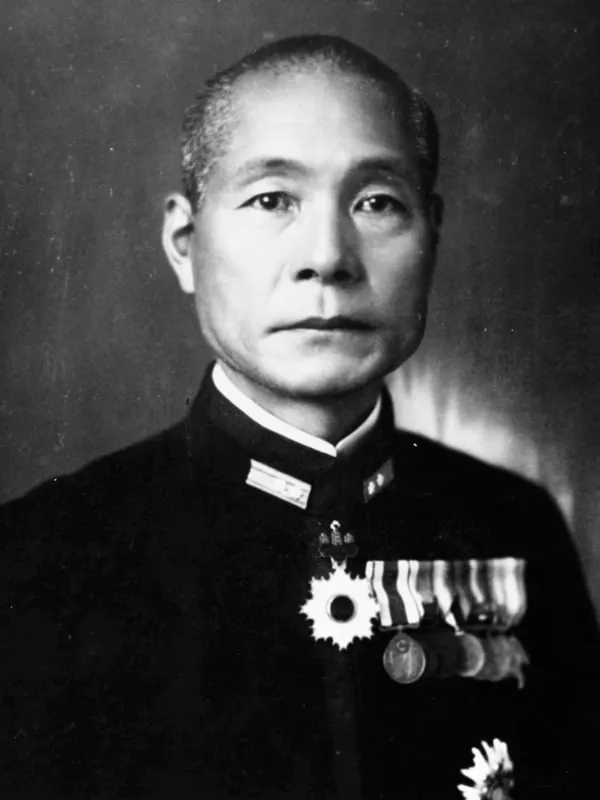
- Born:
- 29 August 1888, Takata, Saeki District, Hiroshima Prefecture (now Etajima, Japan)
- Died:
- 25 February 1981, Ikoma, Nara Prefecture (Japan)
- Author:
- Natalia
- Photo:
- autor nieznany, domena publiczna, Wikimedia Commons

Gun’ichi Mikawa was the author of the Japanese navy’s greatest victory in a night gun-and-torpedo action. A day and a half after the American landing on Guadalcanal he led a hastily assembled cruiser force down from Rabaul and on the night of 8–9 August 1942, in less than an hour, sank four Allied heavy cruisers off Savo Island without losing a single ship in the battle itself. He did not, however, attack the defenceless transports on which the fate of the Marines on the island depended, and that decision still weighs on how he is judged. Over the following months his Eighth Fleet fought an exhausting battle for Guadalcanal, and in March 1943 a convoy it sent to Lae was destroyed in the Bismarck Sea. His time as fleet commander at Rabaul is also burdened by a crime committed by the crew of one of his destroyers.
Navigator and diplomat
He was born on 29 August 1888 in the village of Takata in Saeki District, Hiroshima Prefecture, now part of the city of Etajima, home of the Naval Academy. He graduated from the academy in July 1910, third out of 149 in the 38th class. As a young officer he served in cruisers and battleships, took the torpedo and gunnery courses, and during the First World War served in the cruiser “Aso” and in a destroyer. He specialised in navigation and was navigating officer of several ships, including the battleship “Haruna”. He studied twice at the Naval War College, graduating in 1924.
Mikawa was one of the officers who knew the wider world. From 1918 to 1920 he was in France, where he accompanied the Japanese delegation to the peace conference. At the end of the 1920s he went to France again, served on the naval delegation to the League of Nations and at the London Naval Conference, and in 1930 became naval attaché in Paris. In December that year he was promoted to captain. On his return he was chief instructor at the academy at Etajima, and in the mid-1930s he commanded in turn the heavy cruisers “Aoba” and “Chōkai” and the battleship “Kirishima”. On 1 December 1936 he became a rear admiral and chief of staff of the Second Fleet, from November 1937 he headed a bureau of the Naval General Staff, and from 1939 he commanded cruiser divisions. On 15 November 1940 he was promoted to vice admiral.
Pearl Harbor, the Indian Ocean, Midway
In September 1941 Mikawa took over Battleship Division 3, made up of fast ships of the Kongō class. With two of them, “Hiei” and “Kirishima”, he screened the carriers of Vice Admiral Chūichi Nagumo on the way to Hawaii and was second-in-command of the whole force; the other two battleships went south to cover the landings in Malaya. According to Kent Budge, he was sceptical of the operation itself, believing that it dispersed the fleet’s strength. According to Japanese sources, however, after the attack on Pearl Harbor he advised launching a further strike, which Nagumo did not do. In the following months his battleships screened the carriers in the operation against Rabaul, in the Indian Ocean raid in April 1942 and in the Battle of Midway.
Savo
After Midway the Japanese navy formed the Eighth Fleet, which was to be responsible for New Guinea and the Solomon Islands. Mikawa took command on 14 July 1942. Aboard “Chōkai” he sailed via Truk, where Vice Admiral Shigeyoshi Inoue briefed him on the situation, to Rabaul, and on 30 July he moved his staff ashore. His fleet was weak: a few cruisers, destroyers and landing forces. His staff did not expect a serious Allied offensive before the end of the year.
On 7 August 1942 the Americans landed on Guadalcanal and Tulagi. Mikawa reacted at once. He recalled the transports carrying reinforcements to the island when it became clear how strong the landing was, gathered five heavy cruisers, two light cruisers and one destroyer, and set out south-east that same day. He was counting on the advantage the Japanese navy had in night fighting: training, optics and Type 93 torpedoes with a range unknown to the enemy. His force was sighted several times, but the reports arrived late and with a wrong description.
The Battle of Savo Island began shortly after one o’clock in the morning of 9 August. Floatplanes from the Japanese cruisers dropped flares, and Mikawa’s ships attacked first the southern group of the Allied screen and then, accidentally split into two columns, the northern one. The Australian cruiser “Canberra” and the American “Quincy”, “Vincennes” and “Astoria” sank or were damaged beyond saving; more than a thousand Allied sailors were killed. The Japanese lost a few dozen men, and their ships suffered only light damage, although “Chōkai” took several hits.
At about 2.20 Mikawa conferred with his staff and ordered a withdrawal. The anchorage of the transports, with their cargo for the 1st Marine Division, lay before him almost unprotected. But he did not know how many ships remained in the sound, his force was scattered, and reloading the torpedo tubes would take a long time. He was convinced that American carriers would attack him at dawn, and, by his own post-war account, the Chief of the Naval General Staff, Osami Nagano, had earlier told him to avoid losses, because Japan could not replace heavy cruisers. He did not know that the carriers of Frank Jack Fletcher were just then sailing away to the south. On the way back, on 10 August, the American submarine S-44 sank the cruiser “Kako”.
Admiral Isoroku Yamamoto congratulated Mikawa on his victory, but before long he was reproached for a wasted opportunity. Many historians, such as Richard B. Frank, believe that destroying the transports would have given the Japanese a real chance of recapturing the island. Others defend Mikawa: Kent Budge considers his decision justified by what he knew, and Japanese sources stress that the Combined Fleet had not assigned him the transports as a target and that he was never officially called to account for the withdrawal. Mikawa himself maintained to the end of his life that he had acted rightly.
The struggle for Guadalcanal
In the following months the Eighth Fleet fought the Guadalcanal campaign day and night. At the end of August, at the request of the commander of the Seventeenth Army, General Harukichi Hyakutake, Mikawa sent a naval landing force to Milne Bay in New Guinea, where the Australians destroyed it in less than two weeks. At the same time the convoys of Rear Admiral Raizō Tanaka were trying to carry troops to Guadalcanal; when after the Battle of the Eastern Solomons exaggerated airmen’s reports reached Rabaul, Mikawa turned the transports back towards the island, where aircraft from Henderson Field caught them. From then on reinforcements were carried mostly by fast destroyers, at night.
In October Mikawa’s staff planned the supply run that led to the defeat of the Japanese cruisers off Cape Esperance, and a few days later Mikawa himself led “Chōkai” and “Kinugasa” to shell the airfield. In November, during the Naval Battle of Guadalcanal, his cruisers shelled Henderson Field on the night of 13–14 November in place of the battleship force that had turned back, but did not put it out of action. In the morning aircraft from the island and from the carrier “Enterprise” caught the retiring force, sank “Kinugasa” and damaged several other ships, and then shattered Tanaka’s convoy. At the beginning of February 1943 the Eighth Fleet’s destroyers, in three night runs, evacuated the surviving soldiers from Guadalcanal. According to Budge, Mikawa argued to the high command that the fight for the Solomons was swallowing men, ships and aircraft like a bottomless pit.
The Bismarck Sea and the crime aboard “Akikaze”
After the loss of Guadalcanal, Mikawa and the commander of the Eighth Area Army, General Hitoshi Imamura, decided to reinforce Lae in New Guinea. At the beginning of March 1943 a convoy of eight transports carrying nearly 7,000 soldiers, escorted by eight destroyers, left Rabaul. In the Battle of the Bismarck Sea American and Australian aircraft sank all the transports and half the destroyers; nearly 3,000 men were killed. The defeat weighed above all on Mikawa.
That same month a crime took place for which Mikawa’s command bore responsibility. On 17 March 1943 the destroyer “Akikaze” picked up about 60 civilians from the island of Kairiru near Wewak and from other missions, most of them German Catholic and Protestant missionaries with their workers and families, among them three infants. The next day, on the way to Rabaul, all of them were murdered on board. The order came from Eighth Fleet headquarters. After the war Mikawa and his chief of staff, Shinzō Ōnishi, were questioned by Australian investigators. Both testified that a junior staff officer had issued the order on his own and that they had learned of it only afterwards. The historian Yuki Tanaka finds these explanations hard to believe, because an order of this kind could not have been encrypted and transmitted without the signatures of the commander and the chief of staff. The Australian investigator Albert Klestadt wrote that even if the admirals had not issued the order, they bore command responsibility for allowing the crime to happen. Neither admiral was ever charged with it.
In the background
In April 1943 Mikawa was recalled from Rabaul and appointed head of the navigation school, which was widely seen as being sidelined. From September 1943 he commanded the 2nd Southern Expeditionary Fleet, and from June 1944 the Southwest Area Fleet in Manila, with small naval and air forces in the Philippines. In the Battle of Leyte Gulf in October 1944 he played a minor role, and he then directed the destroyer runs carrying reinforcements to Leyte, which did not change the course of the fighting. On 1 November 1944 he was recalled to Japan. He also chaired the commission investigating the sinking of the carrier “Shinano”, and on 21 May 1945 he was placed on the reserve list.
After the war
According to Japanese sources, Mikawa was held for a time after the war in Sugamo prison as a suspected war criminal, and in 1947 he was caught by the purge of former military men. He never stood trial. He spent the rest of his life quietly with his family in Tokyo, with summers in Karuizawa. He died on 25 February 1981 in Ikoma, Nara Prefecture, at the age of 92.
Mikawa was remembered as a gentle, quiet man with the manners of an intellectual, and at the same time a courageous commander. At Savo he showed what the Japanese navy’s pre-war training for night combat was worth, and the Allies long drew lessons from that defeat. For historians, though, he remains above all the admiral who won the battle and left the prize untouched: the American transports came back, the Marines held Guadalcanal, and the Japanese offensive in the Pacific came to a halt precisely there.
Sources
Commanded in battles
(01)Mentioned in battles
(01)Often appears with
People who appear in the same events.