Poland
Roman Dmowski
Leader of the National League and the National Democrats (from 1893), President of the Polish National Committee (1917–1919), delegate to the Paris Peace Conference (1919), Foreign Minister (1923)
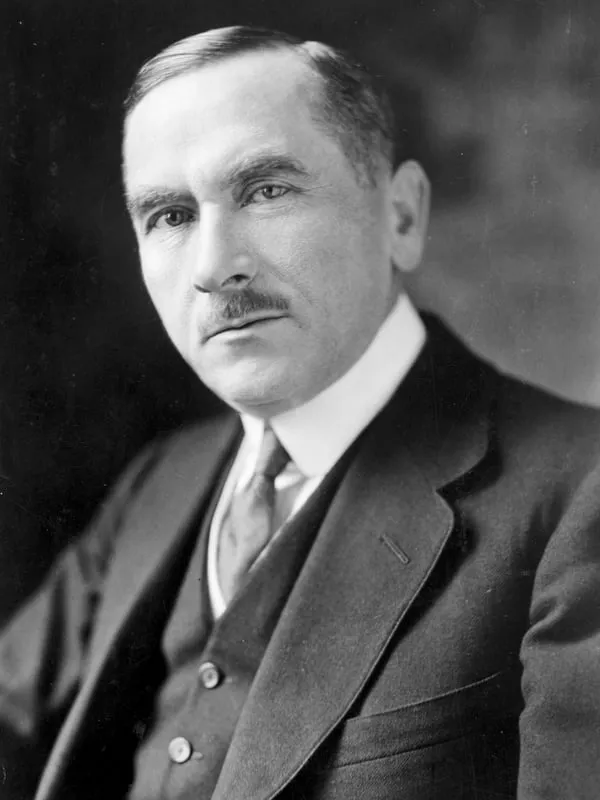
- Born:
- 9 August 1864, Kamionek near Warsaw (Russian Empire)
- Died:
- 2 January 1939, Drozdowo near Łomża
- Author:
- Natalia
- Photo:
- Harris & Ewing, domena publiczna, Wikimedia Commons

Roman Dmowski created Polish nationalism as a political movement and for almost half a century was the chief opponent of Józef Piłsudski. Both men wanted an independent Poland, but they chose opposite paths. Piłsudski saw Russia as the main enemy; Dmowski saw Germany, which in his view threatened the very existence of the Polish nation. During the First World War he staked everything on Russia and then on her Western allies. The Polish National Committee in Paris, which he led, was recognised by the Entente as the representative of the Poles, and in 1919 Dmowski presented Poland’s demands at the peace conference and signed the Treaty of Versailles. The western frontier he won there, which gave Poland Greater Poland and Pomerania, became for Germany a symbol of the “injustice of Versailles” and one of the aims in whose name Hitler attacked Poland in 1939. Dmowski was also an avowed antisemite and an advocate of a nation state in which minorities were either to assimilate or to remain on the margins. His ideas shaped the Polish right throughout the interwar years and remain fiercely contested to this day.
Youth and the National League
He was born on 9 August 1864 in Kamionek near Warsaw, now part of the Warsaw district of Praga, into an impoverished family of minor gentry. His father ran a small paving business. At grammar school, aged seventeen, he founded a secret pupils’ circle that resisted Russification. He studied natural sciences at the Imperial University of Warsaw and was active in the clandestine youth organisation “Zet”.
In April 1893 Dmowski and a group of younger activists took control of the émigré Polish League and turned it into the secret National League, from which grew the National Democratic camp, known as the Endecja. For taking part in a demonstration on the centenary of the Constitution of 3 May he spent several months in the Warsaw Citadel and was exiled to Mitau (Jelgava) in Courland. In February 1895 he escaped to Lwów (Lviv), where he edited the Przegląd Wszechpolski (All-Polish Review). His programme went down in history in the form of the book Thoughts of a Modern Pole (PL) (1903). In it Dmowski preached “national egoism”: the nation is the highest value, and the life of nations is a struggle for existence in which there is no room for sentiment. He rejected the Romantic tradition of uprisings and called for “realism”.
The Russo-Japanese War and the Duma
When the Russo-Japanese War broke out in 1904, Piłsudski travelled to Tokyo to seek Japanese help for a rising in the Kingdom of Poland. Dmowski arrived there in mid-May, ahead of him, and argued to the Japanese that a rising would be a disaster for the Poles and would bring Japan nothing. The Japanese did not take up the insurrectionary plans. During the Revolution of 1905 the National Democrats fought the socialists, by force as well, and Dmowski proposed a deal to the Russian prime minister Sergei Witte: the National Democrats would help restore order in exchange for autonomy for the Kingdom. St Petersburg did not take up the offer.
In 1907 Dmowski was elected a deputy to the Second and then the Third State Duma and chairman of its Polish caucus. In his book Germany, Russia and the Polish Question, published at that time, he set out the idea that would guide him for decades to come. The greatest danger was Prussia and its policy of Germanisation, and for Germany the existence of Poland was a matter of “to be or not to be”. Russia was weaker, and for her the Polish question was of merely local importance; within the Franco-Russian alliance against Germany, therefore, the Polish lands could be united. This course towards St Petersburg cost him the departure of some of his colleagues, and the Russians themselves responded with a plan to detach the Chełm region from the Kingdom. In 1909 Dmowski resigned his seat. Hostility towards Jews became ever more prominent in his politics. In 1912 he lost the election to the Fourth Duma in Warsaw to a candidate backed by Jewish voters, and responded with a call to boycott Jewish trade. That autumn, at a secret congress in Pieniaki, the leaders of the National Democrats from all three partitions decided that in a future war the Poles would stand against Germany.
The First World War
Dmowski greeted the outbreak of war in 1914 as confirmation of his predictions. He took the proclamation of the Russian Commander-in-Chief, Grand Duke Nicholas Nikolaevich, which promised the unification of Poland under the Tsar’s sceptre, as the foundation of Polish policy. In November 1914 he became head of the Executive Committee of the Polish National Committee in Warsaw, which opposed Piłsudski’s Legions. Russia, however, gave the Poles nothing concrete. When the Germans took Warsaw in the summer of 1915, Dmowski concluded that he could achieve nothing more in Petrograd, and in the autumn he left for the West by way of Scandinavia.
In London and Paris he started from scratch, because as long as the alliance with the Tsar lasted, Western governments regarded the Polish question as an internal Russian matter. He built up influence through journalists, scholars and officials. In 1916 he received an honorary doctorate from the University of Cambridge. The breakthrough came with the February Revolution. Once Tsarism had fallen, Dmowski could speak openly of independence. In memoranda for the British government, and in the memorandum “Problems of Central and Eastern Europe”, circulated in July 1917, he outlined the borders of a future Poland that would include Greater Poland, Pomerania, Gdańsk and Upper Silesia.
On 15 August 1917 in Lausanne Dmowski founded the Polish National Committee and became its president. The Committee moved to Paris, and within a few months it was recognised by France, Britain, Italy and the United States. Ignacy Jan Paderewski became its representative in America. The Committee assumed political authority over the Polish Army in France, commanded in 1918 by General Józef Haller. On 3 June 1918, in the Declaration of Versailles, the prime ministers of France, Britain and Italy recognised a united and independent Poland with access to the sea as a condition of a just peace. In the autumn Dmowski held talks in Washington with President Woodrow Wilson, who did not care for him and received the far-reaching Polish territorial demands with reluctance. According to Polish tradition, Dmowski also lobbied for the Armistice of Compiègne not to require the Germans to withdraw at once from the lands of the former Russian Empire, so that the Bolsheviks would not occupy them.
The peace conference
For Dmowski the war ended in a paradox. Poland had come into being, but power in Warsaw had been taken by Piłsudski, and the National Committee did not recognise his government. A split loomed, averted only by a compromise at the turn of 1918 and 1919: Paderewski became prime minister, the Committee recognised the new cabinet, and Dmowski became Poland’s first delegate to the Paris Peace Conference. At the same time the Greater Poland Uprising broke out, and its leaders in the Supreme People’s Council were politically close to the National Democrats. The insurgents’ successes gave the delegation in Paris an argument it lacked in the case of other disputed lands.
On 29 January 1919 Dmowski spent some five hours setting out Poland’s demands to the Council of Ten, translating his own address into French and English. In the east he proposed a frontier close to that before the Second Partition, later called the Dmowski Line. He wanted Poland to be a nation state that would absorb and Polonise the minorities in the eastern borderlands, not the federation Piłsudski dreamed of. He did not carry his programme in full. The British prime minister David Lloyd George was particularly opposed to it. Gdańsk became a free city, plebiscites were to decide the fate of Upper Silesia, Warmia and Masuria, and Poland was obliged to sign a minorities treaty, against which Dmowski protested vehemently. On 28 June 1919, together with Paderewski, he signed the Treaty of Versailles, and on 10 September the peace treaty with Austria at Saint-Germain.
In reborn Poland
Although he was elected to the Legislative Sejm in 1919, he reportedly appeared there only once. He spent a long time recovering from pneumonia in Algeria. In July 1920, during the Bolshevik offensive, he joined the Council of State Defence, but withdrew after a sharp quarrel with Piłsudski. He settled on the Chludowo estate near Poznań and rarely held office. The only government office of his career was that of foreign minister in the government of Wincenty Witos, which he held from 27 October to 14 December 1923. He defended the Versailles order and the alliance with France, and on 13 December signed the note recognising the Soviet Union.
He nevertheless remained the undisputed leader and ideologue of the nationalist camp. When in December 1922 the National Assembly elected Gabriel Narutowicz president with the votes of the left and the national minorities, the National Democrats unleashed a campaign of hatred against him. A few days later Narutowicz was killed by a fanatical nationalist, the painter Eligiusz Niewiadomski. After Piłsudski’s May Coup of 1926 Dmowski founded the Camp of Great Poland, openly modelled on Italian Fascism. In 1925 he had called Mussolini “undoubtedly the greatest man in Europe today”. In 1928 the National Party was formed, which became the main force of right-wing opposition to the Sanacja regime. The authorities dissolved the Camp of Great Poland in 1933.
The 1930s
In the last decade of his life Dmowski’s views grew ever more radical. He portrayed the Jews and Freemasonry as the source of almost all the ills of European civilisation, wrote a novel, Dziedzictwo (The Inheritance), criticised for its antisemitism, and did not oppose the anti-Jewish campaigns of nationalist youth: boycotts of shops, brawls at the universities and demands for “ghetto benches”. At the same time the young radicals considered him too moderate. In 1934 some of them broke away and founded the National Radical Camp, whose activities Dmowski condemned in private letters as harmful to the national cause.
Towards Germany he remained true to the conviction of his youth. Although in a private letter of March 1933 he wrote jokingly about Hitler’s successes, in time he refused to call Hitlerism a national movement, and saw in dictatorship a sign of weakness, not strength. The Sanacja’s foreign policy, conducted after 1932 by Józef Beck, remained a target of criticism for his camp, although the National Party itself was not unanimous on the matter. Dmowski foresaw a great upheaval in Europe, about which he wrote in his book Przewrót (The Upheaval) of 1934.
In the spring of 1937 he suffered a stroke. He went to live with friends, the Niklewicz family, at Drozdowo near Łomża. There, after a bout of pneumonia, he died in the night of 1–2 January 1939, eight months before the outbreak of the war he had warned against all his life. His funeral in Warsaw on 7 January was one of the largest demonstrations of the interwar period. Estimates of the number of mourners range from one hundred thousand to more than two hundred thousand, and representatives of the Sanacja government stayed away. He was buried in Bródno Cemetery.
Legacy
Dmowski’s followers outlived him. During the war the National Party joined the government-in-exile of General Władysław Sikorski and, at home, the Polish Underground State, although its radical factions set up their own armed underground. Dmowski’s prediction that Germany would remain a mortal threat to Poland came true in 1939 in the most terrible way. His hope of an understanding with Russia against Germany, however, had already foundered on the reality of the First World War, and in 1939 both neighbouring powers attacked Poland together.
In the judgement of historians, Dmowski was one of the chief architects of independence. It was he who made the Western Allies treat the Polish cause as their own, who ensured that Poland had an army on the side of the victors and that its western frontier largely matched his programme. His critics point out that he embraced the cause of independence only when Russia was weakening, and that his nationalism and antisemitism poisoned the public life of the reborn state, excluding millions of citizens of other nationalities. In communist Poland his books were banned. In 1999 the Sejm honoured him as a statesman, and in 2018 he was posthumously awarded the Order of the White Eagle. The dispute over Dmowski, like the dispute over Piłsudski, is still in Poland a dispute about what kind of state Poland was meant to be and should be.
Sources
Mentioned in battles
(03)Often appears with
People who appear in the same events.