Poland
Stanisław Maczek
Commander of the 10th Cavalry Brigade (1938–1939), the 10th Armoured Cavalry Brigade in France (1940), the 1st Armoured Division (1942–1945) and I Polish Corps in Scotland (from 1945)
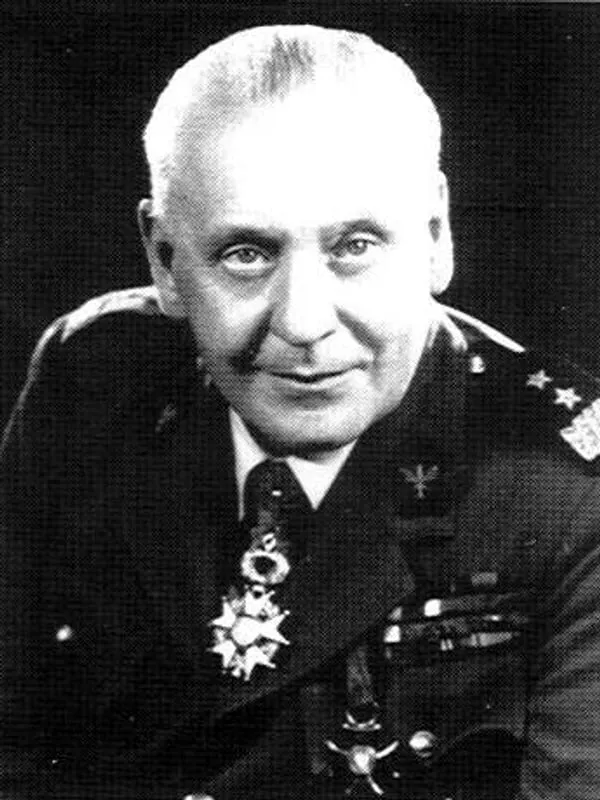
- Born:
- 31 March 1892, Szczerzec near Lwów, Galicia (Austria-Hungary; now Ukraine)
- Died:
- 11 December 1994, Edinburgh (United Kingdom)
- Author:
- Natalia
- Photo:
- autor nieznany, domena publiczna, Wikimedia Commons

Stanisław Maczek was the best-known Polish armoured commander and one of the few generals of the Second World War of whom it is said that they never lost a battle. In September 1939 his motorised 10th Cavalry Brigade delayed the German panzer divisions advancing from the south, in June 1940 the re-formed brigade fought in France, and in August 1944 his 1st Armoured Division closed the pocket at Falaise. It then led the pursuit through Belgium and the Netherlands, liberated Breda and ended the war at Wilhelmshaven. After the war the Communist authorities stripped him of his citizenship, and the victor of Falaise worked for years as a barman in Edinburgh. He died at the age of 102, held in honour in Poland, the Netherlands and Belgium.
A philosopher in uniform
Stanisław Władysław Maczek was born on 31 March 1892 in Szczerzec (PL) near Lwów, into the family of a court official. He spent his childhood in Drohobych, where he passed his school-leaving exams, and in 1910–1914 he studied Polish literature and philosophy at the university in Lwów, among others under Kazimierz Twardowski (PL). Like many Lwów students he belonged to the Riflemen’s Association, but he did not join the Legions: in 1914 he was called up into the Austro-Hungarian army. He spent the war mainly on the Italian front, in mountain rifle units, where he rose to lieutenant and commanded a company; in 1918 he was wounded.
In November 1918 he reported to the Polish Army in Krosno and at once set off with a company of volunteers to relieve Lwów, besieged by the Ukrainians. Travelling in an improvised armoured train, his men captured the station at Ustrzyki Dolne (PL). In 1919 he commanded the so-called flying assault company, carried on horse-drawn carts, which in the operations of the 4th Infantry Division retook Drohobych, Boryslav and Stanisławów; according to accounts, Piłsudski himself promoted him on the battlefield at that time. In the Polish-Soviet war he led an assault battalion in a cavalry division and in August 1920 broke through the Soviet front at Waręż. Even then he thought about soldiering as he later thought about armour: what counted were speed, firepower and the independence of small units.
Between the wars
After the war he stayed in the regular army. He completed a course at the Higher War School, worked for several years in military intelligence in Lwów, reconnoitring the Soviet Union, and then served in Grodno, where from 1929 he commanded the 81st Grodno Rifles Regiment. He became a colonel in 1931. In 1925 he married Zofia Kuryś; they had three children. From 1935 he commanded the divisional infantry of the 7th Infantry Division in Częstochowa.
The turning point of his career came in October 1938, when, during the occupation of Zaolzie, he took over the 10th Cavalry Brigade. It was the first large motorised formation in the Polish Army: its riflemen rode in lorries, and light tanks and tankettes gave support. Maczek had less than a year to teach it to fight.
September 1939
In the September campaign the brigade fought as part of Army Kraków on its southern wing, against German panzer and mountain divisions advancing from Slovakia. In the battle of Jordanów it held off a much stronger enemy for three days, and then fell back step by step, through Wiśnicz, Rzeszów and Łańcut, without letting itself be surrounded. After crossing the San the brigade reached Lwów and from 15 September defended the city. After the Soviet invasion it was ordered to cross into Hungary; on 19 September it crossed the border; it had lost about half its men, but it had not been beaten. For September Maczek received the Gold Cross of the Virtuti Militari and promotion to brigadier general.
France 1940
In Hungary the brigade was interned, but its soldiers made their way to France in small groups. There Maczek was to create a Polish armoured unit, but for a long time the French gave no equipment. Only when the front of the campaign in France collapsed in May 1940 was the re-formed 10th Armoured Cavalry Brigade hastily equipped. In mid-June it fought in Champagne and Burgundy, at Champaubert and Montbard, covering the retreat of French divisions, until it was cut off. On 17 June Maczek ordered the equipment destroyed and the men to disperse. He himself, disguised, according to different accounts, as an Arab or as a legionnaire, made his way through North Africa and then through Portugal to Britain, which he reached in September 1940.
Scotland and the 1st Armoured Division
In Scotland the Polish soldiers were first formed into rifle brigades to defend the coast. General Władysław Sikorski, however, persuaded the British to create a Polish armoured unit, and in February 1942 the 1st Armoured Division of the Polish Armed Forces was formed under Maczek’s command. For two years it trained in Scotland and England, equipped with Sherman and Cromwell tanks. After Sikorski’s death, on the instructions of General Kazimierz Sosnkowski, who had become Commander-in-Chief, Maczek brought younger officers into the division and adapted its organisation to the British pattern.
Falaise
At the end of July 1944 the division landed in Normandy and joined the First Canadian Army. On 8 August it went into its first battle in Operation Totalize, an attack along the road from Caen to Falaise. It began badly: American bombers dropped some of their bombs on their own troops, and the Polish tanks, advancing over open ground, ran into the fire of German anti-tank guns and the 12th SS Panzer Division. Maczek learned from this, and in the following days he led the division in fast, wide manoeuvres deep into the German rear.
When the German Seventh Army and Fifth Panzer Army were encircled at Falaise, the Poles were given the task of closing the last escape route. On 19 August part of the division took Chambois and linked up there with the Americans, while two armoured regiments and several battalions dug in on the hills above Mont-Ormel, which the Poles called “the Mace”. Throughout 20 and 21 August, surrounded, without supplies of ammunition or water, they beat off attacks from both sides: Germans fleeing the pocket and SS divisions trying to open a corridor from outside. According to figures quoted in Polish literature, the division lost 1,441 men in the whole battle, 466 of them killed. Polish literature repeats the words of Bernard Montgomery that the Germans were in a bottle and the Polish division was the cork. After the battle, however, there was no shortage of voices, including among his own soldiers, saying that the division had paid too high a price for this success.
The Falaise pocket was the climax of the battle of Normandy. For Poles it became one of the most important places of memory of the soldiers who fought in the West.
Belgium, the Netherlands, Germany
After Falaise the division set off in pursuit through northern France and Belgium. It liberated Ypres, Tielt, Roeselare and the area around Ghent, and in the second half of September reached the Scheldt near Terneuzen, where it sank the boats in which the Germans were evacuating their units. It then fought on the right wing of the First Canadian Army in the battle of the Scheldt, among the woods and heaths of the Belgian-Dutch border.
Its best-known success came at the end of October. Maczek was ordered to take Breda, a large town in North Brabant. Instead of a frontal attack preceded by heavy shelling he went round the town and, according to Polish and Dutch accounts, limited his artillery fire to spare the inhabitants and the historic buildings. On 29 October Breda was free and almost untouched, and inscriptions appeared on the walls reading “Thank you, Poles”. The division went on fighting until 9 November to reach the Maas at Moerdijk, and spent the winter on the defensive along the river.
In the spring of 1945 the division entered Germany. After the surrender on Lüneburg Heath its soldiers received, at the beginning of May, the surrender of the fortress and naval base of Wilhelmshaven, with its whole garrison and its ships. In the small town of Haren on the Ems, taken by the division, a settlement was set up with the consent of the British occupation authorities for thousands of Poles freed from captivity and forced labour, among them women from the Warsaw Uprising liberated from the camp at Oberlangen; it was named Maczków. At the end of May Maczek handed the division over to General Klemens Rudnicki and took over I Polish Corps in Scotland, and on 1 June 1945 he was promoted to major general.
Exile
Maczek did not return to a Poland ruled by the Communists. In September 1946 the authorities in Warsaw stripped him of his citizenship for serving in the Polish Resettlement Corps, which was subordinate to the British. In 1948 he was demobilised. The British did not grant him a general’s pension because he had not served in their army, and the hero of Falaise earned his living as a labourer, a shop assistant and finally a barman in Edinburgh hotels. In 1961 he published his memoirs, whose title translates as “From the Cart to the Tank”. The Dutch government, alerted by the mayor of Breda, secretly paid him an allowance so as not to provoke the authorities in Warsaw.
To the end he refused contact with the authorities of Communist Poland and did not accept their gestures: in 1971 his citizenship was quietly restored, and in 1989 Mieczysław Rakowski’s government officially revoked the 1946 decision. In 1990 the President of Poland in exile promoted him to lieutenant general, and in 1994 he received the Order of the White Eagle. He died on 11 December 1994 in Edinburgh. In accordance with his last wish he was buried among his soldiers in the Polish war cemetery in Breda.
Maczek is today regarded as one of the best Polish commanders of the twentieth century: a creator of modern armoured forces who knew how to combine boldness of manoeuvre with care for his soldiers and for civilians. His men called him “Baca”, the highland shepherd. His division, which the Germans are said to have called the “Black Devils”, is in Poland a symbol of the soldiers who fought in the West, and in Breda, Tielt and many other Belgian and Dutch places streets and squares bear his name.
Sources
Commanded in battles
(01)Mentioned in battles
(02)Often appears with
People who appear in the same events.