- Category:
- Society
- Date:
- 8 May 1945
- Author:
- Natalia
- Tags:
- United Kingdom, United States, France, Poland
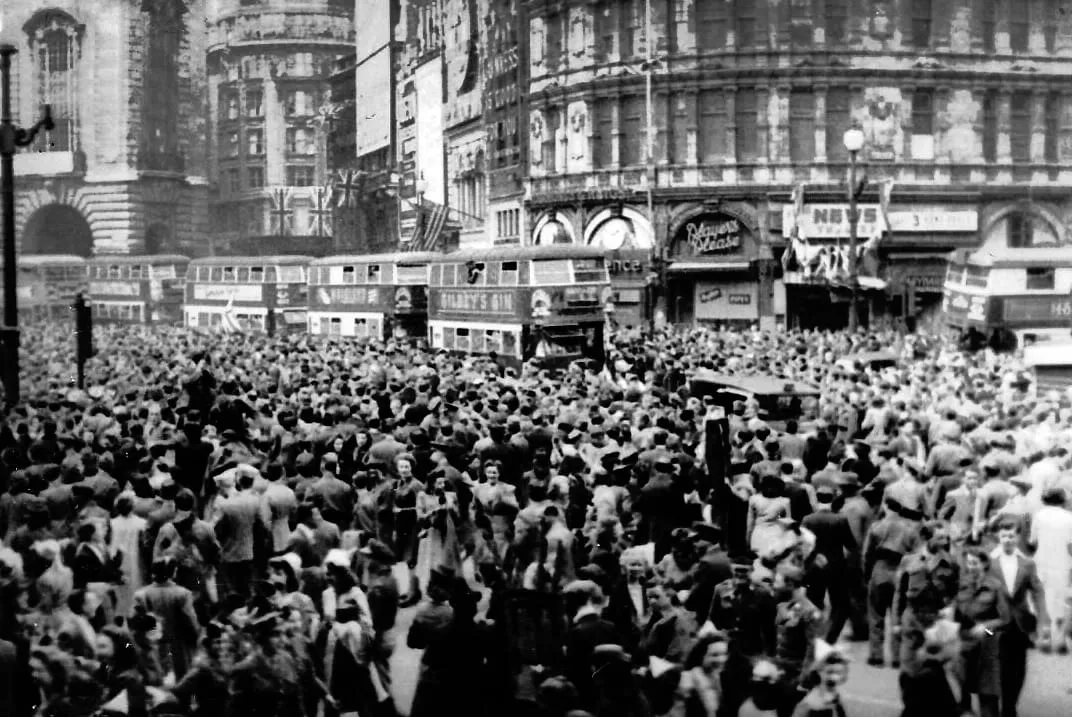
At 3 p.m. on Tuesday 8 May 1945 Winston Churchill sat down at the microphone in the Cabinet Room at 10 Downing Street and told the British people that the war with Germany was over. He reminded them that the day before, at Reims, General Alfred Jodl had signed the act of unconditional surrender of all German armed forces, and he added a phrase that millions of listeners remembered: hostilities would end officially at “one minute after midnight tonight”. That day crowds such as London, Paris, New York, Brussels and Copenhagen had never seen before poured into their streets. The day went down in history as Victory in Europe Day – VE Day, an abbreviation the press had been using since 1944.
Behind the rejoicing, however, lay many reservations. The war with Japan was still in full swing, there was still shooting in Prague and in Courland, and the Soviet Union would not celebrate victory until the following day. For the Poles, who had fought from the first to the last day of the war in Europe, 8 May was a particularly bitter day.
One minute after midnight
The act signed at Reims at 2.41 a.m. on 7 May obliged the German high command to order all forces under German control to cease operations at 11.01 p.m. Central European Time on 8 May. That was the hour Churchill had in mind: in Britain, which was then on double summer time, it corresponded to 12.01 a.m. on 9 May. Hence the phrase “one minute after midnight”, later repeated in many chronicles – accurate for London, but not for the Continent, where the guns were to fall silent before midnight on 8 May. In Moscow it was already 9 May by then, which became one of the sources of the difference between the dates of the commemorations in the East and the West.
The timing itself was a compromise. The Supreme Allied Commander in Western Europe, General Dwight Eisenhower, wanted the surrender to take effect as soon as possible, while the Germans played for time, hoping to move as many soldiers and refugees fleeing the Red Army to the west as they could in the space of a few dozen hours. From the outset the policy of Admiral Karl Dönitz, who after Hitler’s suicide had taken charge of what remained of the Reich, rested on partial surrenders to the Western Allies – such as the surrender at Lüneburg Heath on 4 May – and on resisting in the east for as long as possible.
The three allies agreed to announce the victory simultaneously on 8 May: Churchill in London at 3 p.m. British time, President Harry Truman in Washington at 9 a.m. Eastern Time, and Stalin in Moscow at the same moment. The plan did not survive contact with reality. At noon on 7 May Lutz Schwerin von Krosigk, the “Leading Minister” of Dönitz’s government at Flensburg, announced the surrender to the Germans on the radio. That same day the Associated Press correspondent Edward Kennedy, in defiance of an embargo imposed by Allied headquarters, sent out the news of the signing at Reims; within a few hours it was in newspapers all over the world, and headquarters withdrew Kennedy’s accreditation. On the evening of 7 May the British Ministry of Information, no longer able to keep the secret, announced that the next day would be Victory in Europe Day and a public holiday. Stalin, meanwhile, demanded that the surrender be signed a second time in Berlin, in the presence of representatives of all the great powers, and regarded the Reims document as merely a preliminary protocol; the Soviet announcement was to come only after this second signing.
London: “This is your victory”
The British had been celebrating since the evening of 7 May, but the real festivities came on the Tuesday. From the morning the crowds in central London grew ever denser: in Trafalgar Square, in Whitehall, at Piccadilly Circus and all along The Mall up to Buckingham Palace. People carried flags and rosettes in the national colours, climbed lamp posts and monuments and danced in the streets. By some estimates more than a million people took to the streets across the country. Despite the restrictions in force throughout the war, the government permitted bonfires, and in the evening St Paul’s Cathedral and other buildings were floodlit for the first time since 1939.
Churchill’s broadcast at 3 p.m. was short and businesslike. The Prime Minister gave an account of the surrender, paid tribute to the allies and recalled that Britain had fought Germany alone for a year. But he added a caveat: “We may allow ourselves a brief period of rejoicing; but let us not forget for a moment the toil and efforts that lie ahead.” Japan, he said, remained unsubdued, and the injuries she had inflicted on Britain, the United States and other countries called for justice. He ended with the cry: “Advance, Britannia! Long live the cause of freedom! God save the King!”
Churchill then went to the House of Commons, where he repeated the announcement, and the members walked to a service of thanksgiving at St Margaret’s, Westminster. Later the Prime Minister appeared on the balcony of the Ministry of Health in Whitehall and addressed the crowd: “God bless you all. This is your victory.” According to accounts, the crowd shouted back: “No – it is yours!” Churchill invited the Minister of Labour, Labour’s Ernest Bevin, onto the balcony to share the applause; Bevin replied that it was the Prime Minister’s day and led the crowd in singing “For He’s a Jolly Good Fellow”. Churchill spoke there again in the evening.
The centre of the celebrations, however, was Buckingham Palace. King George VI, Queen Elizabeth and their daughters – the nineteen-year-old Princess Elizabeth, in the uniform of the Auxiliary Territorial Service (ATS), in which she had been serving as a driver and mechanic since February 1945, and the fourteen-year-old Margaret – came out onto the balcony several times, eight times according to accounts; on one occasion Churchill joined them. Late in the evening, with their father’s permission, the two princesses slipped out of the palace escorted by officers and joined the crowd incognito, cheering beneath the windows of their own home – an episode that Elizabeth recalled years later as one of the most memorable nights of her life. At 9 p.m. the King broadcast to the nation, giving thanks to God for deliverance and calling on his listeners to remember the fallen.
Not everyone celebrated carefree. Many Britons had relatives in Japanese captivity or in the units fighting in Burma and the Pacific; for the families of the fallen and the victims of the bombing – including the most recent, the V-2 rockets that had still been falling on London at the end of March – it was a day of reflection. The country was weary, rationing was to last for years yet, and politics quickly returned to the agenda: the wartime coalition government broke up just over two weeks later, and in July the general election ended in victory for Clement Attlee’s Labour Party.
Paris, Washington, New York
In Paris, at 3 p.m., General Charles de Gaulle, head of the Provisional Government of the French Republic, spoke on the radio: “The war is won. Here is victory. It is the victory of the United Nations and the victory of France.” The bells of every church rang, and crowds filled the Champs-Élysées, the Place de la Concorde and the area around the Arc de Triomphe. For the French, whose country had been under occupation only a year earlier, a symbolic diplomatic success also counted: at Reims the French General François Sevez had signed the act as a witness, and at the second signing in Berlin General Jean de Lattre de Tassigny was to take his seat at the table. France was returning to the ranks of the victors.
In the French colonial empire the same day took on a wholly different meaning. In the Algerian town of Sétif a victory parade turned into a demonstration for independence; when the police tried to seize a green-and-white flag from the demonstrators, shots were fired, and Europeans were killed in the town and the surrounding area (about a hundred of them died). The French army and air force and settler militias responded with weeks of repression in the Sétif and Guelma region. The number of Algerian victims remains disputed: official French figures spoke of 1,000–1,500 killed, the Algerian authorities give 45,000, and historians most often estimate it at between several thousand and some fifteen thousand. These events are regarded as one of the starting points of the later Algerian War.
In the United States, 8 May was the 61st birthday of President Truman, who had taken office less than a month earlier, after Roosevelt’s death. At 9 a.m. he spoke on the radio from the White House: “This is a solemn but a glorious hour. My only wish is that Franklin D. Roosevelt had lived to witness this day.” Flags remained at half-mast until the end of the thirty days of mourning for the late President. Truman stressed that the victory was “only half won”: the West was free, but the East was still in bondage to Japan. He proclaimed Sunday 13 May a day of prayer and thanksgiving, and in a separate statement called on Japan to surrender unconditionally, assuring it that this did not mean “the extermination or enslavement of the Japanese people”. Government offices and munitions factories stayed at work – the President appealed for production not to be interrupted.
Even so, the Americans celebrated noisily. In New York’s Times Square crowds had already gathered on 7 May after the AP dispatch, and on 8 May they filled the district again; the press wrote of hundreds of thousands of people, while confetti and scraps of paper rained down from the windows of office blocks. Similar scenes were played out in Chicago, Los Angeles and San Francisco, where the founding conference of the United Nations had been in session since 25 April. In Canada, the celebrations in Halifax turned into riots and the looting of shops.
The East and the rest of Europe
The Soviet Union, which had suffered the greatest losses in the war against Germany, waited for the second signing. The act of surrender was signed in the Berlin district of Karlshorst late in the evening of 8 May, when in Moscow it was already the night of 8–9 May; that is why the Soviet victory announcement and the great celebrations in Red Square fell on 9 May, which became Victory Day in the USSR and the countries of the Eastern Bloc.
In many places in Europe 8 May did not yet bring an end to the fighting. In Prague the uprising was still going on, and German units were trying to break through to the west to avoid Soviet captivity; in Courland an army group cut off from the rest surrendered; on Bornholm, in the Channel Islands and in Norway German garrisons were only preparing to lay down their arms. In the Netherlands the joy of liberation was marred by the shooting in Dam Square in Amsterdam. In Germany, where millions of people were camping in the ruins and the roads were full of refugees, prisoners of war and forced labourers, most Germans experienced the day of surrender as a defeat and a time of fear for the future, whereas for concentration camp prisoners, prisoners of war and millions of forced labourers – among them more than a million Poles – it meant liberation.
Poland: victory without freedom
Poland had been the first country to offer armed resistance to Germany, and Polish soldiers fought until the last days of the war on every European front: General Władysław Anders’s II Corps in Italy; General Stanisław Maczek’s 1st Armoured Division in northern Germany, where on 6 May it accepted the surrender of the fortress of Wilhelmshaven; airmen in the RAF and sailors in the Atlantic; and in the east the soldiers of the Polish 1st and 2nd Armies – units of the 1st Army took part in the storming of Berlin and hoisted the white-and-red flag on the Victory Column. Even so, on 8 May the Poles’ mood was far from euphoric.
The country’s future had largely been decided by the Yalta Conference: an eastern border on the Curzon Line and a government to be created by “reorganising” the Moscow-controlled Provisional Government of the Republic of Poland. The Polish government-in-exile in London, with President Władysław Raczkiewicz and Prime Minister Tomasz Arciszewski, was still recognised by Britain and the United States, but it was losing its influence on the course of events. Poland had no representative at the San Francisco conference, because the great powers could not agree on which government represented it.
The most painful symbol of this situation was the fate of the leaders of the Polish Underground State. At the end of March 1945 the NKVD had treacherously arrested sixteen of them at Pruszków – among them the commander of the Home Army, General Leopold Okulicki, the Government Delegate for Poland, Jan Stanisław Jankowski, and members of the Council of National Unity – who had supposedly been invited to talks. For several weeks Moscow denied knowing what had become of them; only at the beginning of May, during the San Francisco conference, did Vyacheslav Molotov admit that they had been arrested, and on 5 May the TASS agency confirmed it, accusing them of “diversionary activity” behind the lines of the Red Army. On victory day they were sitting in the Lubyanka prison, awaiting the show Trial of the Sixteen, which took place in June.
In the devastated and depopulated country the arrests of underground soldiers went on, and no one was yet certain about the future of either the eastern or the western territories. The authorities in Warsaw organised celebrations: on 8 May the Council of Ministers, with the chairman of the State National Council, Bolesław Bierut, taking part, decided to establish a victory holiday, to be celebrated from then on on 9 May, in line with the Soviet calendar. Among the émigrés and the soldiers of the Polish Armed Forces in the West, however, the prevailing feeling was that the war, which had begun in defence of Poland’s independence, was ending without that independence being regained. Many of them never returned home.
A war that went on
Victory in Europe Day was not the end of the Second World War. On Okinawa one of the bloodiest battles of the Pacific War was still being fought, and the American ships around the island were fending off kamikaze attacks; in Burma the British had only just entered Rangoon, and American Superfortresses were burning Japanese cities. The United States and Britain began moving troops and aircraft from Europe to the Far East, and the Soviet Union – in keeping with its undertaking at Yalta – was preparing to enter the war against Japan within three months of Germany’s surrender. The fighting did not end until August, and Japan’s formal surrender came on 2 September 1945.
Europe emerged from the war in ruins: tens of millions dead, millions of displaced persons and refugees, cities and economies destroyed. Germany was divided into zones of occupation, and the line on which the armies of the Western Allies and the Red Army had met – as on the Elbe in April – soon began to mark the border between two blocs. The joy of 8 May was real and well deserved, but within weeks the allies were already quarrelling over Poland, Trieste, the Balkans and the future of Germany. Victory Day closed one war and opened an era in which half the continent would remain under Moscow’s rule for many decades.
Sources
Meanwhile
(04)Elsewhere, within a week.
- 8 May 1945 · Eastern FrontThe surrender at KarlshorstOn 8 May 1945 in Berlin-Karlshorst, Keitel, Friedeburg and Stumpff signed Germany's final act of unconditional surrender before Zhukov and Tedder.
- 8 May 1945 · Central and Eastern EuropeThe surrender of the Tiso governmentOn 8 May 1945, at Kremsmünster in Austria, Prime Minister Štefan Tiso's fugitive government of the Slovak Republic submitted to the US XX Corps.
- 8 May 1945 · PacificThe division of Indochina at the 16th parallelOn 8 May 1945 in San Francisco the US assured France it did not dispute French sovereignty over Indochina. The 16th-parallel division was agreed in July.
- 7 May 1945 · Western FrontThe surrender at ReimsAt 2.41 a.m. on 7 May 1945, at Eisenhower's headquarters in Reims, General Alfred Jodl signed the unconditional surrender of all German armed forces.
Related events
(04)The same battle, people or subject.
- 28 June 1945 · PolandThe Provisional Government of National UnityOn 28 June 1945 the Provisional Government of National Unity was formed in Warsaw under Osóbka-Morawski, with Gomułka and Mikołajczyk as deputies.
- 4 February 1945 · DiplomacyThe Yalta ConferenceOn 4–11 February 1945 at Yalta Roosevelt, Churchill and Stalin agreed on the occupation of Germany, Poland’s borders and government, UN rules and war on Japan.
- 18 June 1945 · PolandThe Trial of the SixteenOn 18–21 June 1945 a Soviet military court in Moscow tried the leaders of the Polish Underground State, seized by deceit, including Okulicki and Jankowski.
- 5 July 1945 · PolandThe powers recognise the Provisional Government of National UnityOn 5 July 1945 the US and Britain recognised the new Polish government in Warsaw and withdrew recognition from the government-in-exile in London.