United Kingdom
Adrian Carton de Wiart
Head of the British Military Mission to Poland (1919–1924, 1939), commander of the force at Namsos (1940), Churchill's representative in China (1943–1947)
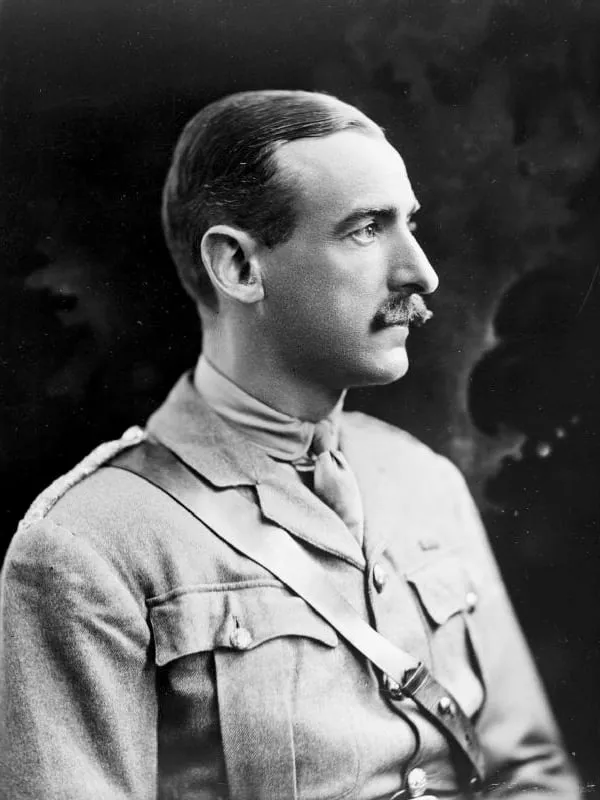
- Born:
- 5 May 1880, Brussels (Belgium)
- Died:
- 5 June 1963, Killinardrish, County Cork (Ireland)
- Author:
- Łukasz
- Photo:
- Henry Walter Barnett, domena publiczna, Wikimedia Commons

Sir Adrian Carton de Wiart was one of the most remarkable soldiers of the British Army in the first half of the 20th century. He fought in three wars, lost his left eye and his left hand, survived two air crashes and two years as a prisoner of war. He holds a special place as a man bound up with Poland: from 1919 to 1924 he headed the British military mission in Warsaw, during the Polish–Soviet War he was one of the few Britons who genuinely supported the Poles, he spent fifteen interwar years living in Polesie, and in the summer of 1939 he again took charge of the British military mission to Poland and was with it during the September Campaign. In April 1940 he commanded the Anglo-French expedition to Namsos, which was meant to recapture the Norwegian city of Trondheim from the Germans. With a black patch over his eye and an empty sleeve he looked, as his biographer in the British national biographical dictionary put it, “like an elegant pirate”, and he became a legendary figure.
Brussels, Cairo, Oxford
Adrian Paul Ghislain Carton de Wiart was born on 5 May 1880 in Brussels into a wealthy Belgian aristocratic family. The family had Belgian and Irish roots; his father, Léon, was a lawyer and judge. A rumour circulated in Brussels that the boy was an illegitimate son of King Leopold II, but nothing supports it. When he was six his parents divorced, and his father moved with his son to Cairo, where he practised in the Mixed Courts and sat on company boards. From 1891 he was educated in England at a Catholic boarding school founded by Cardinal John Henry Newman, and then studied at Balliol College, Oxford.
He never finished his degree. When the Second Boer War broke out, he enlisted under an assumed name, “Trooper Carton”, giving a false age, in a volunteer mounted unit, Paget’s Horse. In South Africa he was seriously wounded in the stomach and groin and sent home. Carton de Wiart returned to South Africa, and in September 1901 he received a regular commission in the 4th Dragoon Guards. He served in India and South Africa and was aide-de-camp to the commander-in-chief of British forces in South Africa; he later called the years before 1914 the best of his life, filled with polo, hunting and travel. In 1907, after eight years of service in the British Army, he became a British subject. A year later he married an Austrian countess, Friederike Fugger von Babenhausen, with whom he had two daughters.
The First World War
The outbreak of war found him on his way to British Somaliland, where fighting was going on against the rebels of Mohammed Abdullah Hassan, whom the British called the “Mad Mullah”. In November 1914, in an attack on the fort at Shimber Berris, he was shot twice in the face and lost his left eye and part of an ear. He was awarded the Distinguished Service Order, and in 1915, wearing an eye patch, he went to the Western Front. At the Second Battle of Ypres in the spring of 1915 German shellfire shattered his left hand. According to his memoirs, he tore off two of his fingers himself when a doctor refused to amputate them. Later that year a surgeon removed the whole hand.
Despite his injuries he returned to the front and commanded three infantry battalions in turn, and then a brigade. On the night of 2–3 July 1916, in the first days of the Battle of the Somme, he commanded the 8th Battalion of the Gloucestershire Regiment at La Boisselle. When the commanders of three neighbouring battalions had been killed or wounded, he took over their men as well and held the captured ground under the heaviest fire. For this he received the Victoria Cross, the highest British award for gallantry in the face of the enemy. In the years that followed he was wounded many more times – on the Somme, at Passchendaele, at Cambrai and at Arras – once with a bullet in his skull. In January 1917 he was given the temporary rank of brigadier general. Years later he wrote of the war the sentence that became his most famous quotation: “Frankly I had enjoyed the war.”
In Poland, 1919–1939
After the armistice Carton de Wiart was sent to the reborn Poland. At the beginning of 1919 he joined an inter-Allied mission that tried to bring about a ceasefire in the Polish–Ukrainian War over Lwów (Lviv) and Eastern Galicia, and held talks with representatives of the West Ukrainian People’s Republic. The talks came to nothing. Soon afterwards he became head of the British military mission in Warsaw. He met Józef Piłsudski, with whom he became friends, and Ignacy Jan Paderewski. He quickly came to support the Polish case, including over Eastern Galicia, which led to sharp disputes with the Prime Minister, David Lloyd George, who was unsympathetic to Poland. He found more understanding with the Secretary of State for War, Winston Churchill, to whom he passed on Piłsudski’s prediction that General Anton Denikin’s offensive on Moscow would fail. Churchill, against Lloyd George’s wishes, sent Poland some equipment.
During the Polish–Soviet War Carton de Wiart acted as liaison between the British War Office and the Polish command. He helped the Poles to obtain weapons in many ways, and the historian Norman Davies wrote that he was involved in smuggling arms from Hungary in requisitioned sleeping cars. In August 1920, when the Bolsheviks stood before Warsaw, he was at the front. According to his memoirs, a detachment of Red cavalry attacked his train and he drove the attackers off with his revolver while standing on the footplate of the locomotive. The nuncio Achille Ratti, the future Pope Pius XI, consulted him about evacuating the diplomatic corps. For his services he received the Silver Cross of the Virtuti Militari and the Cross of Valour.
Once the war was over the mission lost its purpose and was wound up in 1924. Carton de Wiart, who had retired at the end of 1923 with the honorary rank of major general, stayed in Poland. Prince Karol Mikołaj Radziwiłł (PL) let him have the Prostyń estate among the marshes of Polesie. He spent fifteen years there, hunting almost every day. Yet in Poland he was not merely a sportsman: he kept up contacts in the Polish Army and, according to some studies, passed information to British intelligence.
September 1939
When Britain gave Poland a guarantee and the two states then concluded an alliance, Carton de Wiart was recalled to service in the summer of 1939 and placed at the head of the British military mission to Poland. His chief of staff was Lieutenant Colonel Colin Gubbins, later head of the British Special Operations Executive (SOE). At the end of August he talked with the Commander-in-Chief, Marshal Edward Rydz-Śmigły. According to his memoirs, he advised him to pull his forces back behind the Vistula rather than defend the entire border, but failed to persuade him, and he judged the Marshal severely.
After Germany invaded Poland, the mission was evacuated from Warsaw together with the Polish government and the High Command. After the Red Army marched in on 17 September, Carton de Wiart met Rydz-Śmigły near the Romanian border and, as he wrote, offered to stay with the Marshal if he would remain in the country and fight. He later described the Commander-in-Chief’s decision to cross into Romania as a denial of everything he knew about the Poles. He himself crossed into Romania, avoided internment and got out by air on a false passport in the days when Prime Minister Armand Călinescu was assassinated in Bucharest. The Soviets occupied Polesie and took everything he had there: his guns, fishing rods, clothes and furniture. “But they could not take my memories,” he wrote.
Namsos, 1940
In the autumn of 1939 Carton de Wiart returned to active service as an acting major general and took over the 61st Infantry Division in the English Midlands. On 13 April 1940, four days after the German invasion of Norway, he was given command of Mauriceforce, which was to land at Namsos and strike at Trondheim from the north, while the fleet attacked the city from the fjord and a second force advanced from the south via Åndalsnes. On 15 April he flew into Namsos in a flying boat. As it landed on the water a German aircraft attacked it, and his only staff officer was wounded.
The general had no staff, no artillery, no transport, no skis and no air cover. He had three battalions of the British Territorial Army and, from 20 April, French Chasseurs Alpins as well. He showed great energy: he moved his troops by night in destroyers, dispersed them over the hills before dawn and within three days had brought them to Steinkjer, about a hundred kilometres from Trondheim. But he could not change the fact that the Luftwaffe commanded the air. On 20 April German bombers burnt Namsos, and the next day the general reported to London that he saw no chance of any operations until enemy air activity was curtailed. The attack from the fjord was called off, which he learnt of only belatedly. On 21 and 22 April his troops, shelled by German warships and attacked by units landed in their rear, were thrown back at Vist, and Steinkjer went up in flames.
Carton de Wiart recommended withdrawal, but for political reasons he was ordered to hold on. After London’s decision of 26–27 April to evacuate central Norway, and after a series of orders and counter-orders, ships under Louis Mountbatten took his troops off from burning Namsos on the night of 2–3 May. On 5 May 1940, his sixtieth birthday, he stepped ashore at Scapa Flow. The evacuation itself was carried out efficiently, but the Norwegian campaign as a whole was a defeat for Britain, which a few days later cost Neville Chamberlain the premiership.
Captivity in Italy
On his return Carton de Wiart again took over the 61st Division, now moved to Northern Ireland, but he was soon judged too old to command a division. In April 1941 he was to set up a British military mission in Yugoslavia, which Germany was just then attacking. The Wellington bomber in which he was flying to Cairo via Malta lost both engines and came down in the sea off the Libyan coast, and the general, who swam ashore, was taken prisoner by the Italians.
He was held first in a villa near Sulmona and then at the Castello di Vincigliata near Florence, a special camp for senior officers, where Generals Richard O’Connor and Philip Neame, captured in North Africa, were also held. He took part in several escape attempts, including digging a tunnel, which took seven months. After one of them he spent eight days on the run disguised as an Italian peasant, although he spoke no Italian. In August 1943, when the new Italian government was secretly looking for a way out of the war, he was taken from the camp to Rome and sent with General Giacomo Zanussi to Lisbon as an intermediary in the negotiations with the Allies that led to Italy’s surrender. On 28 August 1943 he was back in England.
In China
A few weeks later Churchill sent him to China as his personal representative to Generalissimo Chiang Kai-shek. On the way Carton de Wiart attended the Cairo Conference in November 1943, and in December he reached China’s wartime capital, Chongqing. For three years he was one of the few who managed to work with the difficult American commander in China, General Joseph Stilwell. He admired the industriousness of the Chinese and could not abide the communists. According to his memoirs, he once interrupted a speech by Mao Zedong to accuse the communists of husbanding their strength instead of fighting the Japanese. He kept telling the British Cabinet that there was no alternative to Chiang Kai-shek. In 1945 he was knighted (KBE), and after Japan’s capitulation he was present at the acceptance of the surrender in Singapore. In October 1947 he retired with the honorary rank of lieutenant general.
Last years and legend
After the death of his first wife in 1949 he married, in 1951, Joan Sutherland, 23 years his junior, and settled at Aghinagh House in County Cork in Ireland. In 1950 he published his memoirs, Happy Odyssey, with a foreword by Churchill; a Polish edition appeared in 2016 under the title Moja odyseja. He died on 5 June 1963 at the age of 83 and was buried beside his home.
Carton de Wiart was not a great commander. The most important operation he commanded independently, the Namsos expedition, ended in failure, though not through any fault of his: he was given troops who were unprepared and lacked air support, and his reports of German air superiority were accurate. He is remembered as the embodiment of courage and as a soldier of the old school who believed that force could not be eliminated from politics. He is thought to have been the model for Brigadier Ritchie-Hook in Evelyn Waugh’s war trilogy. In Poland he is remembered above all as a friend of Piłsudski and an ally of 1919–1920 and 1939, and in 2022 the Swedish band Sabaton recorded a song about him, “The Unkillable Soldier”.
Sources
Commanded in battles
(01)Often appears with
People who appear in the same events.