- Category:
- Military operations
- Front:
- Eastern Front
- Date:
- 16 April 1945
- Author:
- Łukasz
- Battle:
- The Battle of Berlin
- Tags:
- Red Army, Georgy Zhukov, Ivan Konev, Poland
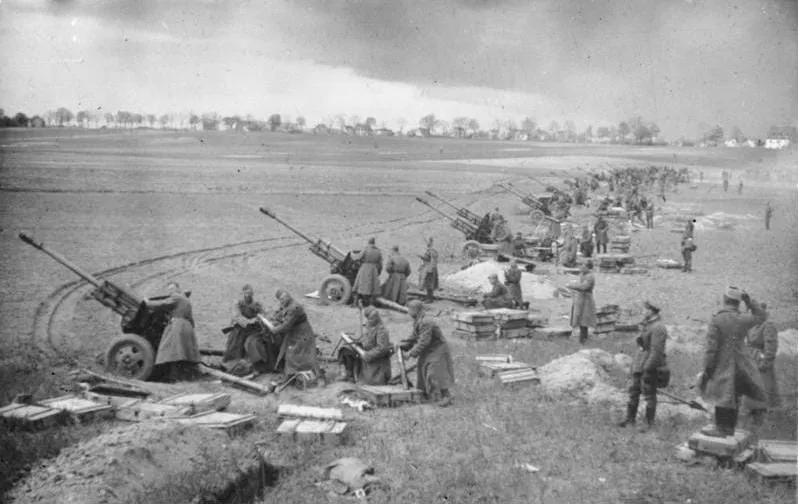
On Monday 16 April 1945, at five in the morning Moscow time, long before dawn, the darkness over the Oder valley was torn apart by the fire of several thousand guns, mortars and rocket launchers. From the bridgehead at Küstrin (Kostrzyn), 70–80 kilometres from Berlin, the 1st Belorussian Front of Marshal Georgy Zhukov began its attack. A little later, some hundred kilometres to the south, the troops of Marshal Ivan Konev’s 1st Ukrainian Front began crossing the Lusatian Neisse. The Berlin offensive had begun – the Red Army’s last great offensive in Europe, in which two armies of the Polish People’s Army also took part.
War chronologies record that the battle of the Seelow Heights and the battle on the Oder and the Neisse began on this day. Both names describe the first stage of the same operation: the breaking of the German defences on the two rivers on 16–19 April. The heaviest fighting took place on the Seelow Heights, the edge of the plateau above the marshy Oder valley, which the Germans called the “gateway to Berlin”. The first day of the offensive did not bring Zhukov the breakthrough he had counted on. Konev advanced faster – and that decided the further course of the battle for the capital of the Reich.
The race for Berlin
Ever since Soviet troops seized a bridgehead on the Oder on 31 January 1945, the Red Army had been less than a hundred kilometres from Berlin. The offensive could not begin at once, however. Zhukov’s and Konev’s troops were exhausted by the advance from the Vistula, their supply lines were overstretched, and on their northern flanks strong German groupings remained in Pomerania and East Prussia. In February and March the Red Army and the Polish 1st Army cleared Pomerania in the East Pomeranian offensive; Gdańsk (Danzig) fell on 30 March and Königsberg on 9 April. Only then could the 2nd Belorussian Front of Marshal Konstantin Rokossovsky hurriedly shift to the lower Oder, from Stettin (Szczecin) to the sea, and cover Zhukov’s right flank.
The plan of the operation was discussed in Moscow at the beginning of April. On 1 April Joseph Stalin received both marshals at the Kremlin. According to the memoirs of Konev and Shtemenko, a report was read out at the meeting – in fact untrue – that the Western Allies were preparing their own drive on Berlin. Stalin’s question as to who would take Berlin, “we or the Allies”, was rhetorical. It was already known that General Dwight Eisenhower had given up the advance on Berlin and had informed Stalin of this on 28 March, but Moscow did not trust these assurances. Stalin set the start of the offensive for 16 April and allowed two weeks to carry it out.
The main task – the capture of the city – was given to the 1st Belorussian Front. Zhukov was to strike due west from the Küstrin bridgehead, along the road through Seelow and Müncheberg, and then encircle Berlin from the north and the south. The 1st Ukrainian Front was to force the Lusatian Neisse, destroy the German forces south of Berlin and reach the Elbe. Stalin settled the dispute over the boundary between the fronts in a way both marshals remembered: on the map he drew the dividing line only as far as Lübben on the Spree, some 60 kilometres south-east of Berlin, and did not continue it. Konev took this as unofficial permission to turn his tank armies on the Reich capital if conditions were favourable. The rivalry between the two commanders, whom Stalin readily played off against each other, was to become one of the driving forces of the operation – and one of the reasons for its high cost.
In the first half of April the Soviet forces carried out one of the largest regroupings of the war. Thousands of guns, millions of shells, and crossing and bridging equipment were brought up to the Oder and the Neisse. According to Soviet figures, the three fronts – the 1st and 2nd Belorussian and the 1st Ukrainian – numbered some 2.5 million men, more than 6,200 tanks and self-propelled guns, about 41,600 guns and mortars, and 7,500 aircraft. This total included the soldiers of the Polish 1st and 2nd Armies – according to Polish studies, between about 155,000 and 180,000 men, depending on the method of counting.
The defence on the Oder
Facing Zhukov was Army Group Vistula, commanded since 20 March by Colonel General Gotthard Heinrici. Since his appointment Heinrici had correctly foreseen that the main blow would come from the Küstrin bridgehead along the road to Berlin. This sector was held by the 9th Army of General Theodor Busse, and to its north, on the lower Oder, by the 3rd Panzer Army of General Hasso von Manteuffel. On the Lusatian Neisse, Konev was opposed by the 4th Panzer Army, part of Field Marshal Ferdinand Schörner’s Army Group Centre.
The German forces had been badly depleted. Front-line divisions were filled out with recruits, sailors, Luftwaffe ground personnel, and Volkssturm and Hitler Youth units. Fuel, artillery ammunition and tanks were in short supply, and the air force could fly only a fraction of the Soviet sorties. Estimates of the strength of the forces defending the approaches to Berlin vary considerably: Soviet historiography spoke of about a million men, while Western historians give markedly lower figures. In the Seelow sector alone the 9th Army had, according to various estimates, between about 90,000 and 110,000 men.
Heinrici decided to make use of the terrain. Beyond the Oder valley – the flat, waterlogged Oderbruch plain, criss-crossed by ditches and canals and further saturated by water released from reservoirs upstream – rose the edge of the plateau, several dozen metres high, with the small town of Seelow. Along it ran the second, main line of defence; further west lay further belts of fortifications, as far as the last position, known as the Wotan Line, some fifteen to twenty-odd kilometres behind the front. The most important section of the heights was held by the LVI Panzer Corps of General Helmuth Weidling, who a few days later was to become the last commandant of Berlin.
The key element of Heinrici’s plan was to pull most of the infantry back from the first line to the second at the last moment before the Soviet artillery preparation. He had used the same method earlier outside Moscow and in Ukraine. The signal came from Soviet reconnaissance activity: on 14 and 15 April Soviet battalions carried out reconnaissance in force, and prisoners taken by the Germans reportedly gave away the date of the attack. During the night of 15/16 April Busse, on Heinrici’s orders, withdrew his troops from the forward trenches. The Soviet barrage fell to a large extent on empty positions.
On 15 April Adolf Hitler issued an order of the day to the soldiers of the Eastern Front. In it he declared that the “Bolshevik” would attack for the last time and bleed to death before the capital of the Reich, threatened death to anyone who gave the order to retreat, and ended with the slogan: “Berlin stays German, Vienna will be German again, and Europe will never be Russian.” Vienna had already been in Soviet hands for two days. Four days earlier President Franklin D. Roosevelt had died, which in Hitler’s bunker was briefly taken as a sign that the coalition of the Reich’s enemies was about to break up.
Searchlights over the Oderbruch
Zhukov watched the start of the attack from the command post of General Vasily Chuikov’s 8th Guards Army (PL) on a hill near the village of Reitwein. In the first echelon on the Küstrin bridgehead stood, from the north, the 47th Army, the 3rd and the 5th Shock Armies – the latter under General Nikolai Berzarin – and Chuikov’s 8th Guards Army; the last two faced the strongest sector of the defence, where the road to Berlin climbs the heights. Behind them waited General Mikhail Katukov’s 1st Guards Tank Army and General Semyon Bogdanov’s 2nd Guards Tank Army, which were to pour into the gap once the defences had been broken.
The artillery preparation lasted about half an hour, and its density – according to Soviet figures, more than 250 barrels per kilometre of front on the main axis – was among the highest of the entire war. Night bombers struck as well. Then, still in darkness, 143 anti-aircraft searchlights, placed about 200 metres apart, were switched on. Zhukov’s idea was to blind the defenders and light the way for the advancing infantry and tanks. The effect was largely the opposite. The smoke and dust thrown up by the explosions reflected the light, creating a bright wall in front of the attackers that made it hard for them to find their way, while silhouetting soldiers and vehicles against the darkness. Assessments of the idea remain divided: in his report to Stalin and in his memoirs Zhukov presented the searchlights as effective; many participants and historians regard them as a costly mistake.
The infantry quickly crossed the abandoned first line, but in the sodden Oderbruch the attack lost momentum. Tanks and guns bogged down in drainage ditches and on flooded meadows, and as the Soviet units approached the foot of the heights they came under fire from the second line – German artillery, anti-tank guns and anti-aircraft “eighty-eights” set up to fire over open sights. By late morning it was clear that the infantry would not break through the main position in time.
Zhukov, irritated by the slow progress, took a step that ran counter to his own plan: in the afternoon he committed both tank armies, although they were not supposed to go into action until the defences had been broken. On the narrow bridgehead, on the few roads leading across the marshy valley, Katukov’s and Bogdanov’s tanks became entangled with the columns of infantry, artillery and supply trains of the 8th Guards Army. Huge traffic jams formed, and the tanks climbing the slopes suffered heavy losses. By evening Zhukov’s troops had advanced a few kilometres in some sectors, and one corps of the 3rd Shock Army – according to some studies – as much as about 8 kilometres, but the main line of defence on the Seelow Heights remained unbroken.
That evening Zhukov had to report to Stalin that the attack was not going to plan. According to his memoirs, Stalin received coldly the news that the tank armies had gone into battle earlier than planned and asked whether Zhukov was sure he would break through the defences on 17 April. At the same time he made it clear that he was considering sending Konev’s tank armies against Berlin.
Crossing the Neisse
In the south the day went quite differently. Konev had no bridgeheads on the west bank of the Lusatian Neisse, so he had to force the river under fire. He relied on surprise and concealment: after the artillery preparation and air strikes, aircraft and chemical troops laid a smokescreen along a stretch many times longer than the attack sector, so that the Germans could not identify where the main blows would fall. The high west bank of the river, thick with firing positions, vanished in the smoke. The first battalions crossed in boats, on rafts and by swimming, and within a few hours the sappers had built dozens of ferry crossings and bridges, over which the tanks crossed.
The main blow of the 1st Ukrainian Front was delivered between Forst and Bad Muskau (Mużaków) by the 3rd and 5th Guards Armies and the 13th Army. By the evening of 16 April Konev’s troops had broken through the first German defensive belt on a front of about 26 kilometres and to a depth of up to 13 kilometres, and in several places had reached the second belt, which ran through Cottbus. On the very first day the leading corps of General Pavel Rybalko’s 3rd Guards Tank Army and General Dmitry Lelyushenko’s 4th Guards Tank Army went into action. On 17 April both armies broke through the second defensive belt and reached the Spree.
This success proved decisive. On the evening of 17 April Konev telephoned Stalin and proposed that his tank armies, instead of heading west towards the Elbe, should swing north and strike at Berlin from the south, through Zossen, the headquarters of the Army High Command (OKH). Stalin agreed. From that moment not one but two fronts were competing to take the capital of the Reich.
The Poles on the Oder and the Neisse
Two Polish armies fought in the Berlin offensive – each as part of a different front and on a different axis.
The Polish 1st Army of Major General Stanisław Popławski, numbering some 78,500 men according to Polish figures, joined the 1st Belorussian Front after the fighting in Pomerania. Between 8 and 13 April its divisions marched some 200 kilometres by night from the Baltic and concentrated in the woods near Stare Łysogórki. The army operated on the right, northern flank of the main grouping, between the Soviet 61st and 47th Armies, in a sector where the Oder had not previously been crossed. During the night of 14/15 April part of its forces crossed to a small bridgehead held by the 47th Army near Gozdowice.
On 16 April, after an artillery preparation, sub-units of the 1st and 2nd Infantry Divisions crossed the Oder in boats and on ferries near Siekierki and Stare Łysogórki, while the 3rd Division, with part of the 2nd and supported by the 4th Heavy Tank Regiment, attacked from the Gozdowice bridgehead. On the west bank, in a floodplain cut by canals, the German 606th Infantry Division was defending. By evening the Polish divisions had seized a bridgehead several kilometres wide. Over the following days, with losses mounting with every kilometre, they broke through one position after another and on 19 April crossed the Old Oder. A reminder of this fighting is the war cemetery at Siekierki, one of the largest cemeteries of soldiers of the Polish People’s Army in Poland, where, according to commemorative records, nearly 2,000 of the fallen are buried.
The Polish 2nd Army of Major General Karol Świerczewski (he was promoted to Lieutenant General only in May 1945) fought as part of the 1st Ukrainian Front, on Konev’s left flank. During the night of 10/11 April it took up positions on the Lusatian Neisse south of Bad Muskau. Reinforced by the 1st Armoured Corps (PL), it was to force the river near Rothenburg and advance through Niesky on Dresden, at the same time covering the front’s main forces from the south. On 16 April its 8th and 9th Infantry Divisions crossed the Neisse and became embroiled in heavy fighting on successive lines of defence. Polish reconnaissance underestimated the German forces in the area of Bautzen and Görlitz, which only a few days later was to have tragic consequences.
The breakthrough
On 17 April Zhukov renewed the attack after a fresh artillery preparation and massed air strikes. That day Chuikov’s 8th Guards Army took the ruins of the town of Seelow, but the German defence on the heights still held. In the evening the 5th Shock Army and Bogdanov’s tanks broke through the second German line. Heinrici threw his last reserves into counter-attacks, including the SS panzergrenadier divisions Nordland and Nederland, made up largely of volunteers from Scandinavia and the Netherlands. On 18 April Soviet troops outflanked the heights from the north, through Wriezen, and reached the third line of defence.
On 19 April, the fourth day of the battle, Zhukov’s front broke through the last position on the Berlin axis. The German 9th Army split into several parts. Its main forces, cut off south of Berlin in the forests between Frankfurt an der Oder and Guben, were soon to be encircled by the troops of both fronts and bled to death in the Battle of Halbe. The road to Berlin lay open. The city was now to be defended only by the shattered remnants of divisions, the Volkssturm, and Hitler Youth, police and anti-aircraft units.
The cost of the breakthrough was very high. Estimates of Soviet losses in the battle of the Seelow Heights alone range from fewer than 10,000 to more than 30,000 killed; including the wounded, the figure runs into tens of thousands. Some historians, following Antony Beevor and Earl Ziemke, attribute these losses to Zhukov’s haste: under pressure from his rivalry with Konev, he threw his troops into frontal assaults and committed the tank armies to a bridgehead that was too narrow. After the war critics also accused him of having been able to bypass the heights by shifting the weight of the attack to Konev’s front. Zhukov’s defenders point out that the 1st Belorussian Front’s sector was very narrow and that Stalin had set impossibly tight deadlines. German losses in those days were also very heavy, and the Oder sector was held by units that could no longer be replaced.
Significance
The offensive launched on 16 April was the Red Army’s last great operation in Europe, and it decided the fate of Berlin. The first day showed both the strength and the weaknesses of the Soviet war machine: an overwhelming superiority in artillery and tanks, but also a readiness to pay for speed with soldiers’ lives. Heinrici managed to hold up Zhukov for three days, but in the face of the enemy’s superiority and Konev’s progress on the Neisse he could not stop the offensive. Within the next week the leading units of both fronts reached the outskirts of the capital and closed the ring around it, and on 25 April Konev’s soldiers met the Americans on the Elbe. Berlin surrendered on 2 May, and a few days later the Third Reich surrendered.
The fighting that began on 16 April holds a special place in Polish memory of the war. The crossing of the Oder at Siekierki and Gozdowice, followed by the part played by 1st Army soldiers in the storming of Berlin, became one of the pillars of the legend of the Polish People’s Army in communist Poland. The 2nd Army’s battles on the Neisse and at Bautzen – costly, and for years presented selectively, with the command errors left out – remained in the shadow of Berlin in that memory. For the soldiers of both armies, most of them conscripts, many from the former eastern borderlands and many previously deported deep into the USSR, these were the bloodiest days of the war. Post-war narratives linked them with the border on the Oder and the Neisse, which soon became Poland’s western frontier.
Sources
Meanwhile
(04)Elsewhere, within a week.
- 14 April 1945 · PacificThe Tokyo raid of 13–14 AprilOn the night of 13/14 April 1945 over 300 B-29s burned some 30 km² of northern Tokyo, killing about 2,500. On 15/16 April Kawasaki and Yokohama burned.
- 18 April 1945 · PacificThe death of Ernie PyleOn 18 April 1945 Ernie Pyle, America's most popular war reporter, was killed by a Japanese machine-gun burst on the island of Ie Shima off Okinawa.
- 13 April 1945 · Western FrontThe Gardelegen massacreOn 13 April 1945, near Gardelegen in the Altmark, Germans burned and shot 1,016 concentration camp prisoners evacuated ahead of the front in a barn.
- 19 April 1945 · Western FrontSwitzerland closes its borderFrom 19 April 1945 Switzerland closed its border with the Reich and Italy, leaving 11 crossings open. About 50,000 refugees came in before the war ended.
Related events
(04)The same battle, people or subject.
- 21 April 1945 · Eastern FrontThe storming of BerlinOn 21 April 1945 Zhukov's troops broke into the outskirts of Berlin as Soviet artillery shelled the city. The battle for the Reich capital had begun.
- 24 April 1945 · Eastern FrontThe encirclement of BerlinOn 24 April 1945 Zhukov's and Konev's troops met south-east of Berlin, and on 25 April they closed the ring around the capital of the Reich.
- 2 May 1945 · Eastern FrontThe surrender of BerlinOn 2 May 1945 General Helmuth Weidling surrendered Berlin to General Chuikov and ordered the garrison to lay down arms. Krebs's talks the day before had failed.
- 2 May 1945 · Eastern FrontThe flag over the ReichstagOn 2 May 1945 the German garrison of the Reichstag surrendered. The red banner had flown on the roof since 30 April; Khaldei's famous photograph was staged.