Germany
Helmuth Weidling
Commander of the 86th Infantry Division (1942–1943), XLI Panzer Corps (1943–1945) and LVI Panzer Corps (1945), commandant of the Berlin Defence Area (23 April – 2 May 1945)
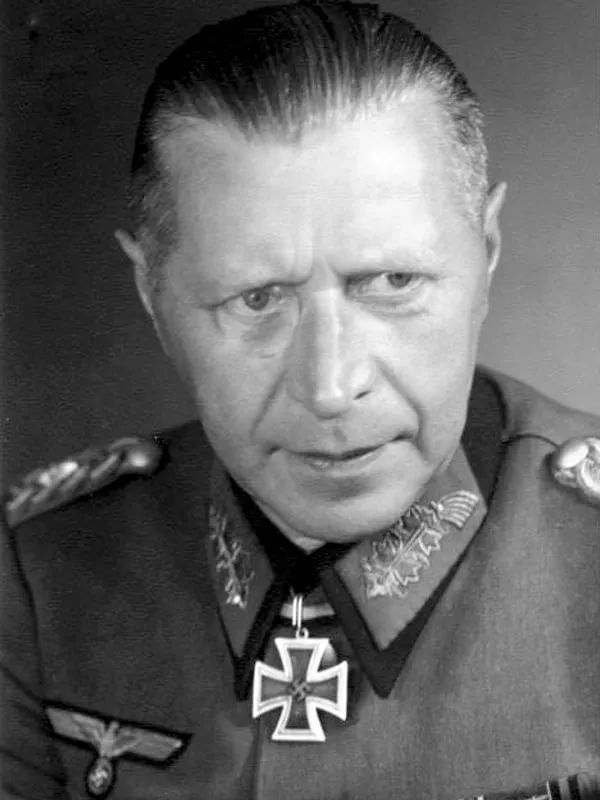
- Born:
- 2 November 1891, Halberstadt (Province of Saxony, German Empire)
- Died:
- 17 November 1955, Vladimir (USSR)
- Author:
- Łukasz
- Photo:
- autor nieznany, CC BY-SA 3.0 DE, Wikimedia Commons

Helmuth Weidling was a professional artilleryman who spent most of the war in command on the Eastern Front – first of an infantry division, then of a panzer corps – and who entered history only in the last ten days of the Third Reich. On 22 April 1945 Adolf Hitler ordered him to be shot for an alleged unauthorised retreat; the next day he appointed him commandant of the defence of Berlin. Weidling defended a city that could not be defended, and on the morning of 2 May 1945, after the deaths of Hitler and Goebbels, he surrendered it to the Red Army and ordered the garrison to lay down its arms. He never returned from Soviet captivity: sentenced in 1952 to 25 years’ imprisonment, he died in 1955 in the prison at Vladimir.
Halberstadt, airships and artillery
Helmuth Otto Ludwig Weidling was born on 2 November 1891 in Halberstadt, in the Prussian Province of Saxony. In 1911 he joined the 6th Field Artillery Regiment in Breslau (Wrocław) as an officer cadet and was posted from there to the 1st Airship Battalion (Luftschiffer-Bataillon) at Tegel in Berlin, where he was commissioned as a lieutenant in August 1912.
In the First World War he served on the Western Front, for the first years in an unusual role: after training he was a watch officer on the army’s airships and then commanded two of them (LZ 97 and LZ 113). When the army gave up its own airships in the spring of 1917, Weidling returned to his parent regiment as an artillery observer and battery commander. He ended the war with both classes of the Iron Cross and the Knight’s Cross of the Royal House Order of Hohenzollern with Swords.
The Reichswehr and the Wehrmacht
Weidling was one of the relatively few officers accepted into the 100,000-strong Reichswehr. In 1922 he was a captain in the 4th Artillery Regiment; in 1931 he commanded a battery and then served on the staff of the infantry commander of the 1st Division in Königsberg, where he was promoted to major in 1932. His career in the 1930s was typical of an officer alternating between staff and line posts in the expanding Wehrmacht: lieutenant colonel in 1935, colonel in March 1938 and, in November of that year, commander of the 56th Artillery Regiment.
He took part in the September Campaign of 1939 with this regiment. In April 1940 he became artillery commander (Arko 128) with XL Corps and went through the French campaign with it, followed in June 1941 by the first phase of Operation Barbarossa.
On the Eastern Front: from division to corps
On 1 January 1942, during the Soviet winter counter-offensive, Weidling took command of the 86th Infantry Division in the Ninth Army, which was holding the Rzhev salient – a bulge in the front pointing towards Moscow that was the scene of bloody fighting throughout 1942, beginning with the Rzhev–Vyazma offensive. He was promoted to Generalmajor early in 1942 and to Generalleutnant at the beginning of 1943, and in January 1943 he received the Knight’s Cross of the Iron Cross for the defence against Soviet attacks near Rzhev at the end of 1942.
In the autumn of 1943 (on 15 or 20 October, according to different lists) he became commander of XLI Panzer Corps, which belonged to the Ninth Army and, after the Battle of Kursk, fell back across the Dnieper and further into southern Belarus. On 1 January 1944 Weidling was promoted to General der Artillerie, and in February he received the Oak Leaves to the Knight’s Cross for defensive fighting on the edge of Polesia.
Ozarichi
The gravest charge against Weidling relates to his command of XLI Corps. In March 1944, while preparing a withdrawal, the headquarters of General Josef Harpe’s Ninth Army ordered civilians unfit for work in the area behind the front – the elderly, the sick, mothers with children, including many suffering from typhus – to be rounded up and confined in three makeshift camps in the marshes near the village of Ozarichi, with no shelter, no water and almost no food. People were driven there from 12 March, among other places from the sectors of XLI and LVI Corps, and when the German troops withdrew the camps were left in no man’s land. By the time units of General Pavel Batov’s Soviet 65th Army reached them on 19 March, at least 9,000 of the more than 40,000 people held there had died, according to the findings of German historians; Belarusian sources give figures of up to 20,000. A Soviet commission on war crimes accused the Wehrmacht of deliberately spreading typhus among the advancing Red Army troops – a charge that later courts did not confirm. The crime at Ozarichi was among the charges on which a Soviet tribunal convicted Weidling in 1952; in the same case General Johann-Georg Richert, whose 35th Infantry Division had driven people into the camps, had already been executed in Minsk in 1946.
Bagration and East Prussia
In the summer of 1944 Weidling briefly handed over the corps to General Edmund Hoffmeister (19 June – 1 July) – and it was precisely then, in the first days of Operation Bagration, that XLI Panzer Corps was encircled and destroyed near Bobruisk and Hoffmeister was captured. Weidling rebuilt the corps from its remnants and new units; in the autumn of 1944, now part of the Fourth Army, it defended the approaches to East Prussia, and at the end of that year or in January 1945 (the lists give different dates) Weidling received the Swords to the Knight’s Cross with Oak Leaves. From January 1945, during the East Prussian offensive, the corps fought a retreat through East Prussia. On 10 April 1945 Weidling was relieved of his command and transferred to the OKH officer reserve.
LVI Panzer Corps on the Seelow Heights
The rest lasted two days. On 12 April 1945 Weidling became commander of LVI Panzer Corps in General Theodor Busse’s Ninth Army, part of General Gotthard Heinrici’s Army Group Vistula. The corps stood at the centre of the German defences facing the Küstrin bridgehead, beyond the Oder valley, and its chief of staff was Colonel Theodor von Dufving. It had several depleted divisions and few tanks, which were short of fuel.
When the Berlin offensive began on 16 April, Weidling’s divisions were among the main forces that held up Marshal Georgy Zhukov’s attack on the Seelow Heights for three days. After the defences were broken on 19 April, the corps, cut off from the rest of the Ninth Army, fell back to the eastern suburbs of Berlin, losing contact with its superiors. Heinrici wanted the corps to cover the capital from outside and avoid being shut up inside it; Hitler wanted Berlin defended to the end.
Death sentence and appointment
On 22 April, the day Hitler broke down at the conference in the bunker, a rumour reached the Reich Chancellery that Weidling had moved his command post west of the city, to the area of the Döberitz training ground, without authorisation. Hitler – and, according to some accounts, Busse as well – ordered him to be relieved and shot. On hearing of this, Weidling drove to the bunker himself, convinced Generals Hans Krebs and Wilhelm Burgdorf that his headquarters was still where it had been, and briefed Hitler on the situation. The next day, 23 April, Krebs informed him that the Führer had appointed him commandant of the Berlin Defence Area in place of the dismissed General Hellmuth Reymann. According to an account cited in the literature, Weidling replied that he would rather have been shot – then this cup would have passed him by.
The defence of Berlin
Weidling took over the defence just as the Soviet forces were closing the ring of encirclement around the city. He had at his disposal the remnants of his own corps, Waffen-SS units, police, Volkssturm battalions and the Hitler Youth – by various estimates anywhere from several tens of thousands to more than 100,000 men of wildly uneven fighting value. He divided the city into sectors; the most important of them, the government quarter (“Z”), was commanded by SS-Brigadeführer Wilhelm Mohnke, who answered directly to Hitler. Weidling’s own command post was in the Bendlerblock, the former army headquarters.
He commanded in conditions familiar from the Eastern Front, but this time without any hope: the relief by Wenck’s and Busse’s armies never came, ammunition and fuel were running out, and civilians were dying in cellars under artillery fire. Before noon on 30 April he reported to Hitler that the defenders would run out of ammunition by that night at the latest and asked for permission to break out of the city. At around 1 p.m. he received it – on condition that there was to be no question of surrender. That afternoon Hitler took his own life; Weidling learned of it in the bunker that evening and was sworn to secrecy.
The surrender of 2 May 1945
On 1 May Krebs spent nearly ten hours talking to General Vasily Chuikov, trying to obtain a ceasefire and recognition of the new Reich government; the Soviet side, however, demanded unconditional surrender, which Goebbels refused to accept. Only the deaths of the Goebbelses that evening freed Weidling’s hands. He put off the surrender until the morning to give units willing to try a chance to break out of the encirclement during the night – among them groups from the bunker, with which Martin Bormann fled. Most of these attempts ended in bloodshed.
During the night of 1–2 May LVI Corps broadcast a request for a ceasefire in Russian, and Colonel von Dufving, acting as an emissary, confirmed the general’s readiness to surrender. At around 6 a.m. on 2 May Weidling and his staff crossed the front line and gave themselves up. At Chuikov’s headquarters, in the presence of General Vasily Sokolovsky, he agreed to the unconditional surrender of the garrison and dictated an order to his troops: the Führer had taken his own life and abandoned those who had sworn allegiance to him; every hour of fighting prolonged the suffering of the civilian population and the wounded; resistance was therefore to cease immediately. The order was driven round the city and broadcast through loudspeakers. In the course of the day Berlin surrendered; the last groups, including those in the Reichstag building, laid down their arms in the afternoon. According to Soviet figures, some 134,000 men were taken prisoner. Thus ended the Berlin offensive.
Weidling’s surrender applied only to the garrison of the capital. The war went on for another six days, until Germany’s unconditional surrender was signed at Reims and Karlshorst.
Captivity and death
Weidling was flown to Moscow. For years he was held in the Butyrka and Lefortovo prisons and interrogated, among other things, about Hitler’s last days. In captivity he wrote an account of the fighting for Berlin, published in West Germany in 1962. On 27 February 1952 the Military Collegium of the Supreme Court of the USSR sentenced him to 25 years’ imprisonment for war crimes committed in the occupied Soviet territories. He did not live to see the release that, in 1955–1956, after Chancellor Konrad Adenauer’s visit to Moscow, extended to the last German prisoners of war. He died on 17 November 1955 in the Central Prison at Vladimir – of heart failure, according to Soviet documents – and was buried in an unmarked grave in the prison cemetery. In 1996 the Russian Chief Military Prosecutor’s Office ruled that he was not eligible for rehabilitation.
Significance
Weidling was neither an outstanding strategist nor a political general; he was a capable line commander of a kind the Wehrmacht had in plenty, and his place in history was decided by chance – a rumour that within a day turned a death sentence into an appointment. In the last days of the war he embodied the dilemma of German commanders who knew the fight was lost yet carried on with it as long as Hitler was alive. His order of 2 May ended the Battle of Berlin and probably saved the lives of many soldiers and civilians, but his earlier service on the Eastern Front, Ozarichi included, meant that in the USSR and Russia he remained above all a convicted war criminal. To a wider audience he is known from the film Downfall (2004), in which he was played by Michael Mendl.
Sources
Commanded in battles
(01)Often appears with
People who appear in the same events.
On the timeline
(08)1945
April
May
- 02
- The flag over the ReichstagOn 2 May 1945 the German garrison of the Reichstag surrendered. The red banner had flown on the roof since 30 April; Khaldei's famous photograph was staged.
- Key eventThe surrender of BerlinOn 2 May 1945 General Helmuth Weidling surrendered Berlin to General Chuikov and ordered the garrison to lay down arms. Krebs's talks the day before had failed.
- The breakout from the bunkerOn the night of 1–2 May 1945 the occupants of Hitler's bunker tried to break out of Berlin. Krebs and Burgdorf shot themselves; Bormann died while fleeing.